


Going on Offense
March 3, 2015
I was a defensive back on my college football team, but I refuse to be put on the defensive about the game of football.
The game is good for students, their schools and our communities. High school football is character-building for students, spirit-building for schools and community-building for cities and towns. Local school football programs ought to be part of the development plans and place-making strategies of all communities of Michigan.
The school-sponsored game has never been safer to play. The equipment has never been more protective, coaches have never had more safety training, the rules have never been more safety-oriented, and game officials have never had more encouragement to enforce those rules. The result is fewer injuries of all kinds – from nicks and bruises to ankles, knees and necks.
When the game of football has faults, we find and fix them. To continue doing so requires that we be honest with ourselves about where the game has weaknesses and be constantly alert to effective ways to improve the game.
Defensiveness gets in the way of discovering ways to go on offense. It blocks innovation and sacks aspirations before they can be launched.
I want our public to know that school-sponsored football is a great game. I also want the public to know that we aspire to keep improving the game and to exceed legal mandates. We will continue to do more than what is required and, in fact, we intend to do what’s unexpected to assure football remains a positive influence on students, schools and communities.
Drive for Detroit: Week 8 Preview
October 17, 2019
By Geoff Kimmerly
Second Half editor
How much should fans enjoy the final two weeks of this football regular season?
 There are 93 leagues for the sport statewide, and 35 championships remain completely up for grabs. Another 35 leagues have had one team clinch a share of the title but still have the possibility for another to join the celebration.
And the playoff picture is similarly a slightly-filled canvas. A total of 346 teams (out of 531 total) remain eligible for at least an additional qualifier berth in the 256-team 11-player field. A total of 110 teams have secured their spots – but 86 more teams can clinch with a win this week.
On the 8-player side, the 32 playoff spots will remain in flux through Week 9 – and it looks like up to 55 teams still have a chance to make that field.
Below again is a look at many games that will tilt these numbers this weekend. The MHSAA.tv live streaming schedule includes 33 games – click for the full listing and links to each game. All games below are Friday unless noted.
"Drive for Detroit" is sponsored by MI Student Aid.
Bay & Thumb
Marine City (7-0) at Marysville (5-2)
The Mariners handed St. Clair its lone league loss last week to earn a share of the Macomb Area Conference Silver title, and will finish the league schedule against the other team tied for second in Marysville. If the Vikings are able to break a two-game losing streak in this series, it will create a three-way shared Silver championship. But they will have to crack a Marine City defense giving up just 8.4 points per game.
Keep an eye on these: FRIDAY Fenton (6-1) at Goodrich (6-1), Flint Powers Catholic (5-2) at Grand Blanc (5-2), Bloomfield Hills Brother Rice (5-2) at Lapeer (6-1), Montrose (6-1) at Byron (5-2).
Greater Detroit
Romeo (6-1) at Clinton Township Chippewa Valley (7-0)
For the second straight season, Chippewa Valley enters this Macomb Area Conference Red finale with a perfect record and Romeo has a chance to break up the league title with a win. The Bulldogs and Utica Eisenhower are tied for second, one game behind the Big Reds, and Romeo fell only 41-34 last season in giving Chippewa Valley one of the toughest games of its undefeated Division 1 championship run.
Keep an eye on these: FRIDAY Royal Oak Shrine (6-1) at Clarkston Everest Collegiate (6-0), Clawson (4-3) at Clinton Township Clintondale (5-2), Farmington (7-0) at North Farmington (7-0), Belleville (7-0) at Livonia Franklin (6-1), Detroit Catholic Central (4-3) at River Rouge (6-1).
Mid-Michigan
Fowler (7-0) at Pewamo-Westphalia (7-0)
This season has been a little unfair to the Eagles, and be sure they’ll use that as motivation tonight. It’s hard to not talk about Pewamo-Westphalia – a lot – when the Pirates are outscoring their opponents by a combined 312-14 with five shutouts, including one over reigning Division 8 champion Reading (which is otherwise averaging 52 points per game). But a few miles over from that all-out domination, rival Fowler is outscoring its opponents 295-70, giving up more than 13 points in a game just once, and with a chance to take the Central Michigan Athletic Conference title outright if they get past the rival Pirates for the first time since 2014.
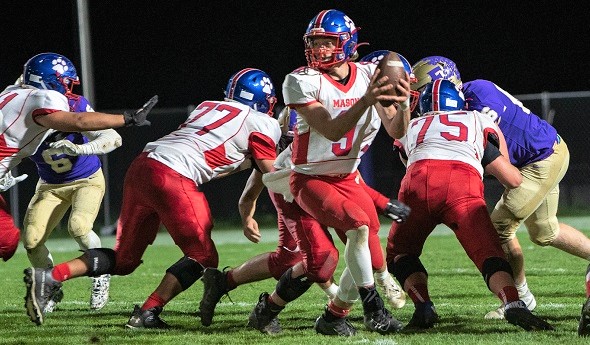
Keep an eye on these: FRIDAY Portland (7-0) at Mason (7-0), St. Joseph (6-1) at DeWitt (5-2), Fowlerville (6-1) at Lansing Catholic (6-1), Olivet (7-0) at Williamston (4-3).
Northern Lower Peninsula
Maple City Glen Lake (6-1) at Charlevoix (5-2)
The leaders of the Northern Michigan Football League Leaders division will meet for the outright championship tonight. A win would give Glen Lake its third straight league title, and of course it would be celebrated – especially bouncing back from last week’s loss to Kingsley. But a win for Charlevoix would be historic; the Rayders not only would clinch a first playoff berth since 2016, but the league title would be the program’s first since 1987 and after a number of runner-up finishes over the years. Glen Lake has won the last six meetings between these teams, including three over the last three years in NMFL play.
Keep an eye on these: FRIDAY Breckenridge (6-1) at Oscoda (7-0), Beal City (7-0) at McBain (4-3), Johannesburg-Lewiston (7-0) at Frankfort (3-4), Ogemaw Heights (5-2) at Grayling (3-4).
Southeast & Border
Milan (7-0) at Carleton Airport (5-2)
Milan claimed a share of the Huron League championship last week. And although third-place Airport can’t win a share as well whatever happens tonight, second-place Monroe St. Mary Catholic Central surely is cheering the Jets on. Milan has won the last eight against Airport, including once in the playoffs, but four of those games were decided by eight or fewer points – including last season’s when the Big Reds won 35-30.
Keep an eye on these: FRIDAY Ann Arbor Pioneer (4-3) at Saline (6-1), Manchester (5-2) at Grass Lake (6-1), Britton Deerfield (4-3) at Ottawa Lake Whiteford (4-3), Jackson (5-2) at Pinckney (5-2).
Southwest Corridor
Kalamazoo United (4-3) at Constantine (5-2)
As we consider what United will try to accomplish over the next two weeks – defeating Constantine and then unbeaten Schoolcraft to earn a third-straight playoff berth and repeat as Southwestern Athletic Conference Valley champion – it’s important to keep in mind the Titans’ start this fall. They began 0-3 – but the first loss was by two to still-unbeaten Jackson Lumen Christi, and the third defeat by just nine to still-undefeated Berrien Springs. Constantine is in a similar place, however – its losses to Berrien Springs and Schoolcraft were by a combined eight points.
Keep an eye on these: FRIDAY Muskegon Catholic Central (4-2) at Benton Harbor (4-3), Parma Western (5-2) at Marshall (4-3), White Pigeon (6-1) at Mendon (6-1), Dowagiac (4-3) at Vicksburg (5-2).
Upper Peninsula
Traverse City Central (6-1) at Escanaba (6-1)
The Eskymos’ chances of getting some help to climb back into the Great Northern Conference title race are getting slimmer by the week as a three-point Week 4 loss to Marquette still stands as the lone decider for first in that league. But Escanaba can continue to gear up for the playoffs and a run at a fourth-straight District title, and playing much larger Central is a great way to get ready. The Trojans have clinched a share of the Big North Conference title and haven’t lost since Week 1. Interestingly, their six-game winning streak started against Marquette – and they’d surely love to go 2-0 against the GNC’s best after falling to Escanaba by 17 a year ago.
Keep an eye on these: FRIDAY Hancock (4-3) at Calumet (6-1), Iron Mountain (7-0) at L’Anse (4-3), Kingsford (4-3) at Menominee (4-3), Lake Linden-Hubbell (4-3) at Bark River-Harris (5-2).
West Michigan
Muskegon (7-0) at Muskegon Mona Shores (6-1)
Championships could be decided all over the Ottawa-Kent Conference this weekend, but this annual matchup in the Black always is one of the most-hyped games in the state and again deserves lots of attention after both teams reached Ford Field last season. Since falling in the 2018 Division 3 Final, Muskegon has been challenged only by East Grand Rapids in a five-point Week 3 win. The reigning Division 2 runner-up Sailors fell to still-unbeaten Rockford by 13 in Week 4 but otherwise have won all of their games by at least 20 points. The Big Reds have won the last four in this series, and regardless of the outcome this latest chapter will be entertaining – the total points scored has increased every game over the last four, with Muskegon winning 55-35 in 2018.
Keep an eye on these: FRIDAY Rockford (7-0) at Grandville (6-1), Ravenna (6-1) at Muskegon Oakridge (7-0), Grand Rapids Christian (5-2) at East Grand Rapids (5-2), Byron Center (7-0) vs. Hudsonville Unity Christian (5-2) at Hope College.
8-Player
Deckerville (7-0) at Kingston (6-1)
A share of the North Central Thumb League Blue championship goes to the victor, and in Deckerville’s case would guarantee a fourth consecutive league title. Two of the last five years this matchup determined the league champion, and a third time Kingston defeated Morrice to help Deckerville take back a share of first place after falling to the Orioles a week earlier in 2017. The Eagles have won all 12 against the Cardinals since the teams began playing each other regularly in 2010, including a pair of victories last season as they also met in the playoffs.
Keep an eye on these: FRIDAY Burr Oak (5-2) at Climax-Scotts (6-1), Onekama (5-2) at Suttons Bay (7-0). SATURDAY Morrice (7-0) vs. Crystal Falls Forest Park (5-2) at Pickford, Mio (7-0) at Gaylord St. Mary (2-5).
Second Half’s weekly “Drive for Detroit” previews are powered by MI Student Aid, a part of the Office of Postsecondary Financial Planning located within the Michigan Department of Treasury. MI Student Aid encourages students to pursue postsecondary education by providing access to student financial resources and information. MI Student Aid administers the state’s 529 college savings programs (MET/MESP), as well as scholarship and grant programs that help make college Accessible, Affordable and Attainable for you. Connect with MI Student Aid at www.michigan.gov/mistudentaid and find more information on Facebook and Twitter @mistudentaid.
PHOTO: Mason works the ground game during a 21-14 league title-deciding win over Fowlerville on Oct. 4. (Click to see more from High School Sports Scene.)