

Grace-ful Run Into Swan Valley History
November 16, 2012
By Geoff Kimmerly
Second Half editor
Alex Grace knew there would be high expectations when he joined Saginaw Swan Valley’s varsity football team this fall as a sophomore.
But he also spent all last season – and most of his life – learning how to fulfill them from one of the Vikings’ best.
Grace watched proudly from the sideline last fall as his older brother Johnathan ran for 1,790 yards and 21 touchdowns. And then, taking Johnathan’s spot this fall, Alex tried to do the same in the same way.
Running with a similar physical style, Grace has helped the Vikings into their third MHSAA Semifinal in seven seasons; Swan Valley takes on Detroit Country Day in one of two Division 4 semis Saturday. He has rushed 256 times for 2,091 yards and 27 touchdowns. With 109 yards and three more touchdowns, he’ll make the MHSAA record book in both categories.
“I was expected to come in and be as good or better than him. I put it behind me,” Alex Grace said. “I just do the best I can, and see what happens.”
So far, this week's Second Half High 5 honoree been making school history and blowing those expectations away.
There are some definite similarities between the brothers. Swan Valley coach Ken Bourbina said Alex is simply carrying on the family tradition.
Like Jonathan, Alex is fast – he can run the 40-yard dash in 4.5 seconds. That’s a tick or two slower than his incredibly speedy brother, but Alex said his speed carries longer – he can beat Jonathan in a 200.
They certainly share similar styles. Jonathan liked to take defenders on, and Alex already is 6-foot and 185 pounds, with a penchant for running over instead of around.
“They both have the ability to turn it on, the ability to lower a shoulder. It’s a good mix,” Bourbina said. “There’s a few differences, but they have the same type (of style). His brother worked extremely hard for us, and (Alex) has just followed in his brother’s footsteps.”
And it’s no doubt helped to run in the footsteps of some of the same blockers. Like any respectful back, Grace is the first to thank his guys up front – tackles Tyler Branch and Anthony Martin, guards Mike Sielinski and Mitch Temple and center Brad Boehler, plus tight end Alex Dils. Branch, Sielinski and fullback Jaime Jimenez are all seniors who also blocked last season for Jonathan.
They’ve given Alex their endorsement. He said they too sense the similarities between the brothers.
“I try to run (tacklers) over. It makes me feel powerful,” Grace said. “I try to keep the runs straight ahead, get the most yards I can. I try to be just like him.”
Johnathan Grace, a redshirt freshman this fall at Michigan Tech, did his part as well to prepare his younger brother for the next level. He took Alex under his wing in the weight room over the summer and guided him through agility work, and that time together brought the brothers even closer.
Johnathan was listening to Swan Valley’s District Final game on the radio two weeks ago when Alex surpassed his yardage total from 2011.
“He was proud of me. He called me,” Alex Grace said. “He said congratulations … and he knew I could do it.”
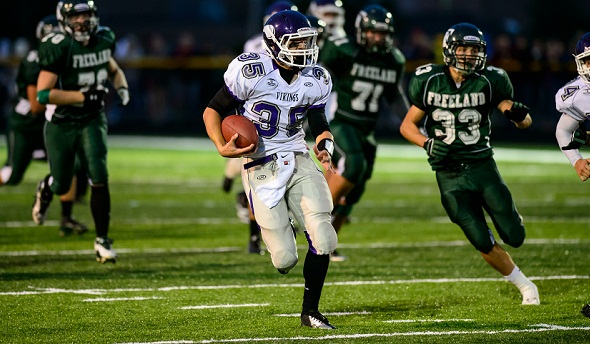
PHOTO: Swan Valley sophomore Alex Grace (35) runs for some of his 127 yards against Freeland earlier this season. (Click to see more from the Regional Final at HighSchoolSportsScene.com.)

Heads and Heat
August 16, 2012
We are engaged in very serious discussions. They’re not only complicated, with unintended negative consequences possible from what are thought to be positive actions; they’re also a matter of life and death.
The topic is football – the high school sport under most scrutiny today and suffering from the most criticism it’s seen since the 1970s when catastrophic neck injuries spiked, liability awards soared, many insurers balked, and most helmet manufacturers abandoned the business altogether.
During recent years we have learned about the devastating long-term effects of repeated blows to the head; and we’re trying to reduce such hits. We’ve learned that 70 percent of concussions in football result from helmet-to-helmet contact, and we’re trying to have coaches teach blocking and tackling differently and have officials penalize “high hits” consistently and rigorously.
During the past several years we’ve learned that serious heat illness and heat-related deaths are 100 percent preventable, yet nationwide there were 35 heat-related deaths in high school football alone from 1995 to 2010; and we’re promoting practices that acclimatize athletes more gradually than “old school” traditionalists might advocate.
As we simultaneously address issues of heads and heat in football, some coaches may think we’re being overbearing, while many in medical fields say we’re out of date, citing higher standards of the American Academy of Pediatrics, National Athletic Trainers Association and National Federation of State High School Associations, as well as many of our counterpart organizations across the country.
As we consider in-season changes to improve athlete acclimatization and reduce blows to the head, we should be open to making out-of-season changes that work toward rather than in opposition to those objectives. There can be no sacred cows. The topic is too serious.
Ultimately, if we err in the outcome of this year’s discussions about heads and heat in football, it must be on the side of safety, on minimizing risks for student participants. They deserve it and, once again, the sport of football needs it.