

Griggs, Kelloggsville Set to Break Free Again
August 22, 2017
By Dean Holzwarth
Special for Second Half
WYOMING – If opposing teams think it’s going to be easy tackling Thomas Griggs this season, they might want to rethink their approach.
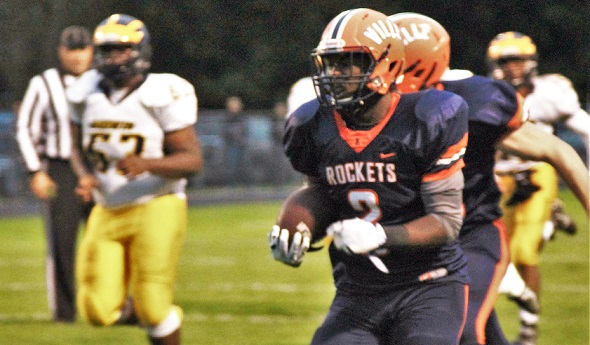
 Griggs, a 5-foot-10, 210-pound running back for the Wyoming Kelloggsville football team, is difficult to stop and a load to bring down.
“He was referred to in the South Bend Tribune last year as a bowling ball with legs,” longtime Rockets head coach Don Galster said. “Those kids did not want to tackle him.”
Just a year ago, Griggs blossomed into one of the top running backs in the Grand Rapids area while leading Kelloggsville to a major turnaround.
The Rockets went 3-6 in 2015, but behind Grigg’s breakout season, finished 8-2 while winning the Ottawa-Kent Conference Silver title with an unbeaten league run.
Those eight were the most wins for a Kelloggsville team since 2009, when it went 10-1.
After a wild 50-47 loss to Whitehall in the opener, Kelloggsville reeled off eight straight wins and advanced to the playoffs. Its season, however, ended in Pre-District play against former conference rival Allendale.
“Last year was really good,” said Griggs, a three-year starter. “Everybody didn’t think we were capable of doing what we did, but our senior class last year put in the hard work. Being able to contribute to last year’s success made me feel even better.”
Griggs rushed for nearly 1,400 yards and tallied 20 touchdowns. He averaged 8.7 yards per carry while wreaking havoc on opposing defenses.
“My stats were good as a sophomore, but we didn’t win a lot of games,” Griggs said. “Coming into my junior year I knew I was going to do better because I worked hard over the summer.”
Griggs, a soft-spoken young man with aspirations to play college football, has a valuable skill set. He’s a punishing hard-nosed runner, but possesses other key attributes.
“What makes him special is he’s got great vision, great feet and he reads blocks very well,” Galster said. “He just doesn’t want to go down, and he has learned how to run the ball in our offense, which has been key.”
As evident by his yards per carry average, it typically takes more than one defender to pull Griggs to the ground. He takes pride in his ability to stay on his feet.
“I always want to break at least one tackle every play,” Griggs said. “I don’t want to let that first person tackle me, and I try to get as many yards as I can.”
 Galster remembers his first encounter with his standout senior. It was an early glimpse into the future.
“He was in eighth grade and the principal brought him over to introduce me to him,” Galster recalled. “I thought, ‘This is a big kid,’ and he just has a ton of ability. He works hard, and he’s a quiet leader. Every year he’s gotten better, and he makes the other guys better.”
Griggs started playing football when he was 7. He actually started out as a center before moving to fullback.
It was a role he embraced.
“In my head, I think I can do anything. So when they put me at center, I had the mindset of I was going to be the best center,” Griggs said.
The Rockets are expected to compete for another conference crown with a bevy of talent back in the fold.
Griggs is one of three returning to the backfield, including dual-threat quarterback Alex Guzman. The Rockets graduated only two seniors on offense.
“There’s not a lot of jealousy with those guys, and it motivates them to work harder,” Galster said. “We have a lot of weapons, but these guys understand that it all starts with the offensive line. If they open holes for them, then we will have some success.”
Griggs said having multiple options on the ground will make it tough for other teams to game plan.
“It’s better for us as a team because other teams can’t come into the game saying they are only going to stop me and then they are going to win,” he said. “We have other players that are going to show up and do what they have to do.”
Kelloggsville’s senior class is a tight-knit group with the potential to duplicate last year’s run.
“As a group, we’re pretty good, and we have that hate-to-lose mentality,” said Griggs, who also averaged 19 points per game as a starting basketball point guard last winter. “I’m glad people have started to notice us, and now we just have to keep it going.”
 Dean Holzwarth covered primarily high school sports for the Grand Rapids Press and MLive for 16 years and more recently served as sports editor of the Ionia Sentinel and as a sports photojournalist for WZZM and WOODTV. Contact him at [email protected] with story ideas for Allegan, Kent and Ottawa counties.
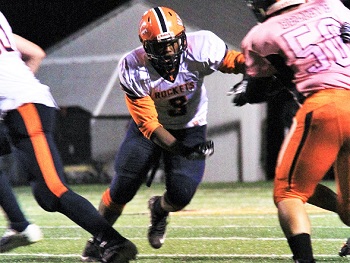
PHOTOS: (Top) Wyoming Kelloggsville's Thomas Griggs runs away from the crowd against Wyoming Godwin Heights. (Middle) Griggs readies to receive a handoff against Belding. (Photos courtesy of the Wyoming Kelloggsville yearbook staff.)
Western's White Enjoys 'Special' Career
By
Tom Markowski
Special for Second Half
May 4, 2016
WALLED LAKE – Seeking a higher level of performance, many high school athletes have channeled their energy to one sport.
 Many refer to this concentration as specialization – and Cody White, for one, isn’t buying it.
White, a junior at Walled Lake Western, is a three-sport athlete and he loves every minute of it. He plays basketball during the winter, baseball in the spring and football in the fall. During the summer he competes in AAU basketball, travel baseball, 7-on-7 football games with his Western teammates, and he participates in a few summer football camps.
White has played these same sports all throughout high school. His freshman year he competed in track and field, along with baseball. White hasn’t ruled out returning to track and field, in addition to baseball, as a senior – but this season he’s sticking with just baseball.
It’s a hectic schedule but, again, White wouldn’t have it any other way.
“I couldn’t see myself not competing in those sports,” he said. “I love them so much. I want to finish my senior year playing all three.”
White estimates that he’ll have two days off, away from sports, in June. In July he’ll take a week off, between his summer baseball team schedule ending and the start of football practice.
There’s no question White is driven, but it’s more than that. In some high schools, and with some coaches, playing multiple sports can be a challenge. There are some coaches who would prefer the students to play one sport and only one sport.
According to Western football coach Mike Zdebski, that isn’t the case at his school.
“We encourage them to play more than one sport,” Zdebski said. “For one, we want them to get their money’s worth. We have a pay-to-play policy of $425. You play one sport and it costs $425. You play three sports and it costs the same. And, two, playing other sports helps them develop other skills. In basketball you create space. In baseball you chase fly balls, and that helps with depth perception. Besides you get to work with other coaches and other teams.
“We’re lifting weights during the summer. If a kid is playing summer baseball or AAU basketball, if they have time they can come by and lift weights. And what we always tell them, if you’re tired let us know. You can take a break.”
Zdebski – whose team finished 12-1 last fall – was quick to point out some excellent athletes in the past, like former Kansas City Royals outfielder/Oakland Raiders running back Bo Jackson, who were multiple-sport athletes. And, more recently, there’s Luke Glendenning of the Detroit Red Wings. Glendenning was an all-state running back at East Grand Rapids.
 When his high school career is done, White will play football in college. Two months ago he committed to sign with Michigan State this winter. At 6-foot-3 and 200 pounds, White played receiver, defensive back and also returned kicks last fall. He played a big role in Western’s run to the Division 2 Semifinals.
During baseball season, White pitches and plays middle infield and right field. He plays the wing and shooting guard in basketball.
His interest in playing a variety of sports came at an early age and, as is the case with most children, a family member was the one who introduced White to athletics. Former NFL player and Detroit Lions executive Sheldon White is his father, but the first sport White played, at age 3, was baseball. Two years later he began playing football and basketball.
Sheldon White also played three sports at his high school in Dayton, Ohio, (Meadowdale High) and helps his son manage his busy schedule, particularly during the offseason.
“Growing up was a little different (for me) than the usual kid,” Cody White said. “Going to Lions games and just being around football all the time. I think I love the game more because I was around it so much.
“But I think playing three sports helped me, too. The twisting of your hips in baseball, when you swing the bat, you’re using different muscles. And all the jumping you do in basketball. You have to move in tight spaces.
“With football, you’re with the football guys. By doing all three you meet different people.”
Playing multiple sports has definitely been the right road for White to follow. And his busy schedule hasn’t hindered his work in the classroom.
White has a 3.54 grade-point average pending his grades for this semester.
 Tom Markowski is a columnist and directs website coverage for the State Champs! Sports Network. He previously covered primarily high school sports for the The Detroit News from 1984-2014, focusing on the Detroit area and contributing to statewide coverage of football and basketball. Contact him at [email protected] with story ideas for Oakland, Macomb and Wayne counties.
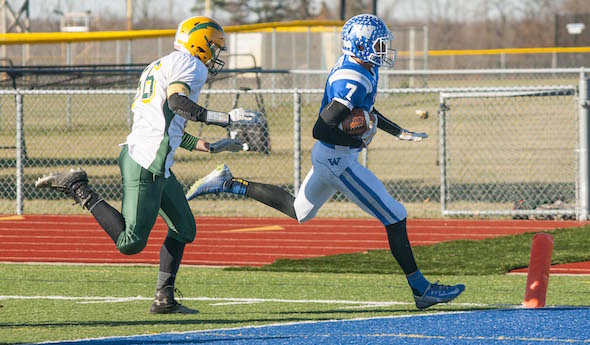
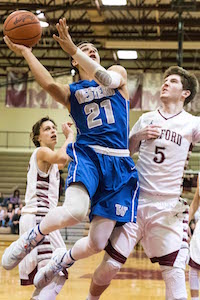
PHOTOS: (Top) Cody White (right) runs away from a Midland Dow defender during their Regional Final this fall. (Middle) White works for a shot against Milford. (Photos by Teresa Presty.)