

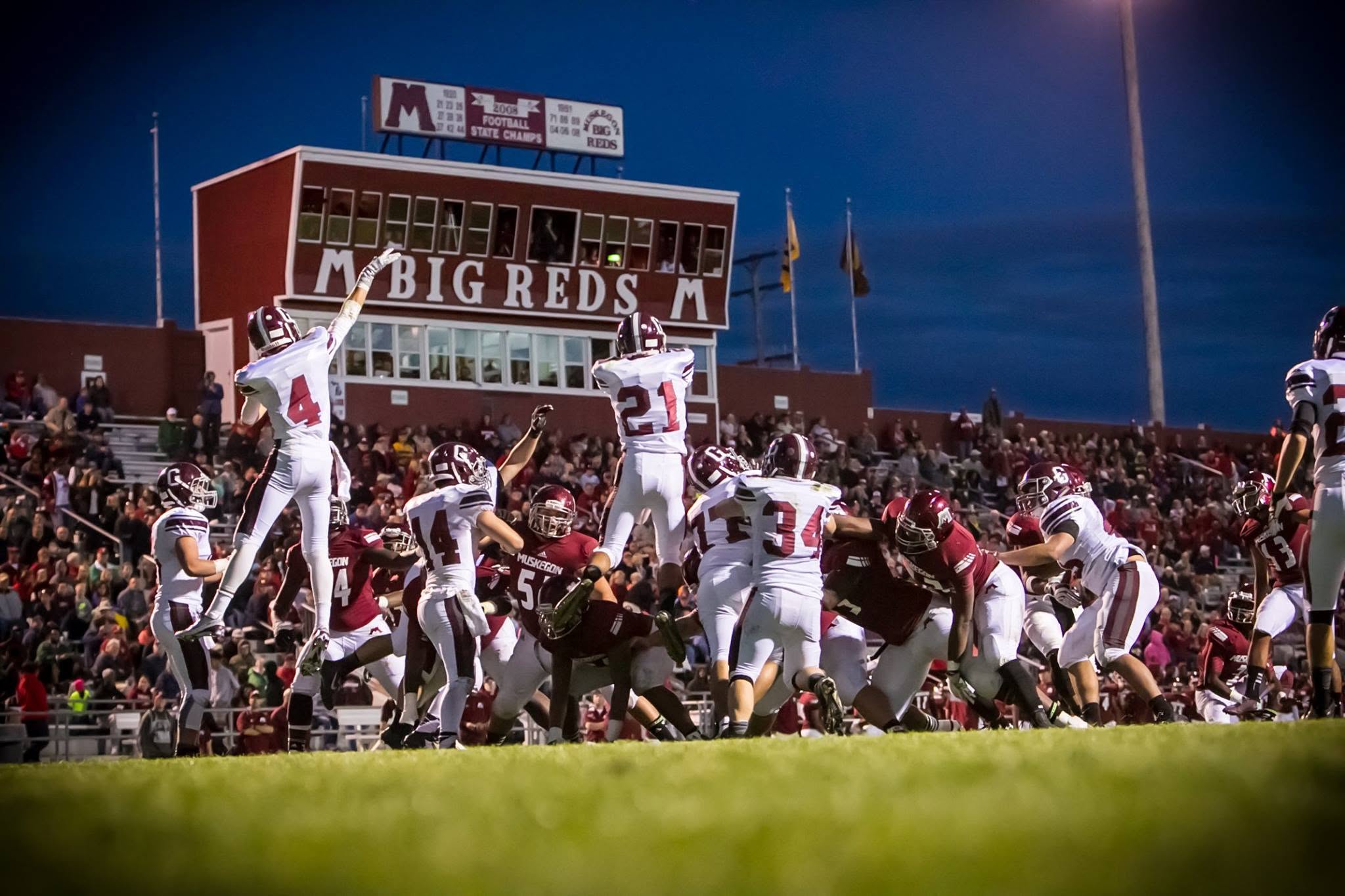
Hackley Stadium Celebrating Century as Monument to Community Dedication, Football Glory
By
Ron Pesch
MHSAA historian
September 4, 2026
Mounted on the brick wall of Hackley Stadium, facing Sanford Street in Muskegon, is a bronze plaque. In raised type, it details a successful “GoFundMe” effort – 1920s style.
The approach was a bit different then, but the fundraising efforts were successful and created an iconic landmark that still stands – now ready to celebrate its 100th year.
Seated, rectangularly, in the middle of a residential neighborhood, directly behind the high school, the site itself has served as home to Muskegon High School’s football team for 120 years. The sport dates to 1895 at MHS.
The wooded lot was gifted in 1902 by Muskegon’s greatest benefactor – lumber baron Charles H. Hackley – to the Board of Education. Hackley desired the space to be developed into an athletic field and playground for use by the school and area youth.
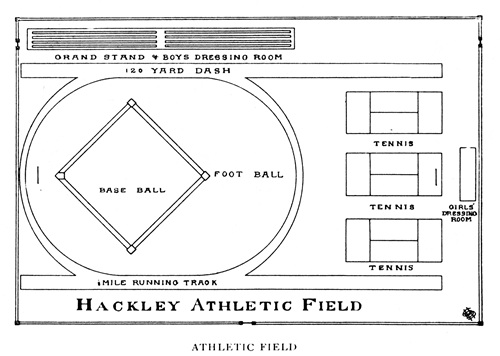 Quickly dubbed Hackley Field, it took four years before administration cleared trees from the lot. Initial plans for the parcel, laid out by a former coach and director of athletics, envisioned a site that would accommodate multiple sports, including a gridiron at the center of the property, surrounded by a track, with tennis courts placed at the site’s four corners.
Bob Zuppke – hired in August 1906 as the school’s newest coach and director – learned that the school board was ready to act on the design. He immediately spotted the planned layout showed a football field of just 50 yards. Recognizing the site could accommodate a full-sized gridiron, his redesign reduced the number of tennis courts to three and pushed them to one end of the site. He expanded the gridiron to regulation size and surrounded it with a 1/5-mile cinder track. His plan included space for a baseball diamond within the gridiron. An extensive wooden grandstand along the northeast side of the site would stretch the length of the football field to handle growing crowds at sporting events.
Zuppke’s modifications were promptly accepted, and Hackley Field was ready in mid-May 1907 for an initial track meet with Muskegon’s biggest rival, Grand Rapids Central. That fall, Muskegon played seven consecutive football home games at the new location. Recognizing the financial value of the annual clash with Central, that contest was moved to the last game of the year and staged on Thanksgiving Day. Crowds soared in size.
Dropping just a single game each season during his four years in town, Zuppke built Muskegon into a football powerhouse before moving on to even greater gridiron success over three years at Oak Park High School in Illinois. In 1913, he was named head football coach at the University of Illinois, earning national titles in 1914, 1919, 1923 – with a team that featured three-time All-American Harold ‘Red’ Grange – and 1927. Zuppke retired following the 1941 season. During his 35-year prep and college career, he introduced numerous innovations that remain hallmarks of the game today.
Plans for a Cement Stadium
From a comfortable chair, stationed in his room at a retirement home in Kalamazoo, 85-year-old C. Leo Redmond, former coach at Muskegon, recalled the story behind the construction of Muskegon High School’s historic Hackley Stadium. The concrete structure, built in 1927, replaced greatly expanded wooden stands (tennis courts were never added) originally placed on the site by Zuppke’s design.
Born in 1900 in Kalamazoo, Redmond arrived at MHS in 1925. A recent graduate of Western State Normal School – today’s Western Michigan University – he wasn’t Muskegon’s first choice to replace his predecessor, the highly-successful J. Francis Jacks.
A 1912 graduate of Muskegon, Jacks had turned the team’s football games into a huge draw between 1920 and 1924. During the span, his teams earned three mythical state titles over five years and produced an array of talented athletes, including University of Michigan great Bennie Oosterbaan.
But in the spring of 1925, Jacks passed away unexpectedly. Gus Cohrs, another Muskegon alum, was experiencing success in basketball and football at Grand Haven High School. He’d accepted the Muskegon job to succeed Jacks, but an outcry by Grand Haven fans and an immediate pay raise kept him from moving.
Fortunately for all, Redmond’s teams went 7-1-2 in 1925, then repeated as Michigan’s mythical champion in 1926. Immediately after the completion of that season, however, the school faced its next challenge.
“We walked out to the bleachers at the football field and Joe Bicknell (the Hackley Manual Training School director and facility manager for athletics) pulled out his pocketknife,” said Redmond. “He then pushed the blade completely into one of the wooden beams supporting the bleachers and said, ‘They will fall down if they have to support another season.’ So, we started a fund drive for Hackley Field’s reconstruction by selling stadium bonds.”
Muskegon contacted The Osborn Engineering Company of Cleveland, Ohio, to discuss the task. Peter P. Evans, vice president of the firm, visited Muskegon to inspect possible sites. “Mr. Evans’ company planned and built Navin Field, Detroit, the Polo Grounds, New York, and is now building the new stadium for the University of Michigan at Ann Arbor,” noted the Muskegon Chronicle.
Visiting in December, Evans advised “it would be best if it could replace the present seating arrangements at Hackley Field,” noting “it would not be architecturally objectionable to anyone in the neighborhood nor spoil the landscape effects of the campus.”
Building a stadium made with cement had been pondered by Bicknell and administration as early as 1913, but cost – then estimated at $25,000 – was viewed as insurmountable.
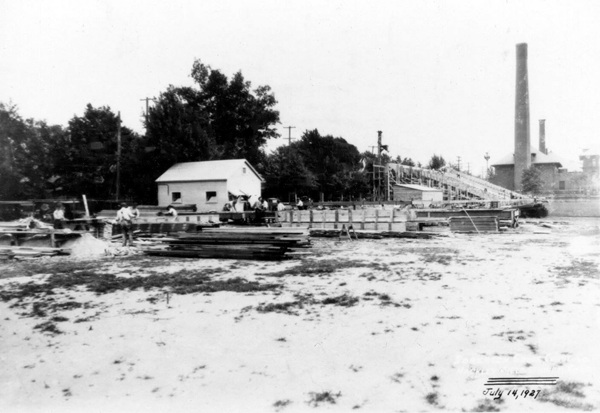 It took until April 1927 for final approval of a plan, and Osborn Engineering was authorized to prepare specifications. Time was of the essence, as the existing bleachers were now condemned and needed to be removed and replaced by fall.
The design would include “two team rooms” and restrooms under the stands, with the project financed by sale of bonds. A total of 1,500 were issued, priced at $50, earning 4 percent interest. The structure would feature seating for 6,000, with a block of 1,100 seats located between the 35-yard lines reserved for bondholders. The $75,000 campaign launched the first week of May.
The district tapped into a young sales force to help execute the plan – the student body. The classes of '27, '28, '29 and '30 – over 2,000 strong – were asked to distribute pamphlets and sell bonds to the public.
Years later, Gont Miller remembered walking home with Bub Meier – both would serve as future captains of Big Reds football teams.
"Principal John Craig talked to us Thursday night after practice,” recalled Miller. “He said, 'We're going to ask you to get out and sell some bonds.'
The pair talked about their frustration at being assigned the unwanted task.
“Together, we decided we weren't going to do it. After I got home, I told my mother about the bonds.”
She reframed it for her son, highlighting the community that surrounded them.
"Boy, that will be easy,” she said. “After dinner, go on over and see Mr. Runzel across the street, and the Nelsons on the side of us. I'm sure they will be interested.
"Well, I guess she got me inspired. I went over and saw Mr. Runzel, and he bought four. And Lester Nelson bought three, and Otto Meeske bought six. Mr. Runzel said, 'Go down and see my son,' and I did, and he bought two. People really supported Big Red football. We sold all the bonds, and they built the stadium. It was quite an experience for a kid."
Construction contracts were awarded by June 1, and actual work on the site started on Wednesday, June 15. According to the files of Osborn Engineering, the concrete and brick structure itself was completed over just 24 days – July 20 to August 12. Final plumbing and electrical preparations were completed in time for the first game against Muskegon Heights on Saturday, September 17.
Dedication and the Birth of a Rivalry
"Impressive and colorful flag-raising ceremonies marked the dedication of the new stands," wrote Jimmy Henderson in the Muskegon Chronicle. "A massed assemblage of over 2,000 students who paraded on the field following the Heights and Muskegon high school bands, and close to 3,000 spectators in the stands stood at attention while the massed bands under the leadership of Ronald Hinchman played the national anthem, as the new flag was slowly raised to its position over the stadium."
The Big Reds posted a crushing 89-0 victory over the Heights and their new coach, Oscar E. "Okie" Johnson – a former teammate of Redmond’s at Western – in the season opener. It was the first of nine shutouts posted by Muskegon en route to a 10-0 campaign and another mythical state title. Outscoring opponents 445-6, the team remains among the greatest in school history.
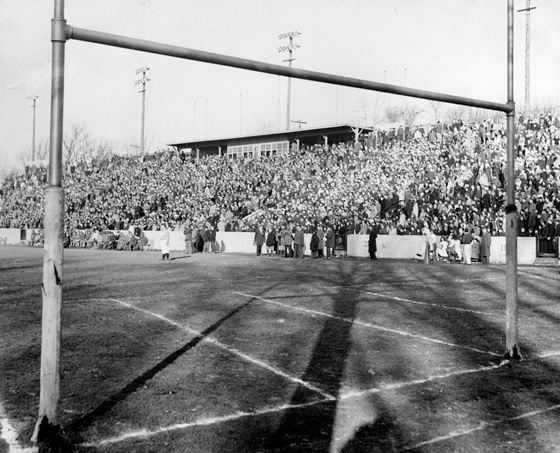 Muskegon claimed a second-consecutive shutout over Johnson’s Tigers in 1928, this time 19-0, and finished the season with another state crown. In ’29, they again blanked the Tigers, but by just seven points. In 1930, Johnson’s squad tied Redmond’s Big Reds, 6-6, and established themselves as Muskegon’s chief rival. Come 1936, the game was moved to the season finale, replacing the matchup with Grand Rapids Central. Lights were added to Hackley in 1940, with most games shifted to Friday nights. Annual classic battles between the Big Reds and Tigers were all played at Hackley (until 1948) and still staged on Saturday afternoons (until 1953) to accommodate the massive crowds.
The 1945 season-ending contest between the schools – both undefeated – was a battle for the state title. A record crowd of 13,500 packed every square inch of the grounds. Heights opened a 7-0 lead early, but Muskegon responded with a touchdown midway through the second quarter. A missed extra point pinned the score at 7-6. It remained stuck there until an intense goal-line stand late in the fourth quarter would determine the game’s outcome. The Big Reds had advanced the ball to the Tigers’ 1 on second down. A charge at the center of the line on third down was stopped.
“The ball, three inches from the goal line when play started, still was an inch from the line when it was set down,” wrote Henderson, still covering the rivalry. “When (the defense) stopped the forward motion of (Muskegon’s quarterback), the air went dark with the applause of the Heights fans, and the groans of Muskegon’s.” The win capped the first of three consecutive state crowns won by the Tigers, and the loss was the first in 16 starts for the Big Reds, the defending state champion.
In 1946, Muskegon installed its first electronic scoreboard, retiring the one manually operated by the Boy Scouts. Redmond retired as coach following the season with a 156-29-13 record and seven state titles over 22 seasons. (His victory total remained tops in school history until recently surpassed by current head coach Shane Fairfield.) Most fittingly, the remarkable gridiron rivalry between coaches Redmond and Johnson ended dead even at 9-9-2.
Reduced revenue during the depression years forced default on bond payments. After a restructuring of obligations, a final payout distributed in 1950 to bondholders meant the stadium was now out of debt. That fall, $8,000 in repairs and waterproofing helped stabilize a structure starting to show wear and tear.
Coach Harry Potter – another Western teammate of Redmond’s, and his longtime assistant – took the reins in 1947 and guided the 1951 Big Reds to another gridiron state championship. That team featured future NFL quarterback Earl Morrall.
Over the years, Hackley Stadium has served the community with World War II events to sell war bonds, practice drill formations, events to honor local industries’ wartime outputs, and VFW Memorial Day gatherings. There have been countless halftime shows, marching band competitions, high school assemblies, and commencement exercises. It has hosted opera, concert performances, and music reviews. In 1951, evangelist Rev. Billy Graham and his music director Cliff Barrows visited. In 1957, a massive Water Follies show with a dive tank, stage, and swim tank – spanning 150 feet – filled Hackley Stadium, raising money for the local ‘Police and Fireman Benevolent Association’.
More than 10,000 fans packed the stands in the fall of 1971 to watch another pair of unbeatens as the Big Reds topped Traverse City on their way to another state championship. Members of the Lake Michigan Athletic Conference, the Trojans became firmly established as new primary rivals on Muskegon’s annual slate.
 After four uncharacteristic down years on the gridiron during the early 1980s, huge crowds returned to pack Hackley’s stands beginning in 1985, especially during Muskegon’s march to MHSAA playoff titles in 1986 and 1989.
Continued maintenance over the years ensured the stadium’s survival. In 1996, extensive renovations and rejuvenation of the concrete stadium ensured the safekeeping of the ‘Home of the Big Reds’. Concession stands were moved from beneath the seating to structures at the north and south ends of the stadium. Modern requirements meant removal of the track that once surrounded Hackley to expand the concourse that leads to seating. But proximity and sight lines to the playing surface – always a feature of Hackley for fans – were not sacrificed.
The Tunnel
Terry Foster, writing for the Detroit News, visited the stadium as part of his “Terry’s Tour” in 2006. Kicking off a series of articles where he visited high school football games across the state, Foster’s opening paragraphs focused on another unique feature of the stadium.
Postgame, the Big Red Band ends home game festivities by marching – shoulder-to-shoulder, students aligned three-or-four-or-five across, with instruments swinging up-and-down and side-to-side, beneath the stands.
“Fans lined both sides of the cramped corridor as the band paraded through the narrow human tunnel …
“‘Ok. You got to hang tight against the wall,’ Muskegon head coach Tony Annese told Foster. … You will get hit if you are not careful.’ … Like Annese, they wanted to feel the booming drums vibrate off the concrete walls as the band marched underneath the stadium. …
“The march that eventually took the musicians (down Sanford Street) to their music room has been going on for decades. So has winning football.”
A new video scoreboard was installed in 2015. Field turf replaced Hackley Field’s natural grass in 2020. Also added was a brick fence similar in placement to one that surrounded the site back in 1914 and was removed in phases between 1927 and 1946.
Muskegon continues to lead the state in all-time football victories, earning additional MHSAA titles in 2004, 2006, 2008, 2017 and 2023. Many feel that rich tradition, combined with the classic backdrop of Hackley Stadium packed with alumni and passionate football fans, has played a huge role in those wins.
For the Big Reds, Hackley has always been more than brick, concrete, and rebar.
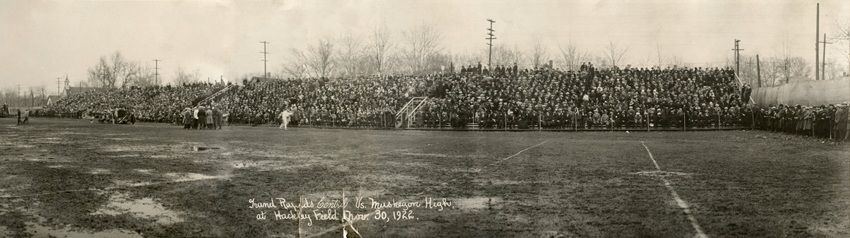
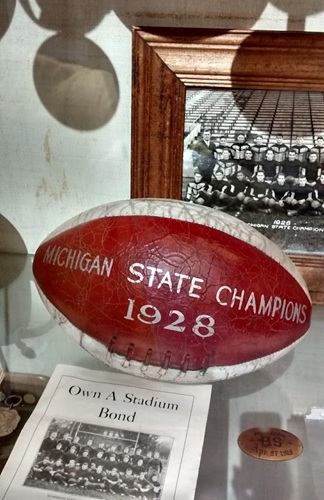
PHOTOS (Top) Muskegon takes on Grandville in 2015 at Hackley Stadium in what would end as the program’s 800th victory. (2) The proposed stadium plan from 1906 shows the football field, baseball diamond, track and tennis courts among other proposed features to the new athletic field. (3) Muskegon takes on Grand Rapids Central in 1922. (4) Osborn Engineering works on the renovated stadium during the summer of 1927. (5) The stands are filled for a game in 1942. (6) This display includes a photo of the 1928 state championship team and brochure for stadium bonds. (Top photo by Tim Reilly. Other photos collected by Ron Pesch.)
Championship Official, Longtime Mentor Walters Named 2023 Norris Honoree
By
Geoff Kimmerly
MHSAA.com senior editor
June 30, 2023
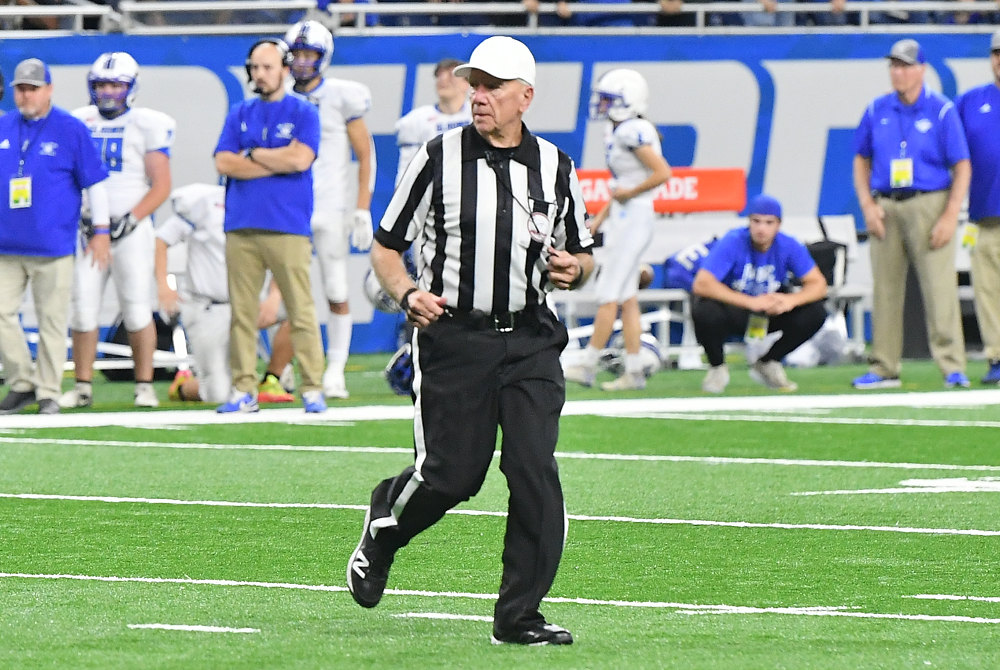
From volunteering to umpire slowpitch softball to officiating at last season’s 11-Player Football Finals at Ford Field, Jackson’s Chuck D. Walters has enjoyed every step of the climb over 44 years as a Michigan High School Athletic Association-registered official.
As a revered and beloved trainer, mentor and recruiter of officials, he’s also dedicated decades to providing opportunities to the next generations of officials in his community.
For especially his work in nurturing others in the avocation, Walters has been selected as this year’s MHSAA Vern L. Norris Award honoree.
The Norris Award is presented annually to a veteran official who has been active in a local officials association, has mentored other officials, and has been involved in officials’ education. It is named for Vern L. Norris, who served as executive director of the MHSAA from 1978-86 and was well-respected by officials on the state and national levels.
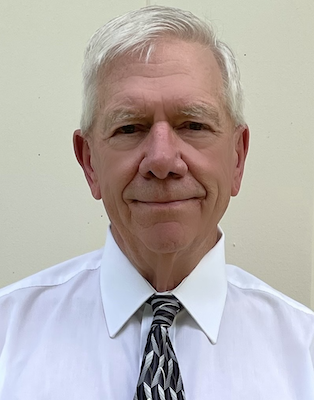 Walters has registered to officiate MHSAA football again this fall, which will begin his 45th year of refereeing or umpiring school sports. He’s a member of the Jackson Area Officials Association, Kalamazoo Officials Association and Southeast Michigan Sports Officials organization, and he has served as a football and baseball trainer in the JAOA while also working more than 100 MHSAA postseason games in those sports including six football and two baseball Finals.
“Chuck Walters is one of the best people I’ve known through officiating. He’s been a leader and mentor for hundreds of officials in the Jackson area over many years,” said MHSAA Executive Director Mark Uyl, who also is a longtime football and baseball official at the high school and college levels. “Chuck is the epitome of what the Vern Norris Award is meant to honor.”
Walters was a three-sport athlete at East Jackson High School – playing football, basketball and baseball – and upon graduating in 1965 took a job with Chrysler at its Proving Grounds in Chelsea. While later coaching his son Chuck in youth baseball, Walters put on a slowpitch softball tournament to benefit the local Little League association – and umpired the bases at those games to help save money so more could go to the organization.
From there, he began filling a need locally for youth umpires. Relationships built in baseball turned into working subvaristy football. After his son graduated from Napoleon, Walters’ Friday nights opened up and he filled that personal sports void by beginning a long and successful career in varsity football as well. He first registered for two years at the start of the 1970s, and returned to register without pause beginning with the 1981-82 school year.
In addition to working youth and high school athletes, Walters has umpired college baseball primarily at the Division II, III and NAIA levels but also in the Big Ten Conference and Mid-American Conference. He also served 35 years as the volunteer clock operator at Napoleon High School basketball games – his current football crew includes multiple former Napoleon athletes or coaches.
Among recommendations for this Norris Award came a letter from his entire crew and another noting Walters continues to mentor 14 current officials while always seeking to introduce opportunities to others.
“I used to go to a lot of college football meetings just to stay current, and they’d talk about this and that and my head would be spinning forever,” Walters said. “We have four new officials in our area starting football this fall, and I know their heads will be spinning when we talk about this and that. My focus will be to get those new officials’ feet on the ground, get them (progressing) step by step by step. Once they get that passion to officiate whatever sport it might be, they just take off.”
Walters received the Al Cotton Award in 2013 from the Jackson Citizen Patriot for his contributions to Jackson-area sports, and was named to the Basketball Coaches Association of Michigan (BCAM) Hall of Fame in 2021 as a “friend of basketball” for his hundreds of games operating the clock.
Walters and his high school sweetheart Judy have been married 57 years, and they have adult children Stacy and Chuck. Walters retired from Chrysler after 32 years and has a car restoration business.
Previous recipients
1992 – Ted Wilson, East Detroit
1993 – Fred Briggs, Burton
1994 – Joe Brodie, Flat Rock
1995 – Jim Massar, Flint
1996 – Jim Lamoreaux, St. Ignace
1997 – Ken Myllyla, Escanaba
1998 – Blake Hagman, Kalamazoo
1999 – Richard Kalahar, Jackson
2000 – Barb Beckett, Traverse City; Karl Newingham, Bay City
2001 – Herb Lipschultz, Kalamazoo
2002 – Robert Scholie, Hancock
2003 – Ron Nagy, Hazel Par
2004 – Carl Van Heck, Grand Rapids
2005 – Bruce Moss, Alma
2006 – Jeanne Skinner, Grand Rapids
2007 – Terry Wakeley, Grayling
2008 – Will Lynch, Honor
2009 – James Danhoff, Richland
2010 – John Juday Sr., Petoskey
2011 – Robert Williams, Redford
2012 – Lyle Berry, Rockford
2013 – Tom Minter, Okemos
2014 – Hugh R. Jewell, West Bloomfield
2015 – Sam Davis, Lansing
2016 – Linda Hoover, Marshall
2017 – Michael Gentry, Shelby Township
2018 – Jill Baker-Cooley, Big Rapids
2019 – David Buck, St. Joseph
2020 – Hugh Matson, Saginaw
2021 – Lewis Clingman, Grand Rapids
2022 – Pat Hayes, Birmingham
MICHIGAN HIGH SCHOOL ATHLETIC ASSOCIATION
20, 30, 40, 45 & 50-YEAR OFFICIALS
The officials on this list are receiving their 20, 30, 40, 45 and 50-year service awards.
20-YEAR OFFICIALS
Allegan – Joseph Munn
Allen Park – James Murdoch
Ann Arbor – Shawna Lorch
Bad Axe – Gary Krause
Bannister – Clyde English
Baraga – Scott Koski
Battle Creek – Lonzo Warren
Bay City – Jason Ruple
Bay City – David Szczypka
Belleville – Michael McCormick
Big Rapids – Marty Shaffer
Blissfield – Steven Babbitt
Bloomfield Township – Richard Dylewski
Bloomfield Village – Maynard Timm
Bridgman – Shane Peters
Brimley – George Jones
Bronson – Brian Case
Bronson – Kevin Gardner
Brownstown Township – Charles Monette
Byron Center – Michael Jager
Cadillac – Demetrio Rojas-Cruz
Chassell – Robert Fay
Chassell – Shana Ruotsala
Chesterfield – Paul McBride
Clarkston – Jamie Rykse
Clarksville – Michael Burgess
Clinton Township – Mark Carney
Clinton Township – Keith Justice
Clinton Township – Brad Thomas
Commerce Township – Robert Foss
Constantine – Jerry Burgess
Cottrellville – Grant Harris
Dearborn Heights – Abasi Sanders
Detroit – Cozette Ealy
Detroit – Cedric Green
Detroit – Delonda Little
Detroit – William Pugh
DeWitt – Mark Kellogg
DeWitt – Adam Miller
Dorr – Dan Heasley
East Lansing – Eric McGaugh
Farmington hills – Kevin Cleveland
Fenton – Paula McAllister
Flint – Rozier Looney
Frankenmuth – Matthew Krause
Freeland – Nick Horn
Fremont – Kevin Holmberg
Gaylord – Michael Switalski
Gobles – Randy Hood
Grand Blanc – Josh Dean
Grand Blanc – Anthony Klinck
Grand Blanc – David Clement
Grand Ledge – Brian Gorman
Grand Rapids – Marc Davis
Grand Rapids – Timothy Gildner
Grand Rapids – Lloyd Kilgore
Grand Rapids – Fritz Owen
Grand Rapids – Debra Rambow
Grand Rapids – James Stokes
Grand Rapids – Michael Underwood
Grand Rapids – Randy Wilson
Grosse Ile – Michael Szczechowski
Grosse Pointe Woods – Douglas Bohannon
Harbor Beach – Jill Fuller
Harrison Township – Kimberly Broski
Hart – Chris Romero
Haslett – Scott Bradley
Haslett – Casey Kern
Hastings – Fred Koning
Highland – Jason Zimmerman
Holland – Jayson Dibble
Holt – Andrew Hoard
Honor – Matt Olson
Horton – Jerry Waddington
Houghton – Gregg Richards
Howell – Anthony Vella
Howell – Nathan Thompson
Hudsonville – Roberto Ortega-Ramos
Ionia – April Holman
Ironwood – Guy Trier
Jackson – Tracy Boyers
Jackson – Troy Fairbanks
Jackson – Daniel Garrison
Jackson – Jim Miller
Jackson – Bernard Nabozny
Jackson – Douglas Richardson
Jenison – Alfred Kennedy
Kalamazoo – Jill Lansky
Kentwood – Andrew Terrien
Kentwood – Rus Tien
Lansing – Oscar Castaneda
Lansing – Steve Crowley
Lansing – Terry Harris
Lansing – Arthur Lilly
Lansing – Keith Rhodabeck
Lansing – Cameron Rodgers
Lathrup Village – Gerald Jones
Livonia – Scott Racer
Macomb – Don Kalpin
Macomb – Terry Prince
Manistique – Joseph Crowder
Manistique – Howard Parmentier
Marlette – Chris Storm
Marquette – John Schultz
Marshall – James Dyer
Marshall – Eric Earl
Marysville – John Schweihofer
Mason – Ammahad Wnaikau
Memphis – Steven Gray
Merrill – Malena Marr
Michigan City – Larry Jordan
Middleville – Darrin Oliver
Midland – Thomas Coatoam
Midland – Alan Huntress
Milan – Jill Hargrove
Milan – Michael St. John
Milford – Jeffrey Garvin
Milford – Larry Walters
Mt. Pleasant – Jeff Siler
Muskegon – Robert Koekkoek
Niles – Cory Gowen
Niles – Glenn Kimmerly
Northville – Doug Doyle
Ortonville – Laurel Kobe
Perrysburg – Gregg Becker
Petersburg – Mike Faunce
Pickford – Marc Andrzejak
Pontiac – Wanda Clayton
Port Austin – Andrew Preston
Portage – Phillip Baker
Portage – Jeff Kirkman
Portage – Mike Lauraine
Portage – Michael Northuis
Reed City – Aaron Keup
Riverview – Gregory Drewno
Rochester – Avoki Omekanda
Rochester Hills – Michael Timko
Rochester Hills – Terry Zangkas
Royal Oak – Linda Mariani
Saginaw – Richard Moody
Saginaw – Charles Smith
Schoolcraft – Nathan DeMaso
Schoolcraft – Reid Jones
South Haven – Ken Dietz
South Haven – Douglas Jones
South Lyon – Elisabeth Tyzo-DePaulis
St. Clair Shores – Chad Kelly
Sterling Heights – Robert Hornik
Sterling Heights – Patrick Radaj
Sterling Heights – Erik Schneider
Sterling Heights – Ernest Sciullo
Sterling Heights – Terry Sheen
Stevensville – Thomas Rivette
Stevensville – Douglas Wegscheid
Swartz Creek – Andrew Palovich
Tecumseh – Eryn Stamper
Temperance – Larry Nocella
Traverse City – Jeffrey Brunner
Traverse City – Jason Meriwether
Traverse City – Thomas Spencer
Trenton – Brian Hill
Trenton – Kevin McMillion
Troy – Glenn Craze
Troy – Patrick Grady
Twin Lake – Mike Vanderstelt
Utica – Edward Kotulski
Wallace – Terry Unti
Walled Lake – Terry Prickett
Warren – Arthur Lynn
Wayland – Joseph Kramer
West Bloomfield – Ilya Beltser
West Branch – Howard Hanft
White Lake – Gregory Waun
Williamston – Kelli Hart
Wixom – Cuba Gregory
Wyoming – Kelli Polinskey
30-YEAR OFFICIALS
Allen – Kent Sanborn
Allen Park – Mark Klein
Alpena – Robert Centala
Alto – Bene Benedict
Bad Axe – Brent Wehner
Baroda – Chris Falak
Battle Creek – John Crumb
Bay City – Stephen Linton
Bay City – Scott Packard
Bay City – Joseph Pietryga
Bessemer – James Trcka
Brooklyn – Gregg Wonderly
Caledonia – Stacy Smith
Center Line – Scott Manteuffel
Charlotte – Val Nelson
Chelsea – Eric VanHevel
Chesterfield – Anthony Mancina
Clinton Township – Barbara Laird
Clinton Township – Scott Walendowski
Comstock Park – Kathy Felty
Davison – James Edgar
Dearborn – Gloria Joseph
Dearborn Heights – Rick Ballnik
Detroit – Joyce Smith
Dowagiac – Scott Stewart
East Lansing – Brent Sorg
Eaton Rapids – Wesley Collins
Essexville – Mark Gentle
Farmington Hills – Robert Dobson
Fenton – Paul White
Flat Rock – Janis Stahr
Flint – Richard Higgins
Flint – John Yelle
Flushing – Jeffrey Straley
Freeland – Terry Schmidt
Grand Blanc – Bernadette Koenig
Grand Blanc – Thomas Le Blanc
Grand Blanc – Leonard Sparks
Grand Rapids – Jacquie DeJonge
Grand Rapids – Jeff Green
Greenville – Darcia Kelley
Grosse Pointe – Ryan Murphy
Grosse Pointe Park – George Markley
Grosse Pointe Woods – Renee Dicristofaro
Hazel Park – Benny Holzman
Hickory Corners – Dean Bostwick
Holt – John Massey
Imlay City – John Forti
Kalamazoo – Julie Jones
Kalamazoo – Mark Kampen
Kingsley – David Lemmien
Lansing – Dee Hammond
Lansing – Robert Mccullem
Livonia – Steve Timm
Manchester – James Connors
Marinette – Neil Motto
Mason – Daniel Carmichael
Mason – Kathy Showers
Mattawan – John Visser
McMillan – Anthony Immel
Midland – Katherine Duso
Monroe – Carolyn Peters
Montague – Stanley Bush
Muskegon – Jacklyn Burr
Muskegon – Chris Calkins
Muskegon – Dennis Danicek
Muskegon – Randall Peters
North Muskegon – Tony Kartes
Ontonagon – Andrew Borseth
Ottawa Lake – Douglas Sanders
Paw Paw – Karla Koviak
Perry – Thomas Montpas
Petoskey – Mark Holland
Pierson – Joseph Williams
Pleasant Lake – Marty Shean
Plymouth – Michael Rossman
Plymouth – Richard Schmidt
Quincy – Candace Cox
Rapid River – Mike Pilon
Rochester – Janette Luttenberger
Rochester Hills – Katherine DiMeglio
Romeo – Mary Milke
Rossford – Steven Agler
Saginaw – Thomas Nichols
Saline – Todd Schultz
Shelby – Todd Fox
Shelby Township – Sheila Brownlee
Shelby Township – Kristi Dean
South Lyon – Michael Kiselis
Sparta – Ryan Huber
St. Clair Shores – Gary Kowalewski
St. Joseph – Terry Myers
St. Joseph – Dave Waaso
Standish – Kimberly Belchak
Stanton – Jason Petersen
Sterling Heights – George Braund
Sterling Heights – John Moceri
Traverse City – Allen Hebden
Utica – Sean Barel
Waldron – Michael Granger
Walled Lake – Donald Magee
Warren – Joseph DiBucci
Washington – Gloria Berger
Wayne – Robert Allen
West Bloomfield – Cynthia Tyzo
Williamston – David Sweeney
Wolverine – David Ashenfelter
Wyandotte – David Shalda
Wyoming – Stephen Hendrickson
Yale – Perry Sutherland
40-YEAR OFFICIALS
Adrian – Doris Goodlock
Allen Park – James Sombati
Battle Creek – Corby O'Leary
Bay City – Tony Biskup
Buchanan – Ronald Bartz
Cedar Springs – Dan Rypma
Charlevoix – Daniel Ulrich
Clark Lake – Ralph Piepkow
Clinton Township – Patrick Crandall
Crystal Falls – Lyle Smithson
Detroit – Aimee Davis
Detroit – John Leidlein
Detroit – Richard Shalhoub
Eastpointe – Wayne Rockensuess
Fort Gratiot – Jeff Klausing
Garden City – Eric Hebestreit
Grosse Ile – Steven Vecchioni
Hancock – Brian Rimpela
Holland – Brent Hoitenga
Hudsonville – Gerald Kuiper
Jackson – Thomas Morrissey
Jackson – Joseph Page
Jonesville – Kirk Snyder
Kentwood – William Meade
Lake Orion – James Weidman
Lansing – Daniel Kitchel
Lapeer – Gary Oyster
Lapeer – Scott Strickler
Macomb Township – William Gerbe
Mayville – Gary Libka
Midland – Bradley Crampton
Newaygo – Clinton Abbott
Ray – David Hines
Reed City – David Erler
Republic – Paul Price
Rockford – Carl Knoop
Rogers City – Karl Grambau
Roseville – Mario Soresi
Saginaw – Michael Mayers
Saginaw – Richard Welzein
Saginaw – Dennis Wildey
Sand Creek – Jack Sager
Sault Ste. Marie – Dale Cryderman
St. Clair Shores – Gerald Garcia
St. Joseph – Bruce Molineaux
Swartz Creek – James Loria
Temperance – Michael Bitz
Traverse City – Barbara Beckett
Walled Lake – Nicholas Lesnau
Waters – Rick Sehl
Ypsilanti – Jerry Kelley
45-YEAR OFFICIALS
Alpena – Scott MacKenzie
Berkley – Charles Tyrrell
Boyne City – Peter Moss
Bronson – Randy Houtz
Brown City – Curt Lowe
Buchanan – Larry Monsma
Burton – Thomas Rau
Cheboygan – Peter Stempky
Conklin – Gary Meerman
East Lansing – Bruce Heeder
Flint – Joseph Johnson
Flushing – David Cowden
Fowler – Dean Schrauben
Frankfort – Peter Olson
Grand Rapids – Todd VandenAkker
Haslett – Heidi Doherty
Holland – Craig Kuipers
Houghton – Roy Britz
Iron Mountain – Robert Barkle
Jenison – James Kerbel
Lake Isabella – James Novar
Linden – John Cross
Madison Heights – Joseph Marcinkowski
Muskegon Heights – Johnny Robinson
Oxford – Donald Maskill
Plymouth – Charles Hempel
Portage – Richard Bird
Portage – Robert Burch
Posen – Donna Couture
Prescott – Charles Wren
Roseville – Robert Iwasko
Shelby Township – Michael Gentry
South Bend – Dale Matteson
South Lyon – Dan Riggs
Taylor – Clayton Conner
Warren – Vern Rottmann
50-YEAR OFFICIALS
Adrian – Gary Laskowsky
Ann Arbor – Michael Parsons
Canton – David Mattingly
Caseville – Daniel Korbutt
DeWitt – Raymond Barnes
Fenton – Hewitt Judson
Fruitport – David Fisher
Kalamazoo – David Turley
Livonia – Steven Boyak
Livonia – John Dunn
Ludington – Roger Chappel
Marlette – Jerry Sauder
Marquette – Gene Aho
Ontonagon – John Gravier
Palmetto – Donald Bourdon
Rodney – Jeffrey Greene
Rogers City – Michael Grulke
Saginaw – Richard Havercroft
South Haven – Robert Linderman
South Lyon – Richard Gibson
Stevensville – Bruce Arter
Traverse City – Tom Post
West Bloomfield – Anthony Magni
Whitehall – Chuck Hulce
PHOTO Chuck Walters officiates this past season's Division 5 Final.