

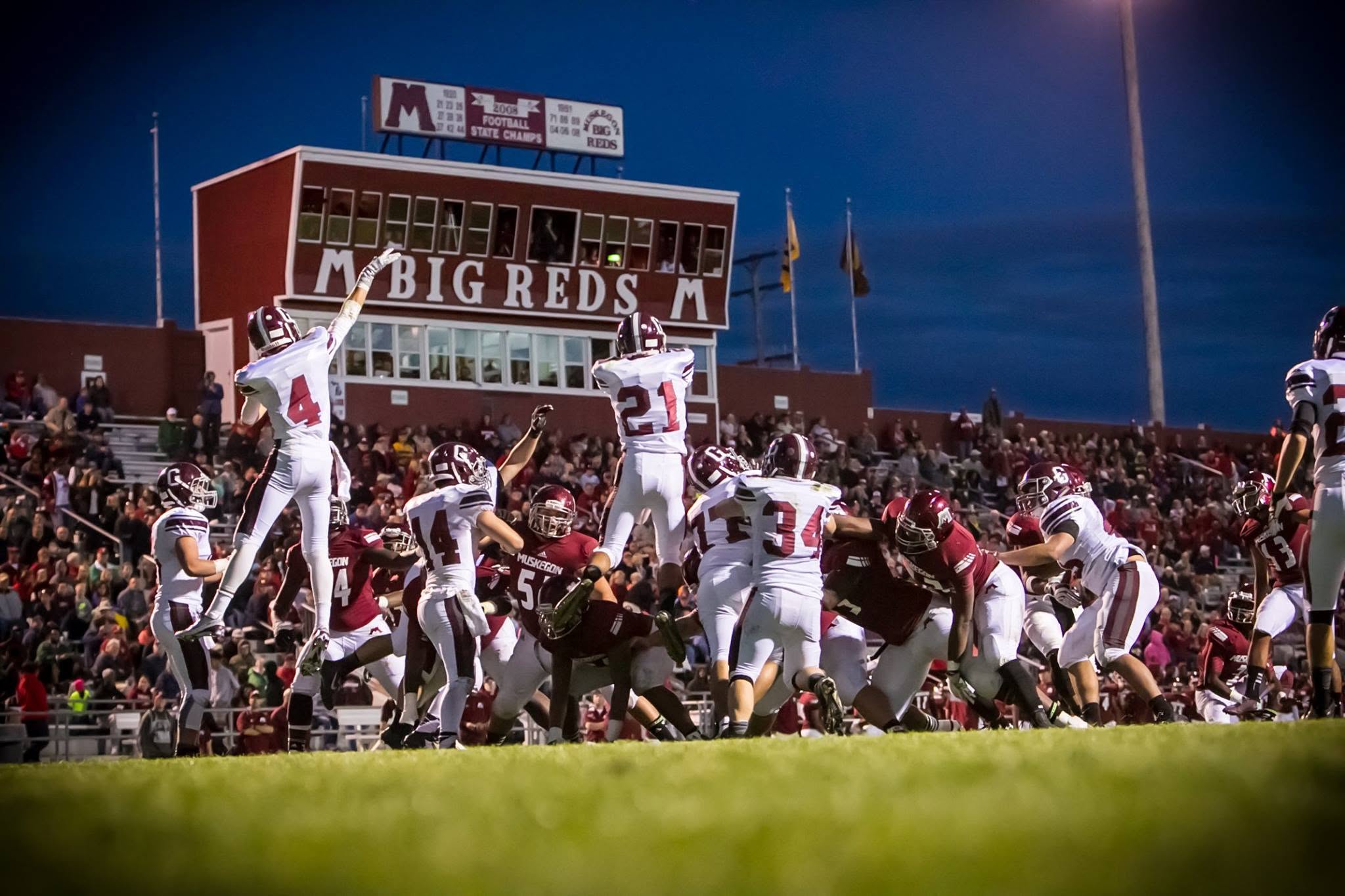
Hackley Stadium Celebrating Century as Monument to Community Dedication, Football Glory
By
Ron Pesch
MHSAA historian
September 4, 2026
Mounted on the brick wall of Hackley Stadium, facing Sanford Street in Muskegon, is a bronze plaque. In raised type, it details a successful “GoFundMe” effort – 1920s style.
The approach was a bit different then, but the fundraising efforts were successful and created an iconic landmark that still stands – now ready to celebrate its 100th year.
Seated, rectangularly, in the middle of a residential neighborhood, directly behind the high school, the site itself has served as home to Muskegon High School’s football team for 120 years. The sport dates to 1895 at MHS.
The wooded lot was gifted in 1902 by Muskegon’s greatest benefactor – lumber baron Charles H. Hackley – to the Board of Education. Hackley desired the space to be developed into an athletic field and playground for use by the school and area youth.
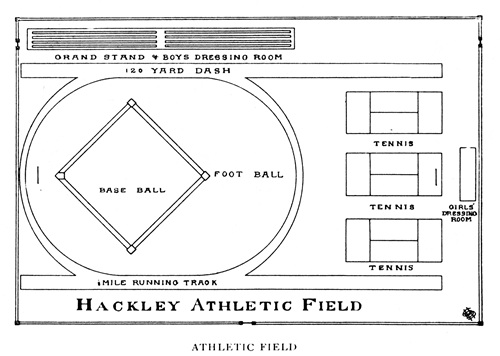 Quickly dubbed Hackley Field, it took four years before administration cleared trees from the lot. Initial plans for the parcel, laid out by a former coach and director of athletics, envisioned a site that would accommodate multiple sports, including a gridiron at the center of the property, surrounded by a track, with tennis courts placed at the site’s four corners.
Bob Zuppke – hired in August 1906 as the school’s newest coach and director – learned that the school board was ready to act on the design. He immediately spotted the planned layout showed a football field of just 50 yards. Recognizing the site could accommodate a full-sized gridiron, his redesign reduced the number of tennis courts to three and pushed them to one end of the site. He expanded the gridiron to regulation size and surrounded it with a 1/5-mile cinder track. His plan included space for a baseball diamond within the gridiron. An extensive wooden grandstand along the northeast side of the site would stretch the length of the football field to handle growing crowds at sporting events.
Zuppke’s modifications were promptly accepted, and Hackley Field was ready in mid-May 1907 for an initial track meet with Muskegon’s biggest rival, Grand Rapids Central. That fall, Muskegon played seven consecutive football home games at the new location. Recognizing the financial value of the annual clash with Central, that contest was moved to the last game of the year and staged on Thanksgiving Day. Crowds soared in size.
Dropping just a single game each season during his four years in town, Zuppke built Muskegon into a football powerhouse before moving on to even greater gridiron success over three years at Oak Park High School in Illinois. In 1913, he was named head football coach at the University of Illinois, earning national titles in 1914, 1919, 1923 – with a team that featured three-time All-American Harold ‘Red’ Grange – and 1927. Zuppke retired following the 1941 season. During his 35-year prep and college career, he introduced numerous innovations that remain hallmarks of the game today.
Plans for a Cement Stadium
From a comfortable chair, stationed in his room at a retirement home in Kalamazoo, 85-year-old C. Leo Redmond, former coach at Muskegon, recalled the story behind the construction of Muskegon High School’s historic Hackley Stadium. The concrete structure, built in 1927, replaced greatly expanded wooden stands (tennis courts were never added) originally placed on the site by Zuppke’s design.
Born in 1900 in Kalamazoo, Redmond arrived at MHS in 1925. A recent graduate of Western State Normal School – today’s Western Michigan University – he wasn’t Muskegon’s first choice to replace his predecessor, the highly-successful J. Francis Jacks.
A 1912 graduate of Muskegon, Jacks had turned the team’s football games into a huge draw between 1920 and 1924. During the span, his teams earned three mythical state titles over five years and produced an array of talented athletes, including University of Michigan great Bennie Oosterbaan.
But in the spring of 1925, Jacks passed away unexpectedly. Gus Cohrs, another Muskegon alum, was experiencing success in basketball and football at Grand Haven High School. He’d accepted the Muskegon job to succeed Jacks, but an outcry by Grand Haven fans and an immediate pay raise kept him from moving.
Fortunately for all, Redmond’s teams went 7-1-2 in 1925, then repeated as Michigan’s mythical champion in 1926. Immediately after the completion of that season, however, the school faced its next challenge.
“We walked out to the bleachers at the football field and Joe Bicknell (the Hackley Manual Training School director and facility manager for athletics) pulled out his pocketknife,” said Redmond. “He then pushed the blade completely into one of the wooden beams supporting the bleachers and said, ‘They will fall down if they have to support another season.’ So, we started a fund drive for Hackley Field’s reconstruction by selling stadium bonds.”
Muskegon contacted The Osborn Engineering Company of Cleveland, Ohio, to discuss the task. Peter P. Evans, vice president of the firm, visited Muskegon to inspect possible sites. “Mr. Evans’ company planned and built Navin Field, Detroit, the Polo Grounds, New York, and is now building the new stadium for the University of Michigan at Ann Arbor,” noted the Muskegon Chronicle.
Visiting in December, Evans advised “it would be best if it could replace the present seating arrangements at Hackley Field,” noting “it would not be architecturally objectionable to anyone in the neighborhood nor spoil the landscape effects of the campus.”
Building a stadium made with cement had been pondered by Bicknell and administration as early as 1913, but cost – then estimated at $25,000 – was viewed as insurmountable.
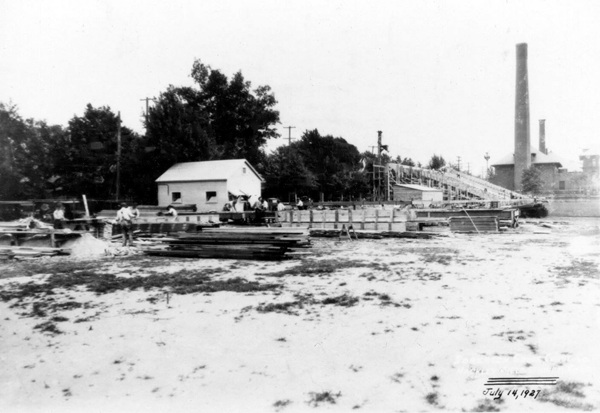 It took until April 1927 for final approval of a plan, and Osborn Engineering was authorized to prepare specifications. Time was of the essence, as the existing bleachers were now condemned and needed to be removed and replaced by fall.
The design would include “two team rooms” and restrooms under the stands, with the project financed by sale of bonds. A total of 1,500 were issued, priced at $50, earning 4 percent interest. The structure would feature seating for 6,000, with a block of 1,100 seats located between the 35-yard lines reserved for bondholders. The $75,000 campaign launched the first week of May.
The district tapped into a young sales force to help execute the plan – the student body. The classes of '27, '28, '29 and '30 – over 2,000 strong – were asked to distribute pamphlets and sell bonds to the public.
Years later, Gont Miller remembered walking home with Bub Meier – both would serve as future captains of Big Reds football teams.
"Principal John Craig talked to us Thursday night after practice,” recalled Miller. “He said, 'We're going to ask you to get out and sell some bonds.'
The pair talked about their frustration at being assigned the unwanted task.
“Together, we decided we weren't going to do it. After I got home, I told my mother about the bonds.”
She reframed it for her son, highlighting the community that surrounded them.
"Boy, that will be easy,” she said. “After dinner, go on over and see Mr. Runzel across the street, and the Nelsons on the side of us. I'm sure they will be interested.
"Well, I guess she got me inspired. I went over and saw Mr. Runzel, and he bought four. And Lester Nelson bought three, and Otto Meeske bought six. Mr. Runzel said, 'Go down and see my son,' and I did, and he bought two. People really supported Big Red football. We sold all the bonds, and they built the stadium. It was quite an experience for a kid."
Construction contracts were awarded by June 1, and actual work on the site started on Wednesday, June 15. According to the files of Osborn Engineering, the concrete and brick structure itself was completed over just 24 days – July 20 to August 12. Final plumbing and electrical preparations were completed in time for the first game against Muskegon Heights on Saturday, September 17.
Dedication and the Birth of a Rivalry
"Impressive and colorful flag-raising ceremonies marked the dedication of the new stands," wrote Jimmy Henderson in the Muskegon Chronicle. "A massed assemblage of over 2,000 students who paraded on the field following the Heights and Muskegon high school bands, and close to 3,000 spectators in the stands stood at attention while the massed bands under the leadership of Ronald Hinchman played the national anthem, as the new flag was slowly raised to its position over the stadium."
The Big Reds posted a crushing 89-0 victory over the Heights and their new coach, Oscar E. "Okie" Johnson – a former teammate of Redmond’s at Western – in the season opener. It was the first of nine shutouts posted by Muskegon en route to a 10-0 campaign and another mythical state title. Outscoring opponents 445-6, the team remains among the greatest in school history.
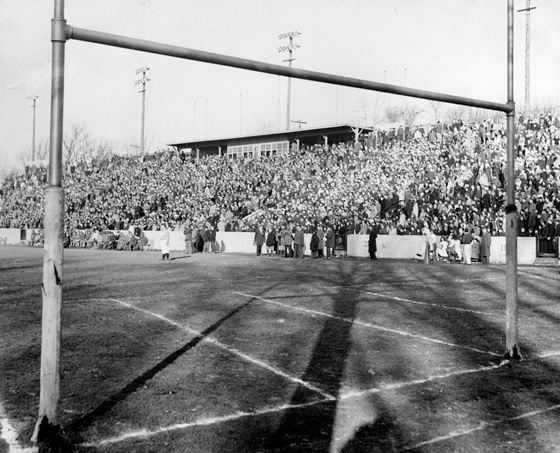 Muskegon claimed a second-consecutive shutout over Johnson’s Tigers in 1928, this time 19-0, and finished the season with another state crown. In ’29, they again blanked the Tigers, but by just seven points. In 1930, Johnson’s squad tied Redmond’s Big Reds, 6-6, and established themselves as Muskegon’s chief rival. Come 1936, the game was moved to the season finale, replacing the matchup with Grand Rapids Central. Lights were added to Hackley in 1940, with most games shifted to Friday nights. Annual classic battles between the Big Reds and Tigers were all played at Hackley (until 1948) and still staged on Saturday afternoons (until 1953) to accommodate the massive crowds.
The 1945 season-ending contest between the schools – both undefeated – was a battle for the state title. A record crowd of 13,500 packed every square inch of the grounds. Heights opened a 7-0 lead early, but Muskegon responded with a touchdown midway through the second quarter. A missed extra point pinned the score at 7-6. It remained stuck there until an intense goal-line stand late in the fourth quarter would determine the game’s outcome. The Big Reds had advanced the ball to the Tigers’ 1 on second down. A charge at the center of the line on third down was stopped.
“The ball, three inches from the goal line when play started, still was an inch from the line when it was set down,” wrote Henderson, still covering the rivalry. “When (the defense) stopped the forward motion of (Muskegon’s quarterback), the air went dark with the applause of the Heights fans, and the groans of Muskegon’s.” The win capped the first of three consecutive state crowns won by the Tigers, and the loss was the first in 16 starts for the Big Reds, the defending state champion.
In 1946, Muskegon installed its first electronic scoreboard, retiring the one manually operated by the Boy Scouts. Redmond retired as coach following the season with a 156-29-13 record and seven state titles over 22 seasons. (His victory total remained tops in school history until recently surpassed by current head coach Shane Fairfield.) Most fittingly, the remarkable gridiron rivalry between coaches Redmond and Johnson ended dead even at 9-9-2.
Reduced revenue during the depression years forced default on bond payments. After a restructuring of obligations, a final payout distributed in 1950 to bondholders meant the stadium was now out of debt. That fall, $8,000 in repairs and waterproofing helped stabilize a structure starting to show wear and tear.
Coach Harry Potter – another Western teammate of Redmond’s, and his longtime assistant – took the reins in 1947 and guided the 1951 Big Reds to another gridiron state championship. That team featured future NFL quarterback Earl Morrall.
Over the years, Hackley Stadium has served the community with World War II events to sell war bonds, practice drill formations, events to honor local industries’ wartime outputs, and VFW Memorial Day gatherings. There have been countless halftime shows, marching band competitions, high school assemblies, and commencement exercises. It has hosted opera, concert performances, and music reviews. In 1951, evangelist Rev. Billy Graham and his music director Cliff Barrows visited. In 1957, a massive Water Follies show with a dive tank, stage, and swim tank – spanning 150 feet – filled Hackley Stadium, raising money for the local ‘Police and Fireman Benevolent Association’.
More than 10,000 fans packed the stands in the fall of 1971 to watch another pair of unbeatens as the Big Reds topped Traverse City on their way to another state championship. Members of the Lake Michigan Athletic Conference, the Trojans became firmly established as new primary rivals on Muskegon’s annual slate.
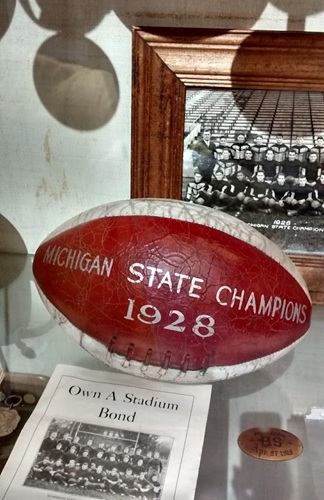 After four uncharacteristic down years on the gridiron during the early 1980s, huge crowds returned to pack Hackley’s stands beginning in 1985, especially during Muskegon’s march to MHSAA playoff titles in 1986 and 1989.
Continued maintenance over the years ensured the stadium’s survival. In 1996, extensive renovations and rejuvenation of the concrete stadium ensured the safekeeping of the ‘Home of the Big Reds’. Concession stands were moved from beneath the seating to structures at the north and south ends of the stadium. Modern requirements meant removal of the track that once surrounded Hackley to expand the concourse that leads to seating. But proximity and sight lines to the playing surface – always a feature of Hackley for fans – were not sacrificed.
The Tunnel
Terry Foster, writing for the Detroit News, visited the stadium as part of his “Terry’s Tour” in 2006. Kicking off a series of articles where he visited high school football games across the state, Foster’s opening paragraphs focused on another unique feature of the stadium.
Postgame, the Big Red Band ends home game festivities by marching – shoulder-to-shoulder, students aligned three-or-four-or-five across, with instruments swinging up-and-down and side-to-side, beneath the stands.
“Fans lined both sides of the cramped corridor as the band paraded through the narrow human tunnel …
“‘Ok. You got to hang tight against the wall,’ Muskegon head coach Tony Annese told Foster. … You will get hit if you are not careful.’ … Like Annese, they wanted to feel the booming drums vibrate off the concrete walls as the band marched underneath the stadium. …
“The march that eventually took the musicians (down Sanford Street) to their music room has been going on for decades. So has winning football.”
A new video scoreboard was installed in 2015. Field turf replaced Hackley Field’s natural grass in 2020. Also added was a brick fence similar in placement to one that surrounded the site back in 1914 and was removed in phases between 1927 and 1946.
Muskegon continues to lead the state in all-time football victories, earning additional MHSAA titles in 2004, 2006, 2008, 2017 and 2023. Many feel that rich tradition, combined with the classic backdrop of Hackley Stadium packed with alumni and passionate football fans, has played a huge role in those wins.
For the Big Reds, Hackley has always been more than brick, concrete, and rebar.
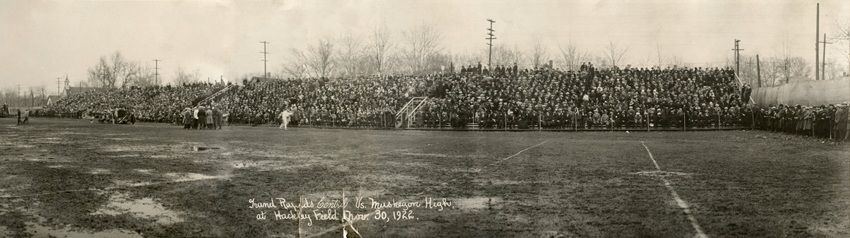
PHOTOS (Top) Muskegon takes on Grandville in 2015 at Hackley Stadium in what would end as the program’s 800th victory. (2) The proposed stadium plan from 1906 shows the football field, baseball diamond, track and tennis courts among other proposed features to the new athletic field. (3) Muskegon takes on Grand Rapids Central in 1922. (4) Osborn Engineering works on the renovated stadium during the summer of 1927. (5) The stands are filled for a game in 1942. (6) This display includes a photo of the 1928 state championship team and brochure for stadium bonds. (Top photo by Tim Reilly. Other photos collected by Ron Pesch.)
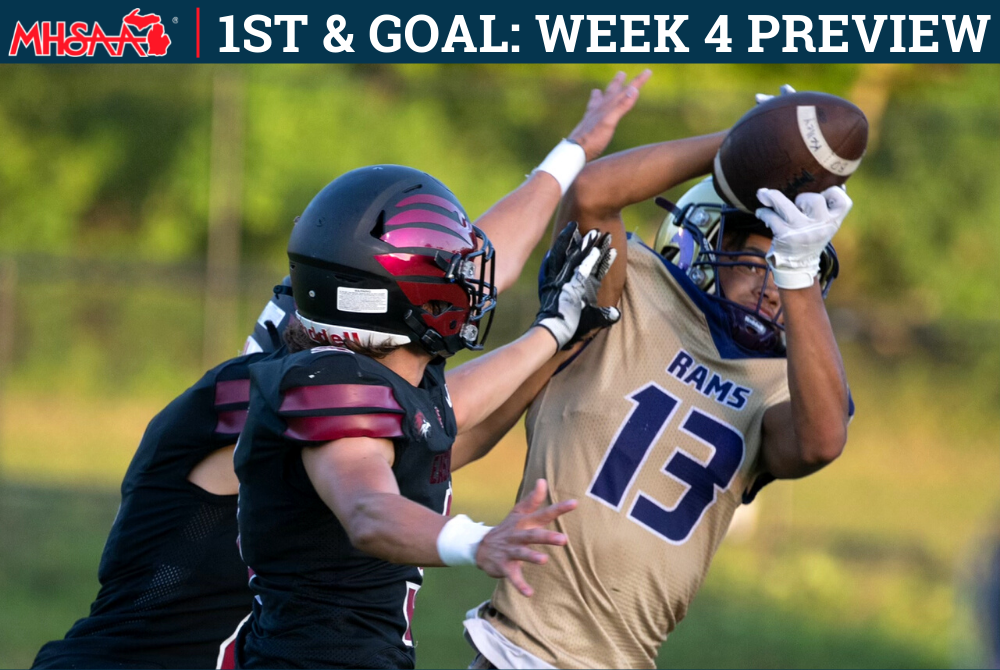
1st & Goal: 2022 Week 4 Preview
By
Geoff Kimmerly
MHSAA.com senior editor
September 16, 2022
If last week’s top matchups could be considered tough to gauge beforehand, this week’s are a breeze to forecast.
 Of the 18 teams listed below in our best-expected games from every region, 13 are ranked in the top 10 of their respective divisions by the Michigan High School Football Coaches Association. Our “Bay & Thumb” highlighted game featured two top-six Division 8 teams, and three more of those 13 are top-ranked with our best 8-player matchup featuring two teams that played in Finals last fall.
Games are Friday unless noted. Click for the full schedule from MHSAA.com and check out the broadcast schedule from MHSAA.tv.
Bay & Thumb
Ubly (3-0) at Harbor Beach (3-0)
The Bearcats continue to thrive as one of the strongest small-school programs in the state, as last season’s only loss came in the Division 8 Semifinals and after they were Division 8 runners-up in 2020 and also made the Semifinals in 2019. Ubly seemed to take over as the Greater Thumb Conference East powerhouse from Harbor Beach, but didn’t truly shake the Pirates until sweeping them last year 50-33 during the regular season and 35-6 in a playoff opener. Harbor Beach should put up another challenge this time; the Pirates didn’t give up a point this season until last week. Both teams have two wins over 2021 playoff teams.
Keep an eye on these FRIDAY Fenton (2-1) at Swartz Creek (3-0), Clare (2-1) at Gladwin (3-0), Saginaw Heritage (3-0) at Davison (2-1), North Branch (3-0) at Almont (3-0).
Greater Detroit
Detroit Martin Luther King (1-1) at Detroit Cass Tech (1-2)
This annual matchup between Detroit Public School League powers – now back in the same division – will be a breakout game for the winner. Both have suffered losses to Indiana powerhouses – Cass Tech to Carmel and King to Indianapolis Warren Central – and both rebounded to open the league schedule with 60-point shutouts. King won both matchups with Cass last season, but by only seven and six points. As usual, this likely will be just the first of two meetings this fall, with the next in the PSL playoffs.
Keep an eye on these FRIDAY Clarkston (2-1) at West Bloomfield (3-0), South Lyon East (3-0) at Walled Lake Western (3-0), River Rouge (2-0) at Orchard Lake St. Mary’s (1-2), Carleton Airport (3-0) at Grosse Ile (3-0).
Mid-Michigan
DeWitt (2-1) at East Lansing (3-0)
This has been the matchup not just in the Capital Area Activities Conference Blue but usually all of Greater Lansing since DeWitt moving into the league in 2018. The Panthers have won four of the five matchups since, including two in the playoffs and 49-14 last season. This should see a much closer result. East Lansing’s run so far this fall includes two wins over likely league title contenders, Portage Central and Fenton. DeWitt’s two wins also came against league title contenders in Haslett and Portland, and the young Panthers continued to show they’re learning quickly in last week’s overtime loss at Detroit Catholic Central.
Keep an eye on these FRIDAY Mason (3-0) at Williamston (3-0), Traverse City Central (1-2) at Mount Pleasant (3-0), Lansing Waverly (3-0) at Grand Ledge (2-1), Lake Odessa Lakewood (2-1) at Perry (2-1).
Northern Lower Peninsula
Kingsley (2-1) at Traverse City St. Francis (3-0)
Don’t let the Stags’ one-point loss to Gaylord in Week 2 take any of the dazzle off this Northern Michigan Football League Legends clash. Kingsley’s only other regular-season losses over the last five seasons were to St. Francis, 38-30 last season and then in 2018. The Gladiators have lit up the scoreboard with 42 or more points every game this fall, and they own an impressive 42-35 Week 2 win over Jackson Lumen Christi.
Keep an eye on these FRIDAY Evart (3-0) at Manton (2-1), Beal City (3-0) at Lake City (2-1), Elk Rapids (3-0) at Charlevoix (3-0), Grand Blanc (1-2) at Traverse City West (1-2).
Southeast & Border
Adrian (2-1) at Tecumseh (3-0)
We featured Tecumseh earlier this week as that team is off to a grand start as it seeks its first winning season since 2013. Adrian is in a similar spot, having won two games a year ago, with those victories breaking a previous losing streak that stretched back to 2017. After falling to Ada Forest Hills Eastern in their opener, the Maples have won by 27 and 31, respectively, the last two weeks. The winner of this matchup may provide the toughest challenge to Chelsea in the Southeastern Conference White.
Keep an eye on these FRIDAY Union City (2-1) at Reading (3-0), Erie Mason (3-0) at Petersburg Summerfield (2-1), Saline (3-0) at Monroe (2-1), Pinckney (1-2) at Chelsea (2-1).
Southwest Corridor
Constantine (2-1) at Schoolcraft (3-0)
After last season’s game couldn’t be played, this rivalry that goes back at least 70 years is back. And although these teams remain in separate divisions of the Southwestern Athletic Conference, this matchup still carries plenty of clout. The Falcons do have a defeat, but by only two to a Hudson team that’s won 17 straight. Schoolcraft is coming off a four-point win over Kalamazoo United as it continues to rebound from last season – the Kalamazoo win was the second straight to avenge a 2021 loss.
Keep an eye on these FRIDAY Edwardsburg (2-1) at Vicksburg (2-1), Battle Creek Lakeview (1-1) at St. Joseph (2-1), Sturgis (2-1) at Paw Paw (2-1), Centreville (2-1) at Decatur (2-1).
Upper Peninsula
Gladstone (3-0) at St. Ignace (3-0)
These two have been the stories of the Upper Peninsula so far this season as both are on a roll after finishing sub-.500 last fall. Gladstone has defeated three 2021 league champions and appears the team to chase in the Great Northern Conference. St. Ignace may be the same in the Northern Michigan Football League Legacy coming off its second-straight shutout this month, this one against last season’s Legends runner-up Frankfort.
Keep an eye on these FRIDAY Manistique (2-1) at Negaunee (3-0), L’Anse (2-1) at Iron Mountain (2-1), Menominee (1-2) at Escanaba (1-2). SATURDAY Bark River-Harris (3-0) at Houghton (2-1).
West Michigan
Ludington (3-0) at Muskegon Oakridge (3-0)
Two of the region’s best matchups this week come from the West Michigan Conference Lakes – Montague/Whitehall is the other – which means the league should sort out a bit by Saturday. Ludington is new to the league after playing formerly in the Lakes 8 Conference, and the Orioles already have equaled their win total of all of last season. The Oakridge matchup presents another level of opportunity though, as the Eagles are regular contenders in the former one-division WMC and owners of three wins already this fall over 2021 playoff qualifiers.
Keep an eye on these FRIDAY Byron Center (1-2) at Lowell (3-0), Montague (2-1) at Whitehall (3-0), Belding (3-0) at Grandville Calvin Christian (3-0), Holland West Ottawa (2-1) at Grandville (3-0)
8-Player
Colon (3-0) at Adrian Lenawee Christian (3-0)
The Cougars are bringing a 27-game winning streak into this matchup – coinciding with their move to 8-player at the start of the 2020 season – and Colon was the opponent for two of those victories. But the Magi, last season’s Division 2 runner-up, also gave eventual Division 1 champ Lenawee Christian one of its best challenges last season, 47-21. Sidenote: These are two of five Southern Central Athletic Association A teams that have opened 2-1 or better.
Keep an eye on these FRIDAY Norway (3-0) at Crystal Falls Forest Park (3-0), Breckenridge (2-1) at Portland St. Patrick (3-0), Cedarville (3-0) at Newberry (2-1). SATURDAY Suttons Bay (2-1) at Brown City (3-0).
Second Half’s weekly “1st & Goal” previews and reviews are powered by MI Student Aid, a part of the Office of Postsecondary Financial Planning located within the Michigan Department of Treasury. MI Student Aid encourages students to pursue postsecondary education by providing access to student financial resources and information. MI Student Aid administers the state’s 529 college savings programs (MET/MESP), as well as scholarship and grant programs that help make college Accessible, Affordable and Attainable for you. Connect with MI Student Aid at www.michigan.gov/mistudentaid and find more information on Facebook and Twitter @mistudentaid.
PHOTO: A South Haven receiver pulls in a pass against Ada Forest Hills Eastern in Week 1. (Photo by Michigan Sports Photo.)