

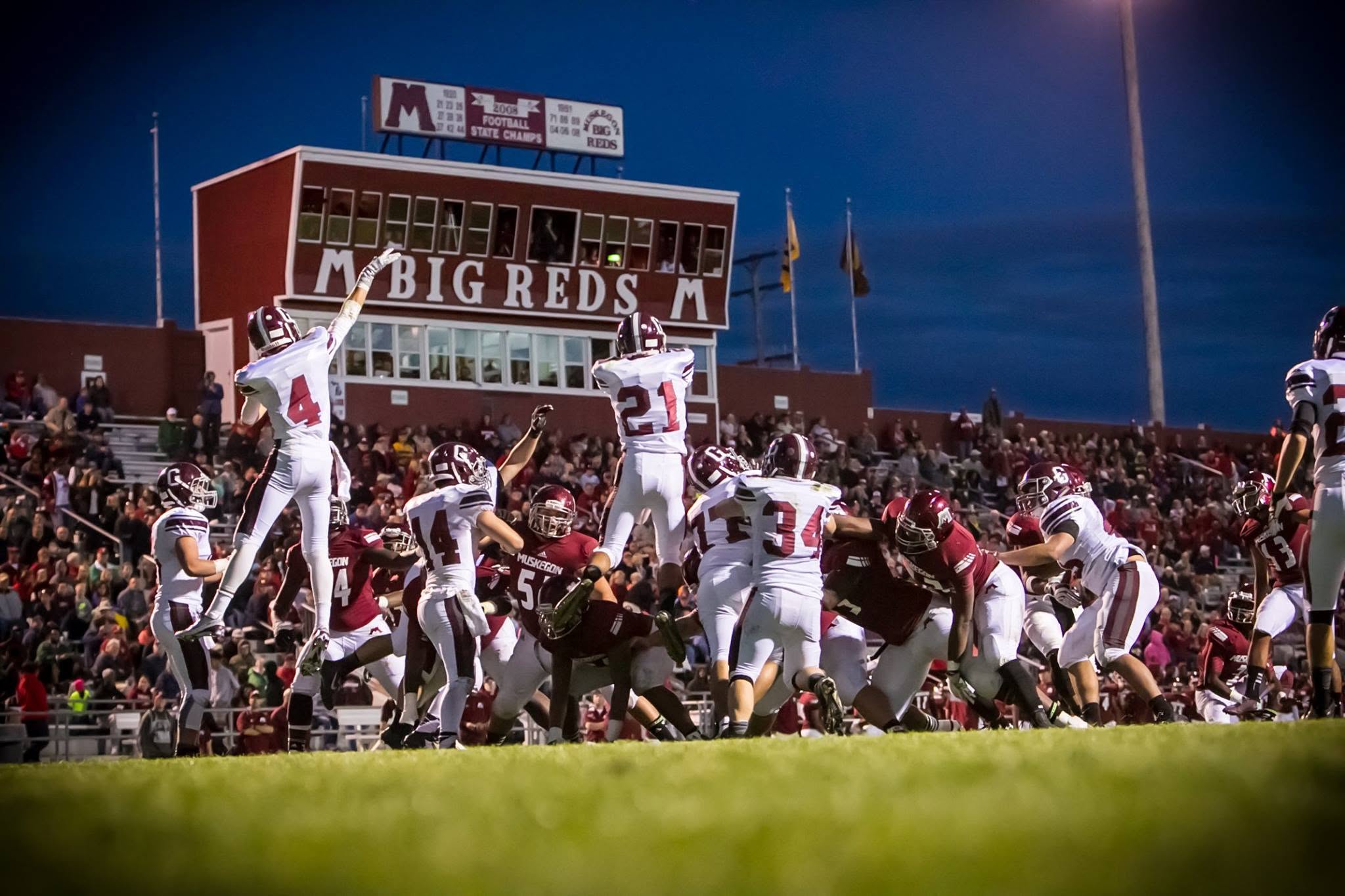
Hackley Stadium Celebrating Century as Monument to Community Dedication, Football Glory
By
Ron Pesch
MHSAA historian
September 4, 2026
Mounted on the brick wall of Hackley Stadium, facing Sanford Street in Muskegon, is a bronze plaque. In raised type, it details a successful “GoFundMe” effort – 1920s style.
The approach was a bit different then, but the fundraising efforts were successful and created an iconic landmark that still stands – now ready to celebrate its 100th year.
Seated, rectangularly, in the middle of a residential neighborhood, directly behind the high school, the site itself has served as home to Muskegon High School’s football team for 120 years. The sport dates to 1895 at MHS.
The wooded lot was gifted in 1902 by Muskegon’s greatest benefactor – lumber baron Charles H. Hackley – to the Board of Education. Hackley desired the space to be developed into an athletic field and playground for use by the school and area youth.
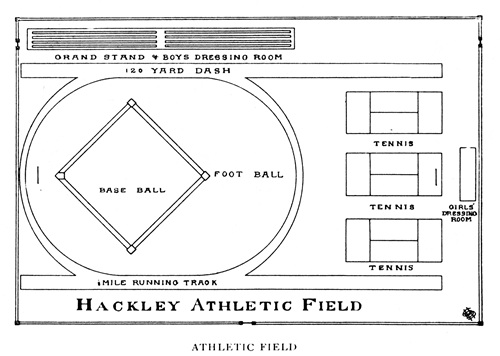 Quickly dubbed Hackley Field, it took four years before administration cleared trees from the lot. Initial plans for the parcel, laid out by a former coach and director of athletics, envisioned a site that would accommodate multiple sports, including a gridiron at the center of the property, surrounded by a track, with tennis courts placed at the site’s four corners.
Bob Zuppke – hired in August 1906 as the school’s newest coach and director – learned that the school board was ready to act on the design. He immediately spotted the planned layout showed a football field of just 50 yards. Recognizing the site could accommodate a full-sized gridiron, his redesign reduced the number of tennis courts to three and pushed them to one end of the site. He expanded the gridiron to regulation size and surrounded it with a 1/5-mile cinder track. His plan included space for a baseball diamond within the gridiron. An extensive wooden grandstand along the northeast side of the site would stretch the length of the football field to handle growing crowds at sporting events.
Zuppke’s modifications were promptly accepted, and Hackley Field was ready in mid-May 1907 for an initial track meet with Muskegon’s biggest rival, Grand Rapids Central. That fall, Muskegon played seven consecutive football home games at the new location. Recognizing the financial value of the annual clash with Central, that contest was moved to the last game of the year and staged on Thanksgiving Day. Crowds soared in size.
Dropping just a single game each season during his four years in town, Zuppke built Muskegon into a football powerhouse before moving on to even greater gridiron success over three years at Oak Park High School in Illinois. In 1913, he was named head football coach at the University of Illinois, earning national titles in 1914, 1919, 1923 – with a team that featured three-time All-American Harold ‘Red’ Grange – and 1927. Zuppke retired following the 1941 season. During his 35-year prep and college career, he introduced numerous innovations that remain hallmarks of the game today.
Plans for a Cement Stadium
From a comfortable chair, stationed in his room at a retirement home in Kalamazoo, 85-year-old C. Leo Redmond, former coach at Muskegon, recalled the story behind the construction of Muskegon High School’s historic Hackley Stadium. The concrete structure, built in 1927, replaced greatly expanded wooden stands (tennis courts were never added) originally placed on the site by Zuppke’s design.
Born in 1900 in Kalamazoo, Redmond arrived at MHS in 1925. A recent graduate of Western State Normal School – today’s Western Michigan University – he wasn’t Muskegon’s first choice to replace his predecessor, the highly-successful J. Francis Jacks.
A 1912 graduate of Muskegon, Jacks had turned the team’s football games into a huge draw between 1920 and 1924. During the span, his teams earned three mythical state titles over five years and produced an array of talented athletes, including University of Michigan great Bennie Oosterbaan.
But in the spring of 1925, Jacks passed away unexpectedly. Gus Cohrs, another Muskegon alum, was experiencing success in basketball and football at Grand Haven High School. He’d accepted the Muskegon job to succeed Jacks, but an outcry by Grand Haven fans and an immediate pay raise kept him from moving.
Fortunately for all, Redmond’s teams went 7-1-2 in 1925, then repeated as Michigan’s mythical champion in 1926. Immediately after the completion of that season, however, the school faced its next challenge.
“We walked out to the bleachers at the football field and Joe Bicknell (the Hackley Manual Training School director and facility manager for athletics) pulled out his pocketknife,” said Redmond. “He then pushed the blade completely into one of the wooden beams supporting the bleachers and said, ‘They will fall down if they have to support another season.’ So, we started a fund drive for Hackley Field’s reconstruction by selling stadium bonds.”
Muskegon contacted The Osborn Engineering Company of Cleveland, Ohio, to discuss the task. Peter P. Evans, vice president of the firm, visited Muskegon to inspect possible sites. “Mr. Evans’ company planned and built Navin Field, Detroit, the Polo Grounds, New York, and is now building the new stadium for the University of Michigan at Ann Arbor,” noted the Muskegon Chronicle.
Visiting in December, Evans advised “it would be best if it could replace the present seating arrangements at Hackley Field,” noting “it would not be architecturally objectionable to anyone in the neighborhood nor spoil the landscape effects of the campus.”
Building a stadium made with cement had been pondered by Bicknell and administration as early as 1913, but cost – then estimated at $25,000 – was viewed as insurmountable.
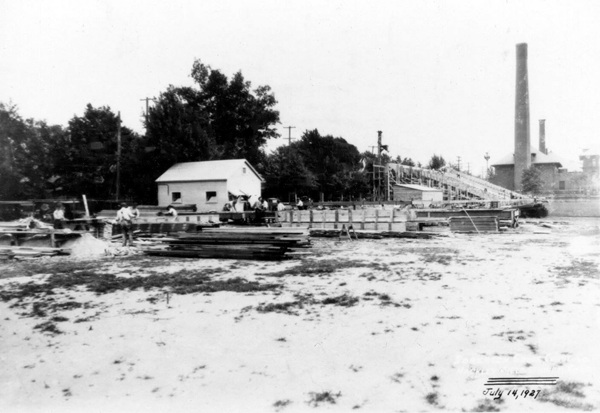 It took until April 1927 for final approval of a plan, and Osborn Engineering was authorized to prepare specifications. Time was of the essence, as the existing bleachers were now condemned and needed to be removed and replaced by fall.
The design would include “two team rooms” and restrooms under the stands, with the project financed by sale of bonds. A total of 1,500 were issued, priced at $50, earning 4 percent interest. The structure would feature seating for 6,000, with a block of 1,100 seats located between the 35-yard lines reserved for bondholders. The $75,000 campaign launched the first week of May.
The district tapped into a young sales force to help execute the plan – the student body. The classes of '27, '28, '29 and '30 – over 2,000 strong – were asked to distribute pamphlets and sell bonds to the public.
Years later, Gont Miller remembered walking home with Bub Meier – both would serve as future captains of Big Reds football teams.
"Principal John Craig talked to us Thursday night after practice,” recalled Miller. “He said, 'We're going to ask you to get out and sell some bonds.'
The pair talked about their frustration at being assigned the unwanted task.
“Together, we decided we weren't going to do it. After I got home, I told my mother about the bonds.”
She reframed it for her son, highlighting the community that surrounded them.
"Boy, that will be easy,” she said. “After dinner, go on over and see Mr. Runzel across the street, and the Nelsons on the side of us. I'm sure they will be interested.
"Well, I guess she got me inspired. I went over and saw Mr. Runzel, and he bought four. And Lester Nelson bought three, and Otto Meeske bought six. Mr. Runzel said, 'Go down and see my son,' and I did, and he bought two. People really supported Big Red football. We sold all the bonds, and they built the stadium. It was quite an experience for a kid."
Construction contracts were awarded by June 1, and actual work on the site started on Wednesday, June 15. According to the files of Osborn Engineering, the concrete and brick structure itself was completed over just 24 days – July 20 to August 12. Final plumbing and electrical preparations were completed in time for the first game against Muskegon Heights on Saturday, September 17.
Dedication and the Birth of a Rivalry
"Impressive and colorful flag-raising ceremonies marked the dedication of the new stands," wrote Jimmy Henderson in the Muskegon Chronicle. "A massed assemblage of over 2,000 students who paraded on the field following the Heights and Muskegon high school bands, and close to 3,000 spectators in the stands stood at attention while the massed bands under the leadership of Ronald Hinchman played the national anthem, as the new flag was slowly raised to its position over the stadium."
The Big Reds posted a crushing 89-0 victory over the Heights and their new coach, Oscar E. "Okie" Johnson – a former teammate of Redmond’s at Western – in the season opener. It was the first of nine shutouts posted by Muskegon en route to a 10-0 campaign and another mythical state title. Outscoring opponents 445-6, the team remains among the greatest in school history.
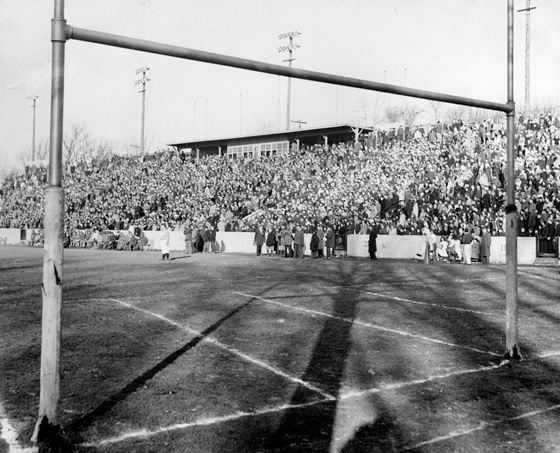 Muskegon claimed a second-consecutive shutout over Johnson’s Tigers in 1928, this time 19-0, and finished the season with another state crown. In ’29, they again blanked the Tigers, but by just seven points. In 1930, Johnson’s squad tied Redmond’s Big Reds, 6-6, and established themselves as Muskegon’s chief rival. Come 1936, the game was moved to the season finale, replacing the matchup with Grand Rapids Central. Lights were added to Hackley in 1940, with most games shifted to Friday nights. Annual classic battles between the Big Reds and Tigers were all played at Hackley (until 1948) and still staged on Saturday afternoons (until 1953) to accommodate the massive crowds.
The 1945 season-ending contest between the schools – both undefeated – was a battle for the state title. A record crowd of 13,500 packed every square inch of the grounds. Heights opened a 7-0 lead early, but Muskegon responded with a touchdown midway through the second quarter. A missed extra point pinned the score at 7-6. It remained stuck there until an intense goal-line stand late in the fourth quarter would determine the game’s outcome. The Big Reds had advanced the ball to the Tigers’ 1 on second down. A charge at the center of the line on third down was stopped.
“The ball, three inches from the goal line when play started, still was an inch from the line when it was set down,” wrote Henderson, still covering the rivalry. “When (the defense) stopped the forward motion of (Muskegon’s quarterback), the air went dark with the applause of the Heights fans, and the groans of Muskegon’s.” The win capped the first of three consecutive state crowns won by the Tigers, and the loss was the first in 16 starts for the Big Reds, the defending state champion.
In 1946, Muskegon installed its first electronic scoreboard, retiring the one manually operated by the Boy Scouts. Redmond retired as coach following the season with a 156-29-13 record and seven state titles over 22 seasons. (His victory total remained tops in school history until recently surpassed by current head coach Shane Fairfield.) Most fittingly, the remarkable gridiron rivalry between coaches Redmond and Johnson ended dead even at 9-9-2.
Reduced revenue during the depression years forced default on bond payments. After a restructuring of obligations, a final payout distributed in 1950 to bondholders meant the stadium was now out of debt. That fall, $8,000 in repairs and waterproofing helped stabilize a structure starting to show wear and tear.
Coach Harry Potter – another Western teammate of Redmond’s, and his longtime assistant – took the reins in 1947 and guided the 1951 Big Reds to another gridiron state championship. That team featured future NFL quarterback Earl Morrall.
Over the years, Hackley Stadium has served the community with World War II events to sell war bonds, practice drill formations, events to honor local industries’ wartime outputs, and VFW Memorial Day gatherings. There have been countless halftime shows, marching band competitions, high school assemblies, and commencement exercises. It has hosted opera, concert performances, and music reviews. In 1951, evangelist Rev. Billy Graham and his music director Cliff Barrows visited. In 1957, a massive Water Follies show with a dive tank, stage, and swim tank – spanning 150 feet – filled Hackley Stadium, raising money for the local ‘Police and Fireman Benevolent Association’.
More than 10,000 fans packed the stands in the fall of 1971 to watch another pair of unbeatens as the Big Reds topped Traverse City on their way to another state championship. Members of the Lake Michigan Athletic Conference, the Trojans became firmly established as new primary rivals on Muskegon’s annual slate.
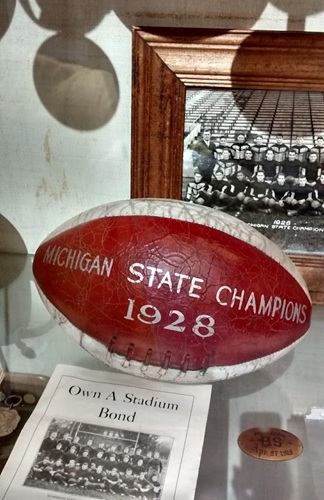 After four uncharacteristic down years on the gridiron during the early 1980s, huge crowds returned to pack Hackley’s stands beginning in 1985, especially during Muskegon’s march to MHSAA playoff titles in 1986 and 1989.
Continued maintenance over the years ensured the stadium’s survival. In 1996, extensive renovations and rejuvenation of the concrete stadium ensured the safekeeping of the ‘Home of the Big Reds’. Concession stands were moved from beneath the seating to structures at the north and south ends of the stadium. Modern requirements meant removal of the track that once surrounded Hackley to expand the concourse that leads to seating. But proximity and sight lines to the playing surface – always a feature of Hackley for fans – were not sacrificed.
The Tunnel
Terry Foster, writing for the Detroit News, visited the stadium as part of his “Terry’s Tour” in 2006. Kicking off a series of articles where he visited high school football games across the state, Foster’s opening paragraphs focused on another unique feature of the stadium.
Postgame, the Big Red Band ends home game festivities by marching – shoulder-to-shoulder, students aligned three-or-four-or-five across, with instruments swinging up-and-down and side-to-side, beneath the stands.
“Fans lined both sides of the cramped corridor as the band paraded through the narrow human tunnel …
“‘Ok. You got to hang tight against the wall,’ Muskegon head coach Tony Annese told Foster. … You will get hit if you are not careful.’ … Like Annese, they wanted to feel the booming drums vibrate off the concrete walls as the band marched underneath the stadium. …
“The march that eventually took the musicians (down Sanford Street) to their music room has been going on for decades. So has winning football.”
A new video scoreboard was installed in 2015. Field turf replaced Hackley Field’s natural grass in 2020. Also added was a brick fence similar in placement to one that surrounded the site back in 1914 and was removed in phases between 1927 and 1946.
Muskegon continues to lead the state in all-time football victories, earning additional MHSAA titles in 2004, 2006, 2008, 2017 and 2023. Many feel that rich tradition, combined with the classic backdrop of Hackley Stadium packed with alumni and passionate football fans, has played a huge role in those wins.
For the Big Reds, Hackley has always been more than brick, concrete, and rebar.
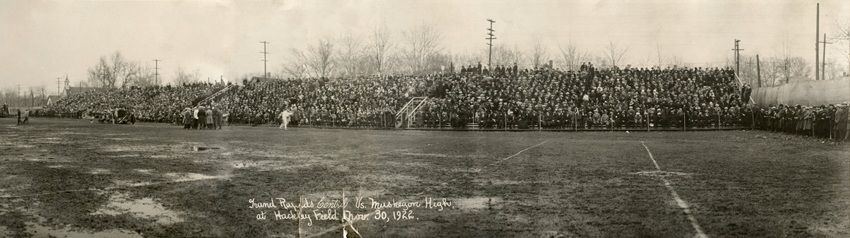
PHOTOS (Top) Muskegon takes on Grandville in 2015 at Hackley Stadium in what would end as the program’s 800th victory. (2) The proposed stadium plan from 1906 shows the football field, baseball diamond, track and tennis courts among other proposed features to the new athletic field. (3) Muskegon takes on Grand Rapids Central in 1922. (4) Osborn Engineering works on the renovated stadium during the summer of 1927. (5) The stands are filled for a game in 1942. (6) This display includes a photo of the 1928 state championship team and brochure for stadium bonds. (Top photo by Tim Reilly. Other photos collected by Ron Pesch.)
Drive for Detroit: Semifinals in Review
November 21, 2016
By Geoff Kimmerly
Second Half editor
After nearly four months, this drive for Detroit is nearly complete.
Sixteen teams remain for this weekend's eight MHSAA 11-Player Finals at Ford Field in Detroit. Below is a glance at how all 16 earned their end-of-season trips, with a number of them frequent visitors to the season's final days.
Division 1
Detroit Catholic Central 17, Romeo 0
The Shamrocks eliminated the reigning Division 1 champion in a matchup of last season’s Regional Final, a 40-29 Romeo win. Detroit Catholic Central (13-0) is on course for its best defensive season since 2011 and a win away from its first undefeated season since 2009. For Romeo (9-4), the loss ends a two-season run that saw the Bulldogs play in their second and third Semifinals ever (and first since 1992) while earning their first MHSAA team title and finishing a combined 22-5. Click for more from the Observer & Eccentric.
Detroit Cass Tech 32, Utica Eisenhower 28
Cass Tech standout receiver Donovan Peoples-Jones caught a 20-yard touchdown pass from quarterback Rodney Hall with only 24 seconds to play to push the Technicians (13-0) ahead of Eisenhower and soon after back into the Division 1 Final for the second straight season and fourth time this decade. The reigning runner-up in this division won its second straight nail-biter after downing Saline by one in the Regional Final, handing Eisenhower (12-1) its first loss after doing the same to the Hornets the week before. Click for more from the Detroit Free Press.
Division 2
Walled Lake Western 37, Lowell 34
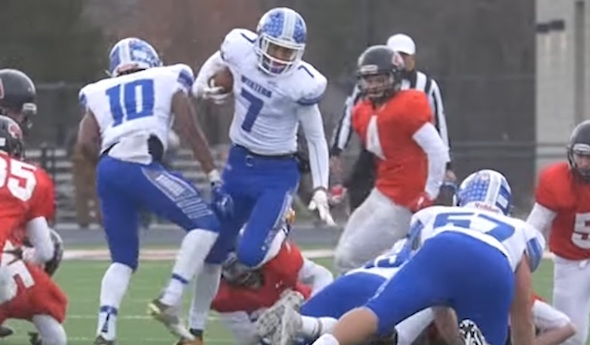
The Red Arrows (12-1), last season’s Division 2 runners-up, found themselves in a comeback quest for the second week in a row but couldn’t come all the way back in this rematch of a 2015 Semifinal. Walled Lake Western (12-1) led 31-14 at halftime and held Lowell off for the final 7:46 to advance to its first championship game since 1999. The Warriors had lost to Lowell 49-34 in the meeting a year ago. Click for more from the Oakland Press.
Detroit Martin Luther King 14, Birmingham Groves 7
King earned a chance to repeat as Division 2 champion with a defensive stand after heading into halftime up 14-0. The Crusaders (11-2) hadn’t scored fewer than 18 points since Week 1 of 2015, but were able to ride out the final two quarters relying on a defense that has given up only 35 points over four playoff games. Groves finished its first Semifinal run 11-2, setting a program record for wins for the second straight season after finishing 10-1 in 2015. Click for more from the Detroit News.
Division 3
Muskegon 19, Edwardsburg 8
This defensive standoff saw both teams easily score their fewest points this season – but Muskegon advance to its fourth championship game in five years while keeping Edwardsburg from advancing to the MHSAA Finals for the first time. The Big Reds (12-1) increased their school record points total to 653 and locked down an Eddies team that hadn’t scored fewer than 30. Edwardsburg finished 12-1, setting a program record for victories in one season. Click for more from the Muskegon Chronicle.
Orchard Lake St. Mary’s 49, Dearborn Divine Child 7
St. Mary’s will play for its third straight Division 3 championship and in its seventh MHSAA Final over the last eight seasons. Divine Child (10-3) was one of the surprises of the playoffs and finished with its most wins since 1985, but couldn’t come back after the Eaglets scored three times during the first quarter and three more times during the second. Click for more from the Oakland Press.
Division 4
Grand Rapids Catholic Central 31, Hudsonville Unity Christian 3
The Cougars (12-1) will play for a championship for the first time since 2010 after ending Unity Christian’s longest playoff run with another impressive defensive performance. GRCC has given up 10 points total over four playoff games and with Grand Rapids West Catholic in Division 5 gives the Ottawa-Kent Conference Blue two finalists this weekend. Unity Christian finished 10-3, two wins better than any season since the program began in 2003. Click for more from the Grand Rapids Press.
Detroit Country Day 20, River Rouge 14
After two straight Semifinal misses, Country Day will play in its second championship game in five seasons after eliminating last year’s Division 5 runner-up. River Rouge (11-2) held the Yellowjackets to their fewest points since opening night, but also scored its fewest since a 2014 Regional Final loss. Country Day (13-0) didn’t score during the second half, but Rouge didn't find the end zone again after scoring on its first possession of the third quarter. Click for more from State Champs! Sports Network.
Division 5
Menominee 23, Frankenmuth 20
Sam Larsen’s 1-yard touchdown blast up the middle with 9:27 to play stood as the winning points in a back-and-forth contest at the Superior Dome. Playing in its seventh Semifinal over the last 11 seasons, Menominee (12-1) earned its fourth championship game of this run and first since 2013. Frankenmuth (11-2) gave the Maroons their second-closest game of this season – the other was a loss to DeWitt in Week 8 – and tied its school record for wins with the most since the program’s last Semifinal run in 1997. Click for more from the Marinette (Wis.) Eagle Herald.
Grand Rapids West Catholic 17, Algonac 0
Reigning Division 5 champion West Catholic (11-2) completed an impressive even if not altogether unexpected run through three road games and a neutral-site semi to return to Ford Field. Defense has been the story for the Falcons this season, and they added a shutout after holding their first three playoff opponents to a combined 20 points. Algonac, in its first Semifinal appearance, held West Catholic to the latter’s second fewest points this season. But the Muskrats (11-2) failed to get on the board for the first time since Week 3 of 2014. Click for more from the Grand Rapids Press.
Division 6
Maple City Glen Lake 34, Leroy Pine River 20
Glen Lake’s earned it first trip to the Finals in football since 1996 on the success of a run game that was able to navigate the snowy conditions at Thirlby Field in Traverse City. Pine River (9-4), playing in its first Semifinal, had given up only 33 points total over the first three playoff games. Glen Lake (11-2), with the win, tied for its most in a season also since that 1996 run. Click for more from the Traverse City Record-Eagle.
Jackson Lumen Christi 27, Millington 7
Lumen Christi (11-2) is headed back to Ford Field for its first championship game since 2009 thanks in part to a second-straight single-digit performance by its defense. After holding Napoleon to only six points in the Regional Final, the Titans kept Millington to its fewest this fall (Millington also had scored only seven against Frankenmuth in Week 5). The Semifinal was the first for the Cardinals (11-1) since back-to-back trips in 2009 and 2010. Click for more from the Jackson Citizen-Patriot.
Division 7
Pewamo-Westphalia 34, Ubly 16
The Pirates (13-0) will return to the Division 7 Final after finishing runner-up a year ago. And they booked the trip by downing an undefeated team for the third straight week, handing Ubly (12-1) a first loss after doing the same to Traverse City St. Francis in the Regional Final and Saugatuck in the District championship game. After missing 100 yards rushing last week for the first time in three seasons, Pirates running back Jared Smith came back with 119 yards and two scores on 17 carries. Click for more from the Lansing State Journal.
Detroit Loyola 54, Cassopolis 22
Loyola will play in its fourth championship game in five seasons seeking to add to its 2014 title after continuing a playoff run that has seen the Bulldogs beat four league title winners and all by at least 23 points. Cassopolis (11-2), champion of the Berrien-Cass-St. Joseph Conference Red, was playing in its first Semifinal and set a program record this fall for victories. But the usually defense-strong Rangers couldn’t stop a Loyola attack that scored its second-most points this season. Click for more from State Champs! Sports Network.
Division 8
Muskegon Catholic Central 35, St. Ignace 0
The Crusaders (13-0) will play for a fourth straight Division 8 championship after improving on a Week 2 win over the Saints. MCC had beaten St. Ignace 21-6 in that first meeting, and led this one 21-0 by the end of its first possession of the second half. The shutout was the Crusaders’ third straight, and they’ve given up only seven points total over four playoff games. MCC also defeated the Saints (11-2) in a Semifinal last season. Click for more from the Muskegon Chronicle.
Ottawa Lake Whiteford 40, Saginaw Michigan Lutheran Seminary 21
Whiteford (13-0) has been building for years toward what will be its first championship game , and broke through after also playing but falling in a Semifinal a year ago. Jesse Kiefer ran for 183 yards and three touchdowns as the team piled up 526 yards of total offense, and the defense held mostly tight despite 152 yards rushing and two scores by MLS’s Casey Williams on only eight carries. The Cardinals finished 10-3 after reaching their second Semifinal in three seasons. Click for more from the Saginaw News.
PHOTO: Walled Lake Western's Cody White breaks through the line against Lowell in their Division 2 Semifinal on Saturday. (Photo courtesy of State Champs! Sports Network.)