

Harbor Beach is Title Town
By
Geoff Kimmerly
MHSAA.com senior editor
November 23, 2012
DETROIT – Harbor Beach always has considered itself a football town. Beginning with its last run to an MHSAA championship game in 1991, the Pirates have amassed six seasons with at least 10 wins – including four over the last decade.
But the 1,600 residents living along that stretch of Lake Huron shoreline now can call it the home of a champion as well.
Harbor Beach claimed its first MHSAA football title Friday, beating two-time champion Beal City 35-10.
Only two years ago, the Pirates were coming off their third straight losing season. But they bounced back with a District title in 2011, and also set a school record for wins this fall finishing 13-1 – guaranteeing this group will be remembered with special regard among the many who have made marks on the program.
“We’re state champions,” Pirates senior Aaron Ginther said. “That’s all I have to say,” leaving junior quarterback Eli Kraft to elaborate.
“I couldn’t be prouder of our team. We lost Sloan earlier in the year, and everybody gave up on us. But what matters is we stuck together and we believe in ourselves, and we believed that if we worked hard every day in practice we could get it.”
“Sloan” is senior running back/linebacker Sloan Klaski. He's 6-foot-2 and 195 pounds and ran for 1,041 yards and 19 touchdowns last season, but was knocked out for this one by an injury on opening night.
That could have knocked the feet out from under Harbor Beach’s title march before it got started. Instead, the Pirates began a stand that carried through the season’s final day.
 Harbor Beach’s defense began Friday by showing off that resolve. Beal City took the ball away on an interception barely more than a minute into the game, but gave the ball back on downs when senior nose guard Josh Keyes led a fourth-down pile-up that stopped the Aggies inches from the goalline.
The Pirates held their ground again when Beal City appeared to be gaining steam. Down 28-10 with 1:53 to play in the third quarter, the Aggies were driving to make the game close again and pushed to Harbor Beach’s 2-yard line. But Keyes and junior linebacker DeAndre Ridner stopped an inside run for no gain, and senior defensive end Brandon Oswald chased down the runner on a fourth-down pitch that also failed to reach the end zone.
Five minutes later, junior Colin Cook snagged an interception that effectively ended the game.
Beal City had scored 40 or more points in eight games this fall and never fewer than 25. The Aggies also averaged 372 total yards per game entering the day but gained only 291 in the Final. They became the 10th team to score 10 or fewer points against Harbor Beach – although Schelke said after that his team played above its usual high level to shut down the Aggies.
“The momentum changed when we didn’t get that score at the beginning. It really stoked them up and set us back a little bit,” Beal City coach Lou Rau said.
“We might’ve made three stands. One time we held them to a field goal too, and that felt like a little bit of a victory,” Schelke added.
And his offense did plenty to give the Pirates a cushion.
Kraft, an all-state honorable mention, completed 8 of 13 passes for 168 yards and two scores and ran for 70 yards and another touchdown. His scoring passes set the tone early – the first 54 yards to Ginther and the second 69 yards to junior Travis Essenmacher, both before the end of the first quarter.
Ginther also had 12 tackles at linebacker, and Keyes had 10. Senior defensive end Kyle Kramer had two sacks for the Pirates.
Junior running back Ty Rollin ran for 76 yards and Beal City’s lone touchdown. Junior linebacker Hayden Huber had 13 tackles and sophomore linebacker Alex Schafer had 10. Kicker Paul Anders, a foreign exchange student from Germany playing football for the first time this season, drilled a 30-yard field goal – the first in a Division 8 Final since Climax-Scott’s J Rustenholtz hit a 26-yarder in his team’s 42-8 win over Crystal Falls Forest Park in 2004.
Beal City fell to Forest Park that season in a Semifinal. But the Aggies are used to making this trip – Friday’s was their sixth championship game appearance, with their last title coming in 2009. The Aggies finished 13-1. “Thirteen wins in a season is pretty admirable, and you can’t ask for a better group of guys,” Rau said.
Harbor Beach's community came out in en masse for a Thanksgiving send-off parade that sent chills through Schelke and his players alike. They then followed the Pirates to Ford Field on Friday.
“We are a football town. We have a great tradition at Harbor Beach starting with coach John Jack Dillon that led the team here in '91, and it’s just carried on,” Schelke said. “We’re on a great streak right now with great seniors leading, and we think we have some great players coming from behind. There’s a lot of alumni here that played on great Harbor Beach teams.”
“Our fans are fantastic, and they support us, and they had a blast today.”
Click for full statistics and to watch a replay of the game. See below for the full press conference.
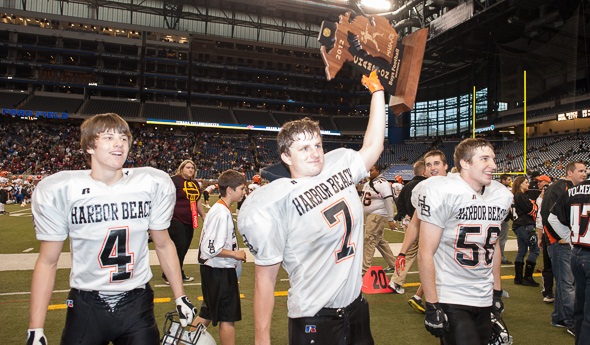
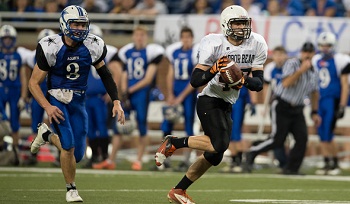
PHOTOS: (Top) Harbor Beach senior Derek Pfaff (7) holds up the Division 8 championship trophy to the crowd with teammates Brandon Pfaff (4) and Justin Lasceski. (Middle) Pirates senior Aaron Ginther (47) pulls in a catch with Beal City's Sam Schafer giving chase. (Click for more from Terry McNamara Photography.)
MHSAA Opposes Big Ten Friday Football
November 2, 2016
By Geoff Kimmerly
Second Half editor
The executive director of the Michigan High School Athletic Association said today that he is “disappointed and disheartened” by the Big Ten Conference announcement that it will play and televise football games on Friday nights beginning with the 2017 season.
Friday night football remains one of the strongest and longest-standing traditions in high school athletics, and the MHSAA has fought since the start of this century to keep Friday nights sacred against the overstepping of college football and the damage televised Big Ten games are now expected to cause to attendance and media coverage of the sport at the high school level.
MHSAA Executive Director John E. “Jack” Roberts was contacted by both Big Ten Conference commissioner Jim Delany and Michigan State University athletic director Mark Hollis before the decision was announced. Roberts said he is appreciative of Michigan State and University of Michigan’s low tolerance to be included in this venture – at most, both will host a Thursday or Friday night game during Labor Day weekend and play one Friday night away game during the remainder of a season – but remains frustrated that similar respect for high school football was not shown by the conference as a whole.
Michigan State has played Friday night games during Labor Day weekend the last six seasons, hosting five and playing at Western Michigan University in 2015. However, most Michigan high school games continue to be scheduled and played on the Thursday before Labor Day, relieving holiday travel conflicts in most communities. University of Michigan did play on the Thursday before Labor Day at University of Utah in 2015, but has not played on a Friday night of Labor Day weekend this decade. The Wolverines are one of five Big Ten schools without a Friday night game in 2017.
“We are saddened by this decision. We had hoped that the Big Ten Conference would stay above this. We think this cheapens the Big Ten brand,” Roberts said. “Fans won’t like this. Recruits won’t like this. And high school football coaches won’t like this.
“We are grateful that Michigan State University and the University of Michigan are trying to minimize the effects of this decision by the Big Ten. But overall, this is just the latest step by major college athletics in the pursuit of cash that is just crushing high school sports.”
The MHSAA has shown its opposition to the use of Friday nights for televised collegiate football games for more than 15 years, dating back to 2001 when the NCAA lifted its restrictions on Friday night telecasts, which at first led to the broadcasting of “mid-major conference” games on the same night traditionally reserved for high school athletes.
The MHSAA launched in 2001 its “Save Our Friday Nights” campaign to emphasize the role that Friday night high school athletic events play in communities and to rally MHSAA member schools to contact NCAA member school football coaches, athletic directors and conference commissioners to voice their concerns.
In addition to causing lower attendance at events going up against Big Ten football games, Roberts anticipates that Friday night college games also will leave high school football as a secondary priority in many media markets. More than 80 radio stations statewide cover high school games regularly, but many also carry Michigan State or University of Michigan football. High school football could lose significant time on local TV highlights shows and in print and online coverage as well, as resources are diverted to cover a college game – potentially quieting significantly the positive buzz that comes from the typical high school football Friday night.
“Everyone knows that football is struggling right now,” Roberts said. “It’s getting a lot of bad publicity. Participation is declining. And now this; there couldn’t be worse timing.”
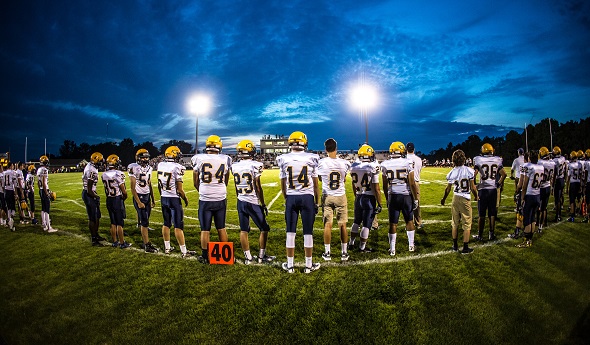
PHOTO: Grand Ledge takes on Okemos under the Friday night lights this season. (Click to see more from HighSchoolSportsScene.com.)