

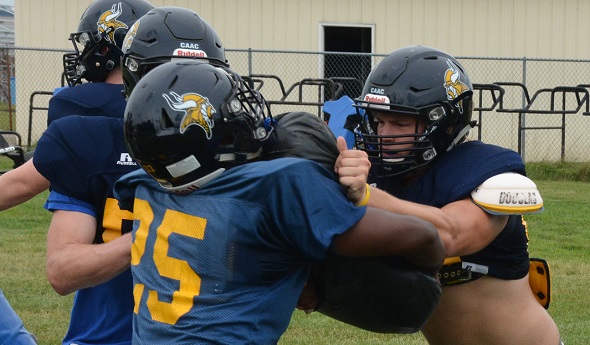
Haslett Saving Big Hits for Game Time

August 16, 2016

By Geoff Kimmerly
Second Half editor

HASLETT – The sound of cleats on pavement. He and his teammates, hand in hand, walking toward the field together minutes before kickoff. Manowar’s “Heart of Steel” ringing in their ears from a few minutes before.
Justin Kuchnicki gave himself goose bumps Monday describing Haslett’s weekly pregame ritual, which the senior lineman will take part in again beginning Aug. 26 when the Vikings open this season against Remus Chippewa Hills.

They’ll certainly be revved up – and especially to lay some big hits after saving them up during three weeks of non-collision practices.

Haslett has one of the most successful football programs in the Lansing area, with two trips to MHSAA championship games and 14 playoff appearances total over the last 18 seasons. The Vikings finished 6-4 a year ago against a schedule featuring four eventual playoff teams.

The program also might be the first in all of Michigan high school football to fully eliminate full-speed hitting at practice, something Haslett has moved toward over the last few seasons before longtime coach Charlie Otlewski decided to knock it out of his practice plans completely this fall in large part to keep his players healthier for when it matters most.

“It gives you the edge when it gets to game day. You practice all week and you’re not really hitting or doing anything like that, and you get to game day … and everyone’s ready to just go out there and fly around and make plays,” Kuchnicki said. “You’re not really worried about kinks and stuff in your body that you’d have from practices, so you just go out there and lay it on the line.”

Friday was the first day Michigan high school players were allowed to practice in full pads. Storms drenched mid-Michigan that afternoon, so Haslett’s first day in full gear was Monday. And from a distance, it sounded like any other full-contact practice with the normal hoots and hollers and smacking of pads.

But on closer look, it was anything but. Lineman worked against blocking dummies on a sled or teammates holding hand pads. When the offense came together to run plays, linemen blocked against overturned plastic trash barrels. On the opposite end of the field, subvarsity players worked on defensive pursuit angles but again without hitting. Under a set of uprights laid an old gymnastics mat used to soften the fall during tackling drills, which players again did against standup dummies instead of their teammates.

Reducing collisions – that is, live, game-speed, player-vs.-player hitting – remains the focus of most conversations on health and safety in football. Much of the discussion is centered on reducing concussions, and MHSAA rules changes that took effect beginning with the 2014 season limit teams to one practice per day during the preseason (when teams frequently practice twice) where collisions can take place. During the regular season, teams can have collisions during practice only two days per week.
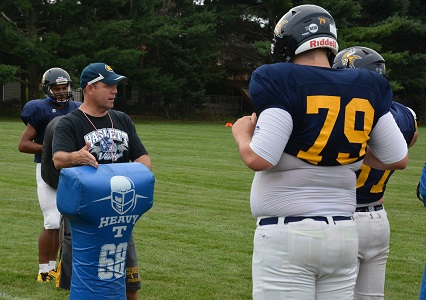
Otlewski – who formerly coached St. Ignace from 1990-93 before taking over at Haslett in 1994 – said his practices used to follow what could be considered a traditional after-school plan: individual position drills for an hour or more followed by 11-on-11 full contact team practice for 30-40 minutes, twice a week.

But a handful of reasons, chiefly the desire to avoid injuries, started his program on a different path five years ago.  

“Nobody wants injuries, but you surely don’t want them in practice. Then the concussion thing started to happen. (But) we didn’t do it because of concussions; we did it because of general overall injuries,” Otlewski said.

“If we lose a guy in Thursday’s scrimmage, or next Thursday in a game, OK, that’s football. But what we don’t want to do is lose someone in practice, because that seems unnecessary.”

The initial changes Haslett began to make to practices that fall of 2011 became drastic two years later, when he and his staff went to a different practice model completely. The Vikings now break every practice into 10-minute sessions alternating between team time and position drills, so position coaches can work with players individually before and after seeing how they perform when all 11 are running plays together.

This new breakdown brought the amount of player-on-player contact at practice down significantly as much more time was dedicated to learning proper footwork, blocking and tackling techniques and other fundamentals. Players on Monday worked at 50-percent speed, at most, against teammates either in front of them and also not moving at game speed, or against others holding pads and dummies.

The last two seasons, the only full-contact session during practices came during preparation for goalline situations; Otlewski and his staff decided to eliminate those this fall as well.

“We’re OK with a certain level (of contact). But we never want to go on the ground; we always want to stay up,” he said. “We want to go fast enough so where we have to use the perfect technique to get there footwork-wise. But we’re trying to eliminate the physicality part.”

To be clear, eliminating all collisions/contact is not required by the MHSAA. And there are probably more than a few in the coaching fraternity who would think Haslett is making a massive mistake.

But the Vikings’ no-contact strategy follows a way of thinking made popular in part by coaches like Dartmouth College’s Buddy Teevens, whose team hasn’t tackled during practices in six years. The Ivy League as a whole adopted a policy of no tackling in practice for the regular season beginning this fall.
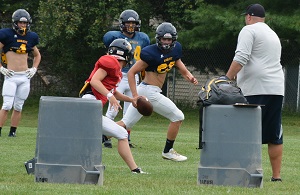
Otlewski said teaching to tackle without contact allows his players to practice the same technique-building drills during four-player offseason workouts, his team’s no-pads summer camp and then while wearing pads during the season. His defense doesn’t face a live offense during the week, but he doesn’t think his players lose out because they can gain just as much from watching film and working on pursuit angles and recognizing formations. Same goes for his offense, which can still practice skill work and the passing game full-speed while lineman go half-speed working on footwork and blocking technique.

And he sees 37 players on his varsity roster, with that total remaining consistent over the last many seasons – while three opponents on this year’s schedule don’t have junior varsities and a fourth won’t field a freshman team.

His players three seasons ago didn’t really like the idea of not hitting in practice at first. But they’ve since bought in. He hasn’t heard a ton from parents either way; but he taught a class on football for local moms over the winter, and they seemed to like the idea as well.

“On one hand, I’m a little apprehensive,” Otlewski said. “OK, we haven’t gone full go. Is there a difference all of a sudden when it’s live Thursday against (Grand Rapids) Christian? Are we going to be up to speed?

“I think I still worry about that a little bit. But once we get into it, it’s fine.”

Kuchnicki is just as confident. Contact doesn’t bother this guy. He’s 6-foot-6 and in the neighborhood of 320 pounds. Sure, he’d love to have one contact practice this year so he and his teammates can back up some of the trash-talking they do to each other on the field.

But he’s fine with saving his biggest hits for opponents – and especially those who might think Haslett won’t be prepared for a physical game.

“They’d probably think we’re soft,” Kuchnicki said. “But when it comes game day, they change their minds instantly. I’ll tell you that.” 

Geoff Kimmerly joined the MHSAA as its Media & Content Coordinator in Sept. 2011 after 12 years as Prep Sports Editor of the Lansing State Journal. He has served as Editor of Second Half since its creation in Jan. 2012. Contact him at [email protected] with story ideas for the Barry, Eaton, Ingham, Livingston, Ionia, Clinton, Shiawassee, Gratiot, Isabella, Clare and Montcalm counties.

PHOTOS: (Top) Haslett lineman work on blocking during Monday's practice. (Middle) Vikings coach Charlie Otlewski instructs his players on one of the team's blocking schemes. (Below) Backs work on the option with barrels serving as the defensive front.
2008 Muskegon's Lesson: Keep the Faith

October 26, 2018

By Ron Pesch
Special for Second Half

Faith.

The word has always been a complex recipe of conviction, trust, belief and loyalty. Sometimes it brings ecstasy, while other times it brings heartbreak. Sometimes it carries surprise.

On a beautiful autumn day 10 seasons ago, Muskegon Big Reds football players, coaches, and fans found their faith tested to the extreme.

Some fans simply couldn’t stand to watch, and departed early, heading to the parking lots surrounding Michigan State University’s Spartan Stadium in East Lansing to get a jump on west-bound traffic. A colossal upset, it seemed, was no longer in the making. Rather, the outcome appeared obvious.


The 2007 regular season was an impressive one for Muskegon. For the first time the Big Reds were competing in the Red division of the Ottawa-Kent Conference, comprised of the largest league schools based on enrollment and considered by many the toughest football league in the state. The reigning MHSAA Division 2 champion, Muskegon rolled to eight straight victories, earning the No. 1 ranking in the Detroit Free Press. Most of the wins were in dominating fashion, included a stunning 52-0 win over No. 2-ranked Hudsonville in the seventh game of the season. 

The streak set the stage for a battle with once-beaten Rockford at historic Hackley Stadium in the final game of the regular season before the cameras of NFL Films. It ended in shattering disappointment as the favored Big Reds lost a lead and fell, 28-21, to the Rams. The following week, Muskegon barely slipped past unranked Grand Rapids Ottawa Hills in the final seconds, 38-35, in the opening round of the MHSAA Playoffs, then melted down in a rematch with Hudsonville as the Eagles thumped the Big Reds, 41-7, in the postseason’s second round.

With 18 graduating starters, many questions hovered as the team hung up the pads and headed into basketball and the winter sports schedule. Among those who would graduate were a pair of Associated Press all-state selections, quarterback Chris Crawford, a three-year starter who had guided the Big Reds to the 2006 title, and offensive lineman Carlin Landingham. The Free Press had named Landingham to its statewide Dream Team, and added line mate Mac Parker to its Division 2 selections.

In February, an even bigger question surfaced: “Who will coach the Big Reds?” Coach Tony Annese announced his decision to resign as head coach, noting his desire to spend more time with his family.

But when possible replacements turned down the job, Annese decided to return. Writing in the Free Press prior to the start of the season under his alias, the ‘Son of Swami’, veteran sports writer Mick McCabe joked that “when Annese’s family found out, they huddled and told him they liked him better when he was bugging other people’s kids and made him return to coaching.” In his preseason announcement of the state’s top 25 prep teams, McCabe recognized that 2008 would be a rebuilding year, ranking the Big Reds No. 22. “Although inexperienced, this is a bright group that has run the system at lower levels.”

Muskegon kicked off the new season with a pair of nonconference contests against top-tier schools. The opener, played at Eastern Michigan University as part of the Big Day Prep Showdown, pitted Muskegon against Detroit Martin Luther King, the 2007 Division 2 champ. A dream matchup based on past performances, in reality, the game featured two teams in the throes of renewal. King, like Muskegon, had been hit hard by graduation. Among the departures were defensive standout Nick Perry, a future No. 1 pick of the Green Bay Packers, and Darrin Williams, who had rushed for more 5,600 yards during his days at King. The Crusaders had failed to make McCabe’s preseason rankings.

Still, the Big Reds were impressive. Led by quarterback Elan Banks, who was starting his first varsity game, and the one-two punch of Jason Hannett and Anthony Davis in the backfield, the Big Reds rolled to an impressive 35-0 win. The Crusaders had difficulty adjusting to Muskegon’s quick no-huddle option offense. Will Gardner highlighted the day with a 91-yard touchdown on a kickoff return.

Week 2 of the season brought perennial state powerhouse Birmingham Brother Rice to Muskegon for a Saturday afternoon contest. Playing in the always-tough Detroit Catholic League, the Warriors had advanced to the MHSAA Division 2 championship contest in five of the previous 10 seasons. Coached by the legendary Al Fracassa, Brother Rice had won six state titles, earning two since 1999. McCabe had the Warriors ranked No. 3 in the preseason. Victorious in Week 1, Brother Rice was favored to win, but once again, the Big Reds cruised to victory, 42-27.

With the wins, Muskegon quickly jumped in the weekly polls to No. 4 in Division 2 and No. 7 in McCabe’s Super 10 – a ranking of all schools, regardless of enrollment classification. Next up was the second year of conference play against O-K Red opponents. Holland West Ottawa (49-14) and Grand Haven (43-6) both were defeated easily. Grandville was defeated 28-14.

All eyes quickly focused on the team’s game with Hudsonville. Led by powerful running back and linebacker Jordan Jonker, the Eagles had a single loss to Rockford, 15-12 in Week 4, then rolled to a 44-17 win over East Kentwood. Jonker had 323 yards in the contest against the Falcons.

The Big Reds didn’t make it easy on themselves, turning over the ball four times in the first half. But Banks was spectacular at quarterback, throwing for a school record 318 yards (the total still stands today) and a pair of touchdowns. He finished with 22 completions on 31 attempts without throwing an interception in the 29-26 win.

“Defensively, the Big Reds did an exceptional job against Hudsonville’s Jonker,” wrote McCabe in Sunday’s Free Press, “but not until after he scored on a 67-yard run on the team’s first possession. Jonker finished with 95 yards on 12 carries and added a touchdown on a 72-yard fumble recovery.”

East Kentwood was next on the Muskegon schedule, and was defeated 42-0. Week 7 brought the top-ranked team in Division 1, the Rockford Rams, with the contest to be played at Rockford. For the state’s game of the week, a crowd of 13,657 packed Ted Carlson Memorial Stadium.

“(Muskegon’s 34-6) victory over Rockford wasn’t a stunning upset because the Big Reds were also 7-0 and ranked No. 2 in Division 2,” wrote McCabe in his Free Press coverage of the game. “But what was stunning was Rockford’s minus-44 yards rushing. Nobody does that to Rockford. It is a victory that will catapult the Big Reds to the No. 1 spot in both our Super 10 and Division 2 rankings this week.”

Muskegon’s 64-22 win over Jenison boosted the team’s record to 9-0, earning the Big Reds outright possession of the O-K Red title in only their second year of competition in the league. It also gave the subs the opportunity to gain additional game experience before the postseason.

Holland, earning a spot in the playoffs for the first time in school history, was Muskegon’s first-round postseason opponent and was quickly disposed of, 49-13. That set the stage for a rematch with Hudsonville.

Played on a muddy, rain-soaked Hackley Field, the first half of the game saw the Big Reds score twice by converting a pair of Hudsonville interceptions into touchdowns. Just before the half, the Eagles recovered a Muskegon fumble at the Big Reds 9-yard line and threatened to put points on the board, but a Hudsonville fumble on the 2-yard line with 28 seconds left to play was snagged by Muskegon’s Carleton Johnson. The Big Reds ran out the clock, and the teams headed to the locker room with Muskegon up 12-0.

Hudsonville regrouped and responded with an 84-yard, 12-play drive. A 49-yard screen pass from QB Casey Blackport to tight end Christian Prince set up a two-yard romp into the end zone by Jonker late in the third quarter to pull the Eagles within a touchdown, 12-6. Hudsonville’s defense provided the opportunity for a win by shutting down the Big Reds offense on fourth down in each of Muskegon’s next four possessions. Following a huge stop of Hannett on a 4th-and-inches play at the Hudsonville 19, the Eagles gained control of the ball with 3:18 to play.

Blackport again went to work, throwing a 17-yard strike to Jordan Keur, then finding Prince, who broke a tackle and dashed down the right sideline for a 50-yard gain to the Muskegon 11. Still, the Big Reds defense held steady, and facing fourth down with 1:14 remaining, Hudsonville lined up for a final shot at the end zone. Blackport’s pass deep in the corner went through the hands of Keur and fell incomplete. Muskegon took over on downs and ran out the clock to advance with a second close win over the Eagles.

The third week of postseason play brought the undefeated Red Arrows of Lowell. While the Free Press had Muskegon at No. 1 at the end of the regular season, the final Associated Press poll showed Lowell at No. 1 in Division 2 with the Big Reds second in the rankings. Based on strength of schedule, Muskegon edged out the Red Arrows in MHSAA playoff points; hence, the Big Reds held home field advantage. Since Hackley Field was in rough shape after the Hudsonville game, Muskegon officials chose to move the contest to the field turf of Grand Haven’s Buccaneer Stadium. Although Big Reds fans were not pleased with giving up home field advantage, Muskegon excelled on the artificial surface, and at halftime held an overwhelming 27-point lead. At game’s end, the Big Reds had scored a 49-14 victory over Lowell before a crowd of 8,500.

Jason Hannett had a career game, running for 183 yards on 15 carries. Defensively, he set the tone with a 4th-and-1 stop of Lowell quarterback Kyle Nichol at the 43 late in the first half.

“Muskegon (12-0) dominated in every facet of the game,” wrote McCabe, “except punting, because the Big Reds didn’t have to punt. They scored the first six times they had the ball …

“’I just know what our kids have done to some other teams this year,’ added Lowell coach Noel Dean. ‘And to be on the other end of that tells you how good (the Big Reds) really are.’”

With the District trophy in hand, Muskegon prepared for Davison in the Regional title game to be played as part of a doubleheader at Michigan State University’s Spartan Stadium. A 25-19 winner over Midland, Davison arguably had played the toughest non-conference schedule in the state, beating Orchard Lake St. Mary’s and Holt late in the year, but losing to Lowell in Week 1, Rockford in the second week and Lansing Sexton in Week 5.

Muskegon was still the overwhelming favorite entering the game. Two years previous, Muskegon had soundly defeated the Cardinals 43-21 in a Semifinal contest at Midland on the way to an undefeated season and the 2006 championship.

Indeed, the Big Reds opened the contest strong, scoring on a 49-yard run by Banks for a 7-0 lead with just under two minutes gone in the first quarter. Following a stop by the defense, it looked like Muskegon would go up 14-0, but a fumble by Banks at the goal line on Muskegon’s second possession halted the drive. The Cardinals took advantage of the miscue when sophomore QB Jake Thompson connected with Ron Silver on a 70-yard touchdown pass to tie the game at 7-7 with 2:25 left in the first quarter. On Muskegon’s next possession, Davison’s Adam Green picked off a pass and returned it 69 yards to the Muskegon 1, setting up a one-yard TD run by the Cardinals’ Oliver Saylor. Suddenly, Davison held a surprising 14-7 lead with 1:57 to play in the first.

The Cardinals capitalized on another Muskegon fumble late in the second quarter, scoring on a 27-yard toss by Thompson to Dan Thwing, increasing the lead to 21-7 with 1:09 to play in the half. This time, however, the Big Reds responded immediately, showing their explosiveness with a 15-yard TD toss from Banks to Karey Webb as time expired in the first half. The kick failed but, to the relief of Big Reds fans, Muskegon had pulled within eight, 21-13. After a disastrous first half, the Big Reds entered the locker room with some momentum.

But that energy was quickly lost. Two muffed punts by Muskegon in the third quarter led to a 35-13 Cardinals lead with 4:45 to play in the third quarter. Following a 55-yard dash by Hannett, Anthony Davis scored from a yard out for the Big Reds with 1:54 left in the quarter, but the extra point attempt again failed and Muskegon trailed, 35-19.

Time rapidly became Muskegon’s biggest enemy when Davison’s Kevin Yoesting stopped Davis on a 4th-and-1 with less than nine minutes to play in the fourth quarter. A time-consuming Cardinals drive, highlighted by a pair of long runs by Saylor, set up a Davison first down at the Muskegon 20 with just over five minutes to play, Many Big Reds fans headed for the exits, shaking their heads in disbelief. Cardinals fans celebrated during a timeout in what appeared to be certain victory.

But a huge stop by the Muskegon defense began a comeback unseen in MHSAA playoff history.

“It started after Banks and Karey Webb hooked up on a 77-yard TD pass to pull Muskegon within 35-25 (with 4:31 remaining),” wrote Mike Mattson in the Muskegon Chronicle. Yet on the 2-point conversion attempt, Yoesting again came up big for Davison, tackling Banks just short of the end zone and the Big Reds still trailed by 10 points, needing two possessions for victory.

Jubenal Rodriguez, who had never played football until the third game of the 2007 season, laid down a successful onside kick that was recovered by Dominique Maybanks.

“Seven plays later,” continued Mattson, “Banks and Maybanks connected on a 27-yard TD pass to trim the deficit to 35-31 at the 2:33 mark.”

“The next onside kick didn't travel 10 yards, but hit a Davison player,” wrote Bill Khan of the Flint Journal. “Maybanks again recovered, this time at the 46-yard line. The winning drive was a six-play, 54-yard march, all on the ground. On the winning touchdown, (slot receiver Greg) Wickliffe took a pitch from Banks on the left side, got some blocks and went into the end zone untouched with 42 seconds on the clock. Rodriguez made the extra point to make it a three-point game.”

Davison drove to the Muskegon 32 with 11 seconds remaining, but a pass to the middle of the end zone was picked off by Banks, sealing the astonishing 38-35 comeback win and starting a wild celebration by the players, coaches and the Big Reds fans who had remained to the end.

"I was running as fast as I could,'' Wickliffe said to Mattson during the postgame on-field party. "I saw daylight and just took off as fast as I could. This is amazing.''

“I always say one of the five have to be a fortunate victory,” Annese said to McCabe about the five-game path to a state title. “You’re going to have one of those games – it happens every year. In 2006 it was the final game. In 2004 it was Bay City Western.”

The trip to Ford Field came next.

“Muskegon's (34-14) rout of (Warren DeLaSalle) looked similar to its season-opening 35-0 whitewash of Detroit Martin Luther King back in August,” wrote Shawn Liverance in the Chronicle’s coverage of the Division 2 title game. “A tough-as-nails defense and an offense filled with playmakers was too much for DeLaSalle as it was for Muskegon's 13 other opponents this year.”

Ten years later, Muskegon and Davison again line up for another shot at glory in the 2018 edition of the MHSAA playoffs. There is no chance for a rematch, as the Cardinals compete in Division 1 and Muskegon plays in Division 3.

Only one sure thing has been revealed in more than 100 years of prep football in Michigan. The game’s not over until it’s over. Who knows what twists and turns the 2018 postseason might bring?

Ron Pesch has taken an active role in researching the history of MHSAA events since 1985 and began writing for MHSAA Finals programs in 1986, adding additional features and "flashbacks" in 1992. He inherited the title of MHSAA historian from the late Dick Kishpaugh following the 1993-94 school year, and resides in Muskegon. Contact him at [email protected] with ideas for historical articles.

PHOTOS: (Top) The Detroit Free Press captured the postgame celebration by Muskegon’s players after their comeback win over Davison in 2008. (Middle top) The 2008 Muskegon team, top, and the 2008 Davison team. (Middle) The Flint Journal captured the action, including Jake Thompson’s run, as Davison jumped out to a big lead. (Middle below) Davison players suddenly saw their season come to a close at Spartan Stadium.