

Haslett Saving Big Hits for Game Time
August 16, 2016
By Geoff Kimmerly
Second Half editor
HASLETT – The sound of cleats on pavement. He and his teammates, hand in hand, walking toward the field together minutes before kickoff. Manowar’s “Heart of Steel” ringing in their ears from a few minutes before.
 Justin Kuchnicki gave himself goose bumps Monday describing Haslett’s weekly pregame ritual, which the senior lineman will take part in again beginning Aug. 26 when the Vikings open this season against Remus Chippewa Hills.
They’ll certainly be revved up – and especially to lay some big hits after saving them up during three weeks of non-collision practices.
Haslett has one of the most successful football programs in the Lansing area, with two trips to MHSAA championship games and 14 playoff appearances total over the last 18 seasons. The Vikings finished 6-4 a year ago against a schedule featuring four eventual playoff teams.
The program also might be the first in all of Michigan high school football to fully eliminate full-speed hitting at practice, something Haslett has moved toward over the last few seasons before longtime coach Charlie Otlewski decided to knock it out of his practice plans completely this fall in large part to keep his players healthier for when it matters most.
“It gives you the edge when it gets to game day. You practice all week and you’re not really hitting or doing anything like that, and you get to game day … and everyone’s ready to just go out there and fly around and make plays,” Kuchnicki said. “You’re not really worried about kinks and stuff in your body that you’d have from practices, so you just go out there and lay it on the line.”
Friday was the first day Michigan high school players were allowed to practice in full pads. Storms drenched mid-Michigan that afternoon, so Haslett’s first day in full gear was Monday. And from a distance, it sounded like any other full-contact practice with the normal hoots and hollers and smacking of pads.
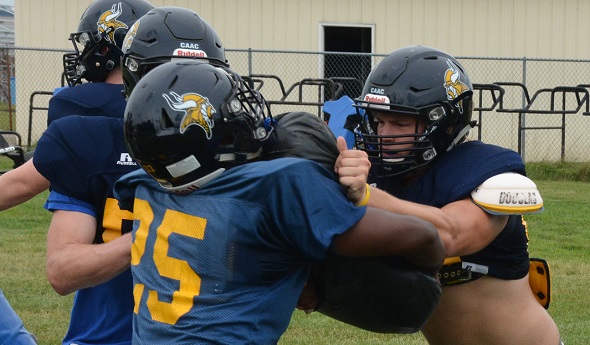
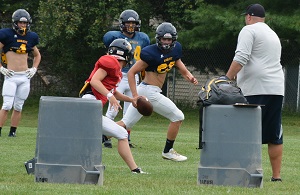
But on closer look, it was anything but. Lineman worked against blocking dummies on a sled or teammates holding hand pads. When the offense came together to run plays, linemen blocked against overturned plastic trash barrels. On the opposite end of the field, subvarsity players worked on defensive pursuit angles but again without hitting. Under a set of uprights laid an old gymnastics mat used to soften the fall during tackling drills, which players again did against standup dummies instead of their teammates.
Reducing collisions – that is, live, game-speed, player-vs.-player hitting – remains the focus of most conversations on health and safety in football. Much of the discussion is centered on reducing concussions, and MHSAA rules changes that took effect beginning with the 2014 season limit teams to one practice per day during the preseason (when teams frequently practice twice) where collisions can take place. During the regular season, teams can have collisions during practice only two days per week.
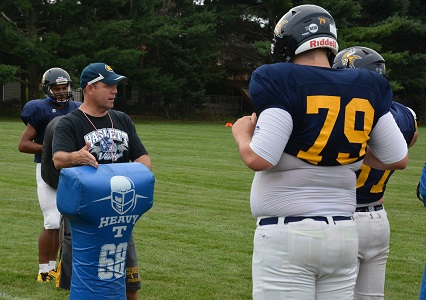 Otlewski – who formerly coached St. Ignace from 1990-93 before taking over at Haslett in 1994 – said his practices used to follow what could be considered a traditional after-school plan: individual position drills for an hour or more followed by 11-on-11 full contact team practice for 30-40 minutes, twice a week.
But a handful of reasons, chiefly the desire to avoid injuries, started his program on a different path five years ago.
“Nobody wants injuries, but you surely don’t want them in practice. Then the concussion thing started to happen. (But) we didn’t do it because of concussions; we did it because of general overall injuries,” Otlewski said.
“If we lose a guy in Thursday’s scrimmage, or next Thursday in a game, OK, that’s football. But what we don’t want to do is lose someone in practice, because that seems unnecessary.”
The initial changes Haslett began to make to practices that fall of 2011 became drastic two years later, when he and his staff went to a different practice model completely. The Vikings now break every practice into 10-minute sessions alternating between team time and position drills, so position coaches can work with players individually before and after seeing how they perform when all 11 are running plays together.
This new breakdown brought the amount of player-on-player contact at practice down significantly as much more time was dedicated to learning proper footwork, blocking and tackling techniques and other fundamentals. Players on Monday worked at 50-percent speed, at most, against teammates either in front of them and also not moving at game speed, or against others holding pads and dummies.
The last two seasons, the only full-contact session during practices came during preparation for goalline situations; Otlewski and his staff decided to eliminate those this fall as well.
“We’re OK with a certain level (of contact). But we never want to go on the ground; we always want to stay up,” he said. “We want to go fast enough so where we have to use the perfect technique to get there footwork-wise. But we’re trying to eliminate the physicality part.”
To be clear, eliminating all collisions/contact is not required by the MHSAA. And there are probably more than a few in the coaching fraternity who would think Haslett is making a massive mistake.
But the Vikings’ no-contact strategy follows a way of thinking made popular in part by coaches like Dartmouth College’s Buddy Teevens, whose team hasn’t tackled during practices in six years. The Ivy League as a whole adopted a policy of no tackling in practice for the regular season beginning this fall.
 Otlewski said teaching to tackle without contact allows his players to practice the same technique-building drills during four-player offseason workouts, his team’s no-pads summer camp and then while wearing pads during the season. His defense doesn’t face a live offense during the week, but he doesn’t think his players lose out because they can gain just as much from watching film and working on pursuit angles and recognizing formations. Same goes for his offense, which can still practice skill work and the passing game full-speed while lineman go half-speed working on footwork and blocking technique.
And he sees 37 players on his varsity roster, with that total remaining consistent over the last many seasons – while three opponents on this year’s schedule don’t have junior varsities and a fourth won’t field a freshman team.
His players three seasons ago didn’t really like the idea of not hitting in practice at first. But they’ve since bought in. He hasn’t heard a ton from parents either way; but he taught a class on football for local moms over the winter, and they seemed to like the idea as well.
“On one hand, I’m a little apprehensive,” Otlewski said. “OK, we haven’t gone full go. Is there a difference all of a sudden when it’s live Thursday against (Grand Rapids) Christian? Are we going to be up to speed?
“I think I still worry about that a little bit. But once we get into it, it’s fine.”
Kuchnicki is just as confident. Contact doesn’t bother this guy. He’s 6-foot-6 and in the neighborhood of 320 pounds. Sure, he’d love to have one contact practice this year so he and his teammates can back up some of the trash-talking they do to each other on the field.
But he’s fine with saving his biggest hits for opponents – and especially those who might think Haslett won’t be prepared for a physical game.
“They’d probably think we’re soft,” Kuchnicki said. “But when it comes game day, they change their minds instantly. I’ll tell you that.”
 Geoff Kimmerly joined the MHSAA as its Media & Content Coordinator in Sept. 2011 after 12 years as Prep Sports Editor of the Lansing State Journal. He has served as Editor of Second Half since its creation in Jan. 2012. Contact him at [email protected] with story ideas for the Barry, Eaton, Ingham, Livingston, Ionia, Clinton, Shiawassee, Gratiot, Isabella, Clare and Montcalm counties.
PHOTOS: (Top) Haslett lineman work on blocking during Monday's practice. (Middle) Vikings coach Charlie Otlewski instructs his players on one of the team's blocking schemes. (Below) Backs work on the option with barrels serving as the defensive front.

2018 Week 9 Football Playoff Listing
October 16, 2018
By Geoff Kimmerly
Second Half editor
Here is a list of Michigan High School Athletic Association football playing schools, displaying their win-loss records and playoff averages through the eighth week of the season.
Schools on this list are in enrollment order for 11-player teams, with 8-player teams ordered by playoff average. An asterisk (*) beside a record indicates a team has eight or fewer games scheduled.
Those schools with 11-player teams with six or more wins playing nine-game schedules, or five or more wins playing eight games or fewer, will qualify for the MHSAA Football Playoffs beginning Oct. 26. Schools with 5-4, 4-3 or 4-4 records may qualify if the number of potential qualifiers by win total does not reach the 256 mark. Schools with six or more wins playing nine-game schedules or five or more wins playing eight games or fewer may be subtracted from the field based on playoff average if the number of potential qualifiers exceeds the 256 mark.
Once the 256 qualifying schools are determined, they will be divided by enrollment groups into eight equal divisions of 32 schools, and then drawn into regions of eight teams each and districts of four teams each. Those schools with 8-player teams will be ranked by playoff average at season’s end, and the top 32 programs will then be divided into two divisions of 16 each based on enrollment. The playoff in that division also begins Oct. 26.
To review a list of all football playoff schools, individual school playoff point details and to report errors, visit the Football page of the MHSAA Website.
The announcement of the qualifiers and first-round pairings for both the 11 and 8-player playoffs will take place at 7 p.m. Oct. 21 on the Selection Sunday Show on FOX Sports Detroit. The Selection Sunday Show will be available on the primary FOX Sports Detroit channel on cable. The program also can be viewed on the internet through the FoxSportsDetroit.com Website, and on handheld devices and television streaming devices like Roku using the FOX Sports app. The playoff qualifiers and pairings will be posted to the MHSAA Website following the Selection Sunday Show.
11-Player Playoff Listing
1. Macomb Dakota, 3114, 6-2, 78.375
2. Dearborn Fordson, 2795, 7-1, 92.875
3. Utica Eisenhower, 2668, 5-3, 69.125
4. East Kentwood, 2651, 7-1, 93.750
5. Grand Blanc, 2637, 5-3, 67.125
6. Sterling Heights Stevenson, 2591, 4-4, 54.500
7. Clarkston, 2548, 7-1, 93.625
8. Rockford, 2481, 5-3, 64.875
9. Clinton Township Chippewa Valley, 2462, 8-0, 120.000
10. Detroit Cass Tech, 2432, 8-0, 107.714
11. Lake Orion, 2393, 4-4, 52.875
12. Howell, 2387, 4-4, 50.750
13. Canton, 2260, 6-2, 79.375
14. Brighton, 2202, 7-1, 94.875
15. Holland West Ottawa, 2190, 6-2, 78.000
16. Oxford, 2170, 6-2, 84.125
17. Dearborn, 2106, 4-4, 49.625
18. Plymouth, 2060, 6-2, 74.375
19. Detroit Catholic Central, 2020, 6-2, 87.268
20. West Bloomfield, 2005, 6-2, 90.000
21. Macomb L'Anse Creuse North, 1994, 4-4, 48.000
22. Monroe, 1949, 6-2, 77.181
23. Hudsonville, 1879, 5-3, 64.036
24. Saline, 1834, 7-1, 96.875
25. Romeo, 1779, 5-3, 71.125
26. Detroit Western International, 1773, 5-3, 52.000
27. Lapeer, 1772, 8-0, 107.000
28. White Lake Lakeland, 1740, 5-3, 65.125
29. Ann Arbor Skyline, 1701, 4-4, 49.375
30. Davison, 1687, 7-1, 87.625
31. Kalamazoo Central, 1672, 5-3, 67.250
32. Walled Lake Northern, 1672, 4-4, 49.750
33. Belleville, 1642, 8-0, 112.000
34. Traverse City West, 1634, 6-2, 81.375
35. Brownstown Woodhaven, 1628, 7-1, 94.625
36. Rochester Adams, 1621, 5-3, 66.750
37. Grosse Pointe South, 1593, 8-0, 103.000
38. Warren Mott, 1585, 6-2, 79.750
39. Waterford Mott, 1558, 4-4, 50.250
40. Saginaw Heritage, 1541, 5-3, 53.500
41. Warren DeLaSalle, 1474, 6-2, 83.700
42. Jenison, 1464, 5-3, 67.000
43. Temperance Bedford, 1462, 4-4, 51.125
44. Livonia Franklin, 1443, 4-4, 50.500
45. Livonia Churchill, 1435, 6-2, 79.625
46. Ypsilanti Community, 1433, 4-4, 48.125
47. Dearborn Heights Crestwood, 1424, 8-0, 95.000
48. St. Clair Shores Lakeview, 1399, 5-3, 59.625
49. Traverse City Central, 1391, 6-2, 83.250
50. Okemos, 1381, 6-2, 72.536
51. Birmingham Seaholm, 1376, 7-1, 91.875
52. Wyandotte Roosevelt, 1376, 5-3, 65.125
53. Flint Carman-Ainsworth, 1358, 4-4, 50.750
54. Oak Park, 1349, 7-1, 91.625
55. Portage Central, 1349, 6-2, 80.000
56. Royal Oak, 1335, 4-4, 47.500
57. Roseville, 1303, 5-3, 58.536
58. Birmingham Groves, 1298, 6-2, 72.375
59. Port Huron Northern, 1295, 7-1, 90.500
60. Midland, 1289, 5-3, 58.875
61. Portage Northern, 1284, 6-2, 75.375
62. Midland Dow, 1277, 5-3, 59.250
63. St. Clair Shores Lake Shore, 1276, 6-2, 72.625
64. Flushing, 1275, 6-2, 82.250
65. Swartz Creek, 1262, 6-2, 78.500
66. Walled Lake Western, 1258, 5-3, 66.000
67. Jackson, 1229, 8-0, 104.000
68. Ypsilanti Lincoln, 1226, 4-4, 46.625
69. South Lyon, 1225, 8-0, 108.000
70. Muskegon Mona Shores, 1215, 7-1, 95.875
71. Grand Rapids Forest Hills Central, 1212, 4-4, 54.250
72. Dexter, 1172, 6-2, 69.500
73. Birmingham Brother Rice, 1168, 5-3, 70.329
74. Detroit Renaissance, 1168, 4-4, 43.000
75. Ferndale, 1162, 6-2, 73.375
76. Fenton, 1160, 6-2, 78.375
77. Muskegon Reeths-Puffer, 1154, 5-3, 54.375
78. Mattawan, 1153, 5-3, 62.179
79. Detroit Martin Luther King, 1149, 7-1, 85.875
80. Grand Rapids Forest Hills Northern, 1142, 5-3, 59.500
81. Warren Woods Tower, 1126, 8-0, 90.000
82. Auburn Hills Avondale, 1115, 6-2, 71.250
83. Gibraltar Carlson, 1114, 7-1, 96.750
84. East Lansing, 1111, 7-1, 91.161
85. Farmington, 1111, 6-2, 83.625
86. Allen Park, 1105, 6-2, 81.250
87. Redford Thurston, 1098, 5-3, 53.125
88. Grand Rapids Northview, 1096, 6-2, 74.250
89. Garden City, 1080, 6-2, 70.125
90. South Lyon East, 1063, 5-3, 62.625
91. Mt. Pleasant, 1053, 8-0, 99.000
92. Eastpointe, 1022, 4-4, 50.750
93. Muskegon, 1022, 8-0, 111.000
94. Battle Creek Central, 1014, 5-3, 61.179
95. St. Joseph, 1010, 5-3, 66.750
96. Gaylord, 1002, 5-3, 54.750
97. DeWitt, 1001, 8-0, 115.286
98. East Grand Rapids, 998, 5-3, 67.250
99. Zeeland West, 997, 6-2, 80.375
100. Cedar Springs, 992, 7-1, 88.875
101. Mason, 968, 4-4, 42.625
102. St. Johns, 955, 5-3, 58.750
103. Zeeland East, 955, 7-1, 88.750
104. Marquette, 952, 4-4, 52.333
105. Petoskey, 948, 5-3, 65.125
106. Detroit Mumford, 943, 5-3, 59.125
107. Trenton, 914, 5-3, 65.000
108. Riverview, 913, 6-2, 67.500
109. Middleville Thornapple Kellogg, 903, 6-2, 70.125
110. River Rouge, 897, 7-1, 69.018
111. Haslett, 895, 7-1, 85.750
112. Ortonville-Brandon, 887, 7-1, 90.625
113. Grand Rapids Christian, 886, 6-2, 82.250
114. Parma Western, 870, 7-1, 76.875
115. Stevensville Lakeshore, 864, 4-4, 50.375
116. Chelsea, 851, 6-2, 73.917
117. Farmington Hills Harrison, 849, 5-3, 61.875
118. Spring Lake, 845, 5-3, 52.500
119. Marysville, 843, 4-4, 43.375
120. Edwardsburg, 838, 8-0, 95.000
121. Wayland Union, 829, 4-4, 46.500
122. Plainwell, 825, 5-3, 53.250
123. Bloomfield Hills Cranbrook Kingswood, 809, 5-3, 59.946
124. St. Clair, 807, 6-2, 70.375
125. Sparta, 793, 5-3, 52.625
126. Milan, 761, 6-2, 65.500
127. Goodrich, 758, 5-3, 56.375
128. Detroit Cody, 755, 6-2, 77.375
129. Allendale, 749, 4-4, 46.625
130. North Branch, 726, 6-2, 62.375
131. Croswell-Lexington, 724, 5-3, 58.625
132. Center Line, 720, 5-3, 52.000
133. Battle Creek Pennfield, 709, 4-4, 47.625
134. Pontiac Notre Dame Prep, 702, 4-4, 41.819
135. Sault Ste. Marie, 700, 5-3, 47.250
136. Escanaba, 691, 6-2, 75.278
137. Detroit Country Day *, 687, 6-2, 78.304
138. Flint Powers Catholic, 687, 5-3, 64.125
139. Romulus Summit Academy North, 684, 4-4, 38.696
140. Three Rivers, 682, 7-1, 80.875
141. Holland Christian, 672, 5-3, 57.125
142. Paw Paw, 670, 6-2, 66.625
143. Whitehall, 669, 6-2, 56.500
144. Wyoming Kelloggsville, 663, 4-4, 39.875
145. Grand Rapids Catholic Central, 662, 7-1, 81.750
146. Wyoming Godwin Heights, 659, 5-3, 54.750
147. Otsego, 651, 5-3, 53.250
148. Lake Fenton, 648, 4-4, 34.250
149. Yale, 647, 4-4, 39.500
150. Ludington, 645, 6-2, 49.125
151. Alma, 643, 7-1, 75.875
152. Lake Odessa Lakewood, 643, 6-2, 67.946
153. Williamston, 619, 7-1, 84.500
154. Grand Rapids South Christian, 615, 4-4, 53.679
155. Big Rapids, 613, 5-3, 51.750
156. Grosse Ile, 609, 8-0, 94.000
157. Dearborn Heights Robichaud, 608, 6-2, 65.500
158. Hudsonville Unity Christian, 602, 7-1, 85.625
159. Harper Woods, 594, 6-2, 55.768
160. Howard City Tri-County, 585, 4-4, 44.000
161. Freeland, 584, 5-3, 52.125
162. Dowagiac, 580, 4-4, 41.625
163. Essexville Garber, 576, 4-4, 41.000
164. Saginaw Swan Valley, 573, 8-0, 99.000
165. Belding, 572, 6-2, 64.250
166. Muskegon Oakridge, 571, 7-1, 69.750
167. Macomb Lutheran North, 560, 7-1, 72.500
168. Birch Run, 552, 5-3, 58.500
169. Clawson, 550, 5-3, 45.500
170. Portland, 550, 8-0, 90.000
171. Frankenmuth, 549, 7-1, 77.875
172. Kingsford, 547, 4-4, 43.375
173. Olivet, 542, 7-1, 79.750
174. Detroit Osborn, 537, 6-2, 61.250
175. Lansing Catholic, 531, 7-1, 74.875
176. Remus Chippewa Hills, 531, 4-4, 44.500
177. Cheboygan, 527, 4-4, 44.375
178. Grant, 525, 4-4, 37.250
179. Richmond, 524, 5-3, 54.875
180. Grand Rapids West Catholic, 513, 4-4, 50.000
181. Ida, 512, 6-2, 61.500
182. Hopkins, 507, 7-1, 73.750
183. Benzie Central, 505, 5-3, 55.000
184. Detroit Denby, 504, 6-2, 65.554
185. Reed City, 504, 8-0, 94.000
186. Almont, 503, 8-0, 86.000
187. Marine City, 503, 6-2, 70.500
188. Berrien Springs, 500, 7-1, 78.161
189. Dundee, 485, 5-3, 47.875
190. Caro, 473, 4-4, 34.250
191. Detroit Henry Ford, 472, 4-4, 39.500
192. Manistee, 472, 8-0, 79.000
193. Coloma, 460, 4-4, 45.000
194. Ovid-Elsie, 453, 6-2, 63.750
195. Kalamazoo Hackett, 450, 8-0, 85.000
196. Clare, 449, 7-1, 65.750
197. Montague, 445, 7-1, 72.875
198. Newaygo, 445, 5-3, 56.000
199. Kingsley, 443, 7-1, 76.875
200. Hillsdale, 441, 7-1, 71.750
201. Tawas *, 418, 5-2, 43.214
202. Michigan Center, 412, 7-1, 61.875
203. Brooklyn Columbia Central, 410, 7-1, 81.500
204. Negaunee, 404, 5-3, 46.375
205. Constantine, 400, 6-2, 59.625
206. Fennville, 400, 7-1, 58.500
207. Maple City Glen Lake, 395, 4-4, 39.750
208. Calumet, 392, 8-0, 88.000
209. Warren Michigan Collegiate, 392, 8-0, 85.429
210. Ishpeming Westwood, 391, 6-2, 57.750
211. Millington, 390, 5-3, 55.625
212. Ithaca, 388, 7-1, 67.875
213. Ecorse, 387, 7-1, 72.196
214. Sanford Meridian Early College, 387, 4-4, 37.250
215. Blissfield, 383, 5-3, 59.000
216. Byron, 380, 4-4, 43.000
217. Montrose, 379, 6-2, 64.500
218. Delton Kellogg, 378, 5-3, 52.000
219. Hemlock, 374, 7-1, 60.750
220. Morley Stanwood, 369, 6-2, 52.375
221. Quincy, 369, 5-3, 46.250
222. Elk Rapids, 366, 6-2, 52.875
223. Napoleon, 365, 5-3, 43.375
224. Beaverton, 362, 6-2, 59.625
225. Grass Lake, 357, 8-0, 76.000
226. Jackson Lumen Christi *, 356, 8-0, 95.000
227. Traverse City St. Francis, 355, 8-0, 94.000
228. Flint Hamady, 353, 8-0, 82.000
229. Schoolcraft, 353, 7-1, 76.750
230. Niles Brandywine, 352, 6-2, 51.903
231. Kent City, 351, 7-1, 66.875
232. Lutheran Westland, 349, 4-4, 31.179
233. Detroit Central, 348, 4-4, 35.625
234. Lake City, 348, 8-0, 81.000
235. Leroy Pine River, 348, 6-2, 53.500
236. Vermontville Maple Valley, 347, 4-4, 35.250
237. Ravenna, 344, 4-4, 35.875
238. Monroe St. Mary Catholic Central, 331, 6-2, 69.929
239. St. Louis, 331, 4-4, 36.625
240. Oscoda, 329, 7-1, 55.268
241. Riverview Gabriel Richard, 328, 5-3, 56.625
242. McBain, 327, 6-2, 60.625
243. North Muskegon, 327, 4-4, 32.500
244. Hartford, 322, 4-4, 31.750
245. Roscommon, 319, 7-1, 71.625
246. Madison Heights Madison, 316, 8-0, 101.000
247. Pewamo-Westphalia, 315, 8-0, 73.000
248. Clinton, 313, 6-2, 56.375
249. Bad Axe, 311, 4-4, 34.625
250. Detroit Community, 308, 7-1, 57.179
251. Madison Heights Bishop Foley, 306, 7-1, 65.036
252. New Lothrop, 302, 8-0, 86.000
253. Springport, 302, 7-1, 62.875
254. Allen Park Cabrini, 300, 5-3, 40.643
255. Sandusky, 300, 7-1, 59.750
256. Iron Mountain, 298, 6-2, 62.500
257. Union City, 297, 5-3, 42.125
258. Cass City, 291, 7-1, 67.625
259. Elkton-Pigeon-Bay Port Laker, 282, 7-1, 62.750
260. Detroit Loyola, 280, 6-2, 69.536
261. Harbor Springs, 280, 6-2, 49.661
262. Manton, 280, 4-4, 37.750
263. Centreville, 279, 8-0, 70.000
264. Whitmore Lake, 278, 4-4, 34.000
265. Saugatuck, 273, 7-1, 63.750
266. Sand Creek, 266, 5-3, 42.804
267. Detroit Leadership Academy, 264, 4-4, 34.589
268. Cassopolis, 261, 8-0, 73.000
269. Saranac, 257, 6-2, 41.500
270. Hudson, 252, 4-4, 38.625
271. Royal Oak Shrine Catholic, 252, 4-4, 36.250
272. Ottawa Lake Whiteford, 250, 8-0, 74.000
273. Carson City-Crystal, 248, 7-1, 50.875
274. Gwinn, 246, 5-3, 41.750
275. Iron River West Iron County, 246, 6-2, 50.750
276. Dansville, 244, 6-2, 49.125
277. Reading, 244, 8-0, 79.000
278. Addison, 243, 5-3, 39.125
279. Flint Beecher, 237, 6-2, 53.625
280. Holton, 234, 5-3, 40.000
281. Ishpeming, 233, 8-0, 80.000
282. Ubly, 232, 6-2, 51.500
283. Johannesburg-Lewiston, 226, 7-1, 61.661
284. White Pigeon, 225, 6-2, 54.417
285. Breckenridge, 224, 8-0, 69.429
286. Harbor Beach, 222, 7-1, 68.250
287. Norway, 220, 4-4, 32.875
288. Rogers City, 220, 7-1, 66.893
289. Sterling Heights Parkway Christian, 220, 8-0, 61.429
290. Petersburg-Summerfield, 219, 4-4, 34.750
291. Decatur, 216, 4-4, 34.750
292. St. Ignace, 209, 4-4, 30.375
293. Detroit Public Safety Academy, 206, 7-1, 56.179
294. Munising, 201, 4-4, 32.125
295. Mendon, 193, 4-4, 30.750
296. Saginaw Michigan Lutheran Seminary, 193, 6-2, 49.500
297. Merrill, 186, 5-3, 36.179
298. Pittsford, 186, 7-1, 53.639
299. Three Oaks River Valley, 186, 4-4, 31.317
300. Athens *, 185, 4-3, 38.214
301. Adrian Lenawee Christian, 183, 7-1, 57.746
302. Martin, 183, 5-3, 38.786
303. Saginaw Nouvel, 180, 5-3, 43.125
304. Frankfort, 174, 5-3, 39.911
305. Fowler, 170, 4-4, 31.000
306. Detroit Southeastern, 154, 5-3, 49.250
307. Waterford Our Lady, 128, 4-4, 36.125
308. Clarkston Everest Collegiate, 115, 7-1, 59.232
8-Player Playoff Listing
1. Colon, 162, 8-0, 66.000
2. Pickford, 156, 8-0, 65.000
3. Wyoming Tri-unity Christian, 173, 8-0, 60.429
4. Morrice, 182, 8-0, 60.000
5. AuGres-Sims, 160, 8-0, 59.000
6. Suttons Bay, 189, 7-1, 54.446
7. Engadine, 102, 7-1, 52.875
8. Hillman, 140, 7-1, 52.875
9. Powers North Central, 109, 7-1, 52.750
10. Bellevue, 185, 7-1, 52.542
11. Onekama, 131, 6-2, 49.054
12. Deckerville, 175, 6-2, 48.500
13. Kingston, 187, 7-1, 46.625
14. Brethren, 143, 6-2, 42.268
15. Mt. Pleasant Sacred Heart, 122, 6-2, 41.625
16. Posen, 78, 6-2, 39.625
17. Rapid River, 127, 5-3, 37.375
18. Peck, 136, 5-3, 37.292
19. Camden-Frontier, 176, 5-3, 37.000
20. Battle Creek St. Philip, 178, 5-3, 36.125
21. Mayville, 185, 5-3, 36.000
22. New Haven Merritt Academy, 154, 5-3, 35.804
23. Portland St. Patrick, 102, 4-4, 34.625
24. Genesee, 169, 5-3, 34.179
25. Crystal Falls Forest Park, 125, 5-3, 33.542
26. Fife Lake Forest Area, 183, 4-4, 33.536
27. Webberville, 176, 4-4, 32.500
28. Marion, 139, 5-3, 31.768
29. Tekonsha, 121, 5-3, 31.750
30. Kinde-North Huron, 130, 4-4, 31.500
31. Cedarville, 151, 5-3, 30.750
32. Stephenson, 159, 5-3, 30.417
33. Manistee Catholic Central, 181, 5-3, 29.893
34. Mesick, 202, 4-4, 26.518
35. Pellston, 167, 4-4, 26.500
36. Onaway, 187, 4-4, 26.054
37. Eben Junction Superior Central, 121, 3-5, 25.181
38. Ontonagon, 173, 4-4, 24.000
39. North Adams-Jerome, 146, 4-4, 23.750
40. Bellaire, 131, 3-5, 23.482
41. Central Lake *, 190, 3-4, 23.339
42. Bay City All Saints, 77, 3-5, 22.679
43. Lawrence, 171, 3-5, 21.625
44. Caseville *, 95, 3-4, 18.214
45. Burr Oak, 74, 3-5, 17.500
46. Owendale-Gagetown, 57, 3-5, 17.375
47. Rudyard, 159, 3-5, 16.375
48. Ashley, 94, 2-6, 14.875
49. Atlanta, 74, 2-6, 13.000
50. Waldron, 65, 2-6, 11.750
51. Big Rapids Crossroads Academy, 201, 2-6, 10.625
52. Bear Lake *, 94, 1-6, 9.571
53. St. Helen Charlton Heston Academy, 156, 1-7, 9.125
54. Hale, 122, 1-7, 8.625
55. Burton Madison Academy, 163, 1-7, 7.536
56. Brimley, 154, 1-7, 7.500
57. Litchfield, 81, 1-7, 7.375
58. Felch North Dickinson, 83, 0-8, 4.375
59. Flint International Academy, 171, 0-8, 4.250
60. Carney-Nadeau, 133, 0-8, 3.625
61. Baldwin *, 120, 0-7, 2.911
62. St. Joseph Michigan Lutheran, 100, 0-8, 2.750