


Heads and Heat
August 16, 2012
We are engaged in very serious discussions. They’re not only complicated, with unintended negative consequences possible from what are thought to be positive actions; they’re also a matter of life and death.
The topic is football – the high school sport under most scrutiny today and suffering from the most criticism it’s seen since the 1970s when catastrophic neck injuries spiked, liability awards soared, many insurers balked, and most helmet manufacturers abandoned the business altogether.
During recent years we have learned about the devastating long-term effects of repeated blows to the head; and we’re trying to reduce such hits. We’ve learned that 70 percent of concussions in football result from helmet-to-helmet contact, and we’re trying to have coaches teach blocking and tackling differently and have officials penalize “high hits” consistently and rigorously.
During the past several years we’ve learned that serious heat illness and heat-related deaths are 100 percent preventable, yet nationwide there were 35 heat-related deaths in high school football alone from 1995 to 2010; and we’re promoting practices that acclimatize athletes more gradually than “old school” traditionalists might advocate.
As we simultaneously address issues of heads and heat in football, some coaches may think we’re being overbearing, while many in medical fields say we’re out of date, citing higher standards of the American Academy of Pediatrics, National Athletic Trainers Association and National Federation of State High School Associations, as well as many of our counterpart organizations across the country.
As we consider in-season changes to improve athlete acclimatization and reduce blows to the head, we should be open to making out-of-season changes that work toward rather than in opposition to those objectives. There can be no sacred cows. The topic is too serious.
Ultimately, if we err in the outcome of this year’s discussions about heads and heat in football, it must be on the side of safety, on minimizing risks for student participants. They deserve it and, once again, the sport of football needs it.
Fresh from Cancer Fight, Disbrow Returns to Coaching Ready to Continue 'Winning the Day'
By
Doug Donnelly
Special for MHSAA.com
September 16, 2026
Nikki Disbrow grabbed her keys and started to get into the family vehicle to pick up her son from a summer 7-on-7 practice. Her husband, Sand Creek football coach Sid Disbrow, told her he wanted to come, too.
 “What are you doing?” she asked. “You can barely walk.”
Sid, who had just returned home from surgery to have a tumor removed while battling colorectal cancer for the second time in three years, wasn’t having it. He got in the vehicle.
When Nikki arrived at the field, Sid opened the door.
“Where are you going?” she asked.
Sid, unrelenting, got out of the car and began making his way to the field.
“She was kind of my walker,” he said. “I couldn’t walk on my own, but I needed to address the kids. I needed to be out there. I needed to show them that it’s about winning the day, because you never know what might happen.”
Disbrow, 49, has been coach for just about 30 years. It’s part of who he is in the Sand Creek school district and community. He’s been an assistant football coach, youth baseball and softball coach, varsity boys and middle school basketball coach. He’s detailed, organized, loves the competition and thrives on being around kids.
Last year around the eighth or ninth week of the football season, he began noticing the symptoms of the cancer he had chemotherapy and radiation to treat a couple years prior. He finished the season, knowing middle school basketball was getting ready to start.
Within a week of finding out the cancer had indeed returned, he was able to get everything scheduled and begin chemotherapy. He was getting treated at Flower Hospital in Sylvania, Ohio, about 45 minutes from Sand Creek.
 “They would give me the last appointment of the day so I could get there after school,” he said. “They were great to work with.”
It wasn’t easy trying to maintain a rigorous coaching schedule while fighting cancer.
“There are no rules in cancer. You don’t get to do as you wish. Chemotherapy is real,” Disbrow said.
He wasn’t deterred. He coached the entire middle school basketball season – which ended around Christmas. Some days, he was exhausted. Still, quitting wasn’t an option.
“I wanted to be out there for my son and all of the other kids that I’ve been coaching all the way through,” he said. “That was important to me. That was my driving force.”
Not long after basketball season ended, he began eight weeks of radiation. It ended just in time for him to coach his son’s baseball team.
After that season ended, something still wasn’t right. Doctors found a tumor, although they weren’t sure if it was shrinking or growing. They gave him an option – surgery to remove it or wait a few months, get tested again. At that point, if it returned, it meant starting chemotherapy and radiation all over again. He checked the calendar.
“I thought about football season,” he said. “My son is on JV this year. That’s not something I want to miss.”
He went in for surgery and had the tumor successfully removed. Doctors found out later it was indeed cancerous and growing.
“I made the right decision,” he said.
He was recovering from that round of surgery when he made it onto the football field to talk to the Aggies players. The football field is more than a place for Disbrow to forget all about cancer and focus on the lives of the young men on the field. It’s a place him and Nikki, a former varsity volleyball coach at Sand Creek herself, got married.
“It’s probably the first time there was a wedding on the football field, and probably the last time,” he said.
On Aug. 3 – one week before two-a-days started for Sand Creek – he found out the cancer was in remission. He was back with the team when practice began.
“I brought my lawn chair with me,” he said. “There were some days where I just didn’t have the strength.”
Through it all, he’s endured, never wavering.
“The credit goes to God,” he said. “I don’t see how people go through something like this without their faith. I owe it all to Him. He’s given me this chance to continue to teach and coach. I don’t take that lightly.”
 Sand Creek varsity football coach Derek Hewitt said seeing Disbrow come back to practice after all he went through was inspiring. Disbrow coaches special teams, the quarterbacks and helps Hewitt with the offense. On most Fridays he’s in the coach’s box.
“It’s great to have him back out there,” Hewitt said. “He’s not the scout team quarterback anymore, but he’s there, every day. It’s great for me to have him by my side.”
One thing Disbrow is not planning to do is stop coaching. In fact, he’s going to be even busier. He was recently named the school’s junior varsity boys basketball head coach.
“Coaching really kept me going through all of this,” he said. “The kids have been great through it all.”
The father of four is from Morenci, the neighboring town to the south and heated rival of Sand Creek, which he admits caused some angst when he moved from coaching football at his alma mater to Sand Creek.
He was part of the 1995 Morenci football team that played for a Class C championship in the Pontiac Silverdome, graduating in 1996. He was a sophomore at Adrian College when a Morenci coach asked him to join that coaching staff. A couple years later he began coaching at Sand Creek.
Now, he, his wife and four kids are engrained in the Aggies community.
“I wasn’t one of those people who got into teaching because I wanted to coach,” he said. “I wanted to be a teacher, to be around young people and help them. Coaching was something I loved once I started doing it. It’s who we are now as a family. It’s part of our lives.”
 Doug Donnelly has served as a news and sports reporter at the Adrian Daily Telegram and the Monroe News for 30 years, including 10 years as city editor in Monroe. He's written a book on high school basketball in Monroe County and compiles record books for various schools in southeast Michigan. He is now publisher and editor of The Blissfield Advance, a weekly newspaper. E-mail him at [email protected] with story ideas for Jackson, Washtenaw, Hillsdale, Lenawee and Monroe counties.
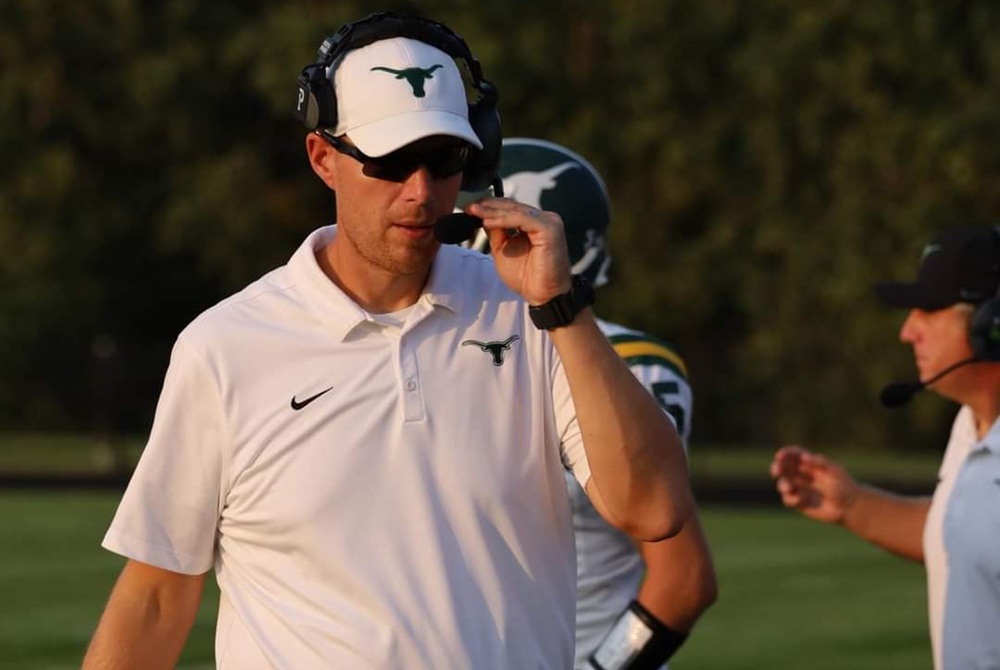
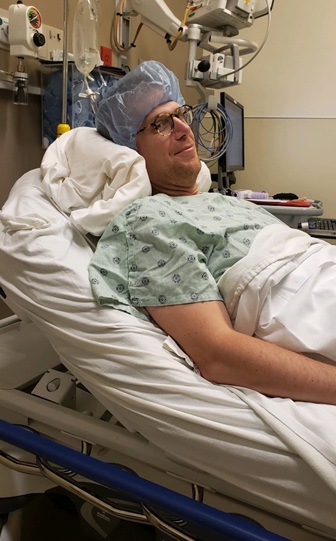
PHOTOS (Top) Sand Creek assistant football coach Sid Disbrow mans the headset while on the sideline during a game. (Middle) Disbrow lays in a hospital bed while receiving care in 2023. (Below) Disbrow stands for a photo with wife Nikki last fall. (Top photo by Becky Serin. Hospital and family photos courtesy of the Disbrow family.)