


Heads and Heat
August 16, 2012
We are engaged in very serious discussions. They’re not only complicated, with unintended negative consequences possible from what are thought to be positive actions; they’re also a matter of life and death.
The topic is football – the high school sport under most scrutiny today and suffering from the most criticism it’s seen since the 1970s when catastrophic neck injuries spiked, liability awards soared, many insurers balked, and most helmet manufacturers abandoned the business altogether.
During recent years we have learned about the devastating long-term effects of repeated blows to the head; and we’re trying to reduce such hits. We’ve learned that 70 percent of concussions in football result from helmet-to-helmet contact, and we’re trying to have coaches teach blocking and tackling differently and have officials penalize “high hits” consistently and rigorously.
During the past several years we’ve learned that serious heat illness and heat-related deaths are 100 percent preventable, yet nationwide there were 35 heat-related deaths in high school football alone from 1995 to 2010; and we’re promoting practices that acclimatize athletes more gradually than “old school” traditionalists might advocate.
As we simultaneously address issues of heads and heat in football, some coaches may think we’re being overbearing, while many in medical fields say we’re out of date, citing higher standards of the American Academy of Pediatrics, National Athletic Trainers Association and National Federation of State High School Associations, as well as many of our counterpart organizations across the country.
As we consider in-season changes to improve athlete acclimatization and reduce blows to the head, we should be open to making out-of-season changes that work toward rather than in opposition to those objectives. There can be no sacred cows. The topic is too serious.
Ultimately, if we err in the outcome of this year’s discussions about heads and heat in football, it must be on the side of safety, on minimizing risks for student participants. They deserve it and, once again, the sport of football needs it.
1st & Goal: Week 5 in Review
September 28, 2020
By Geoff Kimmerly
Second Half editor
Sometimes it doesn’t take long to recognize a team is very good.
We’re only two weeks into this abbreviated Michigan high school football season. But we’ve seen enough to know a few things already about likely title contenders.
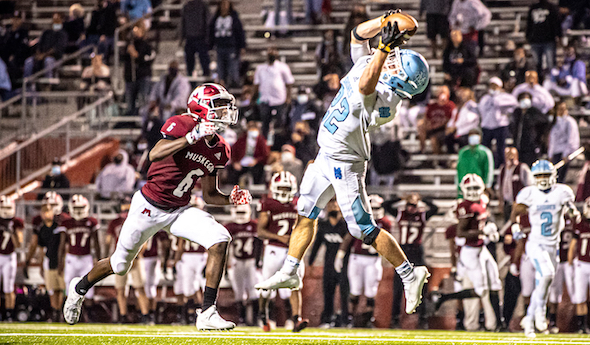
Take East Lansing and Adrian Lenawee Christian, which defeated reigning MHSAA Finals champions (River Rouge and Colon, respectively) this weekend. Three more teams that finished runners-up in 2019 fell, with Northville, Hastings and Muskegon Mona Shores (see photo above) among those enjoying celebrations.
Those are just five of the victors noted below in our weekly look at results that popped off the page from every region of the state.
Bay & Thumb
HEADLINER Flint Beecher 27, Flint Hamady 21 This was big for Beecher for two major reasons of likely similar importance. The Bucs (2-0) had lost three straight to rival Hamady (1-1). This win also puts them in prime position to win the Genesee Area Conference title. And to top it off, it was only Hamady’s second regular-season loss since the start of 2017. See highlights below from WJRT.
.@BeecherSchools holds on to beat Hamady 27-21 https://t.co/6E0AYLXs7l
— ABC12WJRT (@ABC12WJRT) September 26, 2020
Watch list Sandusky 42, Harbor Beach 30 Last week we recognized Harbor Beach for edging Ubly, but this week it’s Sandusky (2-0) for breaking a four-game losing streak to the Pirates (1-1) and grabbing early momentum in the Greater Thumb Conference East.
Remember this one Frankenmuth 35, Saginaw Swan Valley 6 Not only the did the Eagles (2-0) avenge their 2019 playoff loss, but they have now outscored their anticipated two toughest regular-season opponents by a combined 76-9.
More shoutouts Swartz Creek 14, Linden 7 The Dragons (1-1) equaled last season’s win total in one night and avenged their 37-0 loss to Linden (1-1) from last fall. Croswell-Lexington 36, Richmond 0 The Pioneers (2-0) broke an eight-game losing streak against the Blue Devils (0-2).
Greater Detroit
HEADLINER Sterling Heights Stevenson 12, Macomb Dakota 7 While winning their first two games by just a combined nine points, Stevenson (2-0) has had a more noteworthy start than all but a few teams statewide after also defeating Utica Eisenhower in Week 1. The Macomb Area Conference Red got even stronger this year with the addition of Grosse Pointe South, and Stevenson is working its way toward the front of the line. Click for more from the Macomb Daily and see highlights below from State Champs Sports Network.
VIDEO: Check out the highlights of the Sterling Heights Stevenson (@SHSTitansfball) at Macomb Dakota football game from Friday night. Brought to you by @hungryhowies pic.twitter.com/FQskyhpTaL
— STATE CHAMPS! Michigan (@statechampsmich) September 26, 2020
Watch list Belleville 69, Dearborn Fordson 0 The last two matchups between these teams were decided by a combined four points – so now we have another reason to be plugged in to the Tigers (2-0) as they work this season to take the next step after two straight Division 1 Semifinal appearances.
Remember this one Northville 24, Brighton 14 After being shut out by Brighton (1-1) the last two seasons by a combined 55-0, the Mustangs (1-1) bounced back to down the reigning Division 1 runner-up.
More shoutouts Center Line 8, Clawson 7 The Panthers (2-0) have doubled their wins from a year ago, and in this one edged the reigning Macomb Area Conference champion. Riverview 24, Milan 12 The Pirates also avenged a 2019 loss to move to 2-0, doubling up last season’s Huron League title winner.
Mid-Michigan
HEADLINER East Lansing 21, River Rouge 6 The Trojans (2-0) announced themselves as deserving of serious attention in Division 2 with an impressive win over the reigning Division 3 champion. The Panthers (1-1) hadn’t been held to single-digit scoring since their 2018 playoff loss to Detroit Martin Luther King. Click for more from the Lansing State Journal.
Watch list Harrison 26, Beaverton 21 The Beavers (1-1) had beaten Harrison four straight seasons and are reigning Jack Pine Conference champions, but now will be chasing the Hornets (2-0) for the rest of this fall.
Remember this one Hastings 14, Jackson Lumen Christi 13 The Saxons shouldn’t soon forget it. Lumen (1-1) rarely loses during the regular season; in fact, the Titans rode a 22-game regular-season winning streak into this game and had beaten Hastings (1-1) by an average of 26 points over four straight recent wins.
More shoutouts Ithaca 39, Midland Bullock Creek 34 The reigning Tri-Valley Conference West I co-champs are in different divisions this season, but this had the back-and-forth of a title decider nonetheless. Hartland 62, Plymouth 7 The Eagles (2-0) broke a four-game losing streak against Plymouth (1-1) and after falling 35-13 a year ago.
Northern Lower Peninsula
HEADLINER Kingsley 36, Ogemaw Heights 14 The Stags (2-0) ran their Northern Michigan Football League Legends winning streak to 12, with all of those wins by 19 or more points. The Falcons (1-1), previously a nonleague opponent, joined the Legends this season. Click for more from the Traverse City Record-Eagle.
Watch list Houghton Lake 32, Lake City 14 The Bobcats (2-0) have now won eight of nine league games since moving into the Highland Conference at the start of the 2019 season.
Remember this one Frankfort 40, St. Ignace 12 Both had opened the season with defeats, but Frankfort got a nice rebound against a Saints team that made the playoffs last season.
More shoutouts Benzie Central 34, Cheboygan 14 Cheboygan had won all five meetings over the last decade, including 44-0 a year ago. Harbor Springs 30, East Jordan 8 The Rams (2-0) have opened by outscoring their first two opponents by a combined 79-8.
Southeast & Border
HEADLINER Reading 52, Breckenridge 20 If this was any indication, two-time reigning Division 8 champion Reading (2-0) isn’t leaving the elite any time soon. The 52 points represent the most Breckenridge (1-1) has given up since Week 4 of 2015. The Rangers have won 15 straight. Click for more from the Hillsdale Daily News.
Watch list Blissfield 31, Hillsdale 14 The Royals (2-0) are tied for the early lead in the Lenawee County Athletic Association after last year’s seven-point Hillsdale win in this matchup eventually led to the Hornets’ outright title.
Remember this one Clinton 54, Brooklyn Columbia Central 6 Clinton (2-0) is a new addition to the LCAA and immediately should impact the league title race – with Blissfield up this week.
More shoutouts Monroe 42, Jackson 14 The Trojans, winners of just three games a year ago, moved to 2-0 with a second victory over a team that finished above .500 last season. Ann Arbor Skyline 23, Ann Arbor Pioneer 7 Ann Arbor’s three public high schools opted to begin with Week 5, and Skyline began with equaling last season’s win total by avenging a 2019 defeat.
Southwest Corridor
HEADLINER Coldwater 24, Marshall 16 After two weeks, Coldwater is one of two teams (with Parma Western) still unbeaten from what’s quickly looking like a highly-competitive Interstate 8 Athletic Conference. Marshall might be one of the best 0-2 teams in the state after also falling to Lumen Christi by just a point in Week 4. Click for more from the Coldwater Daily Reporter.
Watch list Centreville 14, White Pigeon 8 The Bulldogs lost three Southwest 10 Conference games by a combined 24 points last season. This avenged one, and the other two opponents – Cassopolis then Mendon – are up next.
Remember this one Comstock 12, Berrien Springs 6 The Colts (1-1) broke a five-game losing streak against Berrien Springs and after losing 30-0 a year ago.
More shoutouts Vicksburg 43, Three Rivers 0 After a rough start Week 4 against Edwardsburg, Vicksburg (1-1) bounced back with a big win. Battle Creek Lakeview 6, Portage Central 0 The Spartans ran their regular-season winning streak to 11 with this their closest win of the run.
Upper Peninsula
HEADLINER Sault Ste. Marie 22, Marquette 16 The Blue Devils backed up the impressiveness their Week 4 opening win over Traverse City St. Francis with another that may have solidified them as the Upper Peninsula’s best this fall. Sault Ste. Marie (2-0) had lost four straight to Marquette (1-1), including 31-0 a year ago. Click for more from the Sault Ste. Marie Evening News.
VIDEO: Check out the highlights of the Sault Ste. Marie at Marquette football game from Friday night. @upfootball
Brought to you by @MHSAA pic.twitter.com/zNtwxz84OJ— STATE CHAMPS! Michigan (@statechampsmich) September 26, 2020
Watch list Gladstone 22, Negaunee 20 The Braves (1-0) didn’t open until this weekend, but started out with a win over a traditional power and after falling behind early.
Remember this one Menominee 42, Marinette, Wis., 8 We always note this rivalry series that goes back to 1894 and that Menominee now leads 56-51-7.
More shoutouts West Iron County 16, L’Anse 7 Two games in, West Iron (2-0) has given up a combined 13 points. Iron Mountain 42, Bark River-Harris 6 The Mountaineers (2-0) ran their regular-season winning streak to 14 with this one over a 2019 playoff qualifier.
West Michigan
HEADLINER Muskegon Mona Shores 21, Muskegon 14 There are only a handful of matchups in Michigan these days that can contend with this one to be called the state’s best rivalry game. This latest chapter backs that up. After falling to the Big Reds 53-0 a year ago and going on to win the Division 2 championship, Mona Shores (2-0) this time beat Muskegon (1-1) – last season’s Division 3 runner-up – for the first time since 2015. Click for more from the Muskegon Chronicle.
VIDEO: Check out the highlights of the Mona Shores (@MSSailorFball) at Muskegon football game from Friday night. Brought to you by @LTUAthletics pic.twitter.com/6rPejYbUrA
— STATE CHAMPS! Michigan (@statechampsmich) September 26, 2020
Watch list Montague 42, Muskegon Oakridge 6 This also belongs high on the statewide rivalry list, with this big win coming off two seasons where the matchups were decided by a combined three points.
Remember this one Byron Center 41, Grand Rapids Christian 6 The new-look Ottawa-Kent Conference White is impressive, and defeating last year’s Gold champ big could be a sign reigning Green champ Byron Center is ready to be in the mix again.
More shoutouts Hudsonville Unity Christian 39, Grand Rapids West Catholic 21 Unity (2-0) seems like a strong pick to emerge as a power in the new O-K Blue, and if tradition holds this win could mean even more in a few weeks. Manistee 34, Muskegon Orchard View 20 The 2018 Lakes 8 Athletic Conference champ avenged last season’s 58-7 defeat to the eventual 2019 title winner.
8-Player
HEADLINER Adrian Lenawee Christian 24, Colon 6 Make way for the Cougars (2-0). Lenawee, in its first season of 8-player, broke reigning Division 1 champion Colon’s 14-game winning streak and dealt the Magi (1-1) only their third loss as an 8-player program (against 24 wins). Click for more from the Adrian Daily Telegram.
Watch list Whittemore-Prescott 66, Mio 16 A late add to 8-player this fall, Whittemore-Prescott has scored a combined 114 points during its 2-0 start.
Remember this one Martin 39, Bridgman 12 Last season’s Martin win in this matchup ultimately decided the Southwest Michigan 8-Man Football League title.
More shoutouts Pickford 20, Cedarville 0 The Panthers (2-0) appear on their way again after a fifth-straight win over the Trojans (1-1). Hale 14, Hillman 12 After falling just shy 54-42 against the Tigers last season, Hale scored just enough and rebounded after a season-opening loss.
PHOTO: Muskegon Mona Shores avenged its 2019 loss to Muskegon on Friday with a 21-14 victory. (Photo by Tim Reilly.)