


Heads and Heat
August 16, 2012
We are engaged in very serious discussions. They’re not only complicated, with unintended negative consequences possible from what are thought to be positive actions; they’re also a matter of life and death.
The topic is football – the high school sport under most scrutiny today and suffering from the most criticism it’s seen since the 1970s when catastrophic neck injuries spiked, liability awards soared, many insurers balked, and most helmet manufacturers abandoned the business altogether.
During recent years we have learned about the devastating long-term effects of repeated blows to the head; and we’re trying to reduce such hits. We’ve learned that 70 percent of concussions in football result from helmet-to-helmet contact, and we’re trying to have coaches teach blocking and tackling differently and have officials penalize “high hits” consistently and rigorously.
During the past several years we’ve learned that serious heat illness and heat-related deaths are 100 percent preventable, yet nationwide there were 35 heat-related deaths in high school football alone from 1995 to 2010; and we’re promoting practices that acclimatize athletes more gradually than “old school” traditionalists might advocate.
As we simultaneously address issues of heads and heat in football, some coaches may think we’re being overbearing, while many in medical fields say we’re out of date, citing higher standards of the American Academy of Pediatrics, National Athletic Trainers Association and National Federation of State High School Associations, as well as many of our counterpart organizations across the country.
As we consider in-season changes to improve athlete acclimatization and reduce blows to the head, we should be open to making out-of-season changes that work toward rather than in opposition to those objectives. There can be no sacred cows. The topic is too serious.
Ultimately, if we err in the outcome of this year’s discussions about heads and heat in football, it must be on the side of safety, on minimizing risks for student participants. They deserve it and, once again, the sport of football needs it.
Drive for Detroit: Playoff Week 3 Review
November 18, 2019
By Geoff Kimmerly
Second Half editor
Only 36 teams remain from the original 602 that opened this fall with hopes of reaching the biggest stages in Michigan high school football.
 Suttons Bay, Colon, Pickford and Portland St. Patrick earned the first championship opportunities with 8-Player Semifinal wins over the weekend. And 32 more 11-player teams are one more victory from booking Thanksgiving trips to Detroit.
Below is a glance at all 36 games played during the third round of the MHSAA Playoffs. There’s plenty coming up on Second Half later this week as well as we’ll preview both 8-Player Finals and all 16 11-Player Semifinals, followed by coverage of both Saturday championship games from The Superior Dome.
"Drive for Detroit" is sponsored by MI Student Aid.
8-Player
Division 1
HEADLINER Suttons Bay 45, Kingston 14 The Norsemen (12-0) earned their first trip to the MHSAA Finals since 2004, putting up their most points since Week 6 while holding the Cardinals (9-3) to their fewest since Week 1. Suttons Bay scored 33 unanswered points to close the game, while holding Kingston scoreless during the second half. Click for more from the Traverse City Record-Eagle and see below for highlights from MI Sports Now.
Suttons Bay Defeats Kingston, Heading To State Finals https://t.co/9tZZ82gSyT pic.twitter.com/YVCPxejZOW
— MISportsNow (@MISportsNow) November 16, 2019
HEADLINER Colon 27, Morrice 8 The Magi (12-0) are headed to the MHSAA Finals for the first time. As expected, Colon got its toughest challenge this season from the reigning Division 1 champion Orioles – but still managed to extend its season-long streak of all 12 wins by double digits while holding Morrice (10-2) to its fewest points since the 2017 Regional Final. Click for more from the Battle Creek Enquirer and see below for highlights from JoeInsider.com.
Recap/audio from Colon's 27-8 semifinal win vs Morricehttps://t.co/xdtAVuedfo@JoeInsider #MHSAAFB @ColonFootball @Snooze2you
— Jordan Slocum (@JordanSlocum) November 16, 2019
Division 2
HEADLINER Pickford 40, Hillman 8 The 2018 Division 1 runner-up Panthers (11-1) earned another chance to play for a first championship with one of their best defensive showings of the fall. Quarterback Jimmy Storey ran for two touchdowns and threw for another score, and the Panthers held Hillman (10-2) to its fewest points since Week 2 of its final season of 11-player in 2017. Click for more from the Sault Ste. Marie Evening News and see highlights below from State Champs Sports Network.
Check out the highlights of Pickford High School vs. Hillman Community Jr/Sr High School from Friday Night's State Semifinal.
Presented by @HungryHowies pic.twitter.com/MNWNuSyYNk— STATE CHAMPS! Michigan (@statechampsnet) November 16, 2019
HEADLINER Portland St. Patrick 49, Climax-Scotts 6 The Shamrocks (12-0) have put up at least 42 points in every game this season. But the story Saturday may have been the defense, which gave one of its best showings of the fall in locking down a Climax-Scotts offense averaging 34 points per game. The Panthers finished their first season of 8-player 9-3. Click for more from the Lansing State Journal.
VIDEO: Check out the highlights of the Portland St. Patrick (@PortlandStPats) vs. Climax-Scotts | Division 2 @MHSAA 8-Player Football Semifinal. @WLNSAlexSims reporting.
Brought to you by @MHSAA pic.twitter.com/JAE91yZtAM— STATE CHAMPS! Michigan (@statechampsnet) November 17, 2019
11-Player
Division 1
HEADLINER Belleville 27, West Bloomfield 22 These two were seen as Division 1 favorites before the first kickoff this fall, and as anticipated the Lakers gave Belleville one of only two single-digit games of an otherwise dominating run this season. West Bloomfield (10-2) scored the game’s first 15 points and led into the third quarter, but the Tigers (12-0) came back and then held off a final rally to advance to the Semifinals for the second straight season. Click for more from State Champs Sports Network.
VIDEO: Check out the highlights of the Belleville (@BHS_Sec1) vs. West Bloomfield - Division 1 @MHSAA Football Regional Final from this afternoon. @JermainCrowell.
Brought to you by @hungryhowies pic.twitter.com/GTDcCud9ze— STATE CHAMPS! Michigan (@statechampsnet) November 17, 2019
Regional Roundup Brighton 35, Hudsonville 20 The Bulldogs (10-2) are headed to the Semifinals for the first time since 2005. Brighton got up 21-0 early, and the Eagles (8-4) were unable to catch up. Davison 35, Utica Eisenhower 7 The Cardinals (10-2) will play in their first Semifinal since 2008 after holding Eisenhower (9-3) to its first single-digit scoring output since Week 1. Sterling Heights Stevenson 9, Detroit Cass Tech 7 Both entered the playoffs as additional qualifiers, but Stevenson (8-4) is carrying a five-game winning streak into its first Semifinal since 2009 after ending a five-game winning streak for the Technicians (7-5).
Division 2
HEADLINER Muskegon Mona Shores 28, Portage Northern 23 The Sailors (10-2) have had to defeat three league champions to get within another win of returning to Ford Field after finishing Division 2 runners-up a year ago. Portage Northern (10-2) led into the third quarter before a Mona Shores comeback brought the Huskies’ first double-digit wins season to a close. Click for more from the Muskegon Chronicle and see highlights below from WZZM.
13 On Your Sidelines Game of the Week: Mona Shores vs. Portage Northern https://t.co/P9EzE7Qe0C
— 13 On Your Side (@wzzm13) November 16, 2019
Regional Roundup Walled Lake Western 21, Livonia Churchill 14 A Warriors defense giving up only 14 points per game held on through a late rally to end a six-game winning streak for Churchill (7-5) and get Western back to the Semifinals for the third time in five seasons. Detroit Martin Luther King 49, Detroit U-D Jesuit 21 This matchup of league champions went to the Detroit Public School League’s Crusaders (10-2), who won their fifth straight Regional title in ending the winningest season for Jesuit (8-4) since 2001. Birmingham Seaholm 44, Port Huron 28 The Maples (9-3) are headed back to the Semifinals for the first time since 1997 after jumping out to a big lead and holding off the Big Reds (8-4), who closed their winningest season and longest playoff run since 2011.
11-Player
Division 3
HEADLINER DeWitt 35, Edwardsburg 14 As a set, Division 3 might have had the most captivating games in the state this weekend. DeWitt (10-2) earns the “headliner” by ending a 25-game winning streak for the Eddies (11-1), who won Division 4 a year ago. Edwardsburg had given up only 69 points over its first 10 games on the field (not counting a 2-0 forfeit win Week 5), but DeWitt’s defense also earned some of the spotlight holding the Eddies to their fewest points since a 2016 Semifinal. Click for more from the Lansing State Journal.
See video highlights from DeWitt's regional championship win over Edwardsburg.https://t.co/QClZDZlmr5 via @LSJNews
— Brian Calloway (@brian_calloway) November 17, 2019
Regional Roundup Muskegon 49, East Grand Rapids 10 After getting past East Grand Rapids just 28-23 in Week 3, the Big Reds (12-0) held the Pioneers to their season-low points total and scored the most that EGR (8-4) gave up this fall. Chelsea 28, Allen Park 27 A blocked extra point followed by a late score and conversion sent Chelsea to 12-0 for the first time and the Semifinals for the second-straight season, while Allen Park ended 9-3 for the second-straight year. River Rouge 49, Orchard Lake St. Mary’s 14 The Panthers (11-1) are headed to the Semifinals for the fourth time in five seasons after scoring the most points the Eaglets (10-2) had given up since Week 2 of 2018.
Division 4
HEADLINER Detroit Country Day 24, Milan 6 The Yellowjackets (12-0) won this matchup of undefeated contenders on the strength of a defense that has held every opponent this season to 12 points or fewer and lowered its average with this win to 5.6 points allowed per game. Milan (11-1) hadn’t been held to single-digit scoring since Week 5 of 2017. Click for more from the Oakland Press.
VIDEO: Check out the highlights of the Detroit Country Day (@DCDSAthletics) vs. Milan - Division 4 @MHSAA Football Regional Final from this afternoon. @DCDSchool
Brought to you by @MHSAA pic.twitter.com/pa4HDy3Mf2— STATE CHAMPS! Michigan (@statechampsnet) November 17, 2019
Regional Roundup Grand Rapids Catholic Central 42, Cadillac 7 The Cougars (11-1) are in the Semifinals for the fourth-straight season after a fifth-straight game giving up seven points or fewer, as Cadillac (7-5) closed its longest playoff run since 2013. Hudsonville Unity Christian 38, Paw Paw 17 Last season’s Division 5 champion Unity (9-3) is one more win from playing for the Division 4 title this time after putting up the second-most points Paw Paw (10-2) had surrendered this fall while giving up only 11.9 per game. Flint Powers Catholic 12, Pontiac Notre Dame Prep 9 The Chargers (10-2) won their first Regional title since 2015 with the go-ahead touchdown midway through the fourth quarter, ending Notre Dame Prep’s first 10-win season since 2011 at 10-2.
Division 5
HEADLINER Detroit Denby 40, Dearborn Heights Robichaud 18 The Tars (10-2) reached double-digit wins and won a Regional title both for the first time, continuing a run that has seen them lose this season only to Division 2 contender King (twice). Robichaud (9-3) closed its winningest season since 2012. Click for more from the Dearborn Press & Guide.
VIDEO: Check out the highlights of the Denby vs. Robichaud - Division 5 @MHSAA Regional Final from tonight. Brought to you by @hungryhowies pic.twitter.com/aZ0fljemc7
— STATE CHAMPS! Michigan (@statechampsnet) November 16, 2019
Regional Roundup Kingsley 43, Freeland 21 The Stags (12-0) are headed to the Semifinals for the first time since 2005 after scoring the most Freeland (9-3) gave up in a game this fall. Kingsley has won all of its games by 12 or more points. Lansing Catholic 40, Kalamazoo United 13 The Zac Gillespie-to-Alex Watters connection played a major part in getting the Cougars (11-1) back to the Semifinals for the first time since 2015, as they connected for three of Gillespie’s four touchdown passes. The 40 points tied the most United (7-5) had given up this season. Almont 25, Saginaw Swan Valley 14 After opening the playoffs with two road games, Almont (12-0) came home to earn its first Regional title since 2014 as Swan Valley (8-4) was seeking to make the Semifinals for the third-straight season.
Division 6
HEADLINER Onsted 12, Hillsdale 0 This no doubt was the biggest stunner statewide of the weekend, as Onsted (10-2) – which three weeks ago won a playoff game for the first time since 2008 – avenged a Week 4 loss to unbeaten Hillsdale to claim its first Regional title since 1993. The Hornets (11-1) hadn’t been shut out since Week 2 of 2016 and won that first meeting with Onsted this fall 28-19. Click for more from the Adrian Daily Telegram.
Check out the highlights of Friday night's Regional Final game between Onsted (@OnstedAth) and Hillsdale (@HillsdaleHornet).
Presented by the @MHSAA pic.twitter.com/xGVMN5iFML— STATE CHAMPS! Michigan (@statechampsnet) November 16, 2019
Regional Roundup Maple City Glen Lake 15, Calumet 14 The Lakers (11-1) are headed to the Semifinals for the second time in four seasons after winning by the slimmest of margins, with a second-quarter 2-point conversion run the eventual decider. Calumet (10-2) suffered its two defeats this season both by 15-14 scores against teams still alive in the playoffs. Montague 48, Sanford Meridian 14 The reigning Division 6 runner-up Wildcats (10-2) have won six straight since back-to-back close league defeats, and the 14 points scored by Meridian (8-4) tied the most given up during Montague’s current run. Monroe St. Mary Catholic Central 36, Montrose 7 After Regional Finals losses the last two years by a combined three points, St. Mary (10-1) is headed back to the Semifinals for the first time since 2014 after handing Montrose (10-2) its first loss since Week 4.
Division 7
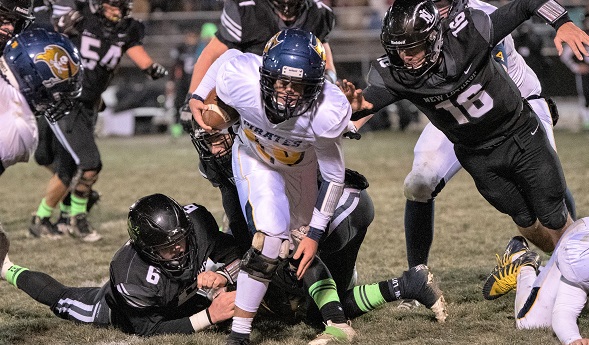
HEADLINER Pewamo-Westphalia 36, New Lothrop 35 In what might be remembered as the top non-Finals matchup of these playoffs, the Pirates (12-0) – Division 7 champions in 2016 and 2017 – got out to a three-touchdown lead and held on to edge last season’s champion New Lothrop (11-1). The Hornets had won 11 straight games and defeated P-W 26-14 in last year’s Regional Final. Click for more from the Lansing State Journal and see below for highlights from FOX 17.
"I'm proud of our guys for weathering through the adversity and the storm," head coach Jeremy Miller said after the win. The Pirates advance to face the winner of Iron Mountain and Traverse City St. Francis. https://t.co/UzPh02yVcy
— FOX 17 Blitz (@FOX17Blitz) November 16, 2019
Regional Roundup Iron Mountain 21, Traverse City St. Francis 7 The Mountaineers (12-0) won their first Regional title since 2011 and reached 12 wins for the first time since 2000 by ending St. Francis’ quest for a third straight Semifinals berth. Iron Mountain held the Gladiators (8-4) scoreless into the fourth quarter. Jackson Lumen Christi 35, Schoolcraft 30 The Eagles (10-2) rallied from more than three scores down but couldn’t catch up to the reigning Division 6 champion Titans (11-0), who ran their winning streak to 24. Cass City 6, Detroit Loyola 0 The Red Hawks’ fifth shutout this season came with historic rewards as Cass City (11-1) added its first Regional title to its most successful season, with a fourth-quarter score the difference against the defensively-tough Bulldogs (6-5).
Division 8
HEADLINER Reading 26, Adrian Lenawee Christian 21 The reigning Division 8 champion Rangers were trailing into the fourth quarter before scoring the go-ahead points with just over eight minutes to play. Both teams’ defenses bent just a bit: Reading (11-1) hadn’t given up more than 14 points all season, and Lenawee (10-2) hadn’t given up more than 14 since its Week 2 loss to Sand Creek. The Cougars concluded their winningest season, which included their first playoff victory two weeks ago. Click for more from the Hillsdale Daily News.
VIDEO: Check out the highlights of the Reading vs. Lenawee Christian - Division 8 @MHSAA Regional Final from tonight.
Brought to you by @hungryhowies pic.twitter.com/6yq3nbMUdH— STATE CHAMPS! Michigan (@statechampsnet) November 16, 2019
Regional Roundup Beal City 27, Ishpeming 14 The Aggies (11-1) won their first Regional title since 2014, scoring all of their points before Ishpeming (9-3) got on the board. The Hematites were making a second-straight Regional Final appearance. Ubly 56, Saginaw Nouvel 36 The Bearcats (10-2) went over 50 points for the fifth time this season to win their second Regional title in four years and despite giving up a season-high point total to Nouvel (7-5). Fowler 33, Royal Oak Shrine 0 The Eagles (11-1) won their first Regional title since 2011, continuing a bounce-back run after two straight 4-5 finishes. Shrine finished 9-3, also with more wins than the last two seasons combined.
Second Half’s weekly “Drive for Detroit” previews are powered by MI Student Aid, a part of the Office of Postsecondary Financial Planning located within the Michigan Department of Treasury. MI Student Aid encourages students to pursue postsecondary education by providing access to student financial resources and information. MI Student Aid administers the state’s 529 college savings programs (MET/MESP), as well as scholarship and grant programs that help make college Accessible, Affordable and Attainable for you. Connect with MI Student Aid at www.michigan.gov/mistudentaid and find more information on Facebook and Twitter @mistudentaid.
PHOTO: Pewamo-Westphalia's Ethan Thelen (10) breaks multiple New Lothrop tackles during Friday's Division 7 Regional Final win. (Click to see more from HighSchoolSportsScene.com.)