


Heads and Heat
August 16, 2012
We are engaged in very serious discussions. They’re not only complicated, with unintended negative consequences possible from what are thought to be positive actions; they’re also a matter of life and death.
The topic is football – the high school sport under most scrutiny today and suffering from the most criticism it’s seen since the 1970s when catastrophic neck injuries spiked, liability awards soared, many insurers balked, and most helmet manufacturers abandoned the business altogether.
During recent years we have learned about the devastating long-term effects of repeated blows to the head; and we’re trying to reduce such hits. We’ve learned that 70 percent of concussions in football result from helmet-to-helmet contact, and we’re trying to have coaches teach blocking and tackling differently and have officials penalize “high hits” consistently and rigorously.
During the past several years we’ve learned that serious heat illness and heat-related deaths are 100 percent preventable, yet nationwide there were 35 heat-related deaths in high school football alone from 1995 to 2010; and we’re promoting practices that acclimatize athletes more gradually than “old school” traditionalists might advocate.
As we simultaneously address issues of heads and heat in football, some coaches may think we’re being overbearing, while many in medical fields say we’re out of date, citing higher standards of the American Academy of Pediatrics, National Athletic Trainers Association and National Federation of State High School Associations, as well as many of our counterpart organizations across the country.
As we consider in-season changes to improve athlete acclimatization and reduce blows to the head, we should be open to making out-of-season changes that work toward rather than in opposition to those objectives. There can be no sacred cows. The topic is too serious.
Ultimately, if we err in the outcome of this year’s discussions about heads and heat in football, it must be on the side of safety, on minimizing risks for student participants. They deserve it and, once again, the sport of football needs it.
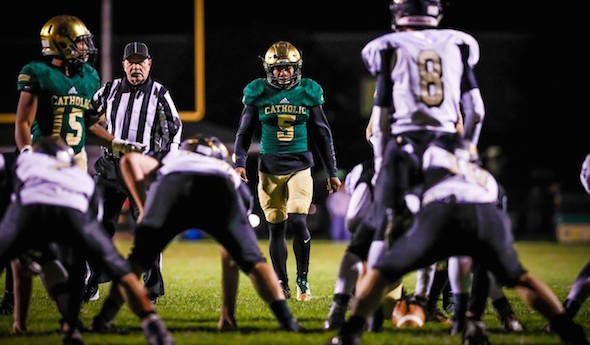
QB Gives MCC New Look, Same Success
October 31, 2017
By Tom Kendra
Special for Second Half
Beating Muskegon Catholic Central in the playoffs was hard enough before Cameron Martinez came along.
 Martinez, a 5-11, 180-pound, dual-threat sophomore quarterback, has added many new dimensions to the Crusaders’ offense – which had become synonymous around the state with ground-and-pound, power football.
“It’s pretty apparent that if we’re sitting in the T (formation) all the time, we’re not maximizing his abilities or our other guys’ abilities,” said fifth-year MCC coach Steve Czerwon, who has won a Division 8 championship in each of his first four seasons as the Crusaders’ head coach. “Cameron makes us coaches look good, too, because with him sometimes a bad play turns into a good play.”
MCC, which is 8-1 and ranked No. 1 in Division 8 by The Associated Press, goes on the road this week for a showdown with a familiar foe and another playoff powerhouse, Mendon (10-0 and ranked No. 3), in a MHSAA District championship game at 1 p.m. Saturday.
Mendon fans will see a different MCC team than they have become accustomed to during the two schools’ seven prior meetings (MCC has won five) – a team that often operates with Martinez in the pistol formation, with just one running back, no tight ends and four receivers spread wide across the field.
The point man is Martinez, whose athletic ability was noticed by Central Michigan University two years ago as a 14-year-old eighth grader. His potential was so apparent that he was offered a scholarship at the conclusion of that camp, before he ever played a snap of high school football.
Last fall, he split time at quarterback with senior Trenton Bordeaux, and started to prove himself on the field as a quarterback, free safety and punt returner. Many other Division I schools are now following him as he is the unquestioned leader of this year’s Crusaders.
Martinez, who was born on the infamous day of Sept. 11, 2001, knows that college is still three years away. More immediate on his mind is the challenge of a 240-mile roundtrip journey to face a Mendon program which has amassed 10 MHSAA championships, the most recent in 2011. MCC has won 12 MHSAA titles during the playoff era.
“We’re all very excited,” said Martinez, whose older brother, Christian, guided MCC to Division 8 titles in 2014 and 2015 and now plays quarterback at Northwood University. “It’s a little bit of a trip, but I’ve always liked playing on the road. We know all about them and their tradition.”
Mendon will have to, first and foremost, contain Martinez if it wants to snap a three-game losing streak to the Crusaders.
The numbers tell the story: Martinez has rushed for 979 yards on 90 carries (10.9 yards per carry) and 15 TDs, more than double as many yards as MCC’s second-leading rusher, sophomore Tommy Watts (441 yards). Others sharing carries in the backfield-by-committee are juniors Dawson Steigman and Avery Davis and senior Riley St. Amour.
Martinez’ completion percentage is down considerably from a year ago, but he has still hit on 45 of 94 passes for 720 yards, six touchdowns and three interceptions. His primary targets are seniors Ryder Smith (14 catches) and Jackson Riegler (11 catches) and sophomore Nolan Convertini (10 catches).
 Martinez & Company looked flat-out unbeatable and a mortal lock to complete the “Drive for Five” – and join East Grand Rapids and Farmington Hills Harrison as the only schools to win five titles in a row – until Montague rolled into Kehren Stadium on Oct. 20 for the first-ever meeting between the two schools.
Montague frustrated the Crusaders with a disciplined pass rush and stingy coverage, limiting Martinez to just 10 of 31 passing for 131 yards, no touchdowns and two interceptions, as MCC’s 27-game winning streak was snapped in a stunning 34-10 loss.
“I put that loss on me,” said Martinez, who did rush for a team-high 80 yards in the defeat. “I need to react better and make better adjustments during games. All respect for Montague, they are a great team, but that game was a wake-up call for us.”
MCC bounced back with a 42-20 win over visiting Decatur last week, in a game that was much closer than many expected.
Now comes the big test against Mendon, which appears to be back to its old, powerful self after posting its first undefeated regular season since 2104.
“This is a classic Mendon football team,” said Czerwon, who is 2-0 against the Hornets as a head coach, posting playoff wins in 2013 and 2014. “They are a power team that wants to run downhill on you. They make very few mistakes and rarely have a negative-yardage play.”
Mendon, champions of the Southwest 10 Conference, are led by quarterback Cole Decker and running backs Wyatt Cool and Austin Rensi. Bobby Kretschman, a former standout player and 10-year assistant coach for the Hornets, is in his second year as head coach after taking over from legend John Schwartz.
MCC will use many different formations, all directed by Martinez, in an attempt to move the ball against a Mendon defense which has six shutouts in its first 10 games.
“We are very diverse, which is what I like about this team,” said Martinez. “Our coaches come up with a lot of different schemes for every game. We just have to go out and execute it.”
 Tom Kendra worked 23 years at The Muskegon Chronicle, including five as assistant sports editor and the final six as sports editor through 2011. E-mail him at [email protected] with story ideas for Muskegon, Oceana, Mason, Lake, Oceola, Mecosta and Newaygo counties.
PHOTOS: (Top) Muskegon Catholic Central’s Cameron Martinez, a 5-11, 180-pound sophomore, surveys the field while awaiting the snap from center Owen Linstrom during the Crusaders' 42-20 victory over visiting Decatur in last week's Division 8 Pre-District game. (Middle) Martinez goes airborne for an incredible interception from his free safety position during the Crusaders' 31-6 victory at Frankfort on Sept. 1. (Photos by Tim Reilly.)