

Hearts Heavy, St. Mary's Keeps Promise
November 29, 2014
By Bill Khan
Special for Second Half
DETROIT — The most important football game in Brandon Adams' life suddenly didn't seem so important.
At a time when excitement should've been rising within the Orchard Lake St. Mary's junior, he was holed up in his bedroom, coming to grips with the lowest moment in his young life.
Football? Who cares about something as trivial as football — even a state championship game — when your mother just died two days earlier?
Playing a game may not have been important, but fulfilling a promise to his mother and continuing to live as she would have wished helped him to get up, get out of his room and move forward.
"At first, I didn't think I was going to play this game," said Adams, whose 1-yard run with 5:42 left in the first quarter was the only touchdown in the Eaglets' 7-0 victory over Muskegon in the MHSAA Division 3 Final on Saturday night at Ford Field.
"Thursday, after she passed, I was sitting in my bed at home. My dad walks in and says, 'I don't want you to sit here and sulk,' so I went to practice Friday. We had a team meeting at 1 before our practice at 2. All the guys gave their condolences and said, 'We're not losing this game. We're making a promise to God, to my mom and to the team that we're gonna win,' and we did. I don't know. It's just ..."
Adams' voice trailed off as he held the game ball, standing before reporters and bravely articulating his feelings while still in the midst of grief.
His mother, Katie, was diagnosed with Stage 4 lung cancer three months ago. She continued to follow her son's team, all the way up through the Semifinal victory over New Boston Huron just five days before she died on Thanksgiving.
"All the guys came to the hospital, because she was in hospice for her last hours," Adams said. "The one thing she was saying to all the guys was, 'I'm going to watch the game on TV and I want you guys to bring me back the trophy. Well, she's not here, but we did. It was a promise my brothers made to me and to my family and to each other that we would win the game.
"She never missed a game. Even with her chemo, she was sick as a dog and she'd come sit in her car and come watch. This was the first game in my football career she's missed."
In a time of tragedy for the team, St. Mary's coach George Porritt saw inspiration in the way Adams was supported by his teammates.
"The last 48 hours have been a whirlwind," Porritt said. "What's great is watching kids take care of kids when there are tough times. This team rallied behind this kid. Last night was special."
 From a football standpoint, Porritt supported Adams by giving him two straight carries after his fumble nearly ended the game's only scoring drive.
Adams broke through the line and appeared primed to scamper into the end zone on a 4-yard run from the 6-yard line, but he lost the ball, only to recover it himself.
Adams got the next carry, moving the ball one yard closer to the end zone, before going untouched around the left side to cap a nine-play, 34-yard drive.
Adams was appreciative of the opportunity to get the next two carries following his fumble.
"My coaches are very persistent on hanging on to the ball," he said. "After that fumble, it's human nature to get down on yourself and hang your head, but my coaches kept preaching, 'Hold your head up, we'll get through it,' and they gave it back to me again. I knew I was going to get into the end zone."
Porritt insisted that Adams wasn't given the chance to bounce back just because he was going through a hard time in his life.
"Sometimes we like the kid to get the ball right away, get it right back in his hands," Porritt said. "We had to have him."
Real life beyond the football field was also the theme for Muskegon as coach Shane Fairfield addressed his players after the Big Reds lost in an MHSAA Final for the third straight year. They lost to Birmingham Brother Rice in the last two Division 2 title games.
"It's not going to be easy," Fairfield told his team. "It hurts. It should hurt, because it means so much. ... We have to continue the pursuit of greatness in our lives."
Adams tempted fate with his early fumble, but wasn't as fortunate in the second quarter. On second-and-goal from Muskegon's 2-yard line, Alezay Coleman popped the ball loose from Adams' grasp and Taron Smith recovered for the Big Reds with 10:53 left in the first half.
Having escaped a possible early 14-0 deficit, Muskegon's offense began to click after its first three possessions resulted in only four yards on eight plays. The Big Reds marched 95 yards in 14 plays, taking 6:56 off the clock, but came away with no points when they also failed to score from the 2-yard line.
Those missed opportunities by each team from the opponents' 2-yard line would be the closest either would come to scoring after the Eaglets opened up with a touchdown.
The defensive standoff was surprising, given the fact St. Mary's averaged 47.5 points and Muskegon 37 in four playoff games.
"You never know what kind of game it's going to be," Porritt said. "We know we have a great defense and they have a great defense. So, that's what happens. The defenses were a little bit better than the offenses today."
The Eaglets nursed their 7-0 lead through a scoreless second half by not allowing Muskegon to get closer than 31 yards from the end zone.
The Big Reds had four possessions after halftime, with two ending in interceptions. Tyler Cochran picked off a pass on the first play of Muskegon's second possession of the third quarter. The key interception came with 6:37 left in the game when Dwayne Chapman came up with an errant pass on fourth-and-three from the St. Mary's 31.
Muskegon would never touch the ball again. St. Mary's ran out the final 6:37 by getting four first downs on a 14-play possession that covered 49 yards.
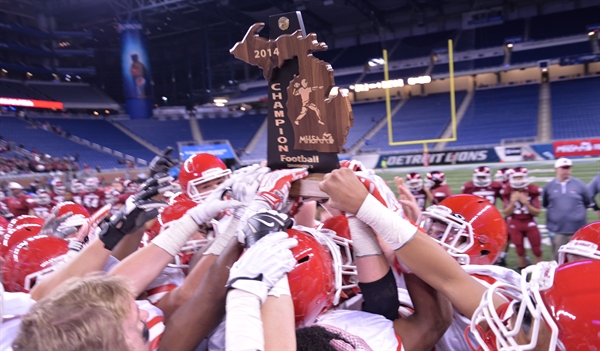
When time expired, St. Mary's had its sixth MHSAA title, while the Big Reds had to settle for the runner-up trophy for the third year in a row.
"A lot of teams around Muskegon can't say they've been there three years in a row," Muskegon senior lineman Rowland Sharp II said. "I've been here since my sophomore year. I'm very proud to say I made it to Ford Field. As I go into my career, I'll be able to say, yes, I played at Ford Field; that's an NFL stadium I played in."
Muskegon's explosive ground game was held to 109 yards on 33 carries. St. Mary's also struggled with its trademark running game, gaining 133 yards on 45 carries.
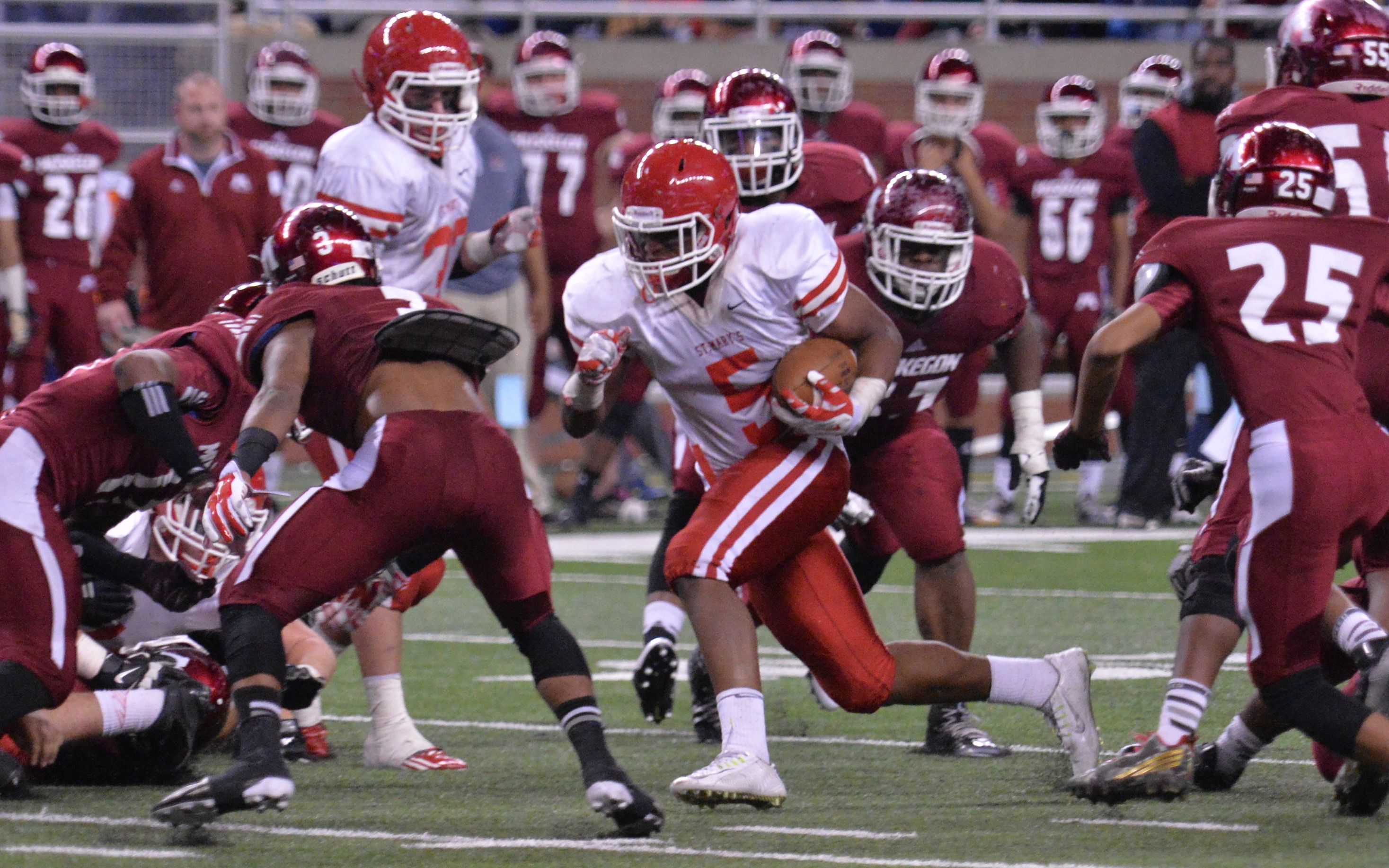
PHOTOS: (Top) Orchard Lake St. Mary’s hoists its Division 3 championship trophy after the final football game of the 2014 MHSAA season Saturday. (Middle) St. Mary’s Josh Ross (5) breaks through the line as Muskegon defenders pursue. (Click for action photos and team photos from Hockey Weekly Action Photos.)
VIDEO HIGHLIGHTS:
BIG REDS GOAL LINE TAKEAWAY - Early in the second quarter, Muskegon forces an Orchard Lake St. Mary's fumble, which is recovered by Alezay Coleman.
EAGLETS THWART MUSKEGON'S LAST CHANCE - Muskegon's last offensive chance came near the midpoint of the fourth quarter, where on a fourth down play, a Big Reds pass by intercepted by Orchard Lake St. Mary's Dwayne Chapman. The Eaglets then ran out the clock and won the Division 3 championship game, 7-0.
Watch the entire game and order DVDs by Clicking Here.
Constantine Comeback Gets Running Start
By
Wes Morgan
Special for MHSAA.com
September 6, 2018
Shawn Griffith is fully aware of the fact he’s now coached fathers and sons, uncles and nephews during his tenure at Constantine High School.
 That doesn’t make him old, he says; it just means he’s “seasoned.”
It also means he’s now been around long enough to experience both the highs and lows of coaching. Traditionally one of the state’s small-school powerhouses, Constantine lost its way in 2017 with a 3-6 record — Griffith’s first losing season since taking over the program in 2007 and the school’s first sub-.500 season in 26 years.
With a pair of Division 6 championship game appearances (2011 and 2012) and a 114-36 overall record to his credit, last autumn’s fall from grace, though somewhat expected, he said, was a reminder that high school sports still have a cyclical nature.
Attrition, inexperience, lower participation numbers, defensive struggles and fractured team chemistry all attributed to the disappointing season. Still, the Falcons were four points away from five wins, which likely would have been enough to qualify for the playoffs. With a 5-4 regular-season record back in 2013, Constantine went on to advance to the Regional Finals, underscoring Griffith’s mantra of improving each week and what can be accomplished by doing so.
“We knew last year we were going to go through some growing pains,” Griffith said. “I think the 3-6 thing really helped these guys focus in the offseason, and they have done a great job coming together.”
Now the Falcons, 2-0 this year after blowout victories against Gobles (56-0) and Quincy (42-7), are out to reclaim their seat at the table, with expectations just as high as they’ve always been. A few players only need to look at their family trees to be reminded of what’s possible.
Senior fullback Brendon Schragg in particular has a bloodline that traces back to the most memorable year in Constantine football history, as his uncles literally carried the Falcons to their only MHSAA football championship.
 With Griffith then serving as offensive coordinator in 2004 — just the second season after he transitioned the offense from an I-Formation to the Wing-T — senior twins Jim and Mike Schragg lined up in the backfield for the Falcons and combined for nearly 3,800 rushing yards, fueling the team’s title run and 13-1 record.
Mike Schragg, a tailback, rushed for more than 100 yards in the championship game against Suttons Bay, a 34-13 Constantine victory. But it was fullback Jim Schragg’s legendary effort that put him atop the MHSAA record book list for yards in a Final after he went for 307, including an 89-yard run.
“We were loaded with backs,” Jim Schragg said. “It’s a fun offense to run. Some parents get ticked off that we don’t throw it enough, but you have three bad things that can happen with a pass and not too many bad things can happen with a run.
“It’s cool to have your name there with the record and all that. But the state championship is more important to me than the record and running for over 300 yards. The state finals was the whole goal for our senior class. It was state championship or bust. That was what every single kid played for on that team.”
Some things haven’t changed. Though going from a three-win season to a state title is extremely unlikely, Brendon Schragg and his teammates believe they can put together a pretty special year.
“They were superstars to me,” Schragg, who rushed for 575 yards and five touchdowns as a junior, said of his uncles. “I always had the dream that if you go to state, I want to go to state. That’s been a goal since I was 4 years old.
“In my opinion, come Week 5 when we start our (Southwestern Athletic Conference) games, I think we are going to come out and compete. There isn’t a doubt in my mind we can’t win a league title. I ask myself a question every day, ‘Why not us?’”
Brendon Schragg is a three-year starter and one of three returning backs this season. The Falcons haven’t needed complete games out of the trio in the victories so far this year, but Schragg has 145 yards and two TDs on 14 carries. He and teammates Hunter Lindbert and Josh Lawson will probably split the load the rest of the season. Lindbert has compiled 188 yards and 4 TDs on 14 carries, and Lawson has 235 yards and two TDs on 18 carries.
Of course, none of it would be possible without the big guys up front.
“We’re just more physical in the trenches this year,” Schragg said of linemen such as Trenton Stears, Marquise Wykle, Matt Hutton and Austin Loose. “Hutton, our center, both his uncles played on the state championship team, believe it or not.”
Part of Griffith’s job is to both encourage his players to shoot for the moon and to make sure they also have their feet firmly planted on the ground. He certainly understands there are challenges ahead with teams like Kalamazoo United, Watervliet and Schoolcraft.
“We look a lot better,” he said. “But we’re certainly not naïve; we see some pretty darn good football teams on our schedule here coming up. I think our guys have done a real good job of not blowing this out of proportion. It is what it is; it’s a good start. They have done a good job of concentrating and preparing week to week.”
 Wes Morgan has reported for the Kalamazoo Gazette, ESPN and ESPNChicago.com, 247Sports and Blue & Gold Illustrated over the last 12 years and is the publisher of JoeInsider.com. He can be reached at [email protected] with story ideas for Berrien, Cass, St. Joseph and Branch counties.
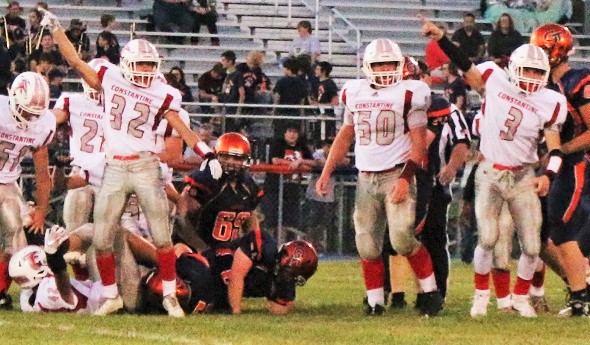
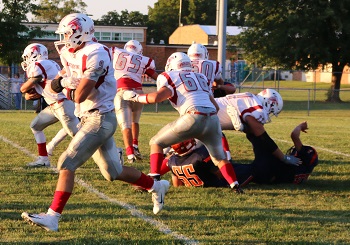
PHOTOS: (Top) Constantine defensive players motion for a turnover during their win over Gobles in Week 1. (Middle) Brendon Schragg, far left, breaks through the Gobles defense. (Photos courtesy of JoeInsider.com.)