

A Hero Comes Home to Vassar
October 17, 2012
By Alex Leveille and Tyler Langley
Vassar High School seniors
(Editor's note: Nothing short of incredible describes the story of U.S. Army Staff Sergeant Travis Mills. He is continuing a successful recovery from losing all four limbs after stepping on an improvised explosive device while on patrol in April during his third tour of duty in Afghanistan. His story turned a national spotlight on Vassar, a town of 2,700 people located in Michigan's thumb. Mills was an athletic standout for the Vulcans before graduating in 2005, and returned for Homecoming earlier this month. Vassar seniors Alex Leveille and Tyler Langley give us the story and explain its impact from a student point of view.)
Homecoming is about many things to high school students. But this year it got a whole lot bigger when word got out that Travis Mills, paratrooper of the 82nd Airborne, was coming home.
When the students at Vassar learned that Travis was coming back for Homecoming, everyone was excited to see him. A couple of students said they were really happy they would finally be able to meet the hero they heard all about.
“Seeing and meeting Travis was a really neat experience for me personally, so I can only imagine the effect he had on the community," said Vassar football player Brik Rupprecht, one of the team captains this fall. "When Travis showed up, you could really feel the positive energy coming from the crowd, supporting him, and the positive attitude Travis brought with him. When it came to the game, we just gave it our best for him. He told us he wanted to see a win, and that’s what we gave him. (Vassar defeated Unionville-Sebewaing that night 22-16.)”
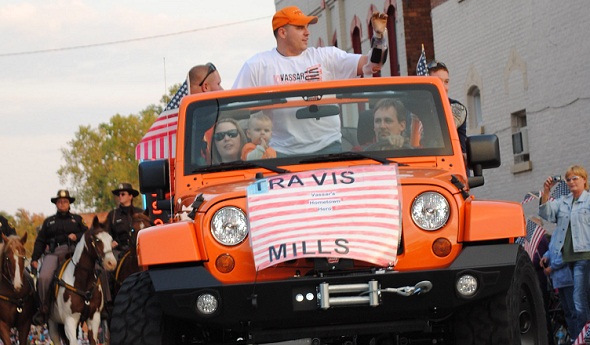
Many things were changed to accommodate Travis’s homecoming. The Homecoming parade, of which Travis was the grand marshal, was moved to Thursday, Oct. 4 instead of Friday before the game. It was followed by a bonfire at which Travis spoke to a crowd of more than 3,000 people, thanking them for everything they have done for him and his family.
On that Friday, the day’s events included a block party sponsored by many local businesses plus Pepsi and Frito-Lay. This was a chance for the community to come together to celebrate Vassar’s Homecoming, as well as welcome Travis home. The pregame festivities included a ceremony to thank all of the area’s veterans, including Travis.
Travis then took center stage before the game to again express his sincere thanks for the community’s love and support throughout his recovery. The community continued that support with various gifts to Travis and his family to further show their love for them.
He then led a special coin toss during which both Vassar and Unionville-Sebewaing players lined up intermixed on both 45 yard-lines to show their united support for Travis. He also spoke to the Vassar team before the game, encouraging them to "play every down like it’s your last, because you never know when it’s going to be your last.”

With Travis coming back to Vassar, our town was put in the spotlight of national news, which was something new to almost all of the students in Vassar. They all had different opinions about it too. Some didn’t like the thought of being in the eye of the country, but others did. Draven Muller, a sophomore and junior varsity football player, said it was a cool thought to be recognized nationally as a town and to be associated with a hero like Travis.
Jim Baker, a former paratrooper himself and teacher at Vassar High School, said, “Travis Mills is a true representative of what a paratrooper is all about. He makes me proud that I was a member of the 82nd Airborne Division.”
Vassar Chief of Police Ben Guile said he remembers Travis when he was in high school. “Only a person like Travis would have been able to survive something like this, and be as positive as he is," Guile said. "He is very charismatic, and him coming back home to thank the community is one of the best things he could have done. This town loves him, and I never have felt any more positive energy at a parade than the one that Travis led.”
Travis came back the following Friday, Oct. 12, to speak to the students at Vassar High School. Travis, being the upbeat guy he is, kept the crowd awake and laughing the entire assembly, cracking jokes and telling the crowd about his experiences in the Afghanistan war.
He also offered advice on high school and college experiences and talked about his plans after getting out of Walter Reed Medical Center, where he's undergoing occupational therapy.
As he put it, “Hopefully the Army will want me back after I’m done at Walter Reed. I might not be able to do all of the physical stuff anymore, but I still have everything they taught me in my head.”
He also plans to go back to college and get a degree in teaching, and hopefully become a teacher and a football coach some day.
Having Travis home was great for the community and the area. He is an all-around great guy and can uplift anyone’s spirits.
Click on links below for Mills' web site and some of the national coverage of his recovery and return home.
TravisMills.org - Fox News - USA Today - Detroit News - Saginaw News
PHOTOS: (Top) Travis Mills served as the grand marshal of Vassar's Homecoming parade Oct. 5. (Middle) Mills returned to his former high school Friday to tell students about his experiences in Afghanistan. (Top photo by Vassar High senior Sarah McKenney; middle photo by English and journalism teacher Jamie Strauss.)
Parking, Entrance Protocols Announced for 2025 11-Player Football Finals
By
Geoff Kimmerly
MHSAA.com senior editor
November 24, 2025
To provide for the convenience and safety of spectators attending the Michigan High School Athletic Association 11-Player Football Finals on Nov. 28 and 30 at Ford Field in Detroit, attendees are being advised of a variety of items related to transportation and security – including policies regarding parking, seating and types of bags allowed into the stadium.
Parking will be available in Ford Field facilities and lots to the east and north of the stadium and costs $8. A map identifying the designated Ford Field lots (4, 5 and 6) and parking deck can be found on the Football page under “2025 Road to the Finals.” (There also are a number of privately-operated parking facilities close to Ford Field, but their pricing may differ.)
Fans also are advised that the consumption of alcohol is prohibited in Ford Field parking facilities and lots, and smoking – including use of electronic cigarettes and vaporizers – is prohibited inside the stadium. Tailgating, including the setting up and use of grilling equipment, also is not allowed.
Tickets are priced at $20 and allow a fan to see all four games in a single day. Tickets are available for purchase at the door (cash or credit accepted), or online from Ford Field via Ticketmaster – links to order tickets both days also are on the MHSAA Website football page. Spectators leaving the stadium will be required to purchase another ticket for re-entry. Babes in arms will be admitted without charge for this event.
Spectators may enter Ford Field at Gates A, D & G. Upon arrival in the building, fans will find their designated seating areas on the South side of the field if their team is the designated home team for their contest and on the North side for the designated visiting team. Home teams this weekend are Detroit Catholic Central, Dexter, DeWitt, Hudsonville Unity Christian, Pontiac Notre Dame Prep, Jackson Lumen Christi, Menominee and Hudson. Brightly-lit video boards above the seating areas will display the names of the participating teams each day, and fans should sit on the side of the stadium where they see their school’s name. For general fans, the entire lower bowl of Ford Field will be open for the event.
Security measures also will be in place to help assure spectator safety. Fans will be subject to metal detector screening, and Ford Field personnel reserve the right to request patrons open their coats, bags and other item-carrying vessels for visual inspection and deny entrance to individuals who do not cooperate. Spectators should remove cell phones, cameras, keys and other large metal objects before passing through the metal detectors.
Items which fans will be prohibited from bringing into the building include, but are not limited to, the following:
* Purses larger than a clutch bag, coolers, briefcases, backpacks, book bags, diaper bags, fanny packs, cinch bags, grocery & paper bags; duffle bags, computer bags or luggage of any kind.
* Aerosol cans (hairspray, mace, pepper spray, etc.)
* Animals (except service animals to aid guests with disabilities)
* Balloons (air or helium)
* Balls (beach balls, footballs, etc.)
* Banners or large flags
* Cameras with lenses longer than five inches or any detachable lens. Selfie Sticks also are prohibited.
* Chairs including folding chairs or stools
* Decals, stickers, confetti or glitter
* Drones and/or remote-controlled aircraft
* Electronic equipment including laptop computers, video recorders (hand-held video cameras are allowed), tripods and wearable video cameras including Go Pros.
* Fireworks
* Flashlights
* Food, beverages – including water – or liquids (cans, bottles, boxes, flasks, etc.)
* Illegal substances
* Knives, pocketknives, box cutters, scissors, etc.
* Laser pointers
* Marijuana including medically prescribed electronic accessories or paraphernalia associated with marijuana or illegal narcotics use.
* Markers (permanent) and/or paint
* Noisemaking devices (bells, horns, kazoos, whistles, etc.)
* Objects that can be used as missiles or projectiles (sticks, poles, bats, clubs, Frisbees, etc.)
* Strollers and infant car seats or carriers
* Umbrellas (large size)
* Weapons
* Wrapped gifts
The following items may be permitted after inspection:
* Bags that are clear plastic, vinyl or PVC and do not exceed 12 inches by 6 inches by 12 inches, or a one-gallon clear plastic freezer bag (Ziploc or similar). An exception will be made for medically necessary items after proper inspection at the Gate.
* Infant items in a clear bag (bottles and formula) only if accompanied by a child
* Binoculars and binoculars cases not exceeding 4½ inches by 6½ inches may be brought in via one of the clear plastic bag options.
* Cameras (lenses may not measure longer than five inches or be detachable, and no tripods or extension cords)
* Small radios (no larger than the size of a football and used with an earpiece)
* Small, compact umbrellas (must be placed securely under seat)
* Posters and signs without poles or sticks, or larger than what one person can hold.
* Tablets (iPads, Kindles, etc.)
* Seat cushions not exceeding 15 inches by 15 inches. Seat cushions also must not contain arm rests, zippers, pockets, flaps or metal backs.
The complete list of prohibited items can be found on the Detroit Lions Website. Prohibited items that are discovered during security inspections at stadium entrances must be returned to the owner's vehicle or discarded. Items will not be held for later pickup.
Fans are reminded that all image taking (still and video) may be only for personal, non-commercial use.