

A Hero Comes Home to Vassar
October 17, 2012
By Alex Leveille and Tyler Langley
Vassar High School seniors
(Editor's note: Nothing short of incredible describes the story of U.S. Army Staff Sergeant Travis Mills. He is continuing a successful recovery from losing all four limbs after stepping on an improvised explosive device while on patrol in April during his third tour of duty in Afghanistan. His story turned a national spotlight on Vassar, a town of 2,700 people located in Michigan's thumb. Mills was an athletic standout for the Vulcans before graduating in 2005, and returned for Homecoming earlier this month. Vassar seniors Alex Leveille and Tyler Langley give us the story and explain its impact from a student point of view.)
Homecoming is about many things to high school students. But this year it got a whole lot bigger when word got out that Travis Mills, paratrooper of the 82nd Airborne, was coming home.
When the students at Vassar learned that Travis was coming back for Homecoming, everyone was excited to see him. A couple of students said they were really happy they would finally be able to meet the hero they heard all about.
“Seeing and meeting Travis was a really neat experience for me personally, so I can only imagine the effect he had on the community," said Vassar football player Brik Rupprecht, one of the team captains this fall. "When Travis showed up, you could really feel the positive energy coming from the crowd, supporting him, and the positive attitude Travis brought with him. When it came to the game, we just gave it our best for him. He told us he wanted to see a win, and that’s what we gave him. (Vassar defeated Unionville-Sebewaing that night 22-16.)”
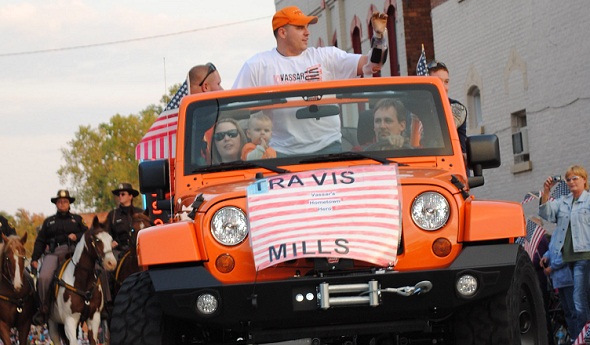
Many things were changed to accommodate Travis’s homecoming. The Homecoming parade, of which Travis was the grand marshal, was moved to Thursday, Oct. 4 instead of Friday before the game. It was followed by a bonfire at which Travis spoke to a crowd of more than 3,000 people, thanking them for everything they have done for him and his family.
On that Friday, the day’s events included a block party sponsored by many local businesses plus Pepsi and Frito-Lay. This was a chance for the community to come together to celebrate Vassar’s Homecoming, as well as welcome Travis home. The pregame festivities included a ceremony to thank all of the area’s veterans, including Travis.
Travis then took center stage before the game to again express his sincere thanks for the community’s love and support throughout his recovery. The community continued that support with various gifts to Travis and his family to further show their love for them.
He then led a special coin toss during which both Vassar and Unionville-Sebewaing players lined up intermixed on both 45 yard-lines to show their united support for Travis. He also spoke to the Vassar team before the game, encouraging them to "play every down like it’s your last, because you never know when it’s going to be your last.”

With Travis coming back to Vassar, our town was put in the spotlight of national news, which was something new to almost all of the students in Vassar. They all had different opinions about it too. Some didn’t like the thought of being in the eye of the country, but others did. Draven Muller, a sophomore and junior varsity football player, said it was a cool thought to be recognized nationally as a town and to be associated with a hero like Travis.
Jim Baker, a former paratrooper himself and teacher at Vassar High School, said, “Travis Mills is a true representative of what a paratrooper is all about. He makes me proud that I was a member of the 82nd Airborne Division.”
Vassar Chief of Police Ben Guile said he remembers Travis when he was in high school. “Only a person like Travis would have been able to survive something like this, and be as positive as he is," Guile said. "He is very charismatic, and him coming back home to thank the community is one of the best things he could have done. This town loves him, and I never have felt any more positive energy at a parade than the one that Travis led.”
Travis came back the following Friday, Oct. 12, to speak to the students at Vassar High School. Travis, being the upbeat guy he is, kept the crowd awake and laughing the entire assembly, cracking jokes and telling the crowd about his experiences in the Afghanistan war.
He also offered advice on high school and college experiences and talked about his plans after getting out of Walter Reed Medical Center, where he's undergoing occupational therapy.
As he put it, “Hopefully the Army will want me back after I’m done at Walter Reed. I might not be able to do all of the physical stuff anymore, but I still have everything they taught me in my head.”
He also plans to go back to college and get a degree in teaching, and hopefully become a teacher and a football coach some day.
Having Travis home was great for the community and the area. He is an all-around great guy and can uplift anyone’s spirits.
Click on links below for Mills' web site and some of the national coverage of his recovery and return home.
TravisMills.org - Fox News - USA Today - Detroit News - Saginaw News
PHOTOS: (Top) Travis Mills served as the grand marshal of Vassar's Homecoming parade Oct. 5. (Middle) Mills returned to his former high school Friday to tell students about his experiences in Afghanistan. (Top photo by Vassar High senior Sarah McKenney; middle photo by English and journalism teacher Jamie Strauss.)
March to Marquette: 8-Player Preview
November 17, 2017
By Geoff Kimmerly
Second Half editor
The MHSAA 8-Player Finals return to where they got their start Saturday, with two champions to be awarded for the first time.
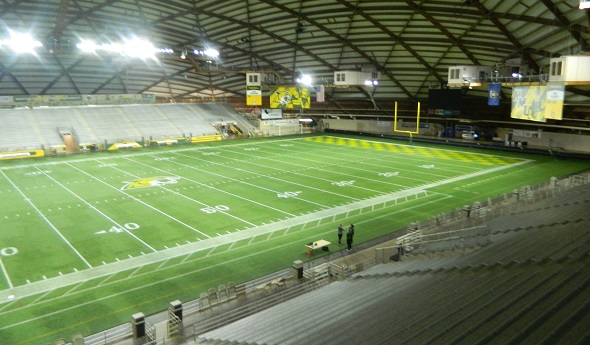
 Saturday’s games will be played at Northern Michigan University’s Superior Dome, which hosted the first MHSAA 8-Player Final in 2011. The 8-Player Playoffs also moved from one to two divisions this year, and Central Lake, Crystal Falls Forest Park and Portland St. Patrick all are seeking their first 8-player championships – while Central Lake will play 2012 champ Deckerville looking to win its first MHSAA title ever in the sport.
Both games will be broadcast live on the FOX Sports Detroit Facebook page and replayed on FOX Sports Detroit’s primary channel on Nov. 21 – Division 1 at 8 p.m. and Division 2 at 11 p.m. Audio of both games will be streamed live on MHSAANetwork.com.
Below is a look at all four finalists. Statistics are through Semifinals unless noted. The MHSAA Playoffs are sponsored by the Michigan Army National Guard.
 Division 1
CENTRAL LAKE
Record: 12-0, No. 1
Coach: Rob Heeke, seventh season (41-30)
League finish: First in Midwest Central Michigan Conference
Championship history: Has never played in an MHSAA Final.
Best wins: 54-20 over No. 7 Stephenson in the Semifinal, 58-26 (Regional Final) and 44-14 over No. 10 Suttons Bay, 36-14 (Pre-Regional) and 64-38 over No. 15 Mesick, 42-28 over Division 2 No. 2 Onekama.
Players to watch: QB/DB Gavin Mortensen, 5-11/160, sr. (1,062 yards/12 TDs rushing, 680 yards/18 TDs passing); TE/DB Jayce Hoogerhyde, 6-2/145, sr. (223 yards/8 TDs receiving, 49 tackles); RB/DB Skyler Spangler, 6-0/160, jr. (1,652 yards/26 TDs rushing, 272 yards/7 TDs receiving); RB/LB Grant Papineau, 6-3/210, jr. (1,886 yards/25 TDs rushing, 95 tackles).
Outlook: Central Lake has shined in its first season of 8-player football, improving from 2-7 in its final season of 11-player a year ago. Onekama came closest to catching the Trojans, losing by 14 in the game Week 8 that decided the league championship. It’s no secret how Central Lake succeeds; led by three 1,000-yard rushers, the Trojans have run for nearly 4,900 yards at 8.3 per carry. Defensively Papineau is a stopper, but Mortensen and Hoogerhyde are impressive pass defenders with 13 and 15 pass break-ups, respectively. Mortensen also has six interceptions.
DECKERVILLE
Record: 11-1, No. 3
Coach: Bill Brown, 25th season (201-71)
League finish: First in North Central Thumb League Stars
Championship history: 8-Player champion 2012, runner-up 2016.
Best wins: 52-18 over No. 5 Bellevue in the Semifinal, 38-0 over No. 4 Morrice in the Regional Final, 66-28 (Pre-Regional) and 42-8 over No. 12 Mayville, 20-14 over No. 6 Kingston, 52-0 over No. 16 Lawrence.
Players to watch: QB/DB Isaac Keinath, 5-10/155, soph. (660 yards/15 TDs passing); TB/DB Kenton Bowerman, 5-6/150, sr. (971 yards/14 TDs rushing, 8 interceptions); TE/LB/P Wyatt Janowiak, 6-4/255, sr. (288 yards/6 TDs receiving); TB/DB Cruz Ibarra, 5-10/150, jr. (1,430 yards/20 TDs rushing).
Outlook: A new cast of stars has emerged after most of last year’s graduated, and Bowerman stepped up even more last week scoring four touchdowns with leading rusher Ibarra reportedly out with an injury. Deckerville’s only loss this season was by a point to Morrice in Week 6, and was avenged with a 38-point shutout win in the Regional Final. Rival Kingston was the only other opponent to get closer than 20 points to catching the Eagles – despite a regular-season schedule that featured seven playoff teams. Senior Zachary Ostrowski has six catches as the team’s third-leading receiver – and five interceptions as its second-leading pass defender.
 Division 2
CRYSTAL FALLS FOREST PARK
Record: 9-2, No. 6
Coach: Dave Graff, fourth season (35-10)
League finish: Second in Western Eight Conference
Championship history: Three MHSAA titles (most recent 2007), 10 runner-up finishes.
Best wins: 36-34 over No. 1 Pickford in the Semifinal, 62-20 over No. 9 Engadine in the Regional Final, 20-6 (Pre-Regional) and 66-58 over No. 7 Powers North Central, 52-38 over Division 1 No. 13 Ontonagon.
Players to watch: RB/LB Connor Bortolini, 5-8/150, sr. (1,749 yards/20 TDs rushing); QB Tommy Peltoma, 6-1/180, soph. (666 yards/10 TDs passing); RB/DE Peter Ropiak, 6-0/185, sr. (863 yards/12 TDs rushing); RB/DB Calvin Post, 5-8/170, soph. (765 yards/9 TDs rushing, 4 interceptions).
Outlook: Forest Park is one of the most successful programs in MHSAA history, especially among smaller schools – it played in the Division 8 Final six straight seasons from 2004-09. The Trojans moved to 8-player last season and might have been the second or third-best team in Michigan, but shared a league and playoff path with eventual repeat champion Powers North Central and lost to the Jets in the Regional Final. Forest Park opened this season 1-2, but hasn’t been defeated since falling to Division 1 semifinalist Stephenson in Week 3. Bortolini took over this fall as the main ball carrier after the Trojans graduated a 2,400-yard rusher, and he’s carried on the program’s tradition of productive backs.
PORTLAND ST. PATRICK
Record: 11-1, No. 3
Coach: Patrick Russman, 11th season (69-42)
League finish: First in Central Michigan 8-Man Conference
Championship history: 11-Player Class D champion 1992, runner-up 1997 and 1991.
Best wins: 33-14 over No. 5 Kinde-North Huron in the Semifinal, 50-0 over No. 8 Flint International Academy in the Regional Final, 44-6 over No. 13 North Adams-Jerome in the Pre-Regional, 24-8 over No. 10 Marion, 38-22 over Division 1 No. 14 Webberville.
Players to watch: QB/DB Tanner Lawson, 6-3/165, jr. (1,093 yards/20 TDs passing); RB/LB Isaiah Smith, 5-10/190, sr. (359 yards/7 TDs rushing); RB/DL Ned Smith, 5-10/160, soph (779 yards/8 TDs rushing); WR/DB Will Simon, 6-2/170, sr. (395 yards/8TDs receiving). (Statistics through nine games plus one forfeit win.).
Outlook: St. Patrick also was one of the state’s top 11-player small-school programs through the 1990s and has been on the verge of playing for an 8-player championship since switching formats in 2012 – and making the Semifinals that first season. The only blemish on this season’s record was a Week 4 loss to eventual Division 1 semifinalist Bellevue, and no other opponent has gotten closer than 16 points. Junior linebacker Paul Cook is among those pacing a defense that has given up only 12.7 points per game.