

Highlight Reel: Saturday Football Finals
November 28, 2016
By John Johnson
MHSAA Communications Director
The final day of the MHSAA 11-Player Football Finals at Ford Field in Detroit – powered by the Michigan Army National Guard – produced a first-time gridiron champion and a game-winning play that will be talked about for a long time.
Division 7
Pewamo-Westphalia 28, Detroit Loyola 14
Logan & Lehman Go Long - The Pewamo-Westphalia combo of quarterback Jimmy Lehman and receiver Logan Hengesbach connected for two touchdowns in the Division 7 title game against Detroit Loyola. Here's the second TD in the third quarter, with Hengesbach winning the jump ball to complete a 37-yard scoring play.
Johnson Powers Into the End Zone - Detroit Loyola gets on the board midway through the fourth quarter, when TE Keith Johnson makes a great play to catch a pass from Price Watkins and then power into the end zone to complete the 18-yard score.
Division 1
Detroit Cass Tech 49, Detroit Catholic Central 20
CC Takes the Early Lead - Detroit Catholic Central led 14-7 at the end of the first quarter, taking the lead on this 35-yard pass interception return by Jack Morris.
The Peoples' Choice for Cass Tech - Detroit Cass Tech QB Rodney Hall tied a Finals record with five touchdown passes against Detroit Catholic Central - two going to Donovan Peoples-Jones, including this 49-yarder in the third quarter.
Division 5
Grand Rapids West Catholic 43, Menominee 7
Meyers Off to the Races - Grand Rapids West Catholic scored its first TD against Menominee on a pitch and catch from Gaetano Vallone to Brett Meyers covering 91 yards.
Hass Records a Finals First - Menominee uses special teams to get on the board in the third quarter. Sam Larson blocks the West Catholic field goal attempt, and Hunter Hass returns it 76 yards for a TD – the first time in Finals history a blocked field goal has been returned for a score.
Division 3
Orchard Lake St. Mary’s 29, Muskegon 28
Pimpleton's Second Score - Lined up in the slot, Muskegon's Kalil Pimpleton gets his second 18-yard rushing touchdown of the Division 3 Final against Orchard Lake St. Mary's on the end-around to give his team a 21-20 lead early in the fourth quarter.
A Catch for the Ages - In the closing seconds of the Division 3 Final, Orchard Lake St. Mary's QB Caden Prieskorn hits Ky’ren Cunningham in the end zone with an 18-yard touchdown strike to give the Eaglets the win.
The MHSAA Football Finals are sponsored by the Michigan National Guard.
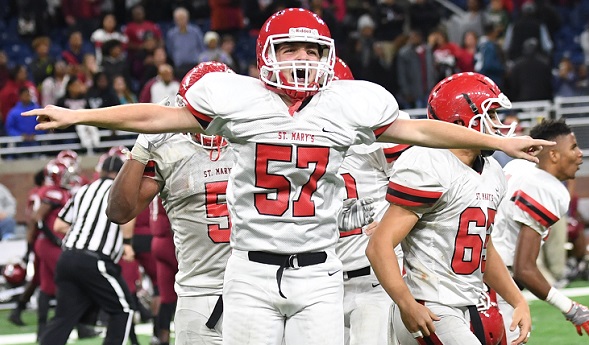
PHOTO: Orchard Lake St. Mary's Chris Bean celebrates during Saturday's Division 3 Final.

Committees Fail Critical Issues
June 7, 2013
Typically, each sport committee meets once each year for three to five hours, during which time it considers proposals that come from schools, leagues and the state’s coaches association for the sport; and the proposals most often deal with allowing more regular-season events and more qualifiers to the MHSAA postseason tournament.
Occasionally there is a proposal that might improve sportsmanship. But much more often the proposals would increase conflicts between academics and athletics and/or strain overstressed local budgets. And almost never is there a proposal that would address the health and safety of participants (the Wrestling Committee has been an occasional exception and the Competitive Cheer Committee is a routine exception).
While coaches associations must shoulder some of the blame because they’ve brought MHSAA committees “trivial” topics, at least in comparison to the tougher health and safety topics, much of the cause of MHSAA committee ineffectiveness is that the committees don’t meet long enough or often enough to research serious problems and develop well-thought-out solutions. That is forgivable because it is difficult to get commitments from busy people all across Michigan to be absent from their regular jobs and travel dozens or even hundreds of miles, and to do so multiple times each year – which is what it takes to more fully understand complex problems and more carefully construct solutions. Meetings have to be few and they have to be efficient.
However, facing the worst publicity football has seen since the mid-1970s, we knew we had to supplement the football committee process. We did so by appointing a special Football Task Force of optimum size and experienced, representative makeup to meet on however many occasions are necessary during 2013 to accomplish three purposes:
- Review practice policies to improve acclimatization of players and reduce head trauma.
- Review competition rules to reduce head trauma and the frequency of the sport’s most injurious game situations.
- Develop promotions that extol the value of football to students, schools and communities and the safety record of school-based football.
The promotional efforts have begun to be rolled out; game rule modifications are being investigated; and four proposals for changing football practice policies have been prepared. They will be the topic of our next posting.