

History-Making Huskies Reverse Course
October 12, 2016
By Geoff Kimmerly
Second Half editor
Breckenridge football coach Kris Robinson is doing his best to remain guarded despite his team’s history-making run to begin this season.
 But the signs something special is playing out in his community are impossible to miss.
Like the multiple TV crews that came to practice Tuesday, one from WJRT, a local channel that still is based more than 60 miles away in Flint. The second crew, from Fox Sports Detroit, was putting together a feature for its statewide audience.
And they are just the latest to take note of the undefeated Huskies, who are 7-0 and clinched their first league championship Friday since 1946 after finishing 0-9 last season.
“The atmosphere here Friday night against Merrill was ridiculous. Our student section, the outpouring has been pretty awesome,” Robinson said. “I was always told – our AD Ryan Sklener played basketball here in the (19)80s and he said when our team was good, they would line up four deep around the basketball court. He said that would happen (for football). I was waiting for it. It didn’t happen when we went 5-4, so I’ve been anxious to see it happen. And it sure has.”
The Breckenridge football team is the first Applebee’s statewide Team of the Month for the 2016-17 school year.
The Huskies have the opportunity to become the first Michigan team in the playoff era (beginning in 1975) to follow an 0-9 finish with a 9-0 regular season – not counting Bellaire, which went 0-9 in 11-player in 2010 but then 9-0 in 8-player the following fall. Even if Breckenridge falls short on that goal, it has guaranteed it will become just the eighth team since 1975 to come back from a winless season to make the playoffs the following year.
A “perfect storm” is how Robinson describes how his team has gone undefeated heading into this week’s matchup with Vestaburg. But truly, a number of pieces have fallen into place to help the Huskies make history – with more opportunities to do so on the way.
Robinson is in his fourth year as coach, having taken over a program in 2013 that went 1-8 the year before and hadn’t made the playoffs since 1993 before qualifying this season with a 38-0 win over Carson City-Crystal on Sept. 30.
His first team finished 2-7, and the Huskies improved to 5-4 in 2014. But they felt all the way back to square one last fall with only three seniors on the team and freshmen at quarterback and running back. Breckenridge scored 68 points over nine games and lost all of them by at least 21.
But things were about to change – and quickly.
“They were ticked off, especially that (current) sophomore group,” said Robinson, who previously coached wrestling at the school and as a football assistant at Farwell and Roscommon. “They’ve won at every level, and for them to come out last year and not win a game, there were some moments last year that were really tough on them.”
 First, Breckenridge – a Class C school with 235 students – is enjoying a roster of 28 players after finishing last fall with only 12. With that jump in numbers has come the opportunity to fit players at their best-possible positions, and at least half on both sides of the ball are playing only one way. Although this team will graduate 14 seniors, another solid group is waiting that is 4-1 at the junior varsity level with only a two-point loss to Fowler. Of 110 boys in the school, 50 are playing football.
Many also put in the time during the offseason. Robinson credits commitment to the weight room for a lot of this team’s turnaround as well, pointing to players like sophomore Lukas Ebright, who was a good JV player last season but added 25 pounds and increased his vertical jump to 32 inches during the offseason to line up this fall as a 5-foot-5, 155-pound cornerback.
It's also helped greatly that those freshmen playmakers from a year ago have become leading sophomores. Quarterback Carter Staley had run for 773 yards and 10 touchdowns and completed 62 percent of his passes for 711 yards and 12 scores heading into last week’s Merrill game. Including that 12-0 win over the Vandals, Hunter Collins has run for 762 yards and seven touchdowns, averaging more than nine yards per carry. (Click to watch the replay of Breckenridge vs. Merrill on MHSAA.tv.)
In front of them is an offensive line that averages 240 pounds, sizable for sure relative to the size of their school. It’s also been brought up that Breckenridge moved to a league this fall – the Mid-State Activities Conference – that is a better fit, as the Huskies have the third highest enrollment among eight schools in the league compared to when they were the third-smallest of eight schools in the Tri-Valley Conference West in 2015. But that doesn't mean the MSAC is some easy run; Breckenridge included, five of eight teams are 4-3 or better, and four teams are tied for second place in the league at 4-2 in conference games.
The Huskies can clinch the title outright Friday, which would represent another accomplishment – Breckenridge hasn’t won an outright conference championship since 1941.
Trophies celebrating those long-ago league championship seasons are among five total owned by the school – with two others a cup from 1917 and a 1931 trophy with a player kicking a football, except all that’s left is the foot. But that will change shortly, as well.
“We broke the season scoring record in Week 6, and they knew we broke the season scoring record and actually asked me that night if we’ve broken the record for breaking the most records yet,” Robinson said. “So they get it.
“But I don’t think they understand the gravity of the situation. This is older than their grandparents.”
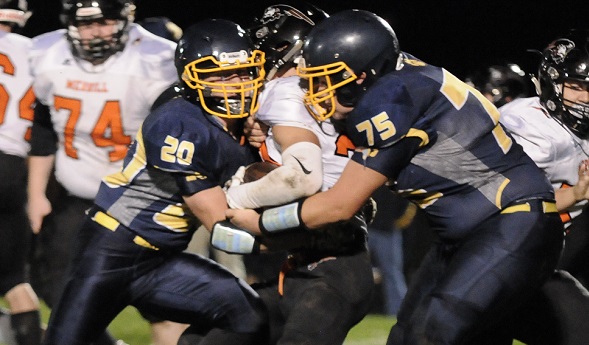
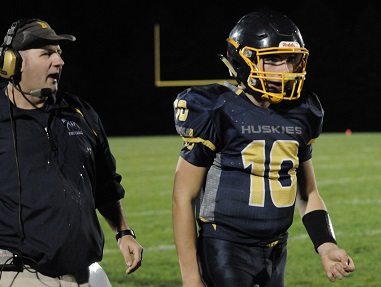
PHOTOS: (Top) A pair of Breckenridge defenders wrap up a Merrill ball carrier during Friday’s 12-0 league title-clinching win. (Middle) Huskies coach Kris Robinson (left) speaks with quarterback Carter Staley. (Click to see more from HighSchoolSportsScene.com.)
Drive for Detroit: Semifinals in Review
November 21, 2016
By Geoff Kimmerly
Second Half editor
After nearly four months, this drive for Detroit is nearly complete.
Sixteen teams remain for this weekend's eight MHSAA 11-Player Finals at Ford Field in Detroit. Below is a glance at how all 16 earned their end-of-season trips, with a number of them frequent visitors to the season's final days.
Division 1
Detroit Catholic Central 17, Romeo 0
The Shamrocks eliminated the reigning Division 1 champion in a matchup of last season’s Regional Final, a 40-29 Romeo win. Detroit Catholic Central (13-0) is on course for its best defensive season since 2011 and a win away from its first undefeated season since 2009. For Romeo (9-4), the loss ends a two-season run that saw the Bulldogs play in their second and third Semifinals ever (and first since 1992) while earning their first MHSAA team title and finishing a combined 22-5. Click for more from the Observer & Eccentric.
Detroit Cass Tech 32, Utica Eisenhower 28
Cass Tech standout receiver Donovan Peoples-Jones caught a 20-yard touchdown pass from quarterback Rodney Hall with only 24 seconds to play to push the Technicians (13-0) ahead of Eisenhower and soon after back into the Division 1 Final for the second straight season and fourth time this decade. The reigning runner-up in this division won its second straight nail-biter after downing Saline by one in the Regional Final, handing Eisenhower (12-1) its first loss after doing the same to the Hornets the week before. Click for more from the Detroit Free Press.
Division 2
Walled Lake Western 37, Lowell 34
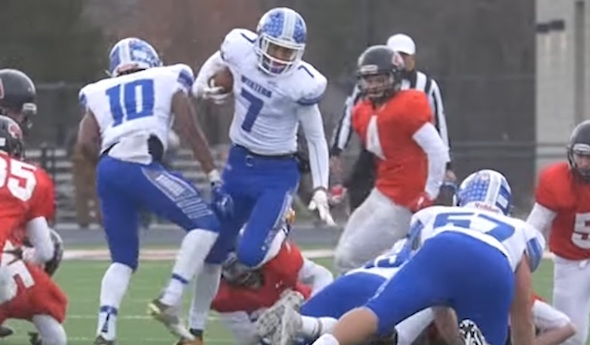
The Red Arrows (12-1), last season’s Division 2 runners-up, found themselves in a comeback quest for the second week in a row but couldn’t come all the way back in this rematch of a 2015 Semifinal. Walled Lake Western (12-1) led 31-14 at halftime and held Lowell off for the final 7:46 to advance to its first championship game since 1999. The Warriors had lost to Lowell 49-34 in the meeting a year ago. Click for more from the Oakland Press.
Detroit Martin Luther King 14, Birmingham Groves 7
King earned a chance to repeat as Division 2 champion with a defensive stand after heading into halftime up 14-0. The Crusaders (11-2) hadn’t scored fewer than 18 points since Week 1 of 2015, but were able to ride out the final two quarters relying on a defense that has given up only 35 points over four playoff games. Groves finished its first Semifinal run 11-2, setting a program record for wins for the second straight season after finishing 10-1 in 2015. Click for more from the Detroit News.
Division 3
Muskegon 19, Edwardsburg 8
This defensive standoff saw both teams easily score their fewest points this season – but Muskegon advance to its fourth championship game in five years while keeping Edwardsburg from advancing to the MHSAA Finals for the first time. The Big Reds (12-1) increased their school record points total to 653 and locked down an Eddies team that hadn’t scored fewer than 30. Edwardsburg finished 12-1, setting a program record for victories in one season. Click for more from the Muskegon Chronicle.
Orchard Lake St. Mary’s 49, Dearborn Divine Child 7
St. Mary’s will play for its third straight Division 3 championship and in its seventh MHSAA Final over the last eight seasons. Divine Child (10-3) was one of the surprises of the playoffs and finished with its most wins since 1985, but couldn’t come back after the Eaglets scored three times during the first quarter and three more times during the second. Click for more from the Oakland Press.
Division 4
Grand Rapids Catholic Central 31, Hudsonville Unity Christian 3
The Cougars (12-1) will play for a championship for the first time since 2010 after ending Unity Christian’s longest playoff run with another impressive defensive performance. GRCC has given up 10 points total over four playoff games and with Grand Rapids West Catholic in Division 5 gives the Ottawa-Kent Conference Blue two finalists this weekend. Unity Christian finished 10-3, two wins better than any season since the program began in 2003. Click for more from the Grand Rapids Press.
Detroit Country Day 20, River Rouge 14
After two straight Semifinal misses, Country Day will play in its second championship game in five seasons after eliminating last year’s Division 5 runner-up. River Rouge (11-2) held the Yellowjackets to their fewest points since opening night, but also scored its fewest since a 2014 Regional Final loss. Country Day (13-0) didn’t score during the second half, but Rouge didn't find the end zone again after scoring on its first possession of the third quarter. Click for more from State Champs! Sports Network.
Division 5
Menominee 23, Frankenmuth 20
Sam Larsen’s 1-yard touchdown blast up the middle with 9:27 to play stood as the winning points in a back-and-forth contest at the Superior Dome. Playing in its seventh Semifinal over the last 11 seasons, Menominee (12-1) earned its fourth championship game of this run and first since 2013. Frankenmuth (11-2) gave the Maroons their second-closest game of this season – the other was a loss to DeWitt in Week 8 – and tied its school record for wins with the most since the program’s last Semifinal run in 1997. Click for more from the Marinette (Wis.) Eagle Herald.
Grand Rapids West Catholic 17, Algonac 0
Reigning Division 5 champion West Catholic (11-2) completed an impressive even if not altogether unexpected run through three road games and a neutral-site semi to return to Ford Field. Defense has been the story for the Falcons this season, and they added a shutout after holding their first three playoff opponents to a combined 20 points. Algonac, in its first Semifinal appearance, held West Catholic to the latter’s second fewest points this season. But the Muskrats (11-2) failed to get on the board for the first time since Week 3 of 2014. Click for more from the Grand Rapids Press.
Division 6
Maple City Glen Lake 34, Leroy Pine River 20
Glen Lake’s earned it first trip to the Finals in football since 1996 on the success of a run game that was able to navigate the snowy conditions at Thirlby Field in Traverse City. Pine River (9-4), playing in its first Semifinal, had given up only 33 points total over the first three playoff games. Glen Lake (11-2), with the win, tied for its most in a season also since that 1996 run. Click for more from the Traverse City Record-Eagle.
Jackson Lumen Christi 27, Millington 7
Lumen Christi (11-2) is headed back to Ford Field for its first championship game since 2009 thanks in part to a second-straight single-digit performance by its defense. After holding Napoleon to only six points in the Regional Final, the Titans kept Millington to its fewest this fall (Millington also had scored only seven against Frankenmuth in Week 5). The Semifinal was the first for the Cardinals (11-1) since back-to-back trips in 2009 and 2010. Click for more from the Jackson Citizen-Patriot.
Division 7
Pewamo-Westphalia 34, Ubly 16
The Pirates (13-0) will return to the Division 7 Final after finishing runner-up a year ago. And they booked the trip by downing an undefeated team for the third straight week, handing Ubly (12-1) a first loss after doing the same to Traverse City St. Francis in the Regional Final and Saugatuck in the District championship game. After missing 100 yards rushing last week for the first time in three seasons, Pirates running back Jared Smith came back with 119 yards and two scores on 17 carries. Click for more from the Lansing State Journal.
Detroit Loyola 54, Cassopolis 22
Loyola will play in its fourth championship game in five seasons seeking to add to its 2014 title after continuing a playoff run that has seen the Bulldogs beat four league title winners and all by at least 23 points. Cassopolis (11-2), champion of the Berrien-Cass-St. Joseph Conference Red, was playing in its first Semifinal and set a program record this fall for victories. But the usually defense-strong Rangers couldn’t stop a Loyola attack that scored its second-most points this season. Click for more from State Champs! Sports Network.
Division 8
Muskegon Catholic Central 35, St. Ignace 0
The Crusaders (13-0) will play for a fourth straight Division 8 championship after improving on a Week 2 win over the Saints. MCC had beaten St. Ignace 21-6 in that first meeting, and led this one 21-0 by the end of its first possession of the second half. The shutout was the Crusaders’ third straight, and they’ve given up only seven points total over four playoff games. MCC also defeated the Saints (11-2) in a Semifinal last season. Click for more from the Muskegon Chronicle.
Ottawa Lake Whiteford 40, Saginaw Michigan Lutheran Seminary 21
Whiteford (13-0) has been building for years toward what will be its first championship game , and broke through after also playing but falling in a Semifinal a year ago. Jesse Kiefer ran for 183 yards and three touchdowns as the team piled up 526 yards of total offense, and the defense held mostly tight despite 152 yards rushing and two scores by MLS’s Casey Williams on only eight carries. The Cardinals finished 10-3 after reaching their second Semifinal in three seasons. Click for more from the Saginaw News.
PHOTO: Walled Lake Western's Cody White breaks through the line against Lowell in their Division 2 Semifinal on Saturday. (Photo courtesy of State Champs! Sports Network.)