

Honoring Lost Teammate, Jackson Rises
By
Chip Mundy
Special for Second Half
September 10, 2015
By Chip Mundy
Special for Second Half
JACKSON – Hollywood producers do not make movies about football teams just two games into a season.
But if they did, Jackson High School would be a good place to start.
 Take an urban football team that hasn’t made winning a habit in decades, mix in the recent addition of a successful coach from a nearby smaller rural school and throw in an eye-popping start this season, and you have a nice story. But there is more.
This also is a heart-wrenching – yet somehow uplifting – story of a bunch of teen-aged boys trying to move on a little more than three months after one of their teammates was killed in a triple-fatal automobile crash.
Meet the 2015 Jackson Vikings. Roll the film.
Dealing with adversity
It was the Sunday of Memorial Day weekend when everything changed. Jackson junior Maseo Moore, 16, was killed in a triple-fatal automobile accident on I-94 in Calhoun County. Also killed in the accident were former Jackson High School secretary Ella Blackwell, who had retired five years earlier, and her sister, Ethel Brinstone.
Moore, a wide receiver on the varsity in 2014, showed improvement late in the season and was in position to move up the depth chart for his senior year, according to Vikings head coach Scott Farley.
Moore’s death presented Farley with a challenge he had never faced during nearly 30 years of coaching.
“There is no session at coaching clinics that tells you how to deal with something like that,” Farley said. “We talked as a staff and kind of talked through what we wanted our reaction to be and how we could support the kids and each other at that point.
“I talked to my brother (Mike), who has been a head coach for years coaching down in Georgia, and he had kind of dealt with something similar, and I talked to a couple of other coaching colleagues to kind of pick their brain a little bit.”
The answer was simple but not so easy: Communication.
“We were just available to the kids,” Farley said. “We met with them in the library first hour and spent a couple of hours with them just talking about Maceo and what he would have wanted us to do going forward, and how we needed to support each other and love each other; basically, because we were all hurting.”
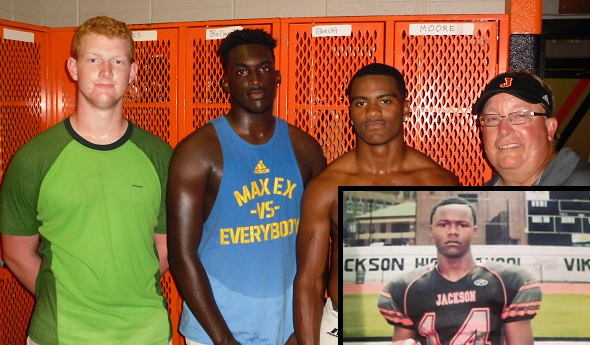
About 100 students, many of them football players, attended Moore’s funeral, and as the summer progressed, the players and coaching staff kept in touch with Moore’s family. A few decisions were made about the upcoming season: One, the team would dedicate its season – and in particular its opening game – to their friend and teammate, and two, running back Shonte’ Suddeth would inherit the No. 14 uniform that had been worn by Moore.
Not only did Suddeth have Moore’s number on the back of his uniform for the season opener, the name “Moore” was across the back instead of “Suddeth.”
“He was like a brother to me,” Suddeth said. “He was with me every day. I’d take him to get his hair cut and everything – everything he needed, I was there for him. Everybody noticed it, and we had a group meeting, and they said I should be the one to wear his number.”
With his emotions running high, Suddeth had an inkling of something special that might happen on opening night: He had talked with his uncle, who told him, “You have to score the first time you touch the ball.”
Just two and a half minutes into the game, Suddeth, on his first carry, raced 11 yards for a touchdown.
He dropped to one knee in the end zone and pointed toward the sky.
“I pointed up to the air to tell him, ‘This is for you,’” Suddeth said. “I think about him before every game.”
Suddeth finished with 110 yards rushing and three touchdowns on just eight carries as Jackson defeated Ann Arbor Huron 40-7. After the game, the entire team presented Moore’s mother with the game ball.
“I think the good Lord uses bad things and bad situations for good,” Farley said. “I think our kids have – where some of them could have gone in another direction because of their sadness and their depression over the loss of their friend – they have used it to become stronger as individuals and as a group, and that has been a positive.”
Moving forward
When you walk into the football locker room at Withington Community Stadium, the first locker on the right has tape with the name Moore on it. It looks like every other locker, but what it represents makes it special to the players and the coaching staff.
Moore’s presence always will be felt by the players, and the locker helps keep his memory fresh. But life and football games go on, certainly as Moore would have wanted. Jackson followed its opening-night win with an even more impressive 56-27 victory over Lansing Everett.
Tonight, Jackson travels to East Lansing in search of its first 3-0 start in football since 2003, the last time the Vikings also started 2-0 prior to this season.
Winning isn’t exactly a tradition in football at Jackson, where the Vikings have not won a conference championship since 1945. (Yes – 70 years!) But the first two games with a combined score of 96-34 offer a huge contrast from a year ago when the Vikings lost to Ann Arbor Huron and Lansing Everett over the first two games by a combined score of 57-12.
The players say the difference is experience and a better understanding of the system that was brought in by Farley, in his third season at Jackson after a long and successful run at Leslie.
“About halfway through last year, we started to get it,” Jackson senior offensive guard Nate Lavery said. “It took us longer than it could have. We came into the season knowing pretty much everything we needed to know – at least the basics.”
Lavery is one of several standouts for Jackson. He helps anchor a strong line while Suddeth, quarterback LaJuan Bramlett and Corey Pryor II offer game-breaking potential on every play. Bramlett scored five touchdowns in the victory over Lansing Everett, and Suddeth, Bramlett and Pryor each have rushed for more than 200 yards just two games into the season.
“We have more speed than normal this year,” Farley said with a grin before adding that the Vikings are much more than speed at the skill positions.
“Guys like Maurice White, who has caught one or maybe two passes up to this point, he’s such a great leader and such a steadying force on the entire team,” he said. “Nate Lavery was an all-conference guard last year and has just been outstanding in the first two games. Carl Albrecht and Mac Carroll on the offensive line have been outstanding seniors. Cain Flowers has had four interceptions in two games.”
Optimism about football isn’t something that has been common around Jackson very often. Since 1950, the Vikings have posted a record of 186-379-14 for a .333 winning percentage, and they won a total of four games from 2011-14.
Farley knows all about football programs in a tailspin. He faced a similar situation more than 20 years ago when he took over at Leslie.
The man in charge
When Farley was hired at Leslie in 1993, the Blackhawks had not had a winning record in 10 years. In fact, since finishing 10-1 in 1983, Leslie was 15-66 over the following nine seasons.
Not unlike Jackson, Farley took over a team in despair, and he said the similarities were striking.
“It was no different than when I took over at Leslie in 1993,” he said. “You have a program that has been down for a while; you’re going to have people who have bad attitudes. If they had winning attitudes, they’d be winning, so that was not a surprise. I anticipated that. I think some of the guys on my staff who have been here for a while were more discouraged about that than I was just from the standpoint of they had been here a while and they were frustrated by it. They kind of felt like it was different here than it is other places, and it’s not.
“The problems that we’ve had here are the same problems we had at Leslie 23 years ago.”
At Leslie, Farley achieved his first winning season in his second year, but it took until 2000 before the Blackhawks made it to the playoffs. When he left Leslie, about 15 miles north of Jackson, he had a record of 117-82, including 84-42 over his final 12 seasons with the Blackhawks.
In 2008, Leslie played for the MHSAA Division 6 championship, losing to Montague 41-20.
So, why would a coach leave such a successful program for one in so much turmoil?
“I think people looked at me and thought, ‘This guy is crazy. He had a good gig in Leslie, and he’s never going to be successful here,’” Farley said. “I could have rolled out of bed for the next 14 years doing the same job, but it was an easier decision because of the situation.
“I think this is what I’m built for. Part of my personal journey for taking the position was to kind of push myself outside of my comfort zone.”
In doing so, Farley has found himself using many of the same techniques he used when he took over the rebuilding job at Leslie.
“It’s the same thing,” he said. “It’s developing work ethic, and you develop work ethic by getting kids to buy into you more than what you are selling. Often, people don’t buy a car; they buy the guy they are getting the car from. It’s just getting them to believe that they want to be on your team.”
By all accounts, the 2015 Vikings want to be on Coach Farley’s team, and his handling of the Maceo Moore tragedy was just another reason for the players to put their trust in their coach.
“It showed he was really there for us,” Suddeth said. “It lit a match, and we were going from there.”
Farley has a keen perspective on the attitudes of today’s youth, one that might have helped him connect with his players.
“People talk all the time about how kids are different today, and kids are different,” he said. “I’ve been coaching for 28 years total, 23 as a head coach, and kids are different, but it’s not a bad different. In society in general, people don’t trust each other, and there is so much dishonesty that goes on out there that there is a reason to be distrustful.
“Kids get burned enough times, and they get to the point where they don’t trust people. They need to know who you are and what you’re about and what you stand for before they are going to buy into whatever you are selling.”
White, the senior receiver whom Farley praised for his leadership, said he has paid into what Farley was selling.
“At the beginning of the summer, I believed it and bought into it and could see we could be where we are now,” he said. “This is the second year in the system for me, and most of us returning are seniors, so we are pretty confident that we know what we are doing.
“This feels good. We feel pretty confident after two games, but at the same time, we’re not satisfied with being 2-0 right now. We want to keep on winning. I think we are playing more as a team and as a collective group. We’re like a band of brothers, and we come together as a team on Friday nights.”
 Chip Mundy served as sports editor at the Brooklyn Exponent and Albion Recorder from 1980-86, and then as a reporter and later copy editor at the Jackson Citizen-Patriot from 1986-2011. He also co-authored Michigan Sports Trivia. E-mail him at [email protected] with story ideas for Jackson, Washtenaw, Hillsdale, Lenawee and Monroe counties.
PHOTO: Jackson football players (left to right) Nate Lavery, Maurice White and Shonte' Suddeth and coach Scott Farley stand in front of the locker that continues to bear the name of teammate Maseo Moore (inset).
A Game for Every Fan: Week 5
September 20, 2012
By Geoff Kimmerly
Second Half editor
Some of the strongest followings of high school football in this state take place in some of our smallest communities.
And some of Michigan's smallest towns should see some of the best games of this week, the midpoint of the 2012 regular season.
See below for this observer's picks of the best matchups from your corner of the state. And remember to visit the MHSAA Score Center all weekend for updated scores and standings.
(All are tonight unless noted. Go to Score Center for additional dates and kickoff times.)
Bay and Thumb
Vassar (4-0) at Reese (4-0)
A move into the Greater Thumb Conference West five years ago, from the Tri-Valley Conference East, has paid off for Vassar. The Vulcans are 30-14 in that time, including a 4-0 start this fall during which they’ve outscored opponents 127-6. The only league team they haven’t beaten since the move: Reese, which handed Vassar its only GTC West losses the last two seasons and is averaging 45 points per game.
Others that caught my eye: Merrill (2-2) at Carrollton (4-0), Saginaw Swan Valley (4-0) at Freeland (3-1), Mount Pleasant (2-2) at Midland (4-0), Essexville Garber (3-1) at Millington (3-1).
Greater Detroit
Livonia Churchill (4-0) at Canton (3-1)
Churchill is lining itself up well for its best season in decades. The Chargers have the most playoff points in the state through four games, have scored at least 35 points in each, and with a another win over Canton – Churchill beat the Chiefs by a point last season – the Chargers will be heavy favorites to win their first league championship since 1979. What about Canton? Its only loss this season was by a point to undefeated Midland.
Others that caught my eye: Detroit Cass Tech (4-0) at Orchard Lake St. Mary (3-1), Farmington (4-0) at Oak Park (4-0), Warren Michigan Collegiate (4-0) at Detroit University Prep (4-0), Wyandotte Roosevelt (4-0) at Taylor Truman (4-0).
Upper Peninsula
Cedarville (4-0) at Eben Junction Superior Central (4-0)
In no other division is the importance of playoff points as cut and dried as in 8-player. The top 16 teams, based on playoff points, make the postseason. Simple as that. These two are in fine shape so far; Cedarville is second only to Portland St. Patrick in points, and Superior Center is third. And they’re also two of three 4-0 teams atop the Bridge 8-Man Football Alliance (Rapid River is the third.). Cedarville and Rapid River shared the title in 2011.
Others that caught my eye: Powers North Central (3-1) at Crystal Falls Forest Park (4-0), Iron Mountain (2-2) at Ishpeming Westwood (2-2), Hurley, Wis (2-2) at Bessemer (3-1), Engadine (2-1) at Rapid River (4-0).
Southwest and Border
Watervliet (4-0) at Hartford (4-0)
No league’s teams have enjoyed more nonconference success than the members of the Southwestern Athletic Conference South. Five of the six have started the season 4-0, with these two perhaps the most impressive so far. Watervliet has followed its 10-win season of last fall by outscoring its first opponents in 2012 by a combined 204-13. Hartford hasn’t been far behind that pace, winning all of its games by at least 28 points.
Others that caught my eye: Lawton (4-0) at Decatur (4-0), Three Rivers (3-1) at Edwardsburg (3-1), St. Joseph (3-1) at Portage Central (3-1), Stevensville Lakeshore (4-0) at Niles (3-1).
West Michigan
Whitehall (2-2) at Montague (3-1)
These West Michigan Conference rivals have played annually for the “Bell” since 1906, with Montague winning the last five meetings. Despite a big loss to Muskegon Oakridge, the Wildcats have won their other three games this fall by a combined score of 152-0. But don’t count out Whitehall; after a 2-0 start, its losses were by eight and four points to Shelby and North Muskegon the last two weeks, respectively.
Others that caught my eye: Caledonia (4-0) at Grand Rapids Christian (3-1), East Grand Rapids (2-2) vs. Grand Rapids Forest Hills Central (3-1) at Fifth Third Ballpark, Hudsonville Unity Christian (2-2) at Grand Rapids South Christian (3-1), Muskegon Oakridge (4-0) at Ravenna (2-2).
Mid-Michigan
DeWitt (3-1) at St. Johns (4-0)
Both coming off of one-point wins last week, these Capital Area Activities Conference Red rivals either will be worn down, or more likely raring to go against what has arguably become the biggest rival for both. These teams haven’t had to play this many close games in a while, and this one should be tight too – all four Redwings wins this season have come by six or fewer points, and DeWitt has scored as many as it has given up. The Panthers hold a 4-3 edge since the series was renewed in 2005.
Others that caught my eye: East Lansing (4-0) at Holt (2-2), Charlotte (2-2) at Mason (4-0), Portland (4-0) at Williamston (3-1), Comstock Park (3-1) at Belding (2-2).
Lower Up North
Pellston (4-0) at Pickford (4-0)
Pellston is arguably the biggest surprise of the northern Lower Peninsula – the Hornets had won a combined four games over the last three seasons, and last won four in one season in 2002. But Pickford also has to be excited about its best start since 2005, especially in its first season in the Ski Valley Conference, which added teams and split into the North and South this fall. The Panthers are just two more wins from their first playoff berth since 2007.
Others that caught my eye: Traverse City Central (3-1) at West Branch Ogemaw Heights (2-2), Onaway (4-0) at Mancelona (4-0), Lake City (4-0) at McBain (2-2), Boyne City (4-0) at Traverse City St. Francis (2-2).
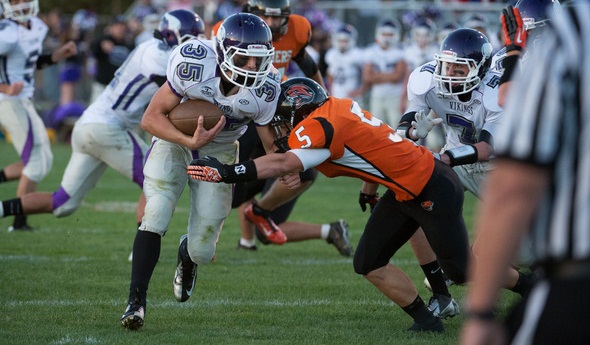
PHOTO: Saginaw Swan Valley (white jerseys) defeated Alma last week to remain atop the Tri-Valley Conference Central standings. (Click to see more from HighSchoolSportsScene.com.)