

Honoring Lost Teammate, Jackson Rises
By
Chip Mundy
Special for Second Half
September 10, 2015
By Chip Mundy
Special for Second Half
JACKSON – Hollywood producers do not make movies about football teams just two games into a season.
But if they did, Jackson High School would be a good place to start.
 Take an urban football team that hasn’t made winning a habit in decades, mix in the recent addition of a successful coach from a nearby smaller rural school and throw in an eye-popping start this season, and you have a nice story. But there is more.
This also is a heart-wrenching – yet somehow uplifting – story of a bunch of teen-aged boys trying to move on a little more than three months after one of their teammates was killed in a triple-fatal automobile crash.
Meet the 2015 Jackson Vikings. Roll the film.
Dealing with adversity
It was the Sunday of Memorial Day weekend when everything changed. Jackson junior Maseo Moore, 16, was killed in a triple-fatal automobile accident on I-94 in Calhoun County. Also killed in the accident were former Jackson High School secretary Ella Blackwell, who had retired five years earlier, and her sister, Ethel Brinstone.
Moore, a wide receiver on the varsity in 2014, showed improvement late in the season and was in position to move up the depth chart for his senior year, according to Vikings head coach Scott Farley.
Moore’s death presented Farley with a challenge he had never faced during nearly 30 years of coaching.
“There is no session at coaching clinics that tells you how to deal with something like that,” Farley said. “We talked as a staff and kind of talked through what we wanted our reaction to be and how we could support the kids and each other at that point.
“I talked to my brother (Mike), who has been a head coach for years coaching down in Georgia, and he had kind of dealt with something similar, and I talked to a couple of other coaching colleagues to kind of pick their brain a little bit.”
The answer was simple but not so easy: Communication.
“We were just available to the kids,” Farley said. “We met with them in the library first hour and spent a couple of hours with them just talking about Maceo and what he would have wanted us to do going forward, and how we needed to support each other and love each other; basically, because we were all hurting.”
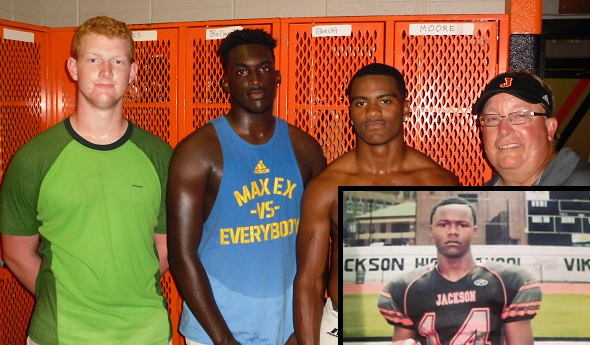
About 100 students, many of them football players, attended Moore’s funeral, and as the summer progressed, the players and coaching staff kept in touch with Moore’s family. A few decisions were made about the upcoming season: One, the team would dedicate its season – and in particular its opening game – to their friend and teammate, and two, running back Shonte’ Suddeth would inherit the No. 14 uniform that had been worn by Moore.
Not only did Suddeth have Moore’s number on the back of his uniform for the season opener, the name “Moore” was across the back instead of “Suddeth.”
“He was like a brother to me,” Suddeth said. “He was with me every day. I’d take him to get his hair cut and everything – everything he needed, I was there for him. Everybody noticed it, and we had a group meeting, and they said I should be the one to wear his number.”
With his emotions running high, Suddeth had an inkling of something special that might happen on opening night: He had talked with his uncle, who told him, “You have to score the first time you touch the ball.”
Just two and a half minutes into the game, Suddeth, on his first carry, raced 11 yards for a touchdown.
He dropped to one knee in the end zone and pointed toward the sky.
“I pointed up to the air to tell him, ‘This is for you,’” Suddeth said. “I think about him before every game.”
Suddeth finished with 110 yards rushing and three touchdowns on just eight carries as Jackson defeated Ann Arbor Huron 40-7. After the game, the entire team presented Moore’s mother with the game ball.
“I think the good Lord uses bad things and bad situations for good,” Farley said. “I think our kids have – where some of them could have gone in another direction because of their sadness and their depression over the loss of their friend – they have used it to become stronger as individuals and as a group, and that has been a positive.”
Moving forward
When you walk into the football locker room at Withington Community Stadium, the first locker on the right has tape with the name Moore on it. It looks like every other locker, but what it represents makes it special to the players and the coaching staff.
Moore’s presence always will be felt by the players, and the locker helps keep his memory fresh. But life and football games go on, certainly as Moore would have wanted. Jackson followed its opening-night win with an even more impressive 56-27 victory over Lansing Everett.
Tonight, Jackson travels to East Lansing in search of its first 3-0 start in football since 2003, the last time the Vikings also started 2-0 prior to this season.
Winning isn’t exactly a tradition in football at Jackson, where the Vikings have not won a conference championship since 1945. (Yes – 70 years!) But the first two games with a combined score of 96-34 offer a huge contrast from a year ago when the Vikings lost to Ann Arbor Huron and Lansing Everett over the first two games by a combined score of 57-12.
The players say the difference is experience and a better understanding of the system that was brought in by Farley, in his third season at Jackson after a long and successful run at Leslie.
“About halfway through last year, we started to get it,” Jackson senior offensive guard Nate Lavery said. “It took us longer than it could have. We came into the season knowing pretty much everything we needed to know – at least the basics.”
Lavery is one of several standouts for Jackson. He helps anchor a strong line while Suddeth, quarterback LaJuan Bramlett and Corey Pryor II offer game-breaking potential on every play. Bramlett scored five touchdowns in the victory over Lansing Everett, and Suddeth, Bramlett and Pryor each have rushed for more than 200 yards just two games into the season.
“We have more speed than normal this year,” Farley said with a grin before adding that the Vikings are much more than speed at the skill positions.
“Guys like Maurice White, who has caught one or maybe two passes up to this point, he’s such a great leader and such a steadying force on the entire team,” he said. “Nate Lavery was an all-conference guard last year and has just been outstanding in the first two games. Carl Albrecht and Mac Carroll on the offensive line have been outstanding seniors. Cain Flowers has had four interceptions in two games.”
Optimism about football isn’t something that has been common around Jackson very often. Since 1950, the Vikings have posted a record of 186-379-14 for a .333 winning percentage, and they won a total of four games from 2011-14.
Farley knows all about football programs in a tailspin. He faced a similar situation more than 20 years ago when he took over at Leslie.
The man in charge
When Farley was hired at Leslie in 1993, the Blackhawks had not had a winning record in 10 years. In fact, since finishing 10-1 in 1983, Leslie was 15-66 over the following nine seasons.
Not unlike Jackson, Farley took over a team in despair, and he said the similarities were striking.
“It was no different than when I took over at Leslie in 1993,” he said. “You have a program that has been down for a while; you’re going to have people who have bad attitudes. If they had winning attitudes, they’d be winning, so that was not a surprise. I anticipated that. I think some of the guys on my staff who have been here for a while were more discouraged about that than I was just from the standpoint of they had been here a while and they were frustrated by it. They kind of felt like it was different here than it is other places, and it’s not.
“The problems that we’ve had here are the same problems we had at Leslie 23 years ago.”
At Leslie, Farley achieved his first winning season in his second year, but it took until 2000 before the Blackhawks made it to the playoffs. When he left Leslie, about 15 miles north of Jackson, he had a record of 117-82, including 84-42 over his final 12 seasons with the Blackhawks.
In 2008, Leslie played for the MHSAA Division 6 championship, losing to Montague 41-20.
So, why would a coach leave such a successful program for one in so much turmoil?
“I think people looked at me and thought, ‘This guy is crazy. He had a good gig in Leslie, and he’s never going to be successful here,’” Farley said. “I could have rolled out of bed for the next 14 years doing the same job, but it was an easier decision because of the situation.
“I think this is what I’m built for. Part of my personal journey for taking the position was to kind of push myself outside of my comfort zone.”
In doing so, Farley has found himself using many of the same techniques he used when he took over the rebuilding job at Leslie.
“It’s the same thing,” he said. “It’s developing work ethic, and you develop work ethic by getting kids to buy into you more than what you are selling. Often, people don’t buy a car; they buy the guy they are getting the car from. It’s just getting them to believe that they want to be on your team.”
By all accounts, the 2015 Vikings want to be on Coach Farley’s team, and his handling of the Maceo Moore tragedy was just another reason for the players to put their trust in their coach.
“It showed he was really there for us,” Suddeth said. “It lit a match, and we were going from there.”
Farley has a keen perspective on the attitudes of today’s youth, one that might have helped him connect with his players.
“People talk all the time about how kids are different today, and kids are different,” he said. “I’ve been coaching for 28 years total, 23 as a head coach, and kids are different, but it’s not a bad different. In society in general, people don’t trust each other, and there is so much dishonesty that goes on out there that there is a reason to be distrustful.
“Kids get burned enough times, and they get to the point where they don’t trust people. They need to know who you are and what you’re about and what you stand for before they are going to buy into whatever you are selling.”
White, the senior receiver whom Farley praised for his leadership, said he has paid into what Farley was selling.
“At the beginning of the summer, I believed it and bought into it and could see we could be where we are now,” he said. “This is the second year in the system for me, and most of us returning are seniors, so we are pretty confident that we know what we are doing.
“This feels good. We feel pretty confident after two games, but at the same time, we’re not satisfied with being 2-0 right now. We want to keep on winning. I think we are playing more as a team and as a collective group. We’re like a band of brothers, and we come together as a team on Friday nights.”
 Chip Mundy served as sports editor at the Brooklyn Exponent and Albion Recorder from 1980-86, and then as a reporter and later copy editor at the Jackson Citizen-Patriot from 1986-2011. He also co-authored Michigan Sports Trivia. E-mail him at [email protected] with story ideas for Jackson, Washtenaw, Hillsdale, Lenawee and Monroe counties.
PHOTO: Jackson football players (left to right) Nate Lavery, Maurice White and Shonte' Suddeth and coach Scott Farley stand in front of the locker that continues to bear the name of teammate Maseo Moore (inset).
Glen Lake Blazes Trail Back to Finals
November 23, 2016
By Dennis Chase
Special for Second Half
TRAVERSE CITY – Congratulatory messages streamed in Saturday after Maple City Glen Lake defeated Leroy Pine River 34-20 in a Division 6 football Semifinal at snow-covered Thirlby Field – a win that secured the Lakers’ first MHSAA Finals appearance in 20 years.
 Head coach Jerry Angers’ phone was particularly active. Among those calling or texting: Former Traverse City West coach Matt Prisk, who Angers previously worked under as a defensive coordinator; retiring St. Ignace coach Marty Spencer, whose Saints fell to defending Division 8 champion Muskegon Catholic earlier in the day; and Eric Gordon, the former Michigan State linebacker, who played for Prisk and Angers at West.
Angers, who was still fielding calls and texts late into the night Saturday, was “touched” by the show of support for his Glen Lake program.
Most of all, he was proud of his players, who kept improving every week to make this moment possible.
“They have worked hard for this opportunity,” he said. “I told them (after Saturday’s game), ‘You’re going to Ford Field. You’re one of 16 teams still playing. A lot of people will be watching, but I want you to enjoy it.’
“It’s like the Alan Jackson song ‘Remember When.’ I said in 20 years when you come back to see me I want you to say, ‘Remember when.’”
Glen Lake, which faces Jackson Lumen Christi for the title Friday, won the Class DD championship in 1994 under coach Bill Hollenbeck. The Lakers lost in the Class DD Final in 1996. Now, 20 years later, Glen Lake’s back.
“It’s an incredible feeling,” all-state linebacker Duke Angers, the coach’s son, said a few hours after the game. “It seems surreal right now. Growing up as a kid, you dream about playing at Ford Field. Now we get that opportunity. We’ll enjoy this for 24 hours and then get to work for Jackson Lumen Christi.”
Junior quarterback Cade Peterson, who rushed for 179 yards and three touchdowns in the win over Pine River, is also a coach’s son. His father, Tim, was head coach at Lake City for 15 seasons. The family moved into the Glen Lake school system this year. Tim is the quarterbacks coach for the Lakers.
“I’ve been going down to the state finals since I was 12,” Cade said. “And I would always think, ‘I want to play in this (state finals).’ Now it’s happening. You can ask any team in the state, and their ultimate goal would be to go to Ford Field and play for a state title. Only a few teams can say they accomplished that – and we did. As soon as that moment set in (Saturday), it was ‘Hey, we achieved our goal. Now let’s go win a state championship.’”
For Tim Peterson, who led Lake City to nine playoff berths, including Regional appearances in 2012 and 2013, it was a moment to savor.
“You work your whole life as a coach to try to get to the apex – and this is it,” he said. “We’re there. I couldn’t be happier for the kids, the program and the community.”
Now the task for the 11-2 Lakers is to a win a 12th game. Glen Lake will be taking on a program steeped in tradition. This will be Lumen Christi’s eighth MHSAA Finals appearance since 2000. The Titans have won five crowns during that span under coach Herb Brogan.
“Our kids have been facing challenges all year, and people keep underestimating them,” Tim Peterson said. “They just keep doing what they do – and they do it very well.”
Glen Lake’s losses were to Traverse City St. Francis (21-13) and Frankfort (26-21), teams that finished 11-1. The Lakers came in second to Frankfort in the Northern Michigan Football League’s Leaders division. Jerry Angers, now in his eighth season at the helm, said his team learned valuable lessons from those defeats.
“Sometimes losses are good for you,” he said. “We, as coaches and fans, never want to believe that, but in our two losses we had 15 or so penalties in one and five turnovers in the other. So you go back and you work on it. You try to reduce the penalties, reduce the turnovers. That became a great focus for our kids. I think we’ve had eight penalties in four playoff games – total. And we’ve kept our turnovers to a minimum. If you focus on the task at hand, and what’s in front of you, those things are going to be eliminated.”
Cade Peterson said the setbacks brought the team closer together, too.
“People can start pointing fingers (in defeat),” he said. “That didn’t go on here. Everybody picked each other up and kept fighting, kept going.”
 The 16 seniors on the team led the way.
“They set the tone,” Tim Peterson said. “The senior leadership has been phenomenal in keeping the focus.”
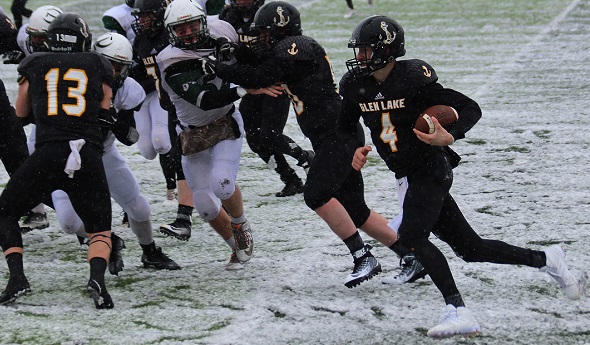
Glen Lake had to go on the road at Roscommon and Calumet to win two of its four playoff games. On Saturday, the Lakers, who were averaging 160 yards passing and 215 yards rushing per contest out of their spread offense, stuck to the ground to beat Pine River in blustery conditions that forced officials to clear snow off the artificial turf before and during the game.
Glen Lake rushed for 309 yards. In addition to Peterson’s 179 yards, Duke Angers picked up 59 and Nick Apsey 54. Apsey also hauled in two catches for 34 yards. The Laker backs – running behind a line that features tackles Jake Palmer and Brandon Tremble, guards Ryan Nadlicki and Zack Gushurst and center Tommy Kendall – averaged nearly five yards a carry. Nadlicki’s uncle, Mike, was a star on Traverse City’s state championship team in 1988.
“The weather forced us to be very one-dimensional (Saturday), but we’re real pleased with our ability to run the football as well as throw it,” Tim Peterson said. “That’s a good combination to have when you go deep into the playoffs because you never know what the weather will be.”
For the season, Cade Peterson’s completed 106 of 207 passes for 1,953 yards and 20 touchdowns. Jared Jackson, last year’s starting quarterback, has caught 30 passes, Apsey 23.
The 6-foot-4, 190-pound Peterson leads the team in rushing with 843 yards. Apsey, also a junior, has added 791 yards.
Defensively, Duke Angers, a four-year starter, is averaging 10 stops a game and Tony Duperon seven. Glen Lake is surrendering less than 200 yards in offense per game. Angers was the Traverse City Record-Eagle’s Defensive Player of the Year a year ago.
“As a football coach, he’s one of the best leaders and overall players that I’ve ever been associated with,” Jerry Angers said.
Jerry Angers led Glen Lake to back-to-back 9-2 seasons in 2012-13. The Lakers reached the District Finals those years.
Glen Lake qualified for the playoffs a year ago, finishing 5-5. This season, with a number of experienced players returning, coupled with the addition of Cade and Drew Peterson, the team has flourished. Drew is a sophomore defensive end and receiver. He had an interception Saturday.
Cade Peterson was a two-year starter at Lake City, throwing for 1,753 yards and 19 touchdowns as a sophomore.
“I feel a big part of why I’ve been successful (at Glen Lake) is because of how welcoming everybody was – not only the team and coaches, but the school and community,” he said.
“When those two (Peterson) boys walked in, our kids just grabbed them and said, ‘Hey, let’s go. You’re part of us now,’” Jerry Angers added.
Tim Peterson retired as a principal in June of 2015. He coached the Trojans that fall, but after the school year the family decided to make a move. Peterson was familiar with the Glen Lake area, since he worked camps with Hollenbeck. He was also good friends with Angers.
“It was time for a change,” Peterson explained. “We came up and looked at the academic piece of it, which is most important to us, and we said this is where we want to go.
“We’ve always said, at some point, we’d like to get here. This community is so supportive of their kids and of their school and that’s what you look for as a parent.”
Now the Lakers are one win away from a second MHSAA title. Regardless of what happens, though, Duke Angers said he believes his senior class has made an impact.
“We raised the bar a little,” he said. “We wanted to leave a trail to follow – and I think we have.”
 Dennis Chase worked 32 years as a sportswriter at the Traverse City Record-Eagle, including as sports editor from 2000-14. He can be reached at [email protected] with story ideas for Manistee, Wexford, Missaukee, Roscommon, Ogemaw, Iosco, Alcona, Oscoda, Crawford, Kalkaska, Grand Traverse, Benzie, Leelanau, Antrim, Otsego, Montmorency, Alpena, Presque Isle, Cheboygan, Charlevoix and Emmet counties.
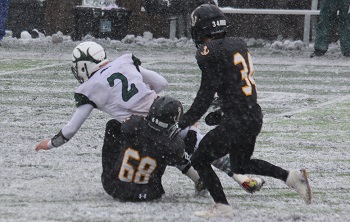
PHOTOS: (Top) Maple City Glen Lake’s Nick Apsey (5) follows his blockers on the way to the end zone during Saturday’s Semifinal win over Leroy Pine River. (Middle) Wes Peplinski (68) drops the Pine River quarterback in the 34-20 victory. (Photos by Kim Jackson.)