

Hudson, Morenci Fondly Recall Rivalry
January 31, 2020
By Doug Donnelly
Special for Second Half
MORENCI – It was a measuring stick for the season. It was Michigan vs. Ohio State, except inside state and county lines. It was tradition.
 The Morenci-Hudson football rivalry was like a lot of other football rivalries across Michigan. Often pitting cousin against cousin and friend against friend, the rivalry was among the oldest in the state, with a continuous string of games dating back 99 years.
However, following a cascade of league changes in southeastern Michigan and recent one-sided history in the matchup, the rivalry has been discontinued – leaving behind nearly a century of memories for both communities.
Hudson has dominated the series of late, winning 17 of the last 20 games on the field, although one of those wins was later forfeited. Over 99 years, Hudson holds a 61-39-2 advantage in 102 all-time meetings. But to those who have coached in and played in the game between two southern Lenawee County teams nestled near the state line, the game has always meant more than wins and losses.
“That game? That game was everything,” said Marc Cisco, a 1954 Morenci graduate. “It was the kind of game that kids lived for back then. Both communities would come out for that game. Heck, it would be packed for the JV game. We played in snow and rain. It didn’t matter.”
Cisco had families on both sides of the rivalry. His father’s farm backed right up to the Hudson school district line. His younger brother ended up playing at Hudson.
Cisco is a member of the Michigan High School Football Coaches Association Hall of Fame. He coached at Monroe Jefferson for 51 years, leading his team to the Class BB title in 1994. In high school he once led the state in scoring while playing for the Bulldogs. There was nothing quite like Hudson-Morenci, he said.
“It was the type of game that everyone talked about all summer,” Cisco said. “I knew a lot of players on Hudson’s team. We spent the summers up at Devil’s Lake, just like they did. It was really, really important to win that one.”
Hudson football historian Bill Mullaly has done the research on the rivalry. The two schools first met on the gridiron in 1921, meaning the 2020 game would have marked 100 continuous years of competition.
"It is sad to see this rivalry end,” Mullaly said. “I understand nothing lasts forever, but I always thought there would be a Hudson-Morenci game each fall.”
Both teams have enjoyed record-setting win streaks – and games against each other kept those streaks alive.
Morenci won 44 straight games from 1948 to 1953, setting the state record at the time. Hudson tied that record at Morenci in 1972, defeating the Bulldogs 42-0.
Hudson would go on to win 72 straight games, the national record at the time, under head coach Tom Saylor. One of the players for Saylor during that streak was Chris Luma, who played quarterback for the Tigers. Luma began coaching at Hudson soon after high school and was head coach of the Tigers varsity from 1997-2019, announcing his retirement this month. In 2009 and 2010, Luma coached the Tigers to shutout wins over Morenci – which was coached by Luma’s former coach, Saylor.
In 1982, Hudson opened the season with a 6-2 win over Morenci. The Bulldogs’ only score came when Hudson dropped back to punt and the snap went over the head of the punter and out of the back of the end zone for a safety. The Tigers didn’t give up a touchdown for the first 10 games that season but didn’t get the shutout against the Bulldogs.
“We didn’t allow them to score, we scored for them,” said Scott Marry, who played on that Tigers team that eventually lost in the Class C Semifinals. Marry, who has coached Hudson’s wrestling team to eight MHSAA Finals titles over the last 11 years, said it’s sad the game won’t be played going forward. “That game, every year, was so special. We’d open up with them every year, and you knew that if you won that game, you had a chance to go 9-0. That game was a measuring stick every year.
“I can still remember some of the collisions, the sound of the games against them.”
Jacob Bovee of Morenci played and coached in the rivalry. His wife is from Hudson.
“I remember my uncles and my grandpa talking about playing against Hudson,” Bovee said. “As a player, you liked to compete against them because you knew you were going to get their best shot. As a coach, you knew if you could play them tough you were going to be all right that season.
“We had some success against them, but records didn’t matter. You knew it was going to be a smash-mouth football game.”
Harley McCaskey was an all-state linebacker for Morenci before graduating in 2018. He played three games as a varsity player against the Tigers. The last two were excruciating two-point losses.
“My dad talked about the games he played against Hudson,” he said. “Everyone in school would talk about the Hudson game. When you started lifting weights for the season, you talked about beating Hudson.”
Hudson and Morenci were both members of the Lenawee County Athletic Association until Morenci left the LCAA to join the Tri-County Conference in 1981. Coincidentally, recent league shuffling played a major part in the move to discontinue the rivalry.
Whitmore Lake left the TCC before last season, causing a series of changes. Erie Mason left the LCAA to join the TCC. When that happened, Clinton left the TCC and joined the LCAA. Pittsford, left without an 11-player conference when Adrian Lenawee Christian and Athens decided to move to 8-player football for 2020, was added to the TCC as a football member starting this fall.
Pittsford and Morenci had been nonleague opponents for the last five years. With Pittsford joining the TCC, that left Morenci looking for a new nonleague opponent. The Bulldogs will open the 2020 season on the road at Three Oaks River Valley. Instead of keeping Hudson in the Week 2 slot – the teams have played each other that week for the last 15 years – Morenci instead will play Stockbridge.
Hudson, then, will play Erie Mason, now a nonleague opponent, in 2020.
Hudson has dominated the series in recent years, with several lopsided wins. The Tigers went 2-7 last season but beat Morenci 54-13 when the Bulldogs had fewer than 20 players on its roster. Morenci is 3-15 over the last two seasons, and the school district felt in order to rebuild the program, a new schedule would help.
But that doesn't mean the formerly annual meeting won't be missed. Marry said league or nonleague, home or away, Hudson vs. Morenci was a backyard rivalry that always seemed to be a little more important than some of the other games.
“If there was such a thing as a preseason playoff game, that was it,” he said. “It was a red-letter game for sure.”
 Doug Donnelly has served as a sports and news reporter and city editor over 25 years, writing for the Daily Chief-Union in Upper Sandusky, Ohio from 1992-1995, the Monroe Evening News from 1995-2012 and the Adrian Daily Telegram since 2013. He's also written a book on high school basketball in Monroe County and compiles record books for various schools in southeast Michigan. E-mail him at [email protected] with story ideas for Jackson, Washtenaw, Hillsdale, Lenawee and Monroe counties.
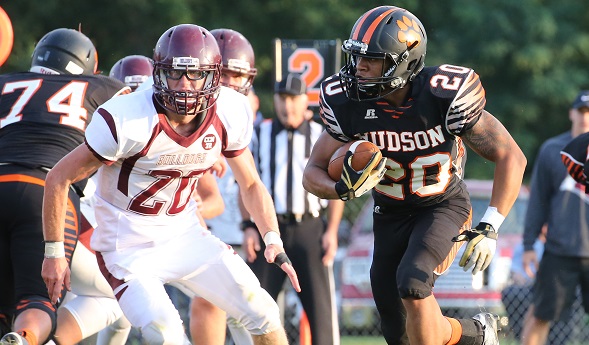
PHOTO: Hudson’s Malik Ray (26) breaks into the open as Morenci’s Harley McCaskey (20) pursues during the 2017 matchup. (Photo by Mike Dickie.)

Longtime Crew Leader Harrelson Begins 32nd Season on Chains, Amid Cancer Fight
By
Tom Spencer
Special for MHSAA.com
September 11, 2026
First down! Move the chains.
 As a member of the Suttons Bay chain gang, Jim Harrelson doesn’t know how many more times he’ll follow the referee crew’s direction on the Norsemen sideline. Similarly, he has no idea how many times he’s already moved the chains.
But, in the meantime, every time he does, it will undoubtedly be a school record. An unofficial record of course, but a well-earned and appreciated achievement nonetheless.
Harrelson stepped on the field Wednesday night sporting a down marker for the 32nd straight year. This time, it was for the Norse’s middle school contest with Onekama. Harrelson was joined by Curt Murphy and Dave Faught. Mike Gordon, another regular member of the crew, was also on hand to celebrate Harrelson’s 32nd season.
Wednesday’s chain gang team was organized – no surprise – by Harrelson. It’s something he’s done on a volunteer basis for Suttons Bay the last 16 years.
Harrelson’s crews have staffed middle school, junior varsity and varsity football games, including the home contests during the Norsemen’s three straight seasons from 2019-21 that culminated in three trips to 8-Player Division 1 Finals. Harrelson, Faught, Murphy and Gordon are in their 10th season working together.
“The chain gang was always his baby, and he was always able to go find other people to help him out,” said Doug Periard, a long-time member of the Norse football coaching staff and former school athletic director. “Somehow he managed to get some of those who might not have done much in football, to suddenly come on board and enjoy doing it.”
Harrelson, who last spring retired from a coaching career spanning 35 years, has no intentions of letting anything get in the way of holding the down marker for the Norsemen.
 “I've always loved sports, and being a part of the chain gang was always big part of it,” Harrelson said. “The ADs didn’t have to worry about it, knowing it was taken care of.”
Jamie Hawkins, Suttons Bay’s principal and current athletic director, was on hand for Wednesday’s kickoff as well. Hawkins, one of the administrators who has relied on Harrelson, believes the community owes Harrelson a huge thank you, acknowledging he has marked more first downs than anyone could ever comprehend.
“Jim’s years as a coach and chain gang chief are an amazing commitment to our student-athletes, our football program, and the entire Suttons Bay community,” said Hawkins. “His time, energy, and passion have been a part of countless Friday nights and memories for generations of Norsemen.”
Harrelson, now 82, is battling cancer for the second time in his life. He was first diagnosed with colorectal cancer in 2010. Early this year, he was told cancer had returned.
Working with doctors and his wife of 53 years, Brenda, Harrelson picked a six-week treatment plan this summer timing it so he could return to the sidelines for the first football game. He’s awaiting word from his medical team on the outcome of the most recent treatment.
“I haven't let it dominate my life – everybody's going to have trials and tribulations no matter what,” Harrelson said of his cancer return. “Cancer is something that thousands of people find themselves having to deal with, and I'm pretty proud I've been able to function pretty much as normal as could be even though it’s obviously right there in front of me.”
Harrelson’s coaching journey began in 1991 with softball, drawn into the role as his children made their way through the Suttons Bay school system. He went on to serve as an assistant and head volleyball coach from 1996 through 2004.
Eventually he served as an assistant or head coach for Suttons Bay in golf, cross country and track.
 Among the highlights of his time on the volleyball bench was helping guide the 2001 squad all the way to the MHSAA Finals, where the team earned a runner-up finish in Class C.
A short while ago, Harrelson was honored with the Don Lukens Legacy Award at the Traverse City Record-Eagle John Lober Honor Roll Meet for his coaching of student-athletes from all four Leelanau County schools – Maple City Glen Lake, Leland, Lake Leelanau St. Mary’s and Northport (with some of that coaching was made possible through the schools becoming a part of a co-op with Suttons Bay).
Much of Harrelson’s coaching was on a purely volunteer basis – even while serving as a head coach responsible for running an entire program.
Now, Harrelson’s favorite thing is watching his grandchildren grow and compete in sports, while admiring his adult children’s great parenting.
Harrelson points to his first grandchild’s birth 15 years ago as a prime motivator during the first cancer round. The Harrelsons have seven grandchildren now, one of whom was playing volleyball Wednesday night for Suttons Bay’s middle school team – with Grandma in the stands.
And while he’s remembered fondly by Leelanau athletes and athletic directors for his coaching commitment and success, Harrelson has only one thought for his family legacy.
“I just hope if I’m remembered for anything by my grandchildren and my kids is that I handled cancer pretty well without letting it affect me in any way, shape, or form in how I behave, how I coach or whatever,” Harrelson said. “I am pretty doggone proud of the fact that I've been able to put that on the table and still be able to function.”
Periard already views Harrelson as a great student-athlete advocate and solution finder.
“It was an incredible amount of time he put in doing the stuff he did and how much he loved it,” recalled Periard. “Cross country, track, whatever he was called upon, he was there to help out. He's a jack of all trades, a great kids guy at heart.”
 Harrelson’s first paid coaching job was as an assistant for track in 2006. At the time he was hired by Cody Ingils, then the Suttons Bay athletic director and now a senior assistant director for the MHSAA.
Harrelson asked Inglis a decade ago to delivery his eulogy someday upon the veteran coach’s passing.
“Jim also always wanted the best for kids at every turn, and he wanted to be a positive force in kids’ lives – and I think Jim's ultimate takeaway is he met the kids where they were and tried to make sure that they got better,” Inglis said. “Jim was able to work with elite athletes, and he was able to work with kids that had never done that sport before. And that was the beauty of his coaching, is that it applied to anybody and everybody because of his positive way of dealing with kids.”
Harrelson, who points to track as his favorite sport to coach because of the camaraderie, is ready to keep moving the down marker as he battles the return of cancer.
“What I've been experiencing is part of who I am,” Harrelson said. “It’s just the cards I've been dealt. I just want to do it with class if I can.”
 Tom Spencer is a longtime MHSAA-registered basketball and soccer official, and former softball and baseball official, and he also has coached in the northern Lower Peninsula area. He previously has written for the Saginaw News, Bay County Sports Page and Midland Daily News. He can be reached at [email protected] with story ideas for Manistee, Wexford, Missaukee, Roscommon, Ogemaw, Iosco, Alcona, Oscoda, Crawford, Kalkaska, Grand Traverse, Benzie, Leelanau, Antrim, Otsego, Montmorency, Alpena, Presque Isle, Cheboygan, Charlevoix and Emmet counties.
PHOTOS (Top) Suttons Bay football chain gang leader Jim Harrelson plants his down marker on the sideline during Wednesday’s middle school game with Onekama. (2) Harrelson shakes hands with referee Ed Blough. (3) Harrelson stands for a photo with Suttons Bay principal and athletic director Jamie Hawkins, far left, past athletic director and longtime coach Doug Periard, far right, and his chain gang of (from left) Dave Faught, Curt Murphy and Mike Gordon. (4) Harrelson enjoys a break in the shade. (Top and sitting photos by Meredith McNabb Photography. Others by Tom Spencer.)