

At Hudson, Winning Starts with the 'Ride'
November 2, 2017
By Doug Donnelly
Special for Second Half
HUDSON – It was a couple hours before kickoff for the Hudson Tigers, and head coach Tom Saylor didn’t think his team was focused enough.
 “It was early on in our winning streak,” said Saylor. “Everybody was kind of laughing and just not thinking about the game. I told them to get on the bus and we drove right out of town, past the cemetery and I think we drove clear to Clayton (a town about six miles away). The players were thinking, ‘What is this guy doing?’”
The home game for Hudson turned into a road game – complete with a bus ride. A tradition was born.
“I thought we played better on road games,” said Saylor, who coached the Tigers through their record-setting 72-game win streak during the 1970s. “There weren’t so many distractions.”
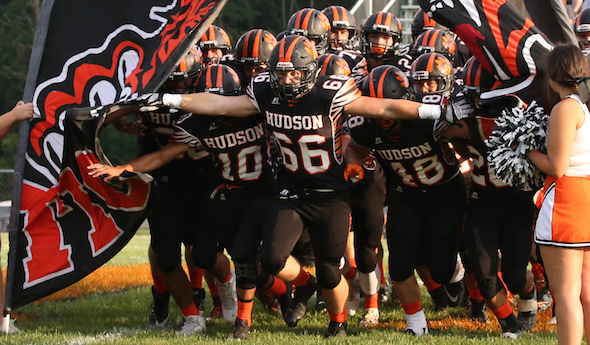
Friday night, Hudson’s players will board the bus once more this season and take the trip from the high school locker room into downtown Hudson to Thompson Field, where the Tigers play their home games. Hudson will take on Monroe St. Mary Catholic Central in a Division 7 District championship game.
The head coach now is Chris Luma, who was a quarterback for Hudson during part of that win streak. He said the bus ride is a little shorter these days, but remains a surreal moment for all Tigers players and coaches.
“Coach Saylor liked to only make right turns,” Luma said. “That was his thing. We’d go out of the school and only make right turns to get to the field. Now, we just come out of the school, go down Maple, go right past my house and turn and go to the stadium. It’s about a five-minute ride.”
And it takes place in total silence.
“I don’t even know how to explain it,” said Tigers running back Malik Ray, who has more than 1,500 yards rushing. “It’s a really different experience. It’s legit. We get on the bus and some kids pray and others just think about the game. We don’t have time to mess around. Once we hit the seats, it’s go time. There’s no joking around. No way.”
Luma said every so often a young player will board the bus and talk or say something and a captain will quickly let him know the bus ride is done in silence.
“I’ll get on the bus, count them up and make sure we have everybody and give them the look,” he said. “It’s all quiet. We drive to the stadium, pull up and the players get out and go to the shed. Everyone has their own routine.”
Hudson has been home to a lot of big games on Friday nights over the years. The Tigers’ tradition is well known. Hudson held the national high school football winning streak record of 72 games for 22 years. Thompson Field has been the site of a lot of those Hudson wins and impactful games.
“The place has held more huge games than any other venue in Lenawee County over the past 60 plus years,” said Hudson sports historian Bill Mullaly. “Thompson Field has been around since 1955, and there have been many exciting, thrilling and very meaningful games played there with upwards of 5,000-plus people watching, especially back in the winning streak days.”
Before 1955, Hudson’s field was located in a low area right next to the current stadium, which sits on a hill in town and was moved because the old field was prone to flooding. The stadium is not on campus, somewhat atypical at the high school level.
 Saylor used to live right next to the stadium, on the hill.
“I would wake up and see the stadium every morning,” he said.
Luma said the bus ride is different to the ‘home’ game than it is for an actual road game.
“When I was a player, I’d sit right next to Coach Saylor,” he said. “For road games, we’d go over my assignments, what he expected out of me. We’d talk about situations and what I should say or do in the huddle. I think those times sitting on the bus with him is one of the reasons I went into coaching.
“Riding to a home game, though, there was no talking. It’s still that way.”
Luma has had a remarkable coaching career at Hudson, winning 175 games, including a Division 7 championship in 2010. Friday will be Hudson’s second game ever against St. Mary, a traditional power from Monroe County with a couple of MHSAA championships to boast about – including its most recent in 2014, a Division 6 championship. The Falcons are competing for the first time in the Division 7 playoffs.
Ironically, both teams run the ‘T’ offense and both teams have strong rushing attacks. Hudson (9-1) was the Lenawee County Athletic Association champion while SMCC (6-4) got into the playoffs at 5-4 after navigating a difficult Huron League schedule.
No matter the weather, Thompson Field figures to be a packed house.
When it’s game time, Ray will board the bus, make the silent ride, get to the stadium and play catch for a few minutes with Hudson quarterback Andrew Valdez. When the team is ready to take the field, they’ll leave the shed and take turns with the rest of the team touching a sign above the door that says “The Team, The Team, The Team.”
Then – and only then – will it be game time.
“On the bus ride to the game, you’ll see people on the streets and they are waving at you and they are excited,” Ray said. “You can see joy in their eyes.
“Anytime you play in a playoff game, it’s a truly great experience. Playing one more game with these guys … its more than I can say.”
 Doug Donnelly has served as a sports and news reporter and city editor over 25 years, writing for the Daily Chief-Union in Upper Sandusky, Ohio from 1992-1995, the Monroe Evening News from 1995-2012 and the Adrian Daily Telegram since 2013. He's also written a book on high school basketball in Monroe County and compiles record books for various schools in southeast Michigan. E-mail him at [email protected] with story ideas for Lenawee and Monroe counties.
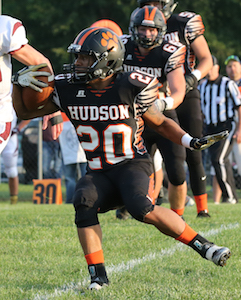
PHOTOS: (Top) Hudson’s players enter Thompson Field at the start of a game this season. (Middle) Malik Ray works to elude a Morenci defender during a Week 2 win. (Photos by Mike Dickie.)

2 Quarterbacks Vault Muskegon to #1
November 1, 2016
By Tom Kendra
Special for Second Half
Stopping the Muskegon High School offense has never been easy.
 This year, it’s twice as tough.
The Big Reds, 9-1 and ranked No. 1 in the season-ending Associated Press Division 3 poll, are attacking opponents with a two-headed monster at quarterback – diminutive senior Kalil Pimpleton (5-7, 160) and physically imposing junior La’darius Jefferson (6-2, 210).
“I’m blessed with two great men, two great leaders, at quarterback,” said seventh-year Muskegon head coach Shane Fairfield, whose team won the Ottawa-Kent Conference Black title. “Using both of them makes us a better team. We don’t go into games with a specific plan for when each will play (quarterback). We see what the defense is doing and how our kids are responding and go from there.”
The result of the dual QB attack has been a Muskegon offense which is averaging 54 points and 428 total yards per game heading into Friday night’s Division 3 District championship game against visiting East Grand Rapids (8-2).
Pimpleton, who has run a 4.4 in the 40-yard dash and has verbally committed to Virginia Tech, has started all 10 games for the Big Reds.
He is primarily a running threat, regularly taking snaps out of the pistol formation from senior center Devin Sanders and then finding a seam somewhere along the line to squeeze through. “KP,” as he’s known, has carried 101 times for 1,081 yards and 17 rushing touchdowns. He also has been effective through the air, completing 34 of 66 passes for 639 yards and six more TDs.
“I look at the system we use as a chance for me to use all of my weapons,” said Pimpleton, who also has three punt returns for touchdowns on his resume. “It doesn’t matter if I am at QB or in the slot. My character doesn’t change, and my focus doesn’t change.”
As good as Pimpleton has been, there have been times in recent years where opponents have bottled up Muskegon’s running quarterbacks.
One example was the 2014 Division 3 championship game at Ford Field, where Orchard Lake St. Mary’s shut down the Big Reds in a 7-0 victory. Another was last year’s Division 2 Regional championship game at Lowell, where Pimpleton and the Muskegon attack got stuck in the mud in a 36-7 loss.
 If that same scenario begins to unfold this fall, Muskegon offensive coordinator Brent White has a Plan B.
And what a Plan B it is.
Jefferson, who has the look of Cam Newton and the big arm to match, presents a whole new set of challenges for opposing defenses when he enters the game, which is normally around the Big Reds’ third offensive series. Jefferson brings a deep vertical passing threat, mixed with the size and strength to run over linebackers.
“I always tell myself that I can’t be stopped – that’s the mentality I like to play with,” said Jefferson, who also has delivered some big hits this fall during limited playing time at outside linebacker. “I just want to thank my coaches for using a two-QB system. Now we’ve got two hungry guys trying to win a state title.”
The benefits of Muskegon’s dual quarterback offense were apparent in last week’s 63-14 Division 3 Pre-District victory over visiting Grand Rapids Forest Hills Northern.
Muskegon’s offense struggled briefly in the early going before Jefferson ignited the Big Reds and their crowd with a 56-yard TD pass to Pimpleton, who had moved out to slot receiver. Near the end of the first quarter, Jefferson scored on a 2-yard run.
In the second quarter, it was back to Pimpleton at QB and he led a scoring drive, ultimately sprinting in from five yards out. And then it was back to Jefferson, who hit standout senior wide receiver Jacorey Sullivan on a 44-yard bomb over the top to complete Muskegon’s first-half scoring.
“The idea is that we have a system and our kids know how to play with either quarterback,” explained Fairfield. “If we do it right, it puts much more pressure on the defense, not knowing what they are going to get.”
Jefferson finished the win over Forest Hills Northern 7 of 8 passing for 175 yards and three touchdowns, along with 11 rushes for 91 yards and two more touchdowns. For the season, Jefferson has completed 42 of 69 passes for 724 yards and 15 touchdowns, against just two interceptions. He has rushed 66 times for 534 yards and 10 TDs.
The two quarterbacks are by far Muskegon’s top two rushers in an offense that lines up with four receivers on most downs. The lone starter in the backfield is senior Division I linebacker prospect Andrew Ward (6-1, 210), who is a devastating lead blocker. In recent weeks, the Big Reds have started to hurt opponents with jet sweeps featuring speedy juniors Da’vion McCall, Clinton Jefferson and Lonnie Clark Jr.
Fairfield, whose team has ripped off eight straight wins after a Week 2 loss to pass-happy Lincolnshire (Ill.) Stevenson, has guided Muskegon to MHSAA Finals three times in his first six years as head coach. The Big Reds have failed to take that final step on each of those occasions, falling to Birmingham Brother Rice in 2012 and 2013 and Orchard Lake St. Mary’s in 2014.
Given that recent heartbreak, the Big Reds have made it clear since Day 1 that the only acceptable outcome this season is an MHSAA title. The next challenge is a dandy matchup in Friday’s District championship game between two of the top tradition-rich programs in Michigan high school football history.
Muskegon is the state’s winningest with 816 wins and 17 state titles, including five in the MHSAA playoff era. East Grand Rapids, meanwhile, has won 11 championships since the playoffs began in 1975, including five in a row from 2006 to 2010. The Pioneers have won seven straight this fall after stumbling to a 1-2 start.
The two powers have played only two times in history, with Muskegon winning both times.
“We need to come out and play our game,” said Pimpleton. “We believe in our coaches and that they will put us in the best spots to win. That’s really all that matters. We can’t lose sight that no matter who is out there, that is our one goal.”
 Tom Kendra worked 23 years at The Muskegon Chronicle, including five as assistant sports editor and the final six as sports editor through 2011. E-mail him at [email protected] with story ideas for Muskegon, Oceana, Mason, Lake, Oceola, Mecosta and Newaygo counties.
PHOTOS: (Top) Muskegon quarterback La'darius Jefferson picks up yards on the ground this season against Byron Center. (Middle) Kalil Pimpleton, here following through on a pass, also is a threat to run. (Jefferson photo courtesy of Muskegon football program, Pimpleton photo by Tim Reilly.)