

Ice Man: Skyline's Copp sets football records, leaves legacy
October 27, 2011
Eventually, Andrew Copp may be best-known as a hockey star. His spot on the USA under-18 national team development program squad marks him as one of the top players his age in the country.
But he’ll be remembered as one of Ann Arbor Skyline’s first standout athletes for another sport he simply couldn’t give up.
Bittersweet and heart-breaking are how Copp described the end of this football season. The MHSAA playoffs begin this weekend, and he hoped to be a part -- a possibility that was likely closer than Skyline’s 3-6 record might imply, given four of those losses were by four or fewer points. And that’s not the worst part. Even if Skyline had earned a berth, Copp would’ve been forced to watch after breaking his right collarbone in multiple spots three weeks ago.
Still, there will be plenty to remember fondly for the first quarterback in his school’s four-year history. Two MHSAA records and his school’s first varsity football wins will top the list, even as the combination of football and the injury will force Copp the miss the first half of his USA team’s season.
“It means a lot, starting something new and trying to put your stamp on it,” Copp said. “As the quarterback, it’s a lot of weight on your shoulders to start something that 10, 20 years down the road people are going look at.
“Last year, when I got offered to play (USA) but had to quit football after the first game, I couldn’t do it. I just couldn’t quit on the team.”
That kind of leadership was “worth its weight in gold” for a school and program only just getting started, Skyline athletic director John Young said.
Copp likely would’ve attended Ann Arbor Pioneer -- like both of his parents had -- had Skyline not opened in fall 2008.
The Eagles’ football program started that first fall, but didn’t field a varsity team until 2010. Copp was the quarterback all four years until his he was injured on a run during the first quarter of his team’s Week 7 game against Temperance Bedford.
Two weeks earlier, against Ann Arbor Pioneer, Copp had thrown for an MHSAA record 557 yards and record-tying seven touchdowns. In six games this fall plus a few minutes of that seventh, Copp completed 96 of 156 passes for 1,732 yards and 27 touchdowns. Those season touchdown passes also qualify for an MHSAA record book listing, as do the 31 completions that led to his record-setting numbers against Pioneer.
“Obviously, I can’t throw for 557 yards without my line doing a great job, my receivers catching balls and making plays. And probably the most unsung heroes on our team are the running backs, who were blocking for me,” Copp said. “I just remember everything going our way, almost like a recess football game.”
But it took some flexibility from USA hockey and a tough decision by Copp to make it possible. Usually, USA players aren’t allowed to play other sports, Copp said, but he was granted that exception. He joined USA hockey after his junior football season, and this summer started that team’s workouts at 8 a.m. before then moving on to workouts and film study for football. This fall, after his five classes at Skyline to start the day, he’d work out for hockey from 1:30-4 p.m. every week Monday through Wednesday, then start football practice at 4:30. All while remaining a strong student and adhering to a hockey-imposed 9 p.m. curfew.
Ironically, the 6-foot, 185-pound Copp joined the football team to become more physical for hockey on the advice of his father Andy, a successful youth hockey coach. Andrew has seen some similarities between the two sports -- as a hockey center he also controls play. Hockey helped Copp be ready for a fast pace of play and developed the quick decision-making necessary to thrive at quarterback.
His football mind helped him help the Eagles when he could no longer lead them on the field. “He had surgery on Tuesday, missed Wednesday, and was back at practice the next day,” Skyline coach Rodrek Jones said. “That was the same day my offensive coordinator was not able to come to practice, and (Copp) called the entire practice for me. He stayed very focused.”
Copp still can’t carry his backpack around school, but hopes to play hockey by January. He is almost assured of an outstanding college hockey opportunity, and Jones thinks he has the ability to play college football as well. Young said Copp, along with receiver Jordan Woods (committed to Purdue) and volleyball player Maggie Halloran (committed to Michigan State), has put Skyline on the map. Despite the tough end this fall, it’s a legacy Copp is glad to leave for those who come after him.
“He’s one of the most popular kids in school, on the Homecoming king court ... a typical All-American kid,” Young said. “I’m extremely happy for him. I was disappointed he broke his collarbone, because he was on track for a more spectacular year. But he helped, along with other players, to elevate their play this year.”
PHOTO
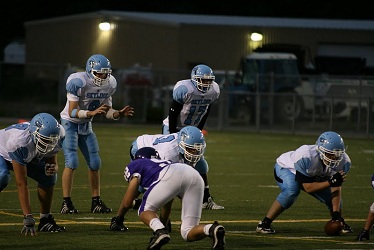
Skyline quarterback Andrew Copp (9) takes a snap against Ann Arbor Pioneer on Sept. 23. Copp threw for an MHSAA-record 557 yards and a record-tying seven touchdowns in a 52-49 loss. (Photo courtesy of Jeff Lepley. Head shot by Pete Draugalis.)
A Game for Every Fan: Week 5
September 25, 2014
By Geoff Kimmerly
Second Half editor
The MHSAA football season nearly stretches over four full months from the first practices until the final championship game ends at Ford Field in November.
But the regular season seems to fly by; just like that, we’re already halfway through and today a month away from the selection of this fall’s playoff divisions and brackets.
One team – two-time reigning Division 7 champion Ishpeming – can earn the first playoff berth of this fall with a win tonight and because it is playing only eight games during the regular season.
Read on for more of the most significant match-ups this weekend across the state.
West Michigan
Muskegon Oakridge (3-1) at Ravenna (4-0)
After three straight MHSAA Semifinal appearances from 2008-10, Ravenna fell back to the pack the last three seasons – finishing 4-5 each of the last two, even despite outscoring its opponents by 62 points in 2013. But the Bulldogs already have equaled that win total and can take another giant step back against Oakridge, a favorite in the West Michigan Conference that lost only on opening night to reigning Division 5 champion Grand Rapids West Catholic.
Others that caught my eye: Fruitport (2-2) at Muskegon Catholic Central (4-0), Rockford (4-0) at Caledonia (2-2), Grand Rapids South Christian (2-2) at Grand Rapids Catholic Central (2-2), Grand Rapids Forest Hills Northern (4-0) at Ada Forest Hills Eastern (2-2).
Bay and Thumb
Richmond (4-0) at Almont (4-0)
The Blue Devils are back on the march in the Blue Water Area Conference after finishing the league schedule perfect in 2013. Only seven points kept Almont from that accomplishment instead, and the Raiders are surely raring for this rematch after falling 42-35 to Richmond a year ago and finishing second in the conference. Almont opened this fall with three shutouts before giving up six points last week to Capac.
Others that caught my eye: Burton Atherton (3-1) at Flint Hamady (4-0), Goodrich (3-1) at Montrose (4-0), Midland Dow (4-0) at Flint Powers Catholic (3-1), Flint Kearsley (2-2) at Fenton (4-0).
Southwest and Border
Plainwell (3-1) at Vicksburg (4-0)
Vicksburg will look to keep its best start since 2010 going in this Wolverine B Conference East opener that could end up deciding the league champion. Plainwell was the league runner-up last season to Paw Paw, which this fall moved to the Wolverine B West, and has beaten Vicksburg in three straight including 26-3 a year ago. Plainwell fell to Edwardsburg by two last week, but Vicksburg has beaten the Eddies and Paw Paw over the last two weeks, respectively.
Others that caught my eye: Edwardsburg (3-1) at Paw Paw (3-1), Stevensville Lakeshore (4-0) at Battle Creek Lakeview (2-1), Battle Creek Harper Creek (2-2) at Battle Creek Pennfield (1-3), Lawton (2-2) at Decatur (4-0).
Greater Detroit
Clarkston (4-0) at Oxford (4-0)
Clarkston is tied with three others for the highest playoff point average in Michigan as it seeks to repeat as MHSAA Division 1 champion. But first up is Oakland Activities Association Red play and a quest for a fourth straight league title – although new to the league this season is Oxford, which fell to the Wolves by a mere 30-27 in last season’s Division 1 playoff opener.
Others that caught my eye: Detroit Catholic Central (2-2) at Birmingham Brother Rice (4-0), Monroe St. Mary Catholic Central (4-0) at Carleton Airport (3-1), Farmington Hills Harrison (3-1) at Southfield (3-1), Orchard Lake St. Mary's (4-0) at Warren DeLaSalle (3-1).
Lower Up North
Traverse City St. Francis (3-1) at Boyne City (4-0)
St. Francis is back in a league – the first-year Northern Michigan Football Conference – for the first time since 2011, and draws its toughest opponent so far in Boyne City. The Ramblers finished Lake Michigan Conference runners-up to Grayling the last two seasons after St. Francis left that conference for football. All three teams are in the Leaders division this season, but Boyne City is the only Michigan team to not yet give up a point – it’s outscored its first four opponents by a combined 166-0.
Others that caught my eye: Traverse City Central (3-1) at Gaylord (4-0), Mancelona (3-1) at Indian River Inland Lakes (3-1), Manistee (3-1) at McBain (2-2), Lincoln Alcona (3-1) at Whittemore-Prescott (4-0).
Mid-Michigan
Hanover-Horton (4-0) at Manchester (3-1)
Hanover-Horton is quickly advancing a turnaround after finishing 4-5 a year ago and a combined 14-31 over the last five seasons. The Comets already have avenged 2013 losses to Addison and Michigan Center over the last two weeks and now get Manchester, last season’s Cascades Conference co-champion and owner of six straight playoff berths.
Others that caught my eye: Fowler (4-0) at Dansville (3-1), Haslett (2-2) at DeWitt (4-0), Homer (4-0) at Jonesville (3-1), Newaygo (3-1) at Stanton Central Montcalm (3-1).
Upper Peninsula
Marquette (3-1) at Gladstone (3-1)
The road to Gladstone’s first playoff berth since 2008 doesn’t get any easier after last week’s loss to reigning MHSAA Division 5 runner-up Menominee. Marquette put 63 points on Gladstone in 2013 – although the Braves defense has been impressive holding its other three opponents this fall to 19 or fewer points.
Others that caught my eye: Iron Mountain (2-2) at Ishpeming Westwood (3-1), Menominee (4-0) at Kingsford (2-2), Maple City Glen Lake (2-1) at Lake Linden-Hubbell (3-1), Hurley, Wis. (4-1) at Bessemer (3-1)
8-Player
Posen (2-2) at Bellaire (4-0)
Bellaire on paper has looked more dominant during the season’s first half, outscoring three opponents 137-32 (the fourth win came as a forfeit). But the Eagles won’t look past Posen after falling to the Vikings 62-14 last season, a defeat that started a 1-4 skid to finish 2013. Posen’s two losses this season were to powerful Cedarville and Rapid River during the first two weeks.
Others that caught my eye: Waldron (3-1) at Webberville (3-1), Burr Oak (2-2) at Portland St. Patrick (4-0).
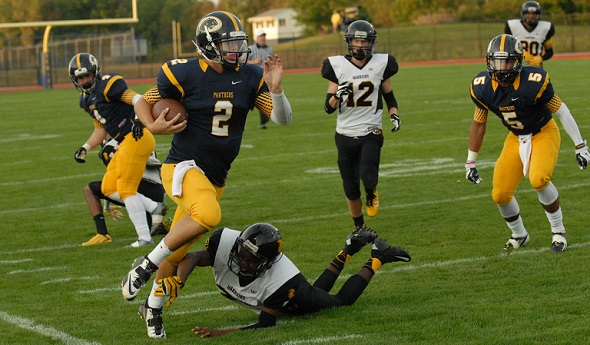
PHOTO: DeWitt defeated Lansing Waverly last week 56-12 and has won 30 straight league games dating to 2008. (Click to see more from HighSchoolSportsScene.com).