Ice Man: Skyline's Copp sets football records, leaves legacy
October 27, 2011
Eventually, Andrew Copp may be best-known as a hockey star. His spot on the USA under-18 national team development program squad marks him as one of the top players his age in the country.
But he’ll be remembered as one of Ann Arbor Skyline’s first standout athletes for another sport he simply couldn’t give up.
Bittersweet and heart-breaking are how Copp described the end of this football season. The MHSAA playoffs begin this weekend, and he hoped to be a part -- a possibility that was likely closer than Skyline’s 3-6 record might imply, given four of those losses were by four or fewer points. And that’s not the worst part. Even if Skyline had earned a berth, Copp would’ve been forced to watch after breaking his right collarbone in multiple spots three weeks ago.
Still, there will be plenty to remember fondly for the first quarterback in his school’s four-year history. Two MHSAA records and his school’s first varsity football wins will top the list, even as the combination of football and the injury will force Copp the miss the first half of his USA team’s season.
“It means a lot, starting something new and trying to put your stamp on it,” Copp said. “As the quarterback, it’s a lot of weight on your shoulders to start something that 10, 20 years down the road people are going look at.
“Last year, when I got offered to play (USA) but had to quit football after the first game, I couldn’t do it. I just couldn’t quit on the team.”
That kind of leadership was “worth its weight in gold” for a school and program only just getting started, Skyline athletic director John Young said.
Copp likely would’ve attended Ann Arbor Pioneer -- like both of his parents had -- had Skyline not opened in fall 2008.
The Eagles’ football program started that first fall, but didn’t field a varsity team until 2010. Copp was the quarterback all four years until his he was injured on a run during the first quarter of his team’s Week 7 game against Temperance Bedford.
Two weeks earlier, against Ann Arbor Pioneer, Copp had thrown for an MHSAA record 557 yards and record-tying seven touchdowns. In six games this fall plus a few minutes of that seventh, Copp completed 96 of 156 passes for 1,732 yards and 27 touchdowns. Those season touchdown passes also qualify for an MHSAA record book listing, as do the 31 completions that led to his record-setting numbers against Pioneer.
“Obviously, I can’t throw for 557 yards without my line doing a great job, my receivers catching balls and making plays. And probably the most unsung heroes on our team are the running backs, who were blocking for me,” Copp said. “I just remember everything going our way, almost like a recess football game.”
But it took some flexibility from USA hockey and a tough decision by Copp to make it possible. Usually, USA players aren’t allowed to play other sports, Copp said, but he was granted that exception. He joined USA hockey after his junior football season, and this summer started that team’s workouts at 8 a.m. before then moving on to workouts and film study for football. This fall, after his five classes at Skyline to start the day, he’d work out for hockey from 1:30-4 p.m. every week Monday through Wednesday, then start football practice at 4:30. All while remaining a strong student and adhering to a hockey-imposed 9 p.m. curfew.
Ironically, the 6-foot, 185-pound Copp joined the football team to become more physical for hockey on the advice of his father Andy, a successful youth hockey coach. Andrew has seen some similarities between the two sports -- as a hockey center he also controls play. Hockey helped Copp be ready for a fast pace of play and developed the quick decision-making necessary to thrive at quarterback.
His football mind helped him help the Eagles when he could no longer lead them on the field. “He had surgery on Tuesday, missed Wednesday, and was back at practice the next day,” Skyline coach Rodrek Jones said. “That was the same day my offensive coordinator was not able to come to practice, and (Copp) called the entire practice for me. He stayed very focused.”
Copp still can’t carry his backpack around school, but hopes to play hockey by January. He is almost assured of an outstanding college hockey opportunity, and Jones thinks he has the ability to play college football as well. Young said Copp, along with receiver Jordan Woods (committed to Purdue) and volleyball player Maggie Halloran (committed to Michigan State), has put Skyline on the map. Despite the tough end this fall, it’s a legacy Copp is glad to leave for those who come after him.
“He’s one of the most popular kids in school, on the Homecoming king court ... a typical All-American kid,” Young said. “I’m extremely happy for him. I was disappointed he broke his collarbone, because he was on track for a more spectacular year. But he helped, along with other players, to elevate their play this year.”
PHOTO
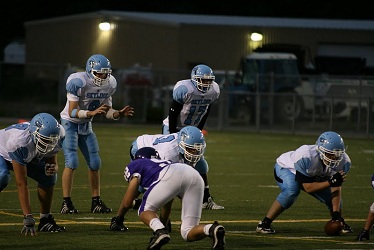
Skyline quarterback Andrew Copp (9) takes a snap against Ann Arbor Pioneer on Sept. 23. Copp threw for an MHSAA-record 557 yards and a record-tying seven touchdowns in a 52-49 loss. (Photo courtesy of Jeff Lepley. Head shot by Pete Draugalis.)
Officials Sharpen Skills at MHSAA Clinic
June 28, 2012
By Geoff Kimmerly
Second Half Editor
ALMA --Frequently in pairs, they lined up beside linebackers, ran the sidelines and monitored the goallines earlier this week, next to many of Michigan's best recently-graduated high school football players.
The athletes were practicing for Saturday's Michigan High School Football Coaches Association All-Star Game at Alma College. But beside and all around them, officials also worked to hone their skills with the upcoming season only two months away.
A group of 34 attended the MHSAA's summer clinic Monday and Tuesday, run in coordination with the all-star game for the second year. Some were veterans brushing up on new rules, while others -- like Flushing's Tim Collick -- were newer officials hoping to pick up some knowledge from 12 clinicians providing instruction and feedback.
"The biggest thing is just the different tips from experienced guys you don't find in the books," said Collick, 32, who was one of 14 chosen from clinic participants to officiate Saturday's game. "Different, helpful clues like keys that made them successful, made things easier for them."
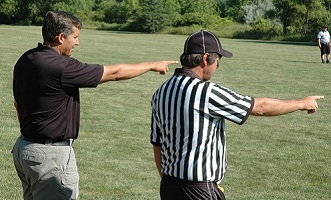 Instructors shadowed Collick and other participants during two practices and a Monday night scrimmage, providing guidance and feedback along the way.
Those practice sessions are combined with classroom instruction, similar to what the MHSAA has conducted during previous summers with basketball officials at Michigan State University camps.
Every participant this week came from the Lower Peninsula, but as far north as just below Mackinac Bridge, east from Detroit and west from the Grand Rapids area.
Two crews of seven officials were chosen from the camp participants to work Saturday’s game. The crews will alternate quarters, with five instructors also on hand to provide feedback.
The MHSFCA has been putting on the All-Star Game for 32 years, and has been a fantastic partner in providing an opportunity football officials don't often receive during the offseason, MHSAA assistant director Mark Uyl said.
"Football is unique in that there isn't a way to get live reps, while basketball, baseball and softball have summer team camps," Uyl said. "This is an opportunity for football officials to get training in the real thing."
Collick, a Flint Hamady grad who has been mentored by longtime Flint-area official Tom Rau, is heading into his third season of football as a back judge with a crew from the Genesee County Coaches and Officials Association. Although he'd heard a few of the speakers at the clinic before, he didn't know any of the officials before Monday. But he was sure to soak up as much as possible, with an eye on officiating for years to come and eventually, perhaps, at the college level as well.
"For me, one of the biggest things (at the clinic) is getting to make contacts with much more veteran officials. I'm learning from those guys," Collick said. "The instructors have worked at high levels as college officials, as high school officials for many years. It's nice to pick their brains."
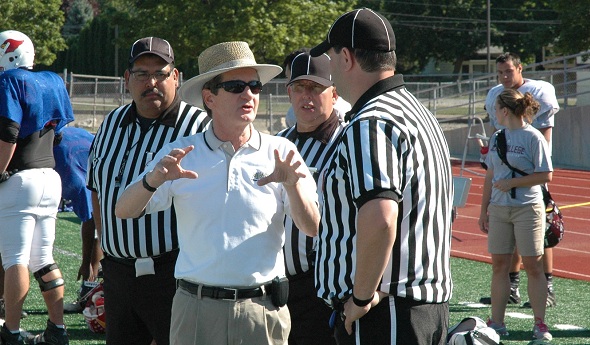
PHOTOS: (Top) Longtime official and recently-retired MHSAA assistant director Tom Minter (center) works with an official during Tuesday morning's East practice at Alma College. (Middle) MHSAA assistant director Mark Uyl (left) points something out to an official during the West practice. (Bottom) Officals at this year's clinic came from all parts of the Lower Peninsula, including the Detroit, Grand Rapids and Mackinaw areas.