

Ice Man: Skyline's Copp sets football records, leaves legacy
October 27, 2011
Eventually, Andrew Copp may be best-known as a hockey star. His spot on the USA under-18 national team development program squad marks him as one of the top players his age in the country.
But he’ll be remembered as one of Ann Arbor Skyline’s first standout athletes for another sport he simply couldn’t give up.
Bittersweet and heart-breaking are how Copp described the end of this football season. The MHSAA playoffs begin this weekend, and he hoped to be a part -- a possibility that was likely closer than Skyline’s 3-6 record might imply, given four of those losses were by four or fewer points. And that’s not the worst part. Even if Skyline had earned a berth, Copp would’ve been forced to watch after breaking his right collarbone in multiple spots three weeks ago.
Still, there will be plenty to remember fondly for the first quarterback in his school’s four-year history. Two MHSAA records and his school’s first varsity football wins will top the list, even as the combination of football and the injury will force Copp the miss the first half of his USA team’s season.
“It means a lot, starting something new and trying to put your stamp on it,” Copp said. “As the quarterback, it’s a lot of weight on your shoulders to start something that 10, 20 years down the road people are going look at.
“Last year, when I got offered to play (USA) but had to quit football after the first game, I couldn’t do it. I just couldn’t quit on the team.”
That kind of leadership was “worth its weight in gold” for a school and program only just getting started, Skyline athletic director John Young said.
Copp likely would’ve attended Ann Arbor Pioneer -- like both of his parents had -- had Skyline not opened in fall 2008.
The Eagles’ football program started that first fall, but didn’t field a varsity team until 2010. Copp was the quarterback all four years until his he was injured on a run during the first quarter of his team’s Week 7 game against Temperance Bedford.
Two weeks earlier, against Ann Arbor Pioneer, Copp had thrown for an MHSAA record 557 yards and record-tying seven touchdowns. In six games this fall plus a few minutes of that seventh, Copp completed 96 of 156 passes for 1,732 yards and 27 touchdowns. Those season touchdown passes also qualify for an MHSAA record book listing, as do the 31 completions that led to his record-setting numbers against Pioneer.
“Obviously, I can’t throw for 557 yards without my line doing a great job, my receivers catching balls and making plays. And probably the most unsung heroes on our team are the running backs, who were blocking for me,” Copp said. “I just remember everything going our way, almost like a recess football game.”
But it took some flexibility from USA hockey and a tough decision by Copp to make it possible. Usually, USA players aren’t allowed to play other sports, Copp said, but he was granted that exception. He joined USA hockey after his junior football season, and this summer started that team’s workouts at 8 a.m. before then moving on to workouts and film study for football. This fall, after his five classes at Skyline to start the day, he’d work out for hockey from 1:30-4 p.m. every week Monday through Wednesday, then start football practice at 4:30. All while remaining a strong student and adhering to a hockey-imposed 9 p.m. curfew.
Ironically, the 6-foot, 185-pound Copp joined the football team to become more physical for hockey on the advice of his father Andy, a successful youth hockey coach. Andrew has seen some similarities between the two sports -- as a hockey center he also controls play. Hockey helped Copp be ready for a fast pace of play and developed the quick decision-making necessary to thrive at quarterback.
His football mind helped him help the Eagles when he could no longer lead them on the field. “He had surgery on Tuesday, missed Wednesday, and was back at practice the next day,” Skyline coach Rodrek Jones said. “That was the same day my offensive coordinator was not able to come to practice, and (Copp) called the entire practice for me. He stayed very focused.”
Copp still can’t carry his backpack around school, but hopes to play hockey by January. He is almost assured of an outstanding college hockey opportunity, and Jones thinks he has the ability to play college football as well. Young said Copp, along with receiver Jordan Woods (committed to Purdue) and volleyball player Maggie Halloran (committed to Michigan State), has put Skyline on the map. Despite the tough end this fall, it’s a legacy Copp is glad to leave for those who come after him.
“He’s one of the most popular kids in school, on the Homecoming king court ... a typical All-American kid,” Young said. “I’m extremely happy for him. I was disappointed he broke his collarbone, because he was on track for a more spectacular year. But he helped, along with other players, to elevate their play this year.”
PHOTO
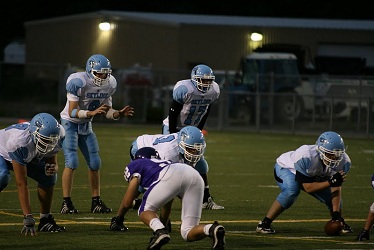
Skyline quarterback Andrew Copp (9) takes a snap against Ann Arbor Pioneer on Sept. 23. Copp threw for an MHSAA-record 557 yards and a record-tying seven touchdowns in a 52-49 loss. (Photo courtesy of Jeff Lepley. Head shot by Pete Draugalis.)

Our Place in the Sun
August 22, 2017
Today’s blog was written by MHSAA Website and Publications Coordinator Rob Kaminski
Millions of people across the country yesterday were mesmerized and fascinated by a once-in-a-lifetime show staged by the solar system: a total solar eclipse, which spanned the contiguous United States from Oregon to South Carolina.
The “Great American Eclipse” (because everything needs a title these days) was preceded by countless hours of coverage to prep enthusiasts on a variety of topics: the best places in which to view “totality;” the time frame in which the phenomenon would occur; the manner in which to view the orbs without damaging retinas; and, for the more scientifically inclined, detailed explanations as to the cause of the event.
It is somewhat ironic that this temporary traveling blackout began in the Pacific Northwest where people often yearn for even a glimpse of the sun over periods of time, and ended off the coast of South Carolina where residents have endured more than their share of weather disasters and a day of total sun would have been greatly preferred. At widespread locations in between, how many citizens beg for just a little more sunshine each day when the clock runs out on Daylight Saving Time?
The attraction to Monday’s event, of course, was its rarity. Its peculiarity. Its deviation from the norm. The last time a total solar eclipse could be seen anywhere in the United States was 1979, and the last time it went coast to coast was 99 years ago. That was the hook. It was darkness’s day in the sun.
Another MHSAA football season kicks off around the state Friday just clear from the shadows of Monday’s historic, but fleeting, happening. The school sports spotlight shines brightest on fall Friday nights and has for decades, not only in Michigan, but also from shore to shore across the country. It is pep rallies and parades; pizza parlors and burger joints; neighborhood caravans and tailgates; perhaps even a Friday cross country meet or volleyball match, all leading up to the football game, for many years the only game in town.
Now, as college football continues its attempt to upset the natural balance and create its own eclipse, it is our hope that high school fans from state to state will consider this movement a fleeting attention grab. It is our hope that the people who have fueled our product over the course of time will turn their heads and focus on the brightest Friday night stars in their own back yards.