


Inside Selection Sunday: Mapnalysis '13
October 28, 2013
By Geoff Kimmerly
Second Half editor
At the end of the day – Sunday, in this case – the 2013 MHSAA football playoff field was determined based on a set of numbers we began working with long before the first kickoff of this season.
So to kick off our discussion of how some of the 2013 playoff-selection decisions were made, here are a few numbers that might boggle the mind – or at least surprise:
- A total of 3,111 high school results were used in determining this season’s field – 2,978 for 11-player and 133 for 8-player games.
- We inputted and then followed the schedules for 623 MHSAA teams.
- We also inputted and followed weekly the schedules for 50 teams from surrounding states and Ontario that played at least one game against one of our MHSAA schools.
- We worked through complicated maneuverings made necessary by seven teams playing a mix of 11 and 8-player games, plus two more teams that played a mix of varsity and junior varsity opponents.
- And by Sunday morning we ended up with a few more numeric rarities: only 225 automatic qualifiers, the fewest since the current playoff system was introduced in 1999, and also an uneven number of at-large bids from our four classes because only six Class D teams reached the number of victories needed to be considered. (This was balanced by taking more at-large qualifiers from Classes A, B and C.)
And that was just the start of one of our most exciting days of the school year.
Following are more details. First, I explain some of the history of the MHSAA playoffs – I’ve lifted this in part from our 2012 report, so skip ahead if you’ve already got that down. Next, I touch on five themes that emerged as we built the brackets for this season’s tournament.
The process
Our past: The MHSAA playoff structure – with 256 teams in eight divisions, and six wins equaling an automatic berth (or five wins for teams playing eight or fewer games) – debuted in 1999, as mentioned above. An 8-player tournament was added in 2011, resulting in nine champions total when November is done.
That’s a long way from our start. The first playoffs were conducted in 1975 with four champions. Four more football classes were added in 1990 for a total of eight champions each fall. Through 1998, only 128 teams made the postseason, based on their playoff point averages within regions (four for each class) that were drawn before the beginning of the season. The drawing of Districts and Regions after the end of the regular season did not begin until the most recent playoff expansion.
In early years of the current process (or until the middle of the last decade), lines were drawn by hand. Dots representing qualifying schools were pasted on maps, one map for each division, and those maps were then covered by plastic sheets. Districts and Regionals literally were drawn with dry-erase markers.
Our present: After a late Saturday night tracking scores, we file in as the sun rises Sunday morning for a final round of gathering results we may still need (which can include making a few early a.m. calls to athletic directors). Then comes re-checking and triple-checking of enrollments, what schools played in co-ops, some records and more before the numbers are crunched and the fields are set.
Those 256 11-player teams are then split into eight equal divisions based on enrollment, and their locations are marked on digital maps that are projected on wall-size screens and then discussed by nearly half of the MHSAA staff plus a representative from the Michigan High School Football Coaches Association. Only the locations themselves are marked (by yellow dots) – not records, playoff point averages or names of the schools or towns. In fact, mentions of those are strictly prohibited. Records and playoff points are not part of the criteria. Matchups, rivalries, previous playoff pairings, etc. also DO NOT come into play. The same process is followed for organizing the 8-player bracket.
Observations and answers: 2013
This doesn’t happen overnight: Preparation for selecting the MHSAA playoff field begins long before the first kickoff of fall, much less the first practice. We load schedules for all 600-plus varsity teams during the summer, and many schedules remain fluid right up until the first Friday of the season – and this fall, a few weren’t settled until Week 2 or 3.
This summer as in some past we also worked through schools closing (Inkster, Saginaw Buena Vista, Detroit Northwestern, Flint Northern), and others deciding in mid-July and early August they would not field teams because of a lack of players.
Sometimes we have to take odd paths to find scores for these games. The last 11-player score to be added to our data this regular season came in as a result of tweeting the sports anchor of a Wheeling, W.Va., television station. Our last 8-player score came in via email from a Wisconsin athletic director at 10:30 Saturday night. Thankfully, we get plenty of assistance from some of our friends in the field, who keep an eye on the data and alert us when something appears missing or incorrect.
Win and advance: This season’s list of 5-4 teams includes a number of heavy hitters that did not receive at-large bids – East Grand Rapids, Utica Eisenhower, Orchard Lake St. Mary’s and Flint Powers Catholic to name a few. All were solid teams and played strong competition. All missing the playoffs likely raised some eyebrows.
But we have to take a look at this from a statewide view. There admittedly can be some argument about what schools qualified for the 226-256 spots in the field – but the important part is that 225 qualified because they all met the minimum win requirement. A playoff is simply that – it decides a champion based on teams winning. For some it’s harder to pile wins, of course, because they play in tough leagues. But the winners of those leagues are in the field – and surely will credit that tough road with getting them prepared to now play the state’s best.
Geography rules: This long has been rule number one for drawing MHSAA brackets in any sport, and is a repeat as well for those who have read this report the last two Octobers. Travel distance and ease DO come into play. Jumping on a major highway clearly is easier than driving across county-wide back roads, and that’s taken into consideration.
Also, remember there’s only one Mackinac Bridge and hence only one way to cross between peninsulas – and boats are not considered a possible form of transportation. When opponents from both peninsulas will be in the same District, distance to the bridge is far more important than as the crow flies.
The best example of this comes this season in Division 5. Grayling clearly is east of both Kingsley and Kalkaska – but also sits on I-75, while those two do not. So while those more western teams are geographically closer to Houghton, Menominee and Kingsford from the Upper Peninsula, we instead paired the three U.P. teams with Grayling because being on a main highway made for a shorter trip. The trip to Grayling for any of those U.P. teams would be 36 miles shorter to Grayling than Kingsley and 13 miles shorter to Grayling than Kalkaska.
Sometimes it’s where the points aren’t: Sure, it would be best-case scenario to have perfect sets of eight dots split into four quadrants from Calumet to Bedford. But generally that doesn’t occur. “Dots determine the map” is a common phrase heard here during this selection process, but that works the other way as well. If there are no qualifiers in a division from a specific area of the state – see Division 1, with none south of Holland or west of the greater Lansing area – there’s no choice but to create the unusual Regional Final possibility of Traverse City West vs. Brighton. Brighton is simply closer to the west side of the state than our other options.
Border to border vs. coast to coast: Should Regions be grouped north to south or east to west? There isn't a right or wrong answer – it just depends on that set of dots.
Whenever we have Upper Peninsula teams in a division, they’ll be grouped with those from the northernmost points of the Lower Peninsula for a District. The next northernmost schools will be grouped into a District, and together those eight will form a Region.
But the tough decision comes with the other six Districts. Look at this season’s Division 5 map: Six Districts are grouped south of U.S. 10 with three near or west of U.S. 127 and three east of that highway, which runs through the center of the Lower Peninsula. We grouped the two southwestern Districts into a Region and the two southeastern Districts into a Region – leaving a final Region that stretches from Muskegon on Lake Michigan to Almont, about 35 miles west of Lake Huron.
That’s a haul. But it’s also the best of our possible compromises. We could’ve instead paired regions that would’ve stretched from Hopkins to Monroe – only 19 fewer miles in distance than Muskegon Oakridge to Almont, but a scenario that could’ve created travel increases for a number of additional teams. Another option included a possible trip from Detroit University Prep to Freeland, which also would take more than two hours.
Bottom line – it’s been written here before – we pour all we have into this process, asking questions often more than once until we come up with a consensus. We do appreciate the arguments that arise once brackets are released to the public: The discussions are proof of how much players, coaches and fans care – and often show us new ways we can look at a system that’s now 15 years old.
But we must remember that the good news is the tournament is still set up to reward nine champions over the next five weeks, and five schools – Auburn Hills Oakland Christian, Coldwater, Detroit Allen, Eaton Rapids and Muskegon Mona Shores – will be competing for those titles for the first time.
It’s not so much how the tournament starts as how it ends. And we’re preparing for nine more memorable conclusions.
PHOTO: Each collection of grouped dots is a District on this season's Division 3 playoff map.
Drive for Detroit: Week 2 in Review
September 9, 2019
By Geoff Kimmerly
Second Half editor
After two weeks of this high school football season, it’s impossible to know how much of what we’re seeing now will be applicable by playoff time or even later this month.
 But there are a number of teams we’ve highlighted in our Week 2 “review” that should be feeling pretty good about what they’ve shown us so far.
Many of the 45 achievers below are regularly mentioned in this report. Others likely are considered surprises at this point – but might not be for much longer.
"Drive for Detroit" is sponsored by MI Student Aid.
Bay & Thumb
HEADLINER Freeland 29, Essexville Garber 20 A 2-0 start isn’t unfamiliar to the Falcons – they’ve begun with two straight wins every season this decade. But coming off last week’s one-point victory over Marshall, this win over the Dukes also is noteworthy for the way Freeland (2-0) held on through the end – especially against a Garber team that opened with a nice win against Boyne City and just missed the playoffs a year ago. This also was an opener in the new-look Tri-Valley Conference Central, which includes most of the best from the East and Central over the past few seasons. Click for more from the Midland Daily News.
Watch list Midland 45, Flint Carman-Ainsworth 0 Although the Cavaliers (0-2) have stumbled so far, Midland’s opening run still needs some mention with this win added to the opening victory over Traverse City West. The Chemics started 0-2 against the same two teams a year ago and still finished 9-4 and made the Division 2 Semifinals.
Remember this one Lapeer 43, Midland Dow 6 The Chargers (0-2) have made the playoffs six years in a row, so Lapeer (1-1) bouncing back from its opening-night loss to Lake Orion in a big way deserves notice.
More shoutouts Saginaw Arthur Hill 40, Flint Southwestern 16 The Lumberjacks (1-1) ended a 25-game losing streak with their highest-scoring performance since 2013. Flint Kearsley 28, Ann Arbor Huron 6 A second win over a larger opponent has the Hornets (2-0) a win away from equaling last season’s total as they play for their first winning record since 2003.
Greater Detroit
HEADLINER Birmingham Groves 24, West Bloomfield 17 The Lakers (1-1) have been considered among early Division 1 championship favorites this fall and had beaten Groves in back-to-back nonleague matchups over the last two seasons. But this shouldn’t be considered entirely stunning by the Falcons (2-0), who finished 10-3 last season and made the Division 2 Semifinals. The ending, on the other hand, was a little wild with a pair of late special teams fumbles turning into scores, including the game-winner. Click for more from the Oakland Press.
Watch list Lake Orion 37, Southfield Arts & Technology 7 The Dragons (2-0) have put themselves in the spotlight quickly with two impressive wins after also downing Lapeer in the opener. The run is especially notable after the team’s 0-2 starts the last two seasons.
Remember this one Romeo 37, Port Huron Northern 6 Romeo is 2-0 for the first time since its Division 1 championship season of 2015, winning big against a Northern team that went 10-2 last season and won big as well in its opener this fall.
More shoutouts Warren Michigan Collegiate 30, Flint Beecher 6 The Cougars (2-0) roll into this week’s matchup with Detroit Country Day with an impressive win over a Bucs team that went 8-4 last season and started this fall with a sizable win. South Lyon 29, Trenton 21 The Lions are picking up where they left off after winning the Lakes Valley Conference in 2018, with Trenton (1-1) providing a strong challenge as it looks to make the playoffs for the sixth straight season.
Mid-Michigan
HEADLINER Portland 29, DeWitt 27 This very well could end up the game of the regular season in the Lansing area, with two of the region’s most successful programs facing off and the reigning Division 5 runner-up Raiders holding the Panthers off during a scoreless fourth quarter. DeWitt (1-1) had won 18 straight regular-season games and is 77-8 during the regular season this decade. Portland (2-0) has now won 18 straight regular-season games and 37 of its last 38. Click for more from the Lansing State Journal and see highlights below from State Champs Sports Network.
VIDEO: Check out the highlights of the DeWitt (@DeWitt_Panthers) at Portland (@RaidersPAA) football game from last night.
Brought to you by @LawrenceTechU, @MHSAA, @hungryhowies pic.twitter.com/6ztRbErY0A— STATE CHAMPS! (@statechampsnet) September 7, 2019
Watch list Holt 22, Hudsonville 21 Welcome back Rams. A pair of 3-6 finishes the last two seasons were helped along in part by 0-2 starts. But Holt is 2-0 for the first time since 2007 and after deciding to go for a 2-point conversion and the win late against the Eagles (1-1).
Remember this one Ithaca 16, Millington 0 The Yellowjackets (2-0) avenged last season’s playoff opener loss to the Cardinals (0-2), and now they are in the same league.
More shoutouts St. Johns 46, Ann Arbor Pioneer 33 After being shut out by East Lansing last week, the Redwings (1-1) bounced back by avenging a 2018 one-point loss to Pioneer (1-1). Lansing Catholic 56, Grand Rapids West Catholic 28 After two games this fall the Cougars have scored 112 points – nearly one-third of their total over 11 games a year ago – and this week beat the always playoff-bound Falcons (0-2) for the second straight season.
Northern Lower Peninsula
HEADLINER Maple City Glen Lake 28, Traverse City St. Francis 7 September isn’t two weeks old, but it’s hard to not anticipate some good things ahead for the Lakers (2-0) after they opened with a win over Millington and followed up by breaking an eight-game losing streak against the Gladiators (1-1) this weekend. St. Francis won last year’s meeting 50-12 and hadn’t been held to single digits in a regular-season game since 2013. Click for more from the Traverse City Record-Eagle and see highlights below from MI Sports Now.
. @LakerAthletics Rolls @TCSFAthletics In Saturday Non-conference Matchup https://t.co/2vX91Q1K3u pic.twitter.com/fQfj4Gq9n6
— MISportsNow (@MISportsNow) September 7, 2019
Watch list Traverse City Central 37, Marquette 28 After falling to DeWitt by just five points at home Week 1, the Trojans (1-1) hit the road and ran their winning streak to six straight over Marquette (0-2).
Remember this one Charlevoix 18, Boyne City 14 The Rayders (2-0) won just once in 2018 and last opened with two straight wins in 2016, when they also last made the playoffs.
More shoutouts Cheboygan 8, Grayling 6 The Chiefs (1-1) are working toward their first playoff berth since 2013 and are a step closer after ending a recent three-game losing streak to Grayling (1-1). McBain 31, Roscommon 0 The Ramblers (1-1) also bounced back from a Week 1 loss by downing a Bucks team that is so far winless but finished 10-2 a year ago.
Southeast & Border
HEADLINER Erie Mason 80, Britton Deerfield 42 These two tied for the 14th-most points in an 11-player game where the losing team put up at least 40, and Erie Mason improved to 2-0 for the first time since 2003 while guaranteeing to tie its best finish for an entire season since 2005. Through two weeks quarterback Noah Beaudrie has thrown for 473 yards and six touchdowns and run for 509 and eight scores. The Patriots (1-1), meanwhile, upped their season scoring average to 35 ppg despite the defeat.
Watch list Clinton 45, Blissfield 13 Last season’s Tri-County Conference runner-up Clinton (2-0) will enter league play 2-0 for the first time since 2016 after avenging last season’s loss to the Royals (1-1), who opened this fall with a 19-point win over reigning TCC champion Ottawa Lake Whiteford.
Remember this one Sand Creek 31, Adrian Lenawee Christian 28 The Aggies (2-0) also play in the strong TCC, so this last-minute win over postseason regular Lenawee Christian (1-1) could end up a difference-maker when playoff selection time rolls around.
More shoutouts Jackson Lumen Christi 22, Parma Western 7 The Titans (2-0) pushed their winning streak to 25, and if it continues to grow this Interstate 8 Athletic Conference opener could be looked back at as key with Western (1-1) staying close into the fourth quarter. Temperance Bedford 20, Flushing 19 Bedford bounced back from a Week 1 loss to earn what could be a key win for its playoff hopes against a Flushing team that has made the last two postseasons but finds itself 0-2 with those defeats by a combined 12 points.
Southwest Corridor
HEADLINER Portage Northern 14, Stevensville Lakeshore 6 In keeping with recent history, this matchup was decided by eight or fewer points for the eighth time in nine seasons and gives reigning league co-champ Northern (2-0) a valuable early edge in the Southwestern Michigan Athletic Conference West race. But 2017 champ Lakeshore is far from being out of it, and a few more contenders also could have a say. Click for more from JoeInsider.com and see below for highlights from FOX 17.
The @PNHuskieSports football program is off to a 2-0 start after an impressive 14-6 win over Lakeshore. https://t.co/ZHaHqq8oDD
— FOX 17 Blitz (@FOX17Blitz) September 7, 2019
Watch list Kalamazoo Central 40, Portage Central 27 Defeating Portage Central last season was the first sign of Kalamazoo Central’s rise that turned into a league title and its first playoff berth since 2004. So the Maroon Giants (1-1) should be excited about the possibilities after bouncing back from last week’s one-point defeat to Mattawan with another notable victory over the annually-strong Mustangs (1-1).
Remember this one Cassopolis 28, Mendon 0 The Rangers (2-0) ran their scoring margin for the season to an early 78-0 advantage and earned a significant edge in their quest to repeat as Southwest 10 Conference champions, as 2017 winner Mendon (1-1) is always in the hunt as well.
More shoutouts Watervliet 22, Saugatuck 14 This was a major win as the Panthers (1-1) work to rebound from last season’s 2-7 finish; Saugatuck (1-1) was 9-2 a year ago and has won at least that many games four straight seasons. Battle Creek Lakeview 28, Mattawan 12 The Spartans (2-0) have had a few tough seasons but with this win tied their victory total of a year ago and against a Mattawan team that has made the playoffs two straight years.
Upper Peninsula
HEADLINER Iron Mountain 42, Ishpeming Westwood 22 Two weeks into the season, Iron Mountain (2-0) could have its two main obstacles out of the way as it looks to challenge reigning champion Calumet in the Western Peninsula Athletic Conference Copper. This week’s win followed up last week’s over Negaunee, and the Copper Kings await in Week 6. Westwood (1-1) was second and Iron Mountain third in the league last season. Click for more from the Iron Mountain Daily News.
Watch list Ishpeming 36, Lake Linden-Hubbell 34 The Hematites (2-0) are reigning champions in the West-PAC Iron and setting themselves up to be in the mix again, although the Lakes (1-1) could still find themselves in contention as well with a little help.
Remember this one Manistique 28, Gwinn 8 The Emeralds broke a 21-game losing streak on the field (not counting forfeits for games not played last season) with their first win since Week 9 of 2015.
More shoutouts Gladstone 20, Gaylord 7 The Braves (2-0) are halfway to last year’s win total with this one over a Gaylord team that made the playoffs last season and now sits 1-1 this fall. Sault Ste. Marie 20, Alpena 14 The Blue Devils (2-0) also downed a Big North Conference opponent, avenging last season’s loss to the Wildcats (0-2).
West Michigan
HEADLINER Muskegon 41, Detroit Martin Luther King 18 It’s impossible to not lead with Muskegon for the second straight week after the Big Reds defeated their second reigning MHSAA champion already this fall. And this one surely meant a little more as it came in a rematch of last season’s Division 3 championship game, won by King 41-25. Click for more from the Muskegon Chronicle.
VIDEO: Check out the highlights of the Muskegon (@mbigredsports) at Detroit King football game from last night.
Brought to you by @LawrenceTechU, @MHSAA, @hungryhowies pic.twitter.com/E0uMmpf1ko— STATE CHAMPS! (@statechampsnet) September 7, 2019
Watch list Caledonia 19, Cedar Springs 12 The Fighting Scots’ Week 1 loss to Holt is looking even better after Holt beat Hudsonville, and this victory over Cedar Springs (1-1) says a lot about Caledonia’s potential heading into Ottawa-Kent Conference Red play starting this week.
Remember this one Byron Center 33, Middleville Thornapple Kellogg 14 After two straight sub-.500 seasons, the Bulldogs (2-0) also could be on their way to big things after sending the Trojans to 1-1.
More shoutouts Rockford 24, Lowell 7 The Rams evened these teams’ latest four-game series at 2-2 and moved to 2-0 to start a season for the first time since 2014. Zeeland West 48, Grand Rapids Christian 27 The Dux (2-0) added to their opening-night win over East Grand Rapids with another impressive one, as the Eagles (0-2) likely will be in the mix again in the O-K Gold.
8-Player
HEADLINER Pellston 42, Posen 38 The Hornets finished 4-5 in their first season of 8-player football in 2018, winning four of their final six games. This fall they’re off to a 2-0 start, and a first winning season since 1995 might become part of the conversation soon. Pellston scored the go-ahead touchdown against Posen (0-2) with 5:03 to play after trailing by 18 midway through the third quarter. Click for more from the Petoskey News-Review.
Watch list Vestaburg 22, North Adams-Jerome 6 The Wolverines (2-0) moved to 8-player football this fall, and so far so good after finishing 0-9 last season and 1-8 in 2017.
Remember this one Bridgman 46, St. Joseph Lake Michigan Catholic 8 It also will be interesting to see how this first season of 8-player goes for Bridgman, which has outscored its first two opponents by a combined 102-24.
More shoutouts Martin 20, Wyoming Tri-unity Christian 0 Martin (2-0) also is a first-year 8-player program and its scores the last two weeks have been much closer, but against two of the traditional best in Bellevue and this week Tri-unity (0-2). Powers North Central 62, Rapid River 6 These Jets (2-0) are scoring like the title-winning Jets of a few seasons ago, with a combined 128 points over their first two games.
Second Half’s weekly “Drive for Detroit” previews are powered by MI Student Aid, a part of the Office of Postsecondary Financial Planning located within the Michigan Department of Treasury. MI Student Aid encourages students to pursue postsecondary education by providing access to student financial resources and information. MI Student Aid administers the state’s 529 college savings programs (MET/MESP), as well as scholarship and grant programs that help make college Accessible, Affordable and Attainable for you. Connect with MI Student Aid at www.michigan.gov/mistudentaid and find more information on Facebook and Twitter @mistudentaid.
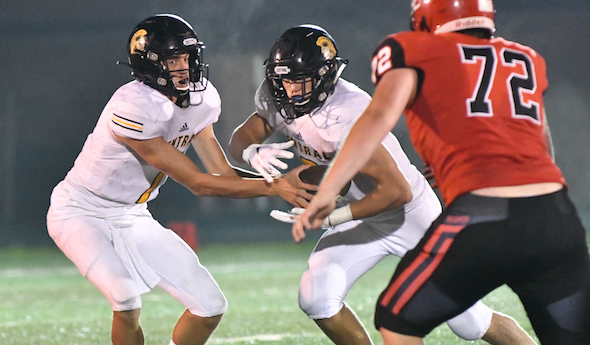
PHOTO: A Marquette defender closes in Friday as Traverse City Central quarterback Peyton Smith decides if he will hand off or keep the ball. (Photo by Cara Kamps.)