


Inside Selection Sunday: Mapnalysis '13
October 28, 2013
By Geoff Kimmerly
Second Half editor
At the end of the day – Sunday, in this case – the 2013 MHSAA football playoff field was determined based on a set of numbers we began working with long before the first kickoff of this season.
So to kick off our discussion of how some of the 2013 playoff-selection decisions were made, here are a few numbers that might boggle the mind – or at least surprise:
- A total of 3,111 high school results were used in determining this season’s field – 2,978 for 11-player and 133 for 8-player games.
- We inputted and then followed the schedules for 623 MHSAA teams.
- We also inputted and followed weekly the schedules for 50 teams from surrounding states and Ontario that played at least one game against one of our MHSAA schools.
- We worked through complicated maneuverings made necessary by seven teams playing a mix of 11 and 8-player games, plus two more teams that played a mix of varsity and junior varsity opponents.
- And by Sunday morning we ended up with a few more numeric rarities: only 225 automatic qualifiers, the fewest since the current playoff system was introduced in 1999, and also an uneven number of at-large bids from our four classes because only six Class D teams reached the number of victories needed to be considered. (This was balanced by taking more at-large qualifiers from Classes A, B and C.)
And that was just the start of one of our most exciting days of the school year.
Following are more details. First, I explain some of the history of the MHSAA playoffs – I’ve lifted this in part from our 2012 report, so skip ahead if you’ve already got that down. Next, I touch on five themes that emerged as we built the brackets for this season’s tournament.
The process
Our past: The MHSAA playoff structure – with 256 teams in eight divisions, and six wins equaling an automatic berth (or five wins for teams playing eight or fewer games) – debuted in 1999, as mentioned above. An 8-player tournament was added in 2011, resulting in nine champions total when November is done.
That’s a long way from our start. The first playoffs were conducted in 1975 with four champions. Four more football classes were added in 1990 for a total of eight champions each fall. Through 1998, only 128 teams made the postseason, based on their playoff point averages within regions (four for each class) that were drawn before the beginning of the season. The drawing of Districts and Regions after the end of the regular season did not begin until the most recent playoff expansion.
In early years of the current process (or until the middle of the last decade), lines were drawn by hand. Dots representing qualifying schools were pasted on maps, one map for each division, and those maps were then covered by plastic sheets. Districts and Regionals literally were drawn with dry-erase markers.
Our present: After a late Saturday night tracking scores, we file in as the sun rises Sunday morning for a final round of gathering results we may still need (which can include making a few early a.m. calls to athletic directors). Then comes re-checking and triple-checking of enrollments, what schools played in co-ops, some records and more before the numbers are crunched and the fields are set.
Those 256 11-player teams are then split into eight equal divisions based on enrollment, and their locations are marked on digital maps that are projected on wall-size screens and then discussed by nearly half of the MHSAA staff plus a representative from the Michigan High School Football Coaches Association. Only the locations themselves are marked (by yellow dots) – not records, playoff point averages or names of the schools or towns. In fact, mentions of those are strictly prohibited. Records and playoff points are not part of the criteria. Matchups, rivalries, previous playoff pairings, etc. also DO NOT come into play. The same process is followed for organizing the 8-player bracket.
Observations and answers: 2013
This doesn’t happen overnight: Preparation for selecting the MHSAA playoff field begins long before the first kickoff of fall, much less the first practice. We load schedules for all 600-plus varsity teams during the summer, and many schedules remain fluid right up until the first Friday of the season – and this fall, a few weren’t settled until Week 2 or 3.
This summer as in some past we also worked through schools closing (Inkster, Saginaw Buena Vista, Detroit Northwestern, Flint Northern), and others deciding in mid-July and early August they would not field teams because of a lack of players.
Sometimes we have to take odd paths to find scores for these games. The last 11-player score to be added to our data this regular season came in as a result of tweeting the sports anchor of a Wheeling, W.Va., television station. Our last 8-player score came in via email from a Wisconsin athletic director at 10:30 Saturday night. Thankfully, we get plenty of assistance from some of our friends in the field, who keep an eye on the data and alert us when something appears missing or incorrect.
Win and advance: This season’s list of 5-4 teams includes a number of heavy hitters that did not receive at-large bids – East Grand Rapids, Utica Eisenhower, Orchard Lake St. Mary’s and Flint Powers Catholic to name a few. All were solid teams and played strong competition. All missing the playoffs likely raised some eyebrows.
But we have to take a look at this from a statewide view. There admittedly can be some argument about what schools qualified for the 226-256 spots in the field – but the important part is that 225 qualified because they all met the minimum win requirement. A playoff is simply that – it decides a champion based on teams winning. For some it’s harder to pile wins, of course, because they play in tough leagues. But the winners of those leagues are in the field – and surely will credit that tough road with getting them prepared to now play the state’s best.
Geography rules: This long has been rule number one for drawing MHSAA brackets in any sport, and is a repeat as well for those who have read this report the last two Octobers. Travel distance and ease DO come into play. Jumping on a major highway clearly is easier than driving across county-wide back roads, and that’s taken into consideration.
Also, remember there’s only one Mackinac Bridge and hence only one way to cross between peninsulas – and boats are not considered a possible form of transportation. When opponents from both peninsulas will be in the same District, distance to the bridge is far more important than as the crow flies.
The best example of this comes this season in Division 5. Grayling clearly is east of both Kingsley and Kalkaska – but also sits on I-75, while those two do not. So while those more western teams are geographically closer to Houghton, Menominee and Kingsford from the Upper Peninsula, we instead paired the three U.P. teams with Grayling because being on a main highway made for a shorter trip. The trip to Grayling for any of those U.P. teams would be 36 miles shorter to Grayling than Kingsley and 13 miles shorter to Grayling than Kalkaska.
Sometimes it’s where the points aren’t: Sure, it would be best-case scenario to have perfect sets of eight dots split into four quadrants from Calumet to Bedford. But generally that doesn’t occur. “Dots determine the map” is a common phrase heard here during this selection process, but that works the other way as well. If there are no qualifiers in a division from a specific area of the state – see Division 1, with none south of Holland or west of the greater Lansing area – there’s no choice but to create the unusual Regional Final possibility of Traverse City West vs. Brighton. Brighton is simply closer to the west side of the state than our other options.
Border to border vs. coast to coast: Should Regions be grouped north to south or east to west? There isn't a right or wrong answer – it just depends on that set of dots.
Whenever we have Upper Peninsula teams in a division, they’ll be grouped with those from the northernmost points of the Lower Peninsula for a District. The next northernmost schools will be grouped into a District, and together those eight will form a Region.
But the tough decision comes with the other six Districts. Look at this season’s Division 5 map: Six Districts are grouped south of U.S. 10 with three near or west of U.S. 127 and three east of that highway, which runs through the center of the Lower Peninsula. We grouped the two southwestern Districts into a Region and the two southeastern Districts into a Region – leaving a final Region that stretches from Muskegon on Lake Michigan to Almont, about 35 miles west of Lake Huron.
That’s a haul. But it’s also the best of our possible compromises. We could’ve instead paired regions that would’ve stretched from Hopkins to Monroe – only 19 fewer miles in distance than Muskegon Oakridge to Almont, but a scenario that could’ve created travel increases for a number of additional teams. Another option included a possible trip from Detroit University Prep to Freeland, which also would take more than two hours.
Bottom line – it’s been written here before – we pour all we have into this process, asking questions often more than once until we come up with a consensus. We do appreciate the arguments that arise once brackets are released to the public: The discussions are proof of how much players, coaches and fans care – and often show us new ways we can look at a system that’s now 15 years old.
But we must remember that the good news is the tournament is still set up to reward nine champions over the next five weeks, and five schools – Auburn Hills Oakland Christian, Coldwater, Detroit Allen, Eaton Rapids and Muskegon Mona Shores – will be competing for those titles for the first time.
It’s not so much how the tournament starts as how it ends. And we’re preparing for nine more memorable conclusions.
PHOTO: Each collection of grouped dots is a District on this season's Division 3 playoff map.
Bronson Football Raising Bar with Growth in Numbers, Growing String of Successes
By
Scott Hassinger
Special for MHSAA.com
October 6, 2026
BRONSON – Tony Myers remembers the excitement he felt 17 years ago when, as a player, his Bronson football team won a Division 6 District championship.
 Years later, Myers, now in his third year as the Vikings' head coach, has fans in this small community located in Branch County buzzing with enthusiasm as Bronson seeks a third-straight playoff berth and upper-tier finish in the Big 8 Conference.
Bronson, 4-2, has big games left on its schedule over the final three weeks of the regular season against league foes Quincy, Reading and East Jackson.
But its lone blemishes came to Division 8 ninth-ranked Springport 35-14 in the season opener and a 22-14 loss a couple weeks later to Union City. The Vikings own an impressive 14-0 win over Division 5 Buchanan in a nonleague battle.
Bronson hasn't won a District since Myers' playing days. The Vikings lost 20-12 to Hanover Horton in a Division 7 District Final last season and fell in a District Semifinal to Schoolcraft 28-14 in 2024.
For several years the program struggled before finally seeing an increase in numbers and players putting in the work during the offseason to make significant changes.
"Our coaching staff has instilled that belief that Bronson can be successful in football. I always talk to the kids about integrity, discipline, honor and those things that aren't mentioned too much outside of football. Men of integrity expect to be believed, and if they aren't then they prove people wrong over time," said Myers, whose wife Kate is a 2012 Bronson graduate; together they have a 7-year-old son Korbin and 5-year-old daughter Charlie June Myers.
He and his coaching staff brought a system and have been successful implementing it across the program. There are solid numbers at the junior varsity and middle school levels.
"It's really exciting to see the growth of this program. We have a new weight room and growth in numbers. Everything has just been really positive, and the community has been very supportive,” said Myers, who is serving as a substitute teacher in Bronson's school district while pursuing an education degree. “There is a huge crowd that follows us, which is great with the situation we're facing this season with no home games."
Due to stadium and field renovations, Bronson has been playing its home games this season at Sturgis, Coldwater and Union City high schools. Thanks to a successful millage vote, renovations to Bronson's stadium are now underway. A new track is being installed, and the field will be re-sodded, along with the addition of new lighting, new goal posts and future plans for upgrades of the press box and seating.
Bronson's defensive unit has forced 14 turnovers in six games. Going into last week's against Maple Valley, the Vikings' hadn't given up a single point during a second half.
Offensively, the Vikings have rolled up 2,428 yards of total offense, with 1,565 rushing yards and 863 passing. Bronson is averaging 30.8 points per game.
"We have a goal for our offense to achieve 5,000 total yards by the end of the season. We've been pretty balanced both passing and running the football," Myers said.
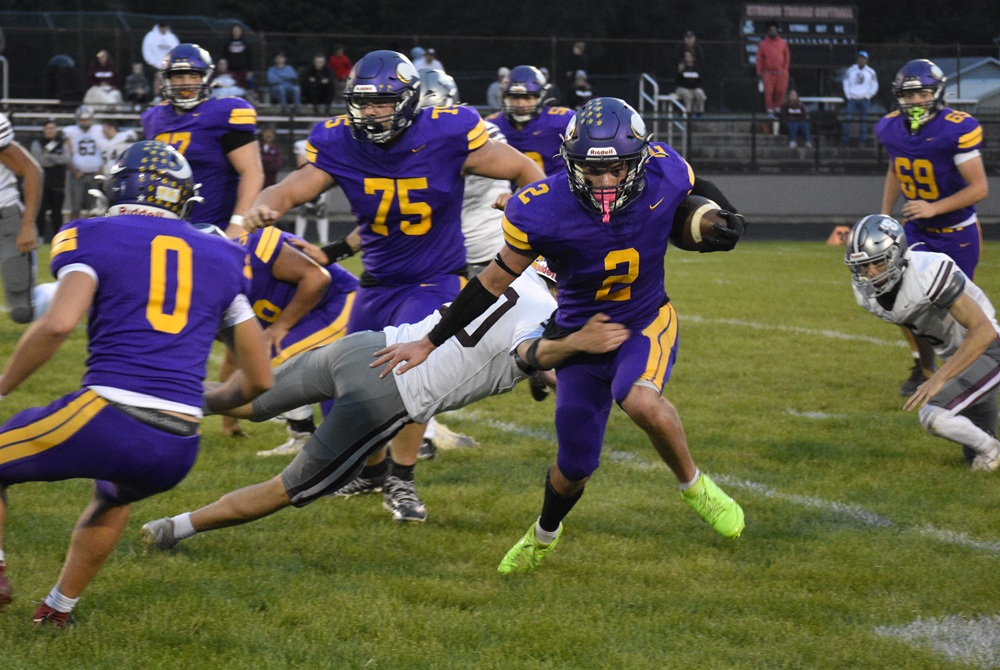
Bronson's backfield is led by the senior duo of Reid Stukey and Ben Stevens.
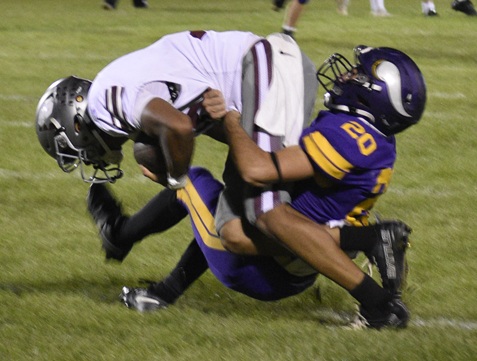
Stukey, a 5-foot-9, 165-pounder, leads his team in rushing with 97 carries for 809 yards and four touchdowns.
"Our mantra is exactly with Coach Myers preaches in practice, hard work and discipline. These guys all show up every day and ready to work. That's what makes you successful,” Stukey said. “The culture we've built calms my nerves. I'm not nervous about any roles I perform on the field. We want to win titles and play for one another.”
Stevens is the team's second-leading ground gainer with 55 carries for 562 yards and eight TDs. He's also caught 12 passes for 183 yards and two TDs.
"Ben is electric and knows how to read blocks. He's patient and waits until that pulling guard comes around, and after he leads into that linebacker he shoots out of the gap and is off to the races," Myers said.
Stevens, a slot back and tailback, also plays cornerback and safety.
"My leadership and explosiveness, I feel, are two of my biggest strengths. I try to get everyone pumped up after we make a big play and celebrate," Stevens said.
Starting quarterback Owen Losinski separated his shoulder two weeks ago, forcing Myers to move Stukey behind center. Stukey is 9-of-16 passing for 126 yards and two TDs since taking over as signal caller. Losinski is expected back on the field later this week.
"Reid has done a nice job stepping in at quarterback. He provides great leadership and picked things right up and has been able to run our offense effectively," Myers said.
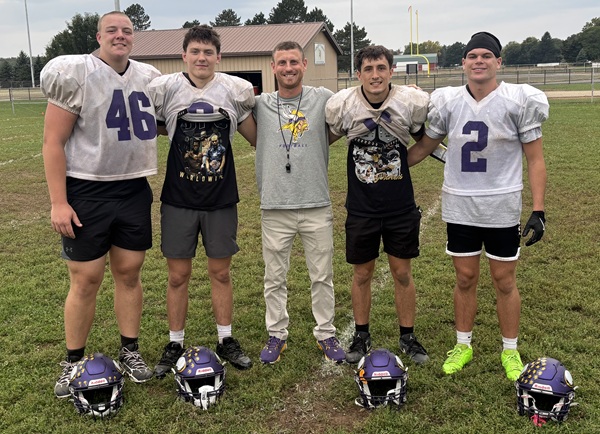
Bronson's most imposing figure on the field is junior offensive tackle and defensive end Kyle Hyska (6-2, 290).
"We have a great deal of size up front with good chemistry within the entire team. Our guys are playing well as a unit and getting better each week,” Hyska said. “We just have to have trust that the guy next to us is doing his job at a high level. I like that with my positions that I get to run through people with controlled aggression.”
Hyska has received a Division I scholarship offer from Harvard.
"Kyle couldn't even squat 185 pounds as a freshman, but he's since grown into his body and increased his strength. He has dreams of playing at the college level and has the right body size, work ethic and mindset to do so," Myers said.
Leading Bronson defensively is senior middle linebacker Caleb Harvey (6-1, 185) with 45 tackles, including nine for loss of yardage and two QB sacks.
"Caleb is one of our toughest kids. He doesn't brag on himself, but he's an absolute animal at linebacker,” Myers said. “He is a great leader, makes quick reads and is always in the backfield making lots of tackles and just gets everyone focused.”
Harvey takes a lot of pride in the Vikings' defense.
"Most of the guys on the team have been playing together since our days in rocket football. At my position I really get to see the field and make big plays. I enjoy leading our defense. We just all need to be in unison to reach our goals," Harvey said.
Thirteen members of Bronson's team went to a summer football camp at Trine University.
"These kids are hungry, but they understand that nothing is given to you in life. We've really tried to ingrain to this group that if there's something you want, that you have to work hard and go after it,” Myers said. “People are going to have their opinions and be critical of you. No one builds statues of critics, so we tell the kids not to let the naysayers hold them down. I'm so thankful our senior group bought into what we're doing at such a young age because now all our underclassmen are seeing they can be successful as well.”
Ultimately, the Vikings want to add some hardware to the school trophy case once the postseason rolls around.
"These kids have talked about getting some trophies to put in their memory bank," Myers said.
 Scott Hassinger is a contributing sportswriter for Leader Publications and previously served as the sports editor for the Three Rivers Commercial-News from 1994-2022. He can be reached at [email protected] with story ideas for Berrien, Cass, St. Joseph and Branch counties.
PHOTOS (Top) Bronson senior tailback Ben Stevens (2) works to break a tackle against Buchanan on Sept. 25. (Middle) Bronson players (from left) Kyle Hyska, Reid Stukey, Caleb Harvey and Ben Stevens pose for a photo with head coach Tony Myers after a practice. (Below) Reid Stukey (20) tackles a Buchanan receiver following a reception. (Photos by Scott Hassinger.)