

Inside Selection Sunday: Mapnalysis '15
October 26, 2015
By Geoff Kimmerly
Second Half editor
Consider that one hour Sunday night was the product of nine weeks of games on top of two more weeks of practice, hours of lifting weights, conditioning and camps and a total of six months of work at the MHSAA office, in addition to hours upon hours put in by athletic directors scheduling years in advance.
The anticipation for the release of another year's MHSAA Football Playoff pairings is matched by a giant exhale only after the results are broadcast on Fox Sports Detroit, streamed online and posted on locker room doors and Facebook walls all over our state.
 And then the fun begins again.
But the Selection Sunday Show is the favorite hour of the season for many fans across our state. And that’s why, for the fifth year, we’ll explain our most difficult decisions in this Mapnalysis 2015 breakdown of how we paired 272 teams that will play next month for championships across nine divisions.
For those familiar with our playoff selection process, or who have read this report in the past and don’t want a refresher on how we do what we do, skip the next section and go directly to the “Observations & Answers: 2015.” For the rest, what follows is an explanation of how we selected the playoff pairings during the morning hours Sunday, followed by how we made some of the toughest decisions and a few thoughts on the breakdown of the field.
Ground Rules
Our past: The MHSAA 11-player playoff structure – with 256 teams in eight divisions, and six wins equaling an automatic berth (or five wins for teams playing eight or fewer games) – debuted in 1999. An 8-player tournament was added in 2011, resulting in nine champions total each season.
The first playoffs were conducted in 1975 with four champions. Four more football classes were added in 1990 for a total of eight champions each fall. Through 1998, only 128 teams made the postseason, based on their playoff point averages within regions (four for each class) that were drawn before the beginning of the season. The drawing of Districts and Regionals after the end of the regular season did not begin until the most recent playoff expansion.
In early years of the current process, lines were drawn by hand. Dots representing qualifying schools were pasted on maps, one map for each division, and those maps were then covered by plastic sheets. Districts and Regionals literally were drawn with dry-erase markers.
Our present: After a late Saturday night tracking scores, we file in as the sun rises Sunday morning for a final round of gathering results we may still need (which can include making a few early a.m. calls to athletic directors). Re-checking and triple-checking of enrollments, what schools played in co-ops and opted to play as a higher class start a week in advance, and more numbers are crunched Sunday morning as the fields are set.
This season, there were a record-low 216 automatic qualifiers by win total – with the final 40 at-large then selected, by playoff-point average, one from each class in order (A, B, C, D) until the field was filled. There were only four Class D additional qualifiers with 5-4 or 4-4 (playing eight games) records from which we could choose – so after those four we added 12 teams each from Class A, Class B and Class C.
Those 256 11-player teams are then split into eight equal divisions based on enrollment, and their locations are marked on digital maps that are projected on wall-size screens and then discussed by nearly half of the MHSAA staff plus a representative from the Michigan High School Football Coaches Association. Only the locations themselves are marked (by yellow dots) – not records, playoff point averages or names of the schools or towns. In fact, mentions of those are strictly prohibited. Records and playoff points are not part of the criteria. Matchups, rivalries, previous playoff pairings, etc. also DO NOT come into play.
The same process is followed for organizing the 8-player bracket, with the difference that the 16 teams are selected purely on playoff-point average.
Geography rules: This long has been rule number one for drawing MHSAA brackets in any sport. Travel distance and ease DO come into play. Jumping on a major highway clearly is easier than driving across county-wide back roads, and that’s taken into consideration. Also, remember there’s only one Mackinac Bridge and hence only one way to cross between peninsulas – and boats are not considered a possible form of transportation. When opponents from both peninsulas will be in the same District, distance to the bridge is far more important than as the bird flies.
Tradition doesn’t reign: Every group of 32 dots is a new group – these 32 teams have not been placed in a bracket together before. How maps have been drawn in the past isn’t considered – it’s hard to say a division has been drawn in a certain way traditionally when this set of 32 teams is making up a division for the first time.
Observations & Answers: 2015
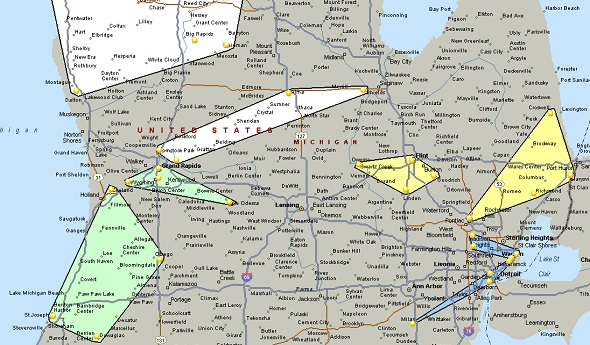
Go north with ease: For the most part, most Regional pairings were easier to draw than in past years. For the most part. Divisions 2 and 4 were not easy, specifically when it came to deciding which teams would be paired with an Upper Peninsula qualifier or a team from the Traverse City area. Keep in mind, distance on these maps isn’t based on how the bird flies, but how a bus would drive. In Division 2, that meant putting Muskegon, Muskegon Mona Shores and Grand Rapids Forest Hills Northern – near U.S. 31 and U.S. 131 – with Traverse City Central instead of sending Midland and Midland Dow west, up I-75 and then east-to-west again on more non-highway roads. In Division 4, we considered pairing Alma and Saginaw Swan Valley with Escanaba instead of Big Rapids and Remus Chippewa Hills. That decision came down to Big Rapids being about 14 miles closer to Escanaba than Swan Valley (Whitehall would go with Big Rapids and Chippewa Hills regardless.).
Four counties wide: Yes, on first glance it looks a little odd that Bay City John Glenn and Orchard Lake St. Mary’s would be in the same Division 3 District – but look at the map as a whole. Eight Division 3 teams are located south and mostly east of St. Mary’s, and John Glenn is the only team that could be considered in the northeastern quarter of the Lower Peninsula (Mount Pleasant and Gaylord are right down the middle and naturals to go with Sault Ste. Marie and Petoskey.). With the thumb playoff qualifiers of near-similar size in Division 4, there were no other options than to create this four-county trip between the Eaglets and Bobcats.
Semifinal selection: When all the Regional lines are drawn for a division, we also must figure out which Regionals will meet for Semifinals. This annually provides some challenges. Do we match east vs. west or north vs. south? If something seems iffy in four weeks when those games are played, again, keep in mind the entire map and entire Regionals that are matched up.
Scheduled strong: Because we’re looking only at dots on a map, we don’t see the matchups until everything is drawn – and in that way, we’re like everyone else. It wasn’t lost on us that two 9-0 teams will have road games this week or three 5-4 at-large qualifiers will be at home. For those 9-0 teams, it’s true: there’s nothing more they could’ve done on the field. But here’s why they will travel.
- Clinton, in Division 6, hasn’t lost a regular-season game since 2011, and in fact plays in a strong Tri-County Conference made up of Class C schools and one Class D. Four of eight from the league made the playoffs, and the competition was so strong that Morenci and Petersburg-Summerfield will host games in Division 8. But Clinton’s opponent, Monroe St. Mary Catholic Central, while it did have one loss, fell to one-loss Class B Lansing Catholic – and the Falcons played eight Class B and one Class A school this season. Beating a Class B team is worth 16 points more than beating a Class C and 32 more than beating a Class D (with those points then divided over the number of games a team plays that season) – and all of that made the difference in St. Mary’s final eight-point playoff average edge over Clinton.
- Saugatuck in Division 7 is a similar story. The Indians are one of three undefeated teams in their District, and did play a pair of Class B opponents. But by no fault of their own, especially in league play where the schedule is set, Saugatuck didn’t face a team this season that won more than five games. Hesperia played three Class B opponents including one that finished 6-3 – enough for the slim 1.8 points more in playoff average that earned the Panthers homefield advantage. Pewamo-Westphalia has the highest average in the District and didn’t play a Class B – the Pirates actually played three Class D teams. But they also beat four teams that made the playoffs including two that finished 8-1 – giving them a 2.7-point edge on Hesperia and 4.5 edge on Saugatuck.
- The 5-4 teams that will host – Redford Thurston in Division 3 and Escanaba and Benton Harbor in Division 4, all earned their spots. Escanaba faced six playoff teams and beat three, Class B Benton Harbor played eight Class A teams, and Thurston played five playoff teams and a sixth that just missed an at-large bid.
At the end of the day ...
What you see is what our committee decided upon after multiple discussions among multiple groups that broke down every sensible possibility we could muster. There are certainly points open to argument – and we likely made those arguments as well.
Those who would like to see the playoff selection process changed are in favor of a larger strength-of-schedule component, and it’s interesting to see how strength of schedule inadvertently made a larger impact this season than in the recent past – especially given the examples above of undefeated teams going on the road and at-large teams hosting.
Why were there fewer automatic qualifiers than ever before? Here's one theory. There were 11 fewer teams in 11-player football this season than in 2014 (most moved to 8-player). An argument can be made that there were fewer wins to be gained against teams that last season might have struggled to field 11-player teams, shifting the balance to fewer automatic qualifiers and more parity with stronger teams facing each other to fill their schedules.
Meanwhile, the 8-player field grew by nine teams this fall and has its strongest ever, with seven teams that finished 5-4 missing the postseason after a team with a sub-.500 record got in just a year ago.
Given how some matchups shook out this fall, the next argument by those seeking change likely will center on seeding entire Regionals instead of just Districts. But keep this in mind as well: if Regionals were seeded with this year's groupings, it would create possibilities of first-week trips like Battle Creek to Traverse City and Cedar Springs to Sault Ste. Marie. We're fairly sure most coaches and players would dread such journeys for a first-round game.
It's a lot to digest, and the scrutinizing will surely continue long after these playoffs are done as we all work to conduct the best tournament possible.
But at the end of the day – and the end of these next five weeks – to be the best, teams will need to beat the best no matter the matchups. And we’ve got plenty to look forward to starting this weekend and all the way through the 11-player Division 3 Final on Nov. 28 at Ford Field.
The MHSAA Football Playoffs are sponsored by the Michigan National Guard.
PHOTO: The Division 4 map was among the most difficult to draw during this year's selection process.
1st & Goal: 2024 11-Player Finals Preview
By
Geoff Kimmerly
MHSAA.com senior editor
November 27, 2024
The 50th MHSAA 11-Player Football Playoffs will conclude this weekend with eight new champions and several first-time opportunities for teams making the trip to Ford Field.
Of the 16 playing in Friday and Saturday’s championship games, only Jackson Lumen Christi is back from last year’s field – and contending in Division 6 after winning Division 7 titles the last two seasons.
Half the field this weekend – eight teams total, including both in Divisions 4 and 5 – are seeking their first Finals titles. Five of those eight are playing in championship games for the first time.
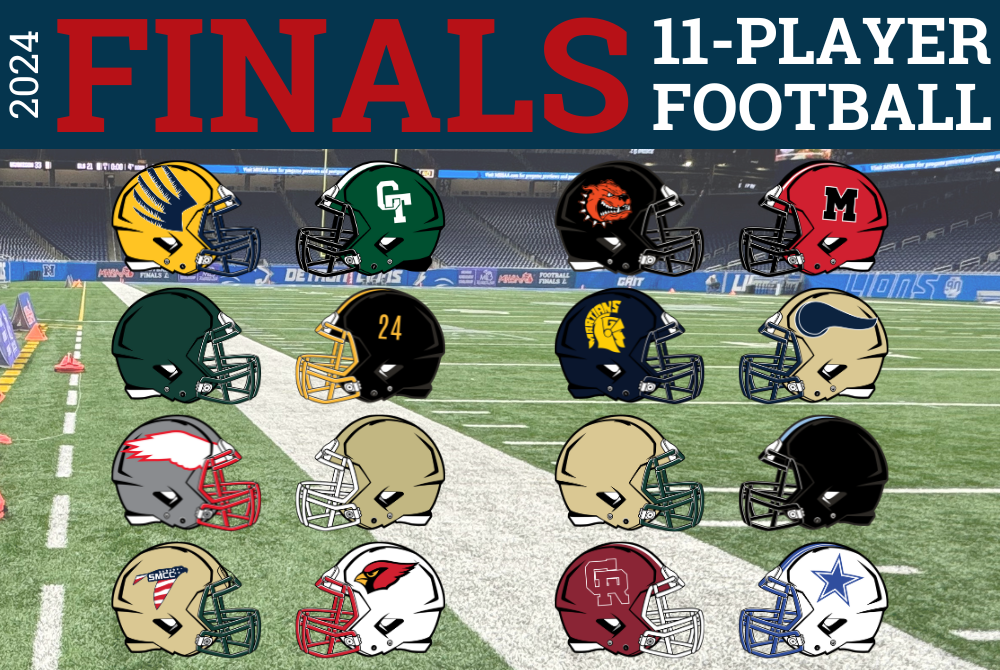
Here's the full schedule for Friday and Saturday's games:
Friday, Nov. 29
Division 8 – Riverview Gabriel Richard (11-1) vs. Beal City (11-2) – 9:30 a.m.
Division 4 – Goodrich (12-1) vs. Niles (12-1) – 12:30 p.m.
Division 6 – Jackson Lumen Christi (12-1) vs. Lansing Catholic (10-3) – 4 p.m.
Division 2 – Byron Center (12-1) vs. Orchard Lake St. Mary’s (10-3) – 7 p.m.
Saturday, Nov. 30
Division 7 – Monroe St. Mary Catholic Central (13-0) vs. Millington (12-0) – 9:30 a.m.
Division 3 – Zeeland West (12-1) vs. Detroit Martin Luther King (10-3) – 12:30 p.m.
Division 5 – Frankenmuth (13-0) vs. Pontiac Notre Dame Prep (11-1) – 4 p.m.
Division 1 – Hudsonville (12-1) vs. Detroit Cass Tech (11-2) – 7 p.m.
The Division 8, 7 and 3 games will be broadcast on the FDSN primary channel, with the remaining five Finals broadcast on FDSN Extra, and all eight also will be available via the FDSN website. Additionally, all eight championship games will be available for listening from the MHSAA Network. Links to purchase tickets and more are available on the Football page.
Below is a glance at all eight matchups. Statistics are through Semifinals unless noted.
Division 1

HUDSONVILLE
Record/Rank: 12-1, No. 4
Coach: Brent Sandee, seventh season (44-28)
League finish: First in Ottawa-Kent Conference Red
Championship history: Division 2 runner-up 2005 and 2000, Class A runner-up 1998.
Best wins: 27-7 over No. 6 Rochester Adams in Semifinal, 35-6 over No. 1 Howell in Regional Final, 28-21 over Rockford, 14-12 over East Lansing.
Players to watch: QB Griffin Baker, 6-2/195 sr. (1,132 yards/11 TDs passing, 650 yards/16 TDs rushing); RB/LB Bryce Fox, 5-9/175 sr. (987 yards/14 TDs rushing); WR/DB/P Braden VanLaecke, 5-11/175 jr. (5 TDs receiving); RB/LB Ethan Carter 6-1/215 sr.
Outlook: After starting this playoffs with some close rematches (25-23 over East Kentwood and 19-16 over Grandville), Hudsonville has powered through a pair of impressive performances to get back to the Finals for the first time in two decades. While Baker is a dangerous two-way threat at quarterback, Hudsonville has made its way by running the ball and not allowing the other team to do so. Junior Owen Haarsma has rushed for another 771 yards and eight touchdowns, and the Eagles are holding opponents to just 254 total yards per game – and just about 100 per game on the ground. That’s turned into just 13 points per game by opponents this season, with Hudsonville giving up more than 20 only three times and no more than East Kentwood’s 23 after the Falcons scored six the first time the teams met.
DETROIT CASS TECH
Record/Rank: 11-2, unranked
Coach: Marvin Rushing, third season (25-9)
League finish: Second in Detroit Public School League Blue
Championship history: Division 1 champion 2016, 2012 and 2011. Division 1 runner-up 2015.
Best wins: 17-14 over No. 2 Detroit Catholic Central in Semifinal, 21-14 over No. 5 Macomb Dakota in Regional Final, 30-14 over Division 3 No. 7 Detroit Martin Luther King, 20-3 over Canton McKinley (Ohio).
Players to watch: SE/DB Corey Sadler Jr., 5-10/175 jr. (780 yards/7 TDs receiving); CB/WR Alex Graham, 6-3/184 sr. (550 yards/6 TDs receiving); QB Donald Tabron II, 6-3/172 fr. (1,475 yards/14 TDs passing); OT Kalief Canty Jr., 6-5/308 jr.
Outlook: The win over DCC in last week’s Semifinal further proved what Cass Tech has shown throughout a nine-game winning streak. The Technicians lost their season opener to Rockford by seven and then by six in overtime to Detroit King in Week 4. But they avenged the King loss four weeks later in the PSL City championship game, and handed DCC its only loss a week after the Shamrocks had eliminated reigning champion Belleville. Canty made the all-state first team last season, and Sadler earned an honorable mention, and the latter has been joined by another electric playmaker in Graham who will continue next season at Colorado and also has returned two kickoffs and one punt for scores. Canty and Sadler are both major Division I prospects, and the defense includes three more players who have committed to Division I programs in linemen Logan Howell (Miami Ohio) and John Baker IV (Toledo) and defensive back Derrick Jackson III (Kent State).
Division 2
 BYRON CENTER
Record/Rank: 12-1, No. 5
Coach: Marc Cisco, 16th season (115-50)
League finish: Second in O-K Green
Championship history: Has never played in an MHSAA Final.
Best wins: 30-23 over No. 4 Muskegon Mona Shores in District Final, 38-17 over No. 9 Grand Rapids Northview in District Semifinal, 41-14 over East Lansing in Semifinal, 52-14 over Portage Central in Regional Final, 43-20 over East Kentwood.
Players to watch: QB/DB Landon Tungate, 5-10/185 sr. (1,784 yards/23 TDs passing, 1,407 yards/25 TDs rushing); SE/DB Isaac Lee, 6-1/175 sr. (789 yards/11 TDs receiving); SE/DB Landen Conrad, 6-0/188 sr. (80 tackles); RB/LB Kellen Payne, 5-11/212 sr. (100 tackles).
Outlook: Byron Center’s run to Ford Field has included its first Regional title, handing Northview its only defeat, and the avenging of the Bulldogs’ lone loss, which came against Mona Shores 14-12 in Week 4. Tungate has been unstoppable – six of his touchdown runs came in the Semifinal win over East Lansing – and he’s joined in the backfield in part by sophomore Cam Payne (580 yards/5 TDs rushing). Lee and senior running back/linebacker Luke Laska (335 yards/3 TDs rushing, 72 tackles) are the team’s two-way starters. Cisco is the son of Marc Cisco Sr., who won 242 games over nearly 50 seasons at Monroe Jefferson, with a run to the Class BB championship in 1994.
ORCHARD LAKE ST. MARY’S
Record/Rank: 10-3, unranked
Coach: Jermaine Gonzales, third season (18-15)
League finish: Fourth in Catholic High School League Central
Championship history: Eight MHSAA titles (most recent 2016), six runner-up finishes.
Best wins: 28-27 (OT) over No. 1 Birmingham Groves in Semifinal, 27-3 over No. 8 Gibraltar Carlson in Regional Final, 50-19 over Portage Northern.
Players to watch: WR/S Bryson Williams, 6-2/217 sr. (575 yards/9 TDs receiving); RB/LB Darrin Jones, 5-11/195 sr. (1,100 yards/11 TDs rushing); QB Axel Newell, 6-4/200 sr. (1,271 yards/11 TDs passing); LB/WR Charles White, 6-2/193 sr. (110 tackles).
Outlook: St. Mary’s has made a tremendous improvement under late 1990s star quarterback Jermaine Gonzales, returning to the Finals for the first time since 2016 and after posting sub-.500 records three of the last four seasons including 3-6 just a year ago. Williams, White and senior tight end Jayden Savoury (275 yards/3 TDs receiving) all have committed to Michigan State and are among several playmakers, including also senior running back Richard Goike III (10 TDs rushing); sophomore quarterback Jabin Gonzales (517 yards/10 TDs passing), junior defensive tackle Ryan Harrington (10 sacks) and senior defensive back Kareem Pruitt (6 interceptions). The Eaglets’ losses came to Division 1 No. 2 Detroit Catholic Central (27-22), Division 2 No. 10 Warren De La Salle Collegiate (38-28) and Toledo Central Catholic (7-6), which will play in an Ohio semifinal this weekend.
Division 3
 ZEELAND WEST
Record/Rank: 12-1, No. 4
Coach: John Shillito, 20th season (184-44)
League finish: Second in O-K Gold
Championship history: Four MHSAA titles (most recent 2015).
Best wins: 33-20 over No. 1 DeWitt in Semifinal, 36-20 (Regional Final) and 28-7 over No. 6 Grand Rapids Forest Hills Central, 42-0 over No. 3 St. Joseph in District Final, 60-43 over Whitehall.
Players to watch: FB/DB Keaton Hendricks, 6-0/165 sr. (1,477 yards/19 TDs rushing, 4 interceptions); QB/DB Trey Sloothaak, 6-0/181 sr. (651 yards/10 TDs passing, 484 yards/4 TDs rushing); RB/LB Isaac VanderZwaag, 6-1/195 sr. (675 yards/9 TDs rushing, 6 TDs receiving, 77 tackles); OT/DL Noah VanderVelde, 6-0/230 sr.
Outlook: Zeeland West defeated the reigning Division 3 champion (for the second time) and then the top-ranked team at the end of the regular season to earn this return to Ford Field. Shutting down DeWitt’s offense reinforced that West’s defense is tough to break, and the Dux have allowed only 269 yards and 16 points per game this fall. Sloothaak made the all-state first team last season at defensive back and is one of seven two-way starters. As a team, Zeeland has 14 interceptions and will work to get pressure up front with senior Brody Maas (six sacks) leading the charge. The traditionally-powerful T offense is up to 3,666 yards and 50 touchdowns rushing this fall, with junior Jonah Leslie adding 12 scores.
DETROIT MARTIN LUTHER KING
Record/Rank: 10-3, No. 7
Coach: Terel Patrick, first season (10-3)
League finish: First in Detroit PSL Blue
Championship history: Six MHSAA titles (most recent 2022), two runner-up finishes.
Best wins: 35-14 over Mason in Semifinal, 34-0 over River Rouge in Regional Final, 18-12 (OT) over Detroit Cass Tech, 25-21 over Cleveland Heights (Ohio).
Players to watch: LB Willie Fletcher Jr., 6-2/230 sr.; RB Michael Dukes, 6-0/185 jr.; QB Darryl Flemister, 5-11/170 soph.; DL/TE Xavier Newsome, 6-6/230 sr. (Statistics not submitted).
Outlook: Although Patrick is closing his first season as head coach, he’s been on staff as offensive coordinator and assistant coach over 14 seasons, with King this weekend playing in its seventh championship game over the last decade. Flemister earned an all-state honorable mention as a freshman and directs a skill position group that includes Dukes but also four seniors. Fletcher and Newsome are joined up front on defense by junior tackles Richard Stewart (5-11/280) and Gregory Keller (6-1/285), and that unit might be the key for a defense that’s given up 13.6 points per game this fall and posted five shutouts include two during the playoffs.
Division 4

GOODRICH
Record/Rank: 12-1, No. 4
Coach: Tom Alward, 32nd season (209-117)
League finish: First in Flint Metro League Stars
Championship history: Division 4 runner-up 2022.
Best wins: 28-14 over No. 5 Harper Woods in Semifinal, 42-13 over Haslett in Regional Final, 27-21 over No. 8 Freeland in District Final, 42-3 over Division 3 No. 9 Fenton.
Players to watch: WR/DB Max Macklem, 6-0/190 sr. (583 yards/6 TDs receiving through Regional); QB/DB Tanner Mazich, 5-10/165 jr. (931 yards/11 TDs passing through Regional); RB/LB Chase Burnett, 6-0/200 sr. (1,463 yards/25 TDs rushing); OL/DL Benjamin Sennabaum, 5-10/200 sr.
Outlook: Goodrich is returning to Ford Field for the second time in three seasons, and has only three losses over the last two seasons – the Martians have avenged last year’s against Corunna and Harper Woods, and their only defeat this fall was to Division 5 finalist Frankenmuth. Burnett and Macklem were among contributors on the 2022 team as well, and the Goodrich offense as a whole benefits from a powerful line that averages 6-foot-1, 250 pounds. Sennabaum earned an all-state honorable mention on the defensive line last season and is part of a unit that has given up only 10.5 points per game and no more than 22 all season. Macklem will continue next year at Central Michigan.
NILES
Record/Rank: 12-1, unranked
Coach: Scot Shaw, fourth season (33-12)
League finish: First in Wolverine Conference
Championship history: Has never played in an MHSAA Final.
Best wins: 62-30 over Grand Rapids South Christian in Semifinal, 37-34 over No. 10 Portland in Regional Final, 21-0 (District Final) and 21-14 over Edwardsburg, 42-14 (District Semifinal) and 21-0 over No. 9 Paw Paw.
Players to watch: RB/DB Peyton Gordon, 5-6/165 sr. (834 yards/15 TDs rushing); RB/LB Paul Hess, 5-9/210 sr. (1,202 yards/14 TDs rushing); RB/LB Sam Rucker, 5-9/175 sr. (1,100 yards/20 TDs rushing); OL/DL Jordan Cunningham, 6-0/230 sr.
Outlook: Niles also is enjoying its longest playoff run, including a first Regional championship, but Shaw has been to this stage before having led Three Rivers to the Division 4 championship in 2003. He enters this weekend with an overall 243-119 record over 35 seasons that also included stops at Grandville and two Indiana schools. Hess at running back and Rucker at linebacker both earned all-state honorable mentions last season as Niles finished 10-2 to build toward this campaign. The Vikings are giving up 10.4 points per game with six shutouts and their only opponents to score more than 14 coming the last two weeks and in a season-opening loss to Division 3 St. Joseph.
Division 5
 FRANKENMUTH
Record/Rank: 13-0, No. 2
Coach: Phil Martin, 12th season (128-19)
League finish: First in Tri-Valley Conference Red
Championship history: Division 5 runner-up 2022 and 2020.
Best wins: 42-35 over No. 7 Grand Rapids Catholic Central in Semifinal, 37-7 over No. 8 Belding in District Final, 21-20 over Division 4 No. 8 Freeland, 22-0 over Division 4 No. 4 Goodrich.
Players to watch: OL/DL Derrick Simmons, 6-4/275 sr. (44 tackles, 20 tackles for loss); QB/DB Lleyton Hoard, 6-3/180 sr. (600 yards/11 TDs rushing, 433 yards/4 TDs passing); RB/DB Kobbi Ke, 5-9/190 sr. (888 yards/5 TDs rushing); QB/DB Aidan Labissoniere, 5-9/160, sr. (500 yards/9 TDs rushing, 364 yards/4 TDs passing).
Outlook: Frankenmuth has reached the Semifinals five straight seasons and now Ford Field three of those five after turning back a challenge from reigning champion Grand Rapids Catholic Central last week. Simmons is committed to Michigan State and a powerful presence on a defensive line that also includes senior leading tackler Logan Diener (90 tackles, 22 tackles for loss); additionally, Simmons made the all-state first team on the offensive line in 2023. With 65 total touchdowns, including 56 rushing, the Eagles are approaching MHSAA record book lists for both and with 12 players contributing to one or both of those totals. Senior running back Hagan Wascher is the team’s leading receiver averaging 18.9 yards per catch and has 11 touchdowns total averaging nine yards per carry as well.
PONTIAC NOTRE DAME PREP
Record/Rank: 11-1, No. 1
Coach: Pat Fox, 11th season (77-34)
League finish: Does not compete in a league.
Championship history: Has never played in an MHSAA Final.
Best wins: 49-7 over Flat Rock in Semifinal, 45-19 over No. 4 Armada in Regional Final, 56-7 over No. 5 Corunna in District Final, 42-0 over No. 7 Grand Rapids Catholic Central, 57-26 over Division 6 No. 6 Reed City, 28-24 over Division 6 No. 1 Jackson Lumen Christi.
Players to watch: RB/DB Billy Collins, 5-9/165 sr. (1,156 yards/8 TDs rushing, 573 yards/8 TDs receiving); RB/DE Drew Heimbuch, 6-0/195 sr. (433 yards/18 TDs rushing, 85 tackles/28 tackles for loss); QB/LB Sam Stowe, 6-5/200 jr. (2,458 yards/33 TDs passing, 7 TDs rushing); WR/DB Joseph Decasas, 6-2/165 sr. (1,126 yards/18 TDs receiving, 7 interceptions).
Outlook: Notre Dame Prep also won its first Regional title on the way to this Finals debut, and during the regular season defeated the reigning Division 5 (GRCC) and Division 7 (JLC) champions. The Fighting Irish’s only loss came Week 9, 43-28 to Hudsonville Unity Christian, which was top-ranked in Division 4 at the end of the regular season. Heimbuch made the all-state first team last season as a defensive lineman, and his 20 touchdowns total include one apiece on interception and fumble returns. Junior linebacker Brody Sink (127 tackles/22 tackles for loss) and senior linebacker Luca Gasperoni (90 tackles) are two more of several standouts on a defense. Fox is 201-115 total with head coaching stops as well at Ortonville Brandon, Berkley, Ann Arbor Pioneer and Milford.
Division 6
 JACKSON LUMEN CHRISTI
Record/Rank: 12-1, No. 1
Coach: Herb Brogan, 45th season (420-96)
League finish: First in CHSL AA
Championship history: 13 MHSAA titles (most recent 2023), three runner-up finishes.
Best wins: 35-6 over No. 4 Marine City in Semifinal, 42-6 over Constantine in Regional Final, 49-28 over Ida in District Final, 39-21 over Kalamazoo United, 35-7 over Division 7 No. 8 Traverse City St. Francis.
Players to watch: RB Kadale Williams, 6-1/180 sr. (1,941 yards/34 TDs rushing); QB Timmy Crowley, 6-3/180, sr. (1,149 yards/8 TDs passing, 5 TDs rushing) FB/LB Isaac Rehberg, 5-9/195 sr. (92 tackles, 437 yards/6 TDs rushing); TE/DE Charlie Saunders, 5-9/190 sr.
Outlook: Lumen Christi has won the last two Division 7 championships and opted up to Division 6 this fall. The lone loss came in Week 2 to Notre Dame Prep, by only four points, and no other opponent got within 17 points of catching the Titans. Williams made the all-state first team last season and was committed at one point to Central Michigan but has reopened his recruitment. Senior receiver Kash Kalahar gives Crowley a nice option to complement the running game; he’s caught a team-leading 32 passes for 712 yards and five touchdowns. Brogan is third on the all-time coaching wins list, 10 from second place and 23 from tying the record.
LANSING CATHOLIC
Record/Rank: 10-3, unranked
Coach: Jim Baker, fourth season (33-17)
League finish: Tied for third in Capital Area Activities Conference White
Championship history: Three MHSAA titles (most recent 2021), two runner-up finishes.
Best wins: 36-29 over No. 8 Chesaning in District Semifinal, 49-36 over No. 5 Newaygo in Regional Final, 34-22 over Boyne City in Semifinal, 31-28 over Ovid-Elsie in District Final, 35-34 over Pewamo-Westphalia.
Players to watch: QB/OLB Alex Fernandez, 6-3/230 sr. (2,898 yards/31 TDs passing, 1,000 yards/18 TDs rushing, 82 tackles); WR/S Benjamin Rabideau, 5-8/170 sr. (957 yards/10 TDs receiving, 387 yards/4 TDs rushing, 98 tackles/6 interceptions); WR/OLB Xavier Luea, 6-3/195 sr. (1,048 yards/10 TDs receiving); OL/DL Josh Pritzlaff, 6-4/295 sr.
Outlook: Lansing Catholic emerged from a league that included top-10 teams in Divisions 4 and 6 and then defeating two top-10 teams, including an undefeated opponent to open the playoffs. Rabideau made the all-state second team as a receiver last season and is one of three this fall with at least 30 catches as Fernandez has joined him in putting up monster numbers on both sides of the ball. Senior Chris Sims is another two-way standout, starting on the offensive line and making 97 tackles at linebacker. Lansing Catholic’s losses were to No. 7 Olivet, Division 4 No. 10 Portland and another solid Division 4 team in Lansing Sexton.
Division 7
 MONROE ST. MARY CATHOLIC CENTRAL
Record/Rank: 13-0, No. 1
Coach: Adam Kipf, 10th season (80-32)
League finish: First in Huron League
Championship history: Four MHSAA titles (most recent 2019), four runner-up finishes.
Best wins: 38-7 over Schoolcraft in Semifinal, 55-18 over Leslie in Regional Final, 51-30 (District Final) and 22-14 over No. 10 Clinton, 37-14 over Flat Rock, 34-15 over Riverview.
Players to watch: QB/DB Ian Foster, 6-0/165 sr. (640 yards/15 TDs passing, 424 yards/7 TDs rushing); RB/DB Drew Harris, 5-6/165 sr. (1,348 yards/21 TDs rushing); QB/RB/DB Brady Hines, 6-2/205 jr. (443 yards/7 TDs rushing); OL/DL Jimmy Rostash, 6-3/260 jr. (Statistics through Regional Final.)
Outlook: St. Mary made a jump this fall after two straight 6-6 finishes, impressing on both sides of the ball as they’ve pursued their first undefeated season since 1991. The defense is giving up just 9.6 points per game and has allowed more than 18 only once – in the rematch with Clinton. The offense is averaging 39 points per game as no team has come closer than 19 to catching the Falcons since an eight-point season-opening win over Clinton. Harris brought a 10.3 yards-per-carry average into last week’s Semifinal. Through 12 games, sophomore Cole Reinhardt had scored eight touchdowns (four rushing, three receiving, one on kickoff return), and junior Lukas Linzell had run for six scores and scored on kickoff and interception returns.
MILLINGTON
Record/Rank: 12-0, No. 5
Coach: Jason Germain, third season (34-3)
League finish: First in Big Thumb Conference White
Championship history: Has never played in an MHSAA Final.
Best wins: 35-28 over North Muskegon in Semifinal, 28-0 over Pewamo-Westphalia in Regional Final, 34-7 (District Final) and 34-6 over Cass City.
Players to watch: RB/LB Dallas Walsh, 5-10/193 sr. (1,411 yards/17 TDs rushing); RB/LB Landon Russell, 5-9/183, sr. (735 yards/10 TDs rushing, 3 TDs receiving); QB/DB Truk Terbush, 5-11/152 sr. (1,420 yards/21 TDs passing, 520 yards/11 TDs rushing); TE/DL Brevin Hendricks, 6-3/220 sr. (7 TDs receiving).
Outlook: This was the seventh time since 1994 that Millington reached the Semifinals, and the Cardinals broke through for their first Finals trip thanks in part to a powerful running game that is balanced out nicely by Terbush’s work throwing the ball. He has only two interceptions to go with his 21 touchdowns through the air, with three receivers with at least 15 catches topped by senior Bryce Martin (25 receptions/511 yards/6 TDs receiving). The defense has given up just 8.4 points per game, keeping opponents to single digits nine times and allowing more than 14 only twice. Walsh, Russell and senior Landon Germain provide a sturdy linebacker group in the middle of that effort.
Division 8
 RIVERVIEW GABRIEL RICHARD
Record/Rank: 11-1, unranked
Coach: Mark Shea, first season (11-1)
League finish: Second in CHSL Intersectional #1
Championship history: Has never played in an MHSAA Final.
Best wins: 36-30 over No. 5 Decatur in Semifinal, 44-26 over No. 10 Manchester in Regional Final, 40-18 over Ann Arbor Father Gabriel Richard, 15-10 over Division 7 No. 9 Montrose.
Players to watch: QB/S Nick Sobush, 5-11/165 sr. (1,597 yards/20 TDs passing); WR/CB Derek Lesko, 6-0/160 jr. (873 yards/7 TDs receiving); RB/S Antonio Sobush, 5-10/160 sr. (711 yards/9 TDs rushing, 451 yards/1 TD receiving); RB/LB Joey Calhoun, 6-3/207 sr. (1,140 yards/16 TDs rushing). (Statistics through Regional Final.)
Outlook: Gabriel Richard reached the Semifinals last season for the first time and has taken another sizable step this fall. The only loss came Week 7, 30-22 to Macomb Lutheran North, which won their league and went on to claim a Division 4 District title as well. The offense has jumped its average more than seven points to 40 per game during the playoffs, an indication of the strength of regular-season competition the Pioneers faced as they took on several larger opponents. Shea previously served as head coach at Allen Park Cabrini from 2010-13 and most recently was an assistant Hazel Park after also assisting at Detroit Loyola during its 2014 Division 7 championship run and 2013 and 2016 runner-up finishes.
BEAL CITY
Record/Rank: 11-2, No. 9
Coach: Brad Gross, 10th season (85-29)
League finish: Second in Highland Conference
Championship history: Two MHSAA titles (most recent 2009), seven runner-up finishes.
Best wins: 17-16 over No. 1 Fowler in Semifinal, 14-7 over No. 3 Iron Mountain in Regional Final, 21-14 over No. 7 Maple City Glen Lake in District Final, 51-6 over Evart.
Players to watch: RB/DB Drew Block, 5-9/170 sr. (800 yards/12 TDs rushing); RB/DB Owen Mckenny, 5-10/175 sr. (825 yards/10 TDs rushing/3 TDs receiving); QB/DB Cuyler Smith, 5-7/150 soph. (1,177 yards/13 TDs passing); OL/LB Wyatt Wilson, 5-7/185 soph. (Statistics through Regional Final.)
Outlook: It’s impossible to argue with the run Beal City has put together to return to Ford Field for the first time since 2021 and third time in six seasons. The Aggies’ only losses this fall were both by four points, to Division 6 No. 6 Reed City in Week 9 and Division 7 McBain in Week 3. They’ve given up only 37 points over four playoff wins, and just 9.4 per game for the season with a 47-0 win over Frankfort kicking off this run four weeks ago. Only McBain scored more than 18 against them. Senior Austin Small has been another major contributor in the backfield with 565 yards and nine touchdowns rushing through the Regional Final. Receiver/defensive end Aaron Locke and lineman Drew Gross join Wilson as sophomore two-way starters.
MHSAA.com's weekly “1st & Goal” previews and reviews are powered by MI Student Aid, a division within the Department of Lifelong Education, Advancement, and Potential (MiLEAP). MI Student Aid encourages students to pursue postsecondary education by providing access to student financial resources and information. MI Student Aid administers the state’s scholarship and grant programs that help make college Accessible, Affordable and Attainable for you. Click to connect with MI Student Aid and find more information on Facebook and Twitter @mistudentaid.