

Inside Selection Sunday: Mapnalysis '15
October 26, 2015
By Geoff Kimmerly
Second Half editor
Consider that one hour Sunday night was the product of nine weeks of games on top of two more weeks of practice, hours of lifting weights, conditioning and camps and a total of six months of work at the MHSAA office, in addition to hours upon hours put in by athletic directors scheduling years in advance.
The anticipation for the release of another year's MHSAA Football Playoff pairings is matched by a giant exhale only after the results are broadcast on Fox Sports Detroit, streamed online and posted on locker room doors and Facebook walls all over our state.
 And then the fun begins again.
But the Selection Sunday Show is the favorite hour of the season for many fans across our state. And that’s why, for the fifth year, we’ll explain our most difficult decisions in this Mapnalysis 2015 breakdown of how we paired 272 teams that will play next month for championships across nine divisions.
For those familiar with our playoff selection process, or who have read this report in the past and don’t want a refresher on how we do what we do, skip the next section and go directly to the “Observations & Answers: 2015.” For the rest, what follows is an explanation of how we selected the playoff pairings during the morning hours Sunday, followed by how we made some of the toughest decisions and a few thoughts on the breakdown of the field.
Ground Rules
Our past: The MHSAA 11-player playoff structure – with 256 teams in eight divisions, and six wins equaling an automatic berth (or five wins for teams playing eight or fewer games) – debuted in 1999. An 8-player tournament was added in 2011, resulting in nine champions total each season.
The first playoffs were conducted in 1975 with four champions. Four more football classes were added in 1990 for a total of eight champions each fall. Through 1998, only 128 teams made the postseason, based on their playoff point averages within regions (four for each class) that were drawn before the beginning of the season. The drawing of Districts and Regionals after the end of the regular season did not begin until the most recent playoff expansion.
In early years of the current process, lines were drawn by hand. Dots representing qualifying schools were pasted on maps, one map for each division, and those maps were then covered by plastic sheets. Districts and Regionals literally were drawn with dry-erase markers.
Our present: After a late Saturday night tracking scores, we file in as the sun rises Sunday morning for a final round of gathering results we may still need (which can include making a few early a.m. calls to athletic directors). Re-checking and triple-checking of enrollments, what schools played in co-ops and opted to play as a higher class start a week in advance, and more numbers are crunched Sunday morning as the fields are set.
This season, there were a record-low 216 automatic qualifiers by win total – with the final 40 at-large then selected, by playoff-point average, one from each class in order (A, B, C, D) until the field was filled. There were only four Class D additional qualifiers with 5-4 or 4-4 (playing eight games) records from which we could choose – so after those four we added 12 teams each from Class A, Class B and Class C.
Those 256 11-player teams are then split into eight equal divisions based on enrollment, and their locations are marked on digital maps that are projected on wall-size screens and then discussed by nearly half of the MHSAA staff plus a representative from the Michigan High School Football Coaches Association. Only the locations themselves are marked (by yellow dots) – not records, playoff point averages or names of the schools or towns. In fact, mentions of those are strictly prohibited. Records and playoff points are not part of the criteria. Matchups, rivalries, previous playoff pairings, etc. also DO NOT come into play.
The same process is followed for organizing the 8-player bracket, with the difference that the 16 teams are selected purely on playoff-point average.
Geography rules: This long has been rule number one for drawing MHSAA brackets in any sport. Travel distance and ease DO come into play. Jumping on a major highway clearly is easier than driving across county-wide back roads, and that’s taken into consideration. Also, remember there’s only one Mackinac Bridge and hence only one way to cross between peninsulas – and boats are not considered a possible form of transportation. When opponents from both peninsulas will be in the same District, distance to the bridge is far more important than as the bird flies.
Tradition doesn’t reign: Every group of 32 dots is a new group – these 32 teams have not been placed in a bracket together before. How maps have been drawn in the past isn’t considered – it’s hard to say a division has been drawn in a certain way traditionally when this set of 32 teams is making up a division for the first time.
Observations & Answers: 2015
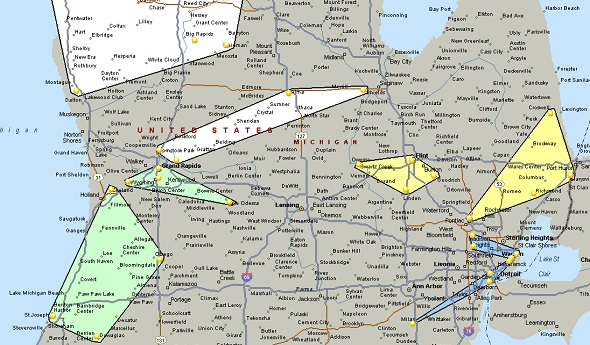
Go north with ease: For the most part, most Regional pairings were easier to draw than in past years. For the most part. Divisions 2 and 4 were not easy, specifically when it came to deciding which teams would be paired with an Upper Peninsula qualifier or a team from the Traverse City area. Keep in mind, distance on these maps isn’t based on how the bird flies, but how a bus would drive. In Division 2, that meant putting Muskegon, Muskegon Mona Shores and Grand Rapids Forest Hills Northern – near U.S. 31 and U.S. 131 – with Traverse City Central instead of sending Midland and Midland Dow west, up I-75 and then east-to-west again on more non-highway roads. In Division 4, we considered pairing Alma and Saginaw Swan Valley with Escanaba instead of Big Rapids and Remus Chippewa Hills. That decision came down to Big Rapids being about 14 miles closer to Escanaba than Swan Valley (Whitehall would go with Big Rapids and Chippewa Hills regardless.).
Four counties wide: Yes, on first glance it looks a little odd that Bay City John Glenn and Orchard Lake St. Mary’s would be in the same Division 3 District – but look at the map as a whole. Eight Division 3 teams are located south and mostly east of St. Mary’s, and John Glenn is the only team that could be considered in the northeastern quarter of the Lower Peninsula (Mount Pleasant and Gaylord are right down the middle and naturals to go with Sault Ste. Marie and Petoskey.). With the thumb playoff qualifiers of near-similar size in Division 4, there were no other options than to create this four-county trip between the Eaglets and Bobcats.
Semifinal selection: When all the Regional lines are drawn for a division, we also must figure out which Regionals will meet for Semifinals. This annually provides some challenges. Do we match east vs. west or north vs. south? If something seems iffy in four weeks when those games are played, again, keep in mind the entire map and entire Regionals that are matched up.
Scheduled strong: Because we’re looking only at dots on a map, we don’t see the matchups until everything is drawn – and in that way, we’re like everyone else. It wasn’t lost on us that two 9-0 teams will have road games this week or three 5-4 at-large qualifiers will be at home. For those 9-0 teams, it’s true: there’s nothing more they could’ve done on the field. But here’s why they will travel.
- Clinton, in Division 6, hasn’t lost a regular-season game since 2011, and in fact plays in a strong Tri-County Conference made up of Class C schools and one Class D. Four of eight from the league made the playoffs, and the competition was so strong that Morenci and Petersburg-Summerfield will host games in Division 8. But Clinton’s opponent, Monroe St. Mary Catholic Central, while it did have one loss, fell to one-loss Class B Lansing Catholic – and the Falcons played eight Class B and one Class A school this season. Beating a Class B team is worth 16 points more than beating a Class C and 32 more than beating a Class D (with those points then divided over the number of games a team plays that season) – and all of that made the difference in St. Mary’s final eight-point playoff average edge over Clinton.
- Saugatuck in Division 7 is a similar story. The Indians are one of three undefeated teams in their District, and did play a pair of Class B opponents. But by no fault of their own, especially in league play where the schedule is set, Saugatuck didn’t face a team this season that won more than five games. Hesperia played three Class B opponents including one that finished 6-3 – enough for the slim 1.8 points more in playoff average that earned the Panthers homefield advantage. Pewamo-Westphalia has the highest average in the District and didn’t play a Class B – the Pirates actually played three Class D teams. But they also beat four teams that made the playoffs including two that finished 8-1 – giving them a 2.7-point edge on Hesperia and 4.5 edge on Saugatuck.
- The 5-4 teams that will host – Redford Thurston in Division 3 and Escanaba and Benton Harbor in Division 4, all earned their spots. Escanaba faced six playoff teams and beat three, Class B Benton Harbor played eight Class A teams, and Thurston played five playoff teams and a sixth that just missed an at-large bid.
At the end of the day ...
What you see is what our committee decided upon after multiple discussions among multiple groups that broke down every sensible possibility we could muster. There are certainly points open to argument – and we likely made those arguments as well.
Those who would like to see the playoff selection process changed are in favor of a larger strength-of-schedule component, and it’s interesting to see how strength of schedule inadvertently made a larger impact this season than in the recent past – especially given the examples above of undefeated teams going on the road and at-large teams hosting.
Why were there fewer automatic qualifiers than ever before? Here's one theory. There were 11 fewer teams in 11-player football this season than in 2014 (most moved to 8-player). An argument can be made that there were fewer wins to be gained against teams that last season might have struggled to field 11-player teams, shifting the balance to fewer automatic qualifiers and more parity with stronger teams facing each other to fill their schedules.
Meanwhile, the 8-player field grew by nine teams this fall and has its strongest ever, with seven teams that finished 5-4 missing the postseason after a team with a sub-.500 record got in just a year ago.
Given how some matchups shook out this fall, the next argument by those seeking change likely will center on seeding entire Regionals instead of just Districts. But keep this in mind as well: if Regionals were seeded with this year's groupings, it would create possibilities of first-week trips like Battle Creek to Traverse City and Cedar Springs to Sault Ste. Marie. We're fairly sure most coaches and players would dread such journeys for a first-round game.
It's a lot to digest, and the scrutinizing will surely continue long after these playoffs are done as we all work to conduct the best tournament possible.
But at the end of the day – and the end of these next five weeks – to be the best, teams will need to beat the best no matter the matchups. And we’ve got plenty to look forward to starting this weekend and all the way through the 11-player Division 3 Final on Nov. 28 at Ford Field.
The MHSAA Football Playoffs are sponsored by the Michigan National Guard.
PHOTO: The Division 4 map was among the most difficult to draw during this year's selection process.
1st & Goal: 2024 Week 5 Preview
By
Geoff Kimmerly
MHSAA.com senior editor
September 27, 2024
As we reach the midpoint of the 2024 football regular season this weekend, 88 teams – or 15 percent of the state’s 601 varsities – have yet to taste a loss this fall.
 That may change substantially over the next three days.
A first defeat is guaranteed for at least four teams, as four Week 5 matchups pit undefeated opponents – and we dig into two of those games below. A total of 24 more undefeated teams will face opponents who have suffered just one loss over the first month, and we highlight some of those matchups as well – plus a few unexpected picks as we take a bit of a long view on potential league title and playoff qualification outcomes while rolling into the second half.
All games listed below are tonight unless noted, with results posting as they are reported all weekend on the MHSAA Scores page. Updated standings also are available by clicking the schools on the score list, and every division’s playoff points summary updates as well as scores are received.
Bay & Thumb
Ovid-Elsie (4-0) at Montrose (3-1) WATCH
Three teams have started the Mid-Michigan Activities Conference schedule 2-0, and these are two of them. Both were original members of the league in 2018, but their only championship came with a three-team share of the title in 2021 – although Montrose has won four District titles and a Regional championship over the last six seasons, and Ovid-Elsie made the Division 6 Semifinals last fall. The Marauders’ 42 points in a 35-point win last week over Durand were their season low; conversely, Montrose downed Durand by only six points 20-14 in Week 3 but over the season is allowing just under 11 per game – and with that lone loss opening night to 2023 Division 8 semifinalist Riverview Gabriel Richard.
Keep an eye on these FRIDAY Almont (4-0) at Croswell-Lexington (3-1) WATCH, Lansing Everett (4-0) at Grand Blanc (3-1) WATCH, Traverse City West (3-1) at Midland (3-1) WATCH, Port Huron Northern (2-2) at Port Huron (3-1) WATCH.
Greater Detroit
Warren De La Salle Collegiate (3-1) at Detroit Catholic Central (4-0), Sunday WATCH
This season’s DCC “Boys Bowl” features two of the top three teams in the Catholic High School League Central. DCC leads the division thanks to a 21-7 Week 2 win over Toledo Central Catholic, and De La Salle is chasing after last week’s 41-6 loss to TCC. But a Pilots win in this Sunday afternoon matchup would reset things at the top of the standings, and De La Salle has claimed the last three meetings with the Shamrocks – including 14-7 a year ago.
Keep an eye on these FRIDAY Roseville (3-1) at Grosse Pointe South (4-0), Rochester Adams (4-0) at Lake Orion (3-1) WATCH, Detroit Henry Ford (4-0) at Detroit Martin Luther King (3-1), Riverview (4-0) at Flat Rock (4-0) WATCH.
Mid-Michigan
DeWitt (4-0) at East Lansing (3-1) WATCH
This has been the most anticipated matchup in the Lansing area going back to last year’s 40-34 East Lansing win that ended up deciding the Capital Area Activities Conference Blue championship. The lone loss between them this season was the Trojans’ 14-12 defeat against Hudsonville in Week 2, and that defeat keeps looking better as Hudsonville downed Division 1 contender Rockford last week. DeWitt has scored at least 55 points in all four of its games, but also given up 42 or more twice – and with the playmakers on both sides, this could be another high-scoring clash.
Keep an eye on these FRIDAY Ogemaw Heights (4-0) at Clare (4-0) WATCH, Lake Fenton (3-1) at Corunna (4-0) WATCH, Portland (4-0) at Lansing Catholic (3-1), Manchester (4-0) at Leslie (4-0) WATCH.
Northern Lower Peninsula
Kingsley (3-1) at Traverse City St. Francis (3-1) WATCH
Much-improved Cheboygan may play a role, and Benzie Central pushed Kingsley hard last week. But these two look like the favorites in the Northern Michigan Football League Legends, and this game looks like it could end up eventually deciding the title. Both have a loss to a good opponent this fall, the Stags to Reed City in their opener and St. Francis two weeks ago to a 2023 league champion in Berrien Springs. Kingsley won last season’s meeting with the Gladiators 44-21 on the way to finishing second in the league but claiming the Division 6 championship in November.
Keep an eye on these FRIDAY Maple City Glen Lake (3-1) at East Jordan (3-1) WATCH, Cheboygan (3-1) at Boyne City (2-2) WATCH, Benzie Central (2-2) at Charlevoix (2-2) WATCH, McBain (4-0) at Houghton Lake (2-2) WATCH.
Southeast & Border
Petersburg Summerfield (3-1) at Ottawa Lake Whiteford (2-2) WATCH
This will be the final season of 11-player football in the 41-year-old Tri-County Conference, and among the remaining three teams Whiteford and Summerfield are tied with the most league titles with seven apiece. Whiteford has dominated in four straight wins between these two, including a 2021 playoff victory and 43-0 a year ago in Week 9 to keep the Bulldogs out of the playoffs. But Summerfield is off to another solid start, with its lone defeat by three to improved Decatur, and will try to catch a Bobcats team coming off a 50-20 loss to undefeated Edon, Ohio.
Keep an eye on these FRIDAY Milan (2-2) at Monroe St. Mary Catholic Central (4-0), Onsted (2-2) at Ida (3-1) WATCH, Blissfield (2-2) at Hudson (3-1) WATCH, Grass Lake (3-1) at Napoleon (2-2).
Southwest Corridor
Galesburg-Augusta (2-2) at Lawton (3-1) WATCH
Galesburg-Augusta is off to its best start since 2016, when it finished 5-4 – its only winning season this century. A victory over Allegan in Week 3 was notable and gave the Rams as many this season (2) as all of last. Things get more difficult from here, however, as Schoolcraft started off the Southwestern Athletic Conference Valley schedule by handing G-A a 49-0 defeat. Lawton, meanwhile, opened its league slate with a 42-6 rumbling over Delton Kellogg and has won 12 straight Valley games and three straight championships.
Keep an eye on these FRIDAY South Haven (2-2) at Parchment (3-1), Parma Western (3-1) at Coldwater (2-2), Allegan (2-2) at Constantine (4-0), Bronson (3-1) at Vermontville Maple Valley (2-2) WATCH.
Upper Peninsula
Bark River-Harris (2-2) at Manistique (2-2) WATCH
This might seem like another unexpected choice for special attention, but both teams enter this weekend with an opportunity to affect their season's eventual outcome significantly. The Emeralds are coming off a 4-5 finish a year ago, their best record since 2012, and a win over Bark River-Harris would not only be a first in five recent meetings but also a strong step toward reaching five or more wins this fall – especially with their final two games against currently undefeated Iron Mountain and Saginaw Nouvel. The Broncos, meanwhile, opened this season 0-2 but have begun to rebound as they pursue a sixth-straight winning regular season – and with Iron Mountain and Menominee coming up, this one would go a long way toward achieving that possibility.
Keep an eye on these FRIDAY Kingsford (4-0) at Calumet (2-2) WATCH, Houghton (2-2) at Menominee (4-0) WATCH, Ishpeming Westwood (1-3) at Gladstone (1-3) WATCH. SATURDAY Gwinn (2-2) at West Iron County (1-3) WATCH.
West Michigan
Zeeland West (4-0) at Hudsonville Unity Christian (4-0)
The realigned Ottawa-Kent Conference Gold took Zeeland West away from the Muskegon powerhouses but dropped it into a division with, among others, reigning Division 3 champion Grand Rapids Forest Hills Central from the O-K White and rebounding Unity from the O-K Blue. The Crusaders are only three years removed from a trip to Ford Field and defeated Forest Hills Central 43-20 last week in a league opener, while West opened with a 28-13 win over rival Zeeland East. Worth noting, Grand Rapids South Christian is the only holdover back from the previous O-K Gold alignment, and the Sailors also are 4-0 and see Unity and Zeeland West back-to-back in Weeks 7 and 8, respectively.
Keep an eye on these FRIDAY Hudsonville (3-1) at East Kentwood (3-1) WATCH, Newaygo (4-0) at Reed City (3-1) WATCH, Grand Rapids South Christian (4-0) at Grand Rapids Forest Hills Central (3-1) WATCH, Muskegon Mona Shores (4-0) at Muskegon (1-2).
8-Player
Brown City (3-1) at Kingston (4-0)
Brown City has an enrollment too large to allow the Green Devils to participate in the playoffs this season, so a repeat league championship has to be a main objective – and despite falling 30-28 to Deckerville last week, Brown City still has a chance to end up with at least a share of the Big Thumb Conference Blue title. Kingston and Deckerville now lead the league, and they face off in Week 7 – and Kingston also ended Brown City’s 2023 season with a Regional Final shutout. But a win tonight definitely would allow the Green Devils to root for the Cardinals in two weeks.
Keep an eye on these FRIDAY Waldron (4-0) at Burr Oak (3-1), Grand Rapids NorthPointe Christian (3-1) at Gobles (4-0) WATCH, Alcona (4-0) at Mio (3-1) WATCH. SATURDAY Indian River Inland Lakes (4-0) at Ishpeming (3-1) WATCH.
MHSAA.com's weekly “1st & Goal” previews and reviews are powered by MI Student Aid, a division within the Department of Lifelong Education, Advancement, and Potential (MiLEAP). MI Student Aid encourages students to pursue postsecondary education by providing access to student financial resources and information. MI Student Aid administers the state’s scholarship and grant programs that help make college Accessible, Affordable and Attainable for you. Click to connect with MI Student Aid and find more information on Facebook and Twitter @mistudentaid.
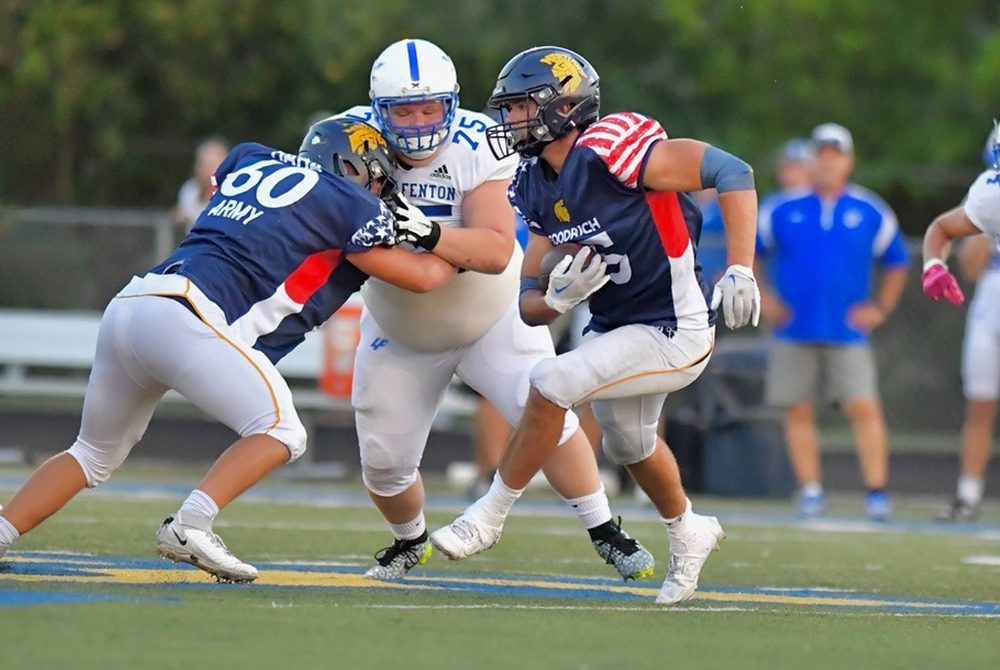
PHOTO Goodrich's Chase Burnett (25) follows teammate Gavin Sukup's block during a Week 3 win over Lake Fenton. (Photo by Terry Lyons.)