

Inside Selection Sunday: Mapnalysis '16
October 24, 2016
By Geoff Kimmerly
Second Half editor
There was a wheel and something that looked like a magic wand. Another started out looking like the head of a caterpillar.
 A number of Michigan football teams realized their sky-high dreams with Sunday’s playoff selection announcement on Fox Sports Detroit.
But earlier that day, as is the case at the end of each fall, shaping this season’s tournament at times looked a little like finding pictures in the clouds.
Beginning last night and into this morning, MHSAA staff have been busily gathering game days and times for this weekend’s opening round. We’re assigning officials for those contests. Schools are preparing for what likely will be one of their biggest crowds of the season. And, of course, teams are preparing for what surely will be one of their most memorable games.
But before all of that could begin, we met Sunday morning with nine maps of Michigan and 272 dots that needed to be organized to set another playoffs in motion.
As we’ve done the past five seasons, we’ll explain our most difficult decisions in this Mapnalysis 2016 breakdown of how we paired 272 teams that will play next month for championships across nine divisions. For those familiar with our playoff selection process, or who have read this report in the past and don’t want a refresher on how we do what we do, skip the next section and go directly to the “Observations & Answers: 2016.” For the rest, what follows is an explanation of how we selected the playoff pairings during the morning hours Sunday, followed by how we made some of the toughest decisions and a few thoughts on the breakdown of the field.
Ground Rules
Our past: The MHSAA 11-player playoff structure – with 256 teams in eight divisions, and six wins equaling an automatic berth (or five wins for teams playing eight or fewer games) – debuted in 1999. An 8-player tournament was added in 2011, resulting in nine champions total each season.
The first playoffs were conducted in 1975 with four champions. Four more football classes were added in 1990 for a total of eight champions each fall. Through 1998, only 128 teams made the postseason, based on their playoff point averages within regions (four for each class) that were drawn before the beginning of the season. The drawing of Districts and Regionals after the end of the regular season did not begin until the most recent playoff expansion.
In early years of the current process, lines were drawn by hand. Dots representing qualifying schools were pasted on maps, one map for each division, and those maps were then covered by plastic sheets. Districts and Regionals literally were drawn with dry-erase markers.
Our present: After a late Saturday night tracking scores, we file in as the sun rises Sunday morning for a final round of gathering results we may still need (which can include making a few early a.m. calls to athletic directors). Re-checking and triple-checking of enrollments, what schools played in co-ops and opted to play as a higher class start a week in advance, and more numbers are crunched Sunday morning as the fields are set.
This season, there were 218 automatic qualifiers by win total – only two more than the record low set a year ago – with the final 38 at-large qualifiers then selected, by playoff-point average, one from each class in order (A, B, C, D) until the field was filled. For the second consecutive season there were only four Class D additional qualifiers with 5-4 or 4-4 (playing eight games) records from which we could choose – so after those four we added 12 teams from Class A and 11 each from Class B and Class C.
Those 256 11-player teams are then split into eight equal divisions based on enrollment, and their locations are marked on digital maps that are projected on wall-size screens and then discussed by nearly half of the MHSAA staff plus a representative from the Michigan High School Football Coaches Association. Only the locations themselves are marked (by yellow dots) – not records, playoff point averages or names of the schools or towns. In fact, mentions of those are strictly prohibited. Records and playoff points are not part of the criteria. Matchups, rivalries, previous playoff pairings, etc. also DO NOT come into play.
The same process is followed for organizing the 8-player bracket, with the difference that the 16 teams are selected purely on playoff-point average.
Geography rules: This long has been rule number one for drawing MHSAA brackets in any sport. Travel distance and ease DO come into play. Jumping on a major highway clearly is easier than driving across county-wide back roads, and that’s taken into consideration. Also, remember there’s only one Mackinac Bridge and hence only one way to cross between peninsulas – and boats are not considered a possible form of transportation. When opponents from both peninsulas will be in the same District, distance to the bridge is far more important than as the bird flies.
Tradition doesn’t reign: Every group of 32 dots is a new group – these 32 teams have not been placed in a bracket together before. How maps have been drawn in the past isn’t considered – it’s hard to say a division has been drawn in a certain way traditionally when this set of 32 teams is making up a division for the first time.
Observations & Answers: 2016
First things, first: Congratulations to five first-time playoff qualifiers – Bloomfield Hills, Detroit Delta Prep, Southfield Arts & Technology, Southfield Bradford and Wyoming Tri-unity Christian. Bloomfield Hills (Lahser and Andover) and Southfield Arts & Technology (Southfield and Southfield-Lathrup) were created by mergers of previous schools. Southfield A&T and Detroit Delta Prep are eligible for tournament play this season for the first time. Bradford and Tri-unity Christian both started programs during the latter half of the 2000s; Tri-unity qualified in 8-player after moving back to that format from 11-player this fall. Of 617 varsity football programs that played games this season (including five not eligible for the playoffs as either a first-year program or with an enrollment too high for 8-player), all but 18 have made the playoffs at least once going back to the first series in 1975.
Tie it up: We had a few ties in a few ways this season. In two situations, we had multiple teams with the same enrollment at a line between divisions. In those cases, the teams with the higher playoff point averages go to the larger divisions – so Ferndale went to Division 2 and East Lansing to Division 3 to settle one tie, and Lansing Sexton went to Division 4 and Dowagiac to Division 5 to settle the other. The additional tie came in 8-player football, with Portland St. Patrick and Wyoming Tri-unity Christian both having the same playoff point average, the same opponents’ winning percentage and drawn into the same District. A coin flip was used to determine St. Patrick as the top seed and home team both this week and next if it advances and plays the Defenders.
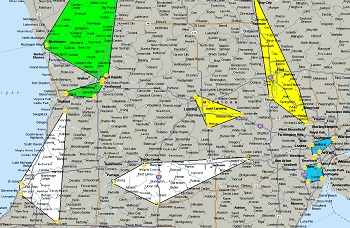 Local really is the rule: Division 3 provided us with a fine example to help show that we work to draw maps locally and beginning with the earliest rounds. There were at least three ways to separate the schools in Region 3 District 1: East Lansing, DeWitt, Fowlerville and Mason. DeWitt, as the westernmost of the group, could’ve been drawn southwest with R2D2’s Vicksburg, Battle Creek Harper Creek and Coldwater, replacing Chelsea. Doing so would’ve literally split the state’s regions down the middle along U.S. 127, which is a favorable picture. But protocol is to favor local matchups at the earliest rounds, and it just didn’t make sense to take DeWitt away from three schools mere minutes away when subbing it in for Chelsea would’ve created a wash in terms of travel for the other three teams in R2D2.
Sometimes, there’s no choice: But keeping a group of four local teams together often is impossible. Remember, 32 dots usually are spread out at least all over the Lower Peninsula. In Division 4, we had Grand Rapids Catholic Central, Wyoming Godwin Heights, Wyoming Kelloggsville and Grand Rapids South Christian stacked nicely along U.S. 131 – but had to send southernmost South Christian down with Benton Harbor, Three Rivers and Hudsonville Unity Christian because there was no other grouping for Allendale, which is about 20 miles west of Grand Rapids. Another incident of splitting up near-neighbors happened in Division 2; we had Lowell and Grand Rapids Forest Hills Central next door to each other, but no other Grand Rapids area teams qualify. By only a few miles, Forest Hills Central is south of Lowell – so although the Rangers had shorter drives than Lowell to possible opponents both north and south, they went into a group with Portage Northern, Portage Central and Battle Creek Lakeview, and Lowell went north to join Greenville, Traverse City West and Traverse City Central.
Why coast to coast: It wasn’t lost on the committee that teams waking up looking at Lake Huron traveling to play on Lake Michigan isn’t the greatest scenario. But it was the best of the options, and we stayed consistent by setting up a possible two District trips across the Lower Peninsula. Tawas will journey to Maple City Glen Lake in Division 6 this week. With wins this week, Lincoln Alcona could end up heading to Frankfort for a Division 8 District Final. Those trips aren’t ideal, but they did allow us to keep northern Lower Peninsula teams together – and in reality, aren’t too different than when teams from the Lower Peninsula and Upper Peninsula match up the first week, as will be the case in Division 4 (Whitehall to Escanaba), Division 5 (Kalkaska to Menominee and Grayling to Kingsford), Division 6 (Charlevoix to Negaunee and Boyne City to Calumet) and Division 8 (Gaylord St. Mary to Newberry).
It’s just the math: The one unexpected oddity of this week’s matchups is Canton going back to Northville for the second week in a row, and after beating Northville 42-27 last week. But math does rule, and Northville does have a higher playoff point average despite that Week 9 loss; the Mustangs beat five teams that finished with winning records, while Canton beat three – which of course is no fault of the Chiefs. It's just the way – rarely – things work out.
At the end of the day …
In six years of being part of these discussions, this weekend’s at least seemed to be the most extensive. We had two and three versions of multiple divisions before deciding which we believed to be the best.
Only one division map – 8-player – was an absolute slam dunk. The rest received plenty of scrutiny from a committee that now includes veterans going back to the beginning but also has had some new eyes join in over the last couple of years. That variety of viewpoints certainly pays off.
And wow, did we fall into some incredible first-week matchups:
• Rockford and Hudsonville in a rematch of the Ottawa-Kent Conference Red-deciding game of Week 9 (a Hudsonville 14-7 win).
• Traverse City West vs. Traverse City Central for the first time in playoff history (Central won 10-8 in Week 3).
• Bloomfield Hills Cranbrook Kingswood at Detroit Country Day in a homecoming for longtime Yellowjackets coach Joe D’Angelo.
• Constantine at Schoolcraft in a matchup of longtime southwestern rivals (Schoolcraft won 20-10 in Week 8).
• Cedarville at Engadine in arguably the most intriguing of three all-U.P. 8-player matchups (Engadine won 52-42 in Week 7).
Truly, at the end of November, the best teams will have to beat the rest to finish as champions – regardless of maps, matchups, weather and anything else that won’t really factor into what eventually is settled on the field.
For many high school sports fans, it’s the favorite time of year. Join us now as we prepare for kickoff.
The MHSAA Football Playoffs are sponsored by the Michigan National Guard.
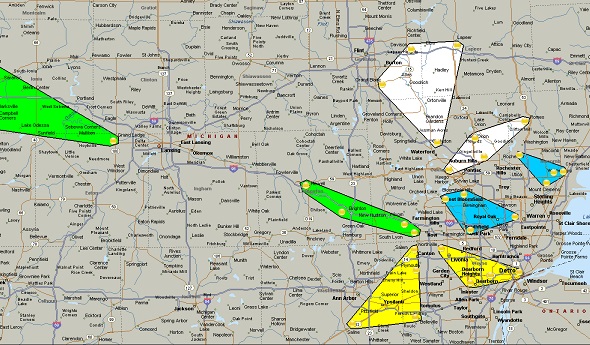
PHOTOS: (Top) The Division 1 bracket mapped out on the Lower Peninsula. (Middle) The Division 3 map keeps four mid-Michigan teams together.
Cisco Recalled for Jefferson Greatness, Care for Kids & Staff Over Half-Century as Coach
By
Doug Donnelly
Special for MHSAA.com
October 1, 2026
Marc Cisco was a gruff old football coach who was intimidating and set in his ways.
 Not really.
In fact, to those who knew him, Cisco was more like a teddy bear who had passions for good football, watching student-athletes play the game right and spending time with his close circle of friends.
Cisco died Sept. 24 in Grand Rapids at the age of 90, leaving a legacy on high school football in southeast Michigan. He was best known for coaching the Monroe Jefferson varsity football team for a remarkable 47 years. His teams won 241 games, including the 1994 Class B championship in the Pontiac Silverdome.
“It appeared he was this mean old guy. He might yell at you, but he would be the first one to pat you on the back and tell you good job,” said one of his former players, Jeff Potter. “He really cared about his kids and nurtured his players. He was mostly a big teddy bear.”
Cisco made a career in education as a teacher and coach. In addition to coaching the Jefferson football team for 47 years, he coached track & field for almost as many seasons.
His son, Zeke, played for his father and was the Jefferson quarterback. Later, Zeke was a walk-on at the University of Nebraska. When Zeke was away at college and would come home for a visit each May, he would volunteer to work at the Jefferson Invitational track meet because that’s where he would find his dad.
“He was just a coach,” Zeke said. “My childhood was all about sports. If I wanted to see him in the fall, I had to go to practice. If I want to hang around with him in the winter, he kept score at basketball games, so I would go to the basketball games. He kept the scoreboard during wrestling meets. I usually would sit under his legs, underneath the scorers’ table. I would hit him in the legs a lot because he would get bored and forget to add the score on.
“He was nestled in the fabric of the high school in every way, shape or form.”
Niles Kruger, sports editor at The Monroe News, said when Zeke was at Nebraska, Marc Cisco was usually one of the first coaches every Friday to call in his stats and scores because he would be jumping in a car to drive to watch his son play.
“He was one of my favorite postgame interviews because he was always the same, win or lose,” Kruger said. “He was quite a character and pretty good at cussing. He would always say afterwards, ‘Clean that up for me.’”
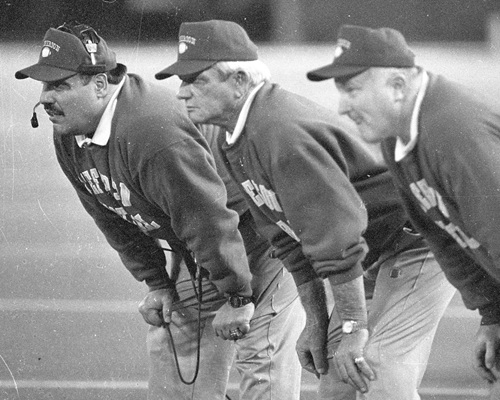
Cisco had a tremendous relationship with his assistant coaches. Several members of the Jefferson coaching staff were there for at least 40 of Cisco’s 47 years.
“His vacations, his fun things to do, were always with other coaches, their wives and their families,” Zeke Cisco said. “They would get together for card nights. They would go to Toledo Raceway (harness racing) Park. Pretty much every coach’s driveway, roof and deck were all built by the other coaches on the staff. They took care of each other.”
Cisco’s legacy includes an extended coaching tree filled with former players. Zeke has built a very successful program at Byron Center. Jason Gendron is the Gibraltar Carlson coach and in the middle of a tremendous run with the Marauders. Potter has coached at Ida for a decade and made that program a playoff regular.
“He was a big part of why I became a coach,” Potter said. “He was like a second family. My dad coached with him for 40 years. He was my Godfather. Our offense now is pretty much the same offense we ran in high school.”
Cisco had spent time in Florida after retiring but made his home in Reading near the Michigan-Indiana border the last few years.
“He would drive up to our games on Fridays,” Zeke said. “He would be in the parking lot at 3 o’clock.”
Marc had health issues over the last year, suffering from a stroke and congestive heart failure. He took a turn for the worse a little more than a week ago. He and his wife Donna, also a former coach at Jefferson, were together for more than 56 years. She survives.
Marc Cisco was a legend long before he started blowing the coaching whistle. Growing up in Morenci, he earned 16 varsity letters – four each in football, basketball, baseball and track – before graduating in 1954. The Bulldogs football team won 44 straight games during his career, and he made The Associated Press all-state team three times.
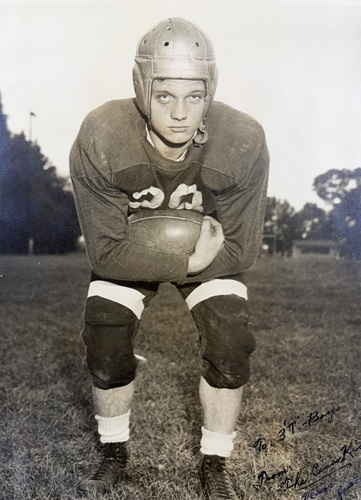
Larry Tuttle, the winningest baseball coach in Michigan high school history, was a student at Morenci when Cisco was a player.
“I never missed one of his games because my mom and dad would go to all of them,” he said. “Later on, we became good friends. He was such a great football player.”
Cisco played football at Michigan State University under head coach Duffy Daugherty and later at the University of Toledo.
He got his teaching start at Britton Macon High School in Lenawee County, before moving closer to the banks of Lake Erie and Jefferson in 1961.
It was 1963 when Cisco first coached Jefferson, leading the varsity to a 4-3 season – the first of three straight winning campaigns. The tide turned in 1966 when Jefferson went 0-6. The team won seven games over the next three seasons before Cisco stepped down.
He regained the job in 1973 and stayed until 2012. He was the Bears’ varsity coach 41 years in all. From the time his 1983 team went 9-0 until the mid-2000s, Jefferson was a model of consistency, producing winner after winner. The 1993 team went 10-1, the 1994 team 12-1, and the 1999 team 11-2. It was the 1994 Bears that won the Class B title.
Zeke Cisco said when his father retired, it was rather unceremonious. There was no big announcement or celebration, although the school had much earlier renamed the football and track stadium after him.
“He just sort of stepped away,” he said. “He would come up here and watch his grandsons play.”
Marc Cisco never took himself or his wins too seriously.
“You know, I used to always give him hell,” Zeke said. “I'd call him and go, oh, ‘It's the winningest coach Monroe County.’ He goes, ‘I'm also the losingest coach in Monroe County.’”
 Doug Donnelly has served as a news and sports reporter at the Adrian Daily Telegram and the Monroe News for 30 years, including 10 years as city editor in Monroe. He's written a book on high school basketball in Monroe County and compiles record books for various schools in southeast Michigan. He is now publisher and editor of The Blissfield Advance, a weekly newspaper. E-mail him at [email protected] with story ideas for Jackson, Washtenaw, Hillsdale, Lenawee and Monroe counties.
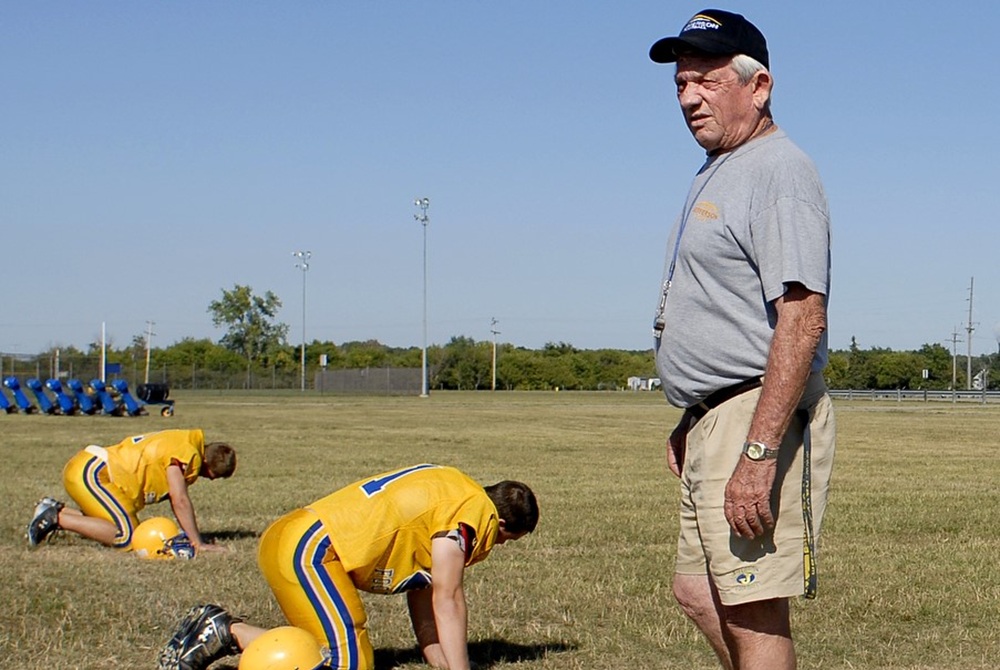
PHOTOS (Top) Marc Cisco coaches his Monroe Jefferson football team. (Middle) From left, John Castiglione, Cisco and Dave Potter monitor the action at the Silverdome during their team’s 1994 Class B Final. (Below) Cisco, while starring at Morenci. (Jefferson photos courtesy of the Monroe News. Morenci photo courtesy of Larry Tuttle.)