

Inside Selection Sunday: Mapnalysis '17
October 22, 2017
By Geoff Kimmerly
Special for Second Half
We haven’t had Michigan high school football teams travel by boat to their playoff games, nor fly like the birds over places like Saginaw Bay and the northern stretch of Lake Michigan.
 But phrases like “use the lake” and “follow the highway” dominated this year’s playoff mapping process, which once again saw members of the MHSAA staff and representatives of the Michigan High School Football Coaches Association draw into Districts and Regionals nearly 300 dots for our 10-division tournament that kicks off this weekend.
At the end of Saturday – around 9:48 p.m., to be nearly exact – there were 223 automatic qualifiers for the 256-team 11-player tournament, plus 32 for 8-player. By midnight, we had our entire playoff field more or less figured. Sunday at the MHSAA started before sunrise with double, triple and quadruple-checking, before a committee of 12 met to draw the tournament, go over all of each other’s work again, and then get everything ready to be presented online at MHSAA.com and broadcast across the state Sunday night on FOX Sports Detroit.
So much more than that goes into the football playoffs, of course. Athletic directors are scheduling games years in advance, and we start loading schedules into our system in late April. We monitor every game played every week by 614 Michigan varsity teams, plus this season 48 of our schools’ non-Michigan opponents located in five states and Ontario. Now we’re on to lining up everything that will come with the next five weeks of games including assigning officials, gathering potential Semifinal hosts and continuing our work with Northern Michigan University and Ford Field’s staffs to prepare for the 8 and 11-player Finals.
But we’re also the first to say that all of that is background noise to what we all look forward to most – five weeks of the best games our state has to offer again this fall.
As we’ve done the past six seasons, we’re explaining below our most difficult decisions in placing 288 playoff qualifiers in this Mapnalysis 2017 breakdown. For those familiar with our playoff selection process, or who have read this report in the past and don’t want a refresher on how we do what we do, skip the next section and go directly to the “Observations & Answers: 2017.” For the rest, what follows is an explanation of how we selected the playoff pairings during the morning hours Sunday, followed by how we made some of the toughest decisions plus a few thoughts on the breakdown of the field. Go to this page on MHSAA.com to see the pairings in full.
Ground Rules
Our past: The MHSAA 11-player playoff structure – with 256 teams in eight divisions, and six wins equaling an automatic berth (or five wins for teams playing eight or fewer games) – debuted in 1999. An 8-player tournament was added in 2011, resulting in nine champions total each season. This fall, a second division of 8-player football was introduced, and we will celebrate 10 champions for the first time.
The first playoffs were conducted in 1975 with four champions. Four more football classes were added in 1990 for a total of eight champions each fall. Through 1998, only 128 teams made the postseason, based on their playoff point averages within regions (four for each class) that were drawn before the beginning of the season. The drawing of Districts and Regionals after the end of the regular season did not begin until the most recent 11-player playoff expansion.
In early years of the current process, lines were drawn by hand. Dots representing qualifying schools were pasted on maps, one map for each division, and those maps were then covered by plastic sheets. Districts and Regionals literally were drawn with dry-erase markers.
Our present: After a late Saturday night tracking scores, we file in Sunday morning for a final round of gathering results we may still need (which can include making a few early a.m. calls to athletic directors and coaches). Re-checking and triple-checking of enrollments, what schools played in co-ops and opted to play as a higher class start a week in advance, and more numbers are crunched Sunday morning as the fields are set.
As noted above, this season there were 223 automatic qualifiers for the 11-player field by win total with the final 33 at-large qualifiers then selected, by playoff-point average, one from each class in order (A, B, C, D) until the field was filled. There were only five Class D additional qualifiers with 5-4 or 4-4 (playing eight games) records from which we could choose – so after those five we added 10 teams from Class A and nine each from Class B and Class C.
Those 256 11-player teams are then split into eight equal divisions based on enrollment, and their locations are marked on digital maps that are projected on wall-size screens and then discussed by nearly half of the MHSAA staff plus this year two representatives from the Michigan High School Football Coaches Association. Only the locations themselves are marked (by red dots) – not records, playoff point averages or names of the schools or towns. In fact, mentions of those are strictly prohibited. Records and playoff points are not part of the criteria. Matchups, rivalries, previous playoff pairings, etc. also DO NOT come into play.
The 8-player process is similar but changed this fall with the additional division. We take the top 32 teams in 8-player based on playoff point average as our field, then re-sort those 32 by enrollment – the 16 biggest make up Division 1, followed by the next 16 in Division 2. There are no automatic qualifiers by record for 8-player.
Geography rules: This long has been rule number one for drawing MHSAA brackets in any sport. Travel distance and ease DO come into play. Jumping on a major highway clearly is easier than driving across county-wide back roads, and that’s taken into consideration. Also, remember there’s only one Mackinac Bridge and hence only one way to cross between peninsulas – and boats are not considered a possible form of transportation. When opponents from both peninsulas will be in the same District, distance to the bridge is far more important than as the bird flies.
Tradition doesn’t reign: Every group of 32 dots is a new group – these 32 teams have not been placed in a bracket together before. How maps have been drawn in the past isn’t considered – it’s hard to say a division has been drawn in a certain way traditionally when this set of 32 teams is making up a division for the first time.
Observations & Answers: 2017
Let’s start with Congratulations: First to Detroit Western and St. Louis, which qualified for the MHSAA Playoffs for the first time. Then to seven more headed back for the first time in a while: Athens (first berth since 2000), Bridgeport (1999), Flat Rock (1990), Hancock (2006), Royal Oak (2006), Salem (1991) and Vermontville Maple Valley (2005). A total of 21 programs added to totals of more than 25 playoff berths, led by Beal City now with 35, Crystal Falls Forest Park and Farmington Hills Harrison with 33, Mendon with 32, Traverse City St. Francis with 31 and Frankfort with 30. Rockford earned its 23rd straight playoff berth, tying the record set by Felch North Dickinson from 1991-2013, and Menominee earned its 22nd straight to tie Traverse City St. Francis (1990-2011) for third on the list. Of our current 614 football varsities, all but 16 have made the playoffs at least once.
Break the tie: We again had to break a tie as teams that will or could meet ended up with the same playoff point averages. Ties are broken by head-to-head competition first – if the teams played each other during the regular season – followed by opponents’ winning percentage as the second criteria and then a coin flip if those two won’t do it. Cedarville will host Rudyard in an 8-player Division 1 game this week although both teams finished with the same playoff point average – Cedarville broke the tie with its 46-28 win over the Bulldogs in Week 1, which is a good thing because their opponents had matching 38-43 records this fall.
Many ways, no great way to slice it: The map in 11-player Division 2 was among our first tough challenges Sunday. Our most northern District seemed to make sense right away – keeping Traverse City West and Traverse City Central together with Midland and Midland Dow. From there, it’s not a pretty picture. We looked at three ways of splitting up the Detroit-area schools. We have five teams on the Grand Rapids/Muskegon/Kalamazoo side of the Lower Peninsula, but Lowell being eastern-most got sent to a District with three Flint-area schools. The 11-player Division 3 map provided a similar quandary – DeWitt, East Lansing and Haslett are packed nicely just north of Lansing, but an uneven seven schools on the western side of the Lower Peninsula meant DeWitt getting grouped with three closer to Grand Rapids with East Lansing and Haslett heading south to join Parma Western and Tecumseh. Bay City Central is the lone qualifier in this division from the Bay City/Saginaw/Midland area and also had to go somewhere – and in this case it made more sense to send it south along I-75 then across to Grand Rapids.
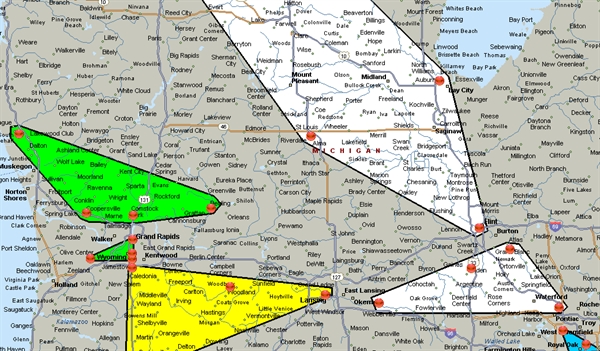
It’s a highway thing: In both Division 4 and Division 6 of 11-player, we have one Upper Peninsula school joining the rest from downstate. In Calumet’s case in Division 6, there are opponents in the northern Lower Peninsula to slot against, but Escanaba in Division 4 left us again relying on I-75. The trip from Escanaba to Flint Powers Catholic – the southernmost team in that four-team District – seems like a longer haul than sending Escanaba instead southwest to Whitehall. But a trip to Powers is estimated to be an hour shorter than from Escanaba to Whitehall, again because of the main highway.
Use the lake: At least three of our 11-player divisions – 1, 2 and 5 – have a District that rides close to the southeastern region of the Lower Peninsula up from Macomb County into Port Huron. While those thin Districts seem a little odd in shape, they make sense by normal traffic flow up from Lake St. Clair toward the Lake Huron coast. That helps explain why Port Huron Northern is with Roseville, Warren DeLaSalle and Ferndale instead of taking Lowell’s spot with Fenton, Flushing and Flint Carman-Ainsworth.
Worst map ever: At least in my seven years of being a part of the process. I’m speaking of the 11-player map in Division 8, which saw us with six Upper Peninsula schools, but then three Lower Peninsula schools grouped together just below Mackinac Bridge. One of these three had to go with another group, which is how we ended up with Frankfort joining Munising, Newberry and Gaylord St. Mary (Johannesburg-Lewiston and Hillman ended up with AuGres-Sims and Lincoln Alcona.). Then there are the pair of triangles in the southwest Lower Peninsula with Muskegon Catholic Central and Fulton-Middleton a good deal north of their District opponents, but with no other way to group those teams since the other six are all along I-94 or just south. It’s not pretty, but splitting MCC and Fulton up and sending them south was the best of the options we developed.
At the end of the day …
So here’s the fun part. We draw the maps without knowing who is where – and then we take a look at the matchups as they’re being prepared for TV and online.
It’s hard to pick out only a handful to mention at this time, but here’s one guess at a few that will create a buzz this week:
• In Division 1, Holland West Ottawa hosts Grandville after beating the Bulldogs 34-18 in Week 9 to earn an outright Ottawa-Kent Conference Red title; a Grandville win would’ve given championship shares to both and Rockford.
• Also in Division 1, Bloomfield Hills travels to West Bloomfield after beating the Lakers 28-24 in Week 2; West Bloomfield hasn’t lost again.
• In Division 3, Zeeland West and Zeeland East face off again after East downed West 28-8 on Friday to win the O-K Green championship.
• Also in Division 3, DeWitt hosts Grand Rapids Christian after rattling off eight straight wins – the Panthers’ only loss was to Christian 38-30 on opening night.
• Rivals Wyoming Kelloggsville and Godwin Heights meet in Division 4 after Kelloggsville beat Godwin by a point in Week 6 on the way to winning the O-K Silver title. Three Rivers and Vicksburg also will meet for the second straight week, this time in a Division 4 game; Vicksburg beat Three Rivers on Friday to deny the Wildcats a share of the Wolverine B Conference title. Harbor Beach claimed the Greater Thumb Conference East title by downing Ubly 26-14 in the league finale in Week 8, and they’ll meet again this week in Division 8.
• The best rivalry in 8-player last year was Powers North Central versus Crystal Falls Forest Park, and they’ll meet to start this postseason with the reigning champion Jets hitting the road looking to avenge a 66-58 loss to the Trojans in Week 2.
We know every game over the next five weeks will be memorable, at least for those on the field and the communities cheering them on. With our maps drawn, we look forward watching championship roads get blazed – and we’ll be waiting where they end at NMU and Ford Field.
The MHSAA Football Playoffs are sponsored by the Michigan National Guard.
PHOTOS: (Top) The Division 4 bracket mapped out on the Lower Peninsula shows how I-75 served as a guide for putting Escanaba in a District that includes Flint Powers Catholic.
Champion Coaches - Including Local Legends - Unite to Restore Ravenna Glory
By
Scott DeCamp
Special for MHSAA.com
October 8, 2026
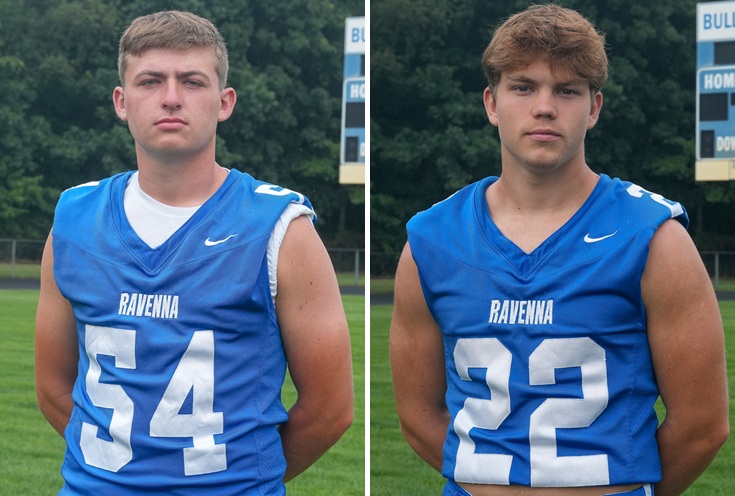
RAVENNA – Whether they want to or not, Ravenna seniors Joel Kantola and Colton Rolison hear about the glory days of Bulldogs football from their fathers.
 Kantola’s dad, Brandon, watches old games from the 1994 season when he was a two-way starter on Ravenna’s first MHSAA Finals championship team.
“He can’t remember very well, but he’ll see a play and he’s like, ‘Oh, I remember doing that play!’” Joel Kantola said. “It’s one of the best things to hear something (from that era). He loves it, too.”
Rolison’s dad, Willy, shares memorable stories from back in the day when he was a dynamic running back on the Bulldogs’ 1997 Class C title squad.
“It’s just insane that he still has all these stories that I’ve never heard. He’s still bringing them up, new ones every day,” Colton Rolison said with a smile.
Three decades have passed since the 1990s heyday of Ravenna football, when the Bulldogs won three of their program’s four Finals titles. But in the small town located on the eastern edge of Muskegon County, the band is back together, one might say.
Steve Czerwon was hired in March as Ravenna’s head football coach, coming from a highly successful 13-year tenure at his Muskegon Catholic Central alma mater where he guided the Crusaders to Division 8 championships all of his first four seasons (2013-16).
One of Czerwon’s first orders of business in Ravenna was securing the commitments of legendary coaches Dusty Fairfield and Randy Helsen – architects of the Bulldogs’ championship teams in 1994, 1996, 1997 and 2003 – to bring their wisdom and serve as a link from the storied era to this current one.
They agreed, others from the old guard hopped aboard, and a couple more experienced coaches joined Czerwon’s staff. Now, entering the final third of the 2026 regular season, the Bulldogs appear to have regained a little traction despite coming off three straight losing campaigns.
Ravenna carries a 5-1 overall record and five-game winning streak into this Friday’s West Michigan Conference Rivers home game against Hesperia.
Next week, Ravenna plays at North Muskegon with at least a share of the WMC Rivers title on the line. Should the Bulldogs win this Friday, they’ll take on the Norsemen for the outright league championship.
Since the WMC expanded and split into two divisions in 2022, North Muskegon has not lost a Rivers football game. Meanwhile, Ravenna has not won a conference title since sharing one with two teams in 2001.
In their football history, the Bulldogs have as many Finals titles as they do conference championships (four), illustrating the enduring strength of the West Michigan Conference.
This pack is hungry to etch its own history: Winning a conference title and making a run in the Division 7 playoffs. But, as Helsen laid out, there’s a price to pay.
“Steve addressed the fact (with the players),” Helsen recalled. “‘You wanted these guys to come back and you wanted what they had in the ’80s through the ’90s into the 2000s, and what it’s going to take is every effort you’ve got and even take it up from where you are. If you want to leave a legacy, that’s what you have to do. These guys (have) a legacy.’”
When Helsen says “these guys,” he’s referring to Fairfield and himself, but also other connections from the days of Ravenna football prominence.
In 20 seasons as Ravenna’s head coach covering two stints – the second ending in 2010 – Fairfield sported a 164-55 record. He’s a Michigan High School Football Coaches Association Hall of Famer.
Helsen served as Ravenna’s defensive coordinator for all of those seasons, and then some. He and Fairfield are both Ravenna Athletic Hall of Famers, their plaques side-by-side on the wall of the high school’s athletic wing.
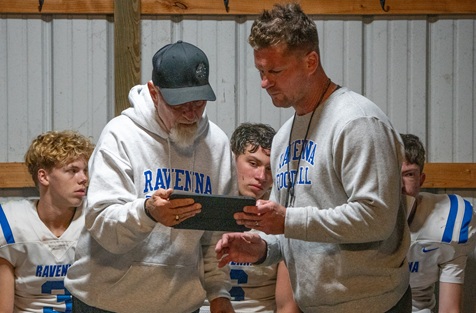
Fairfield and Helsen are both retired and they’re volunteer assistants on Czerwon’s staff. They are not at every practice, but they fill critical roles: The former works with the secondary and quarterbacks, plus he’s on the headset in the press box on game days, while the latter coaches defensive linemen.
“They have so much knowledge, and I think it really does connect the past to the current,” said Czerwon, who did his student teaching at Ravenna in the early 2000s and was a member of the Bulldogs coaching staff during their most recent state title season in 2003. “A lot of kids here, they heard from their uncles and their fathers about some really good teams that Ravenna had in the ’90s and early 2000s, and those guys are the actual link.
“I talk to Dusty daily, and he just reinforces the importance of relationships you have with the kids,” Czerwon added. “He’s second to none at that, and it reinforces to me the importance of that.”
Geoff Nelson, who was a starting lineman on Ravenna’s 1994 team, coaches the offensive line. Neil Sladick, who helped the Bulldogs win Finals titles in 1996 and 1997, works with linebackers. Mark Jacobs, who starred on Ravenna’s first Finals group in 1988, helps coach defensive backs.
Canaan Groff is Ravenna’s defensive coordinator, and Nate Smith specializes in offense. Both bring experience to the table, including as head coaches. Czerwon, Groff, Sladick, and Smith all work in Ravenna school buildings, which is an advantage for coaches.
“I think that we’re bringing back a lot of accountability. I think we don’t settle,” Nelson said about Ravenna’s coaching staff. “This has been a great group. We had to break a lot of bad habits, but they’re starting to form new habits and starting to go in the right direction.”
Ravenna got a reality check to start the season in a 33-7 loss to Division 8 top-ranked Beal City, a perennial small-school power. Czerwon admitted he may have asked too much of his players right away in terms of new schemes and such.
Since then, the Bulldogs have exhibited gradual improvement, including winning a couple of one-point games, and now they’re starting to establish an identity of physical football. That was at its peak in last week’s 28-0 win at Mason County Central, which by the way is coached by Ravenna alumnus David Smith, a former Bulldogs head coach who was a member of Class C championship teams in 1994 and 1996.
Things are moving in the right direction for Ravenna.
“There hasn’t really been a lot of drama or anything like that. We love each other. That wins games,” said Rolison, a linebacker who suffered a fractured collarbone in Week 3. Chances of a return this season are up in the air, he said.
“(The coaches have all) worked together before and nobody motivates like Dusty Fairfield – there’s not a single person out there who does,” Rolison added. “Coach Randy Helsen, he knows his stuff. He knows more than I probably ever will about football.”
According to Helsen, getting to know young people at the ground level is Fairfield’s specialty: Types of music they like, their hunting spots, etc.
In terms of accountability, everybody is responsible for that.
“We get after them if they’re not getting it done,” Helsen said. “Kids that were not getting after it five, six weeks ago and kind of rolling their eyes at me when I’m coaching them on scout defense, they’re now in the starting lineup. I said, ‘You’re getting coached by a guy that coached defense here for 27 years. I’m giving you the same coaching that our all-staters and all-conference players got.’”
Fairfield’s goal in returning was to help lay building blocks for current and future success. He believes the overall health of football in Ravenna is strong considering participation numbers from high school to youth levels, especially at a time when similarly small communities across the state are canceling varsity seasons or not fielding enough players to form junior varsity squads.
“It’s been a good experience, and it’s made me realize, you know, what we did in the past really meant something, and it made me realize how hard we worked because I’m totally invested in the team right now. It is fun with the camaraderie with not just the boys but also the coaches,” Fairfield said.
“You know, it’s my last hurrah where I get to experience what I did for a living for over 30 years. I get to experience it one more time before I, you know, go off into the sunset,” he added with a chuckle.
For families such as the Kantolas and Rolisons, things are coming full circle – and they could not be more excited. Brandon Kantola is enjoying his son’s senior season while also reminiscing about the good ol’ days.
“I think he was invested back then,” said Joel Kantola, Ravenna’s starting center, “but he’s more excited for us than I think he was back then.”

Scott DeCamp has worked more than 25 years in sports media, including 21 at MLive Media Group as a reporter and editor. He is founder and owner of DeCamp Creative Solutions. Email him at [email protected] with story ideas for Lake, Mason, Mecosta, Muskegon, Newaygo, Oceana, and Oceola counties.
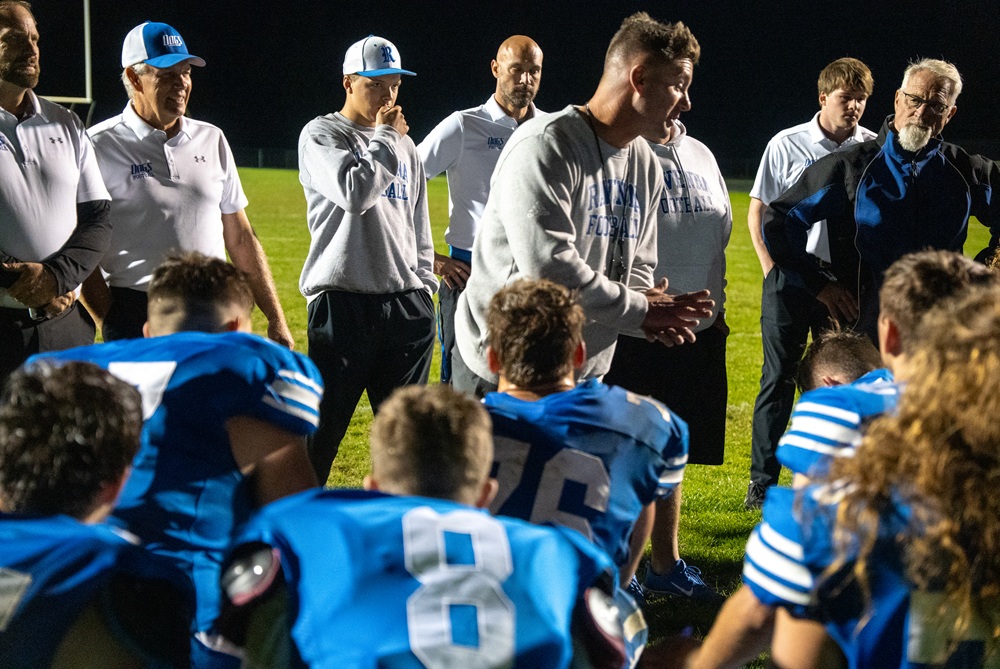
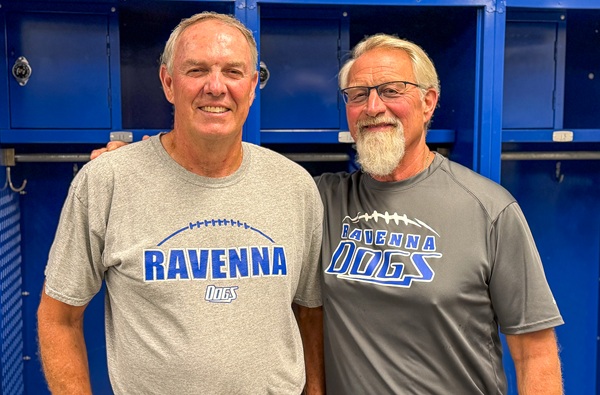
PHOTOS (Top) Ravenna head coach Steve Czerwon addresses the team following a 28-14 victory over Shelby on Sept. 25. (2) Ravenna assistant coaches Randy Helsen, left, and Dusty Fairfield are pictured in the Bulldogs' locker room in August. (3) Joel Kantola, left, is a senior center for the Ravenna football team, and Colton Rolison is a senior linebacker. (4) Fairfield, left, and Czerwon look at an iPad during halftime of a 28-0 victory over Mason County Central on Friday. (Photos by Scott DeCamp.)