

Inside Selection Sunday: Mapnalysis '19
By
Geoff Kimmerly
MHSAA.com senior editor
October 27, 2019
This will be the final MHSAA Football Playoffs under the format created in 1999, with significant changes coming beginning with the 2020 season.
But the soon-to-be old way isn’t going out without a bang.
From a record number of additional qualifiers, to a first-ever coin flip to determine the final team in the 11-player field, to a series of maps that arguably included the toughest to draw at least this decade, this year’s “Selection Sunday” was jammed with notable moments that will play out in 10 divisions over the next five weeks.
Below, we explain how we made many of the most difficult decisions – and follow with a few points of interest that immediately jump out from this season’s brackets.
This process actually begins in April, when we start collecting schedules for the upcoming season – this time for 607 teams, from which 531 ended up eligible for the 11-player playoffs and 71 were eligible in 8-player. And of course, now that the brackets are drawn the major lifting begins – assigning officials for every game, gathering potential Semifinal sites in 11-player and working with our Finals hosts to again create once-in-a-lifetime experiences (for most) when our 8-player finalists face off Nov. 23 at Northern Michigan University’s Superior Dome and our 11-player finalists play for titles Nov. 29-30 at Ford Field.
So let’s dive in. Those familiar with this “Selection Sunday” recap will recognize first a refresher on the playoff selection process, followed by “Observations & Answers: 2019.” That’s followed by thoughts after a glance at this year’s brackets, and be sure to visit MHSAA.com to see all of the pairings in full.
Ground Rules
Our past: The MHSAA 11-player playoff structure – with 256 teams in eight divisions, and six wins equaling an automatic berth (or five wins for teams playing eight or fewer games) – debuted in 1999. An 8-player tournament was added in 2011, and in 2017 a second division of 8-player football was introduced.
The first playoffs were conducted in 1975 with four champions. Four more football classes were added in 1990 for a total of eight champions each fall. Through 1998, only 128 teams made the postseason, based on their playoff point averages within regions (four for each class) that were drawn before the beginning of the season. The drawing of Districts and Regionals after the end of the regular season did not begin until the most recent 11-player playoff expansion.
In early years of the current process, lines were drawn by hand. Dots representing qualifying schools were pasted on maps, one map for each division, and those maps were then covered by plastic sheets. Districts and Regionals literally were drawn with dry-erase markers.
Our present: The last few scores of this regular season were added to MHSAA.com by 8 p.m. Saturday. Re-checking and triple-checking of enrollments, what schools played in co-ops and opted to play as a higher class start a week in advance, and more numbers are crunched Sunday morning as the fields are set.
This final season of 6-wins-and-in (or five wins playing eight games or fewer) produced 202 automatic qualifiers for the 11-player field with a record 54 additional qualifiers then selected by playoff point average – that group of additional qualifiers easily blowing past last year’s then-record total of 43. Additional qualifiers were selected from each class in order (A, B, C, D) until the field was filled. There were only two Class D additional qualifiers with 5-4 or 4-4 (playing eight games) records from which we could choose, and likewise there were 16 additional qualifiers available in Class C – so with those 18 spots filled, we added 18 teams from both Class A and B to fill out the field.
Here’s where the tie-breaker was forced into play. Among Class B teams, Durand and Imlay City tied for the 18th spot with playoff point averages of 42.667. They did not play each other during the regular season – so the first tie-breaker of head-to-head result couldn’t be used. The next tie-breaker is opponents’ winning percentage – and both teams’ opponents won 45.7 percent of their games this season. So we went to the coin flip, and Durand was awarded the final spot in the field.
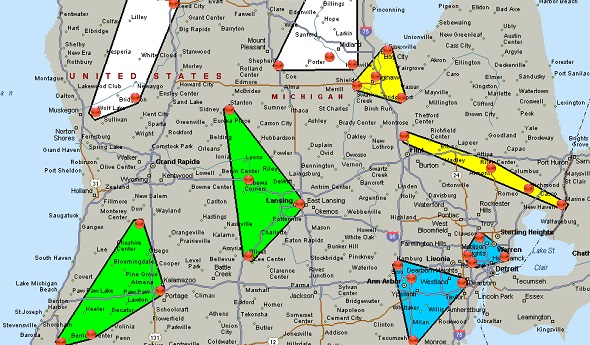
Those 256 11-player teams were then split into eight equal divisions based on enrollment, and their locations were marked on digital maps then projected on wall-size screens and discussed by nearly half of the MHSAA staff plus two representatives from the Michigan High School Football Coaches Association. Only the locations themselves were marked (by red dots) – not records, playoff point averages or names of the schools or towns. In fact, mentions of those are strictly prohibited. Records and playoff points are not part of the criteria. Matchups, rivalries, previous playoff pairings, etc. also DO NOT come into play.
The 8-player process is different for team selection and similar for designation of Regionals. We take the top 32 teams in 8-player based on playoff point average as our field, then re-sort those 32 by enrollment – the 16 biggest make up Division 1, followed by the next 16 in Division 2. There are no automatic qualifiers by record for 8-player, and those fields remain in flux right through the last Week 9 games. For example: Colon as recently as after Week 7 was slated for Division 2. But the Magi after this weekend ended up in Division 1 with the second-highest playoff-point average but the 16th-highest enrollment – meaning Colon (160 students) and Cedarville (154) were the line between Divisions 1 and 2 this year.
Our future: 11-player divisions determined in March. More bonus points awarded in losses. Read all about it: Comparison of old and new playoff formats
Geography rules: This long has been rule number one for drawing MHSAA brackets in any sport. Travel distance and ease DO come into play. Jumping on a major highway clearly is easier than driving across county-wide back roads, and that’s taken into consideration. Also, remember there’s only one Mackinac Bridge and hence only one way to cross between peninsulas – and boats are not considered a possible form of transportation. When opponents from both peninsulas will be in the same District, distance to the bridge is far more important than as the bird flies.
Tradition doesn’t reign: Every group of 32 (or in 8-player, 16) dots is a new group – these 32 teams have not been placed in a bracket together before. How maps have been drawn in the past isn’t considered – it’s hard to say a division has been drawn in a certain way traditionally when this set of 32 teams is making up a division for the first time.
Observations & Answers: 2019
We always start with CONGRATULATIONS: Detroit Leadership Academy, Detroit Communication Media Arts, and Pellston will be making their debuts in the MHSAA Playoffs this week, taking the list of teams that have never qualified for the postseason down to 11. Beal City and Crystal Falls Forest Park will make their MHSAA-best 35th playoff appearances. Five teams will be playing in at least their 17th consecutive playoffs – Rockford (25), Forest Park (23), Jackson Lumen Christi (22), Macomb Dakota (20) and Climax-Scotts (17).
Head-to-head rules: As noted above, it’s the first tie-breaker and comes into play immediately this week. In Division 3, East Lansing and DeWitt have identical playoff point averages, and East Lansing will host their first-round game thanks to a 21-2 Week 5 win. If Portland and Lansing Catholic both advance to an 11-Player Division 5 District Final, Portland will host thanks to a 21-20 Week 5 win over the Cougars. Same in 8-player Division 2, where if Powers North Central and Pickford meet in a Regional Final, the Jets will host thanks to their 20-14 win when the teams met in Week 3.
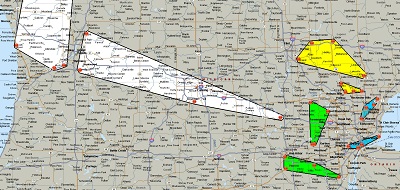 Traverse City traveling: Many years, we have to pay special consideration to ease of travel when we have one of 32 teams from a division in the Upper Peninsula. This year, we spent a lot more time discussing Traverse City schools – notably how to position Traverse City West in Division 1 and Traverse City Central in Division 2. There are three main north-south highways in the Lower Peninsula, with U.S. 131 the thoroughfare out of Traverse City. We also used it as the defining line in Division 1, with West going west with Grand Haven, Grandville and Hudsonville instead of staying with a more northern group that would’ve included Rockford and split Grandville and Hudsonville – which are six miles apart down I-196. In Division 2, we brought U.S. 127 into the mix, figuring it made more sense for travel to use that and 131 in grouping Traverse City Central with Muskegon Mona Shores, Midland and Midland Dow instead of creating a western District stretching from Traverse City to south of Kalamazoo.
Avoid the crisscross: Sometimes Districts drawn on the maps look perfect – but we run into trouble putting them together for a logical Regional. Sometimes we know eight dots should be a Regional, but there’s no reasonable way to split them into two four-team Districts. We do everything possible to keep a team from driving past a different District (or in 8-player Regional) on the way to its first or second-round game. The 8-Player Division 1 map probably looks a little odd with Deckerville possibly playing Morrice in the second round and the Orioles driving past Mayville or Kingston from another Regional to get there. However, there is a distinct northeast-to-southwest line separating those four schools – and if the Regional had been drawn to keep Deckerville with Mayville and Kingston, it would’ve meant Regional champs “jumping” over each other for their Semifinal matchup.
North/South vs. East/West: There isn’t one guiding directional when creating these Districts and Regionals. The 11-player Division 7 map has a little bit of both, with a pair of Districts along I-94 on the south side of the Lower Peninsula, but then Madison Heights Bishop Foley grouped with three Thumb-area teams for a north-south grouping. The other option was sending Bishop Foley northwest toward Flint and Lansing, but that would’ve left the Thumb schools and Beaverton maneuvering around Saginaw Bay.
At the end of the day …
Here’s my annual reminder: We draw these maps not knowing which schools are represented by the dots. The Division 5 and 6 maps were so easy to draw, I had no idea which schools were matched up until checking out the brackets hours later to put together this report.
But with all of that in front of me, here’s a glance at what jumps off the page:
• The Division 1 District made up of unbeaten Belleville and Brownstown Woodhaven, Saline (8-1) and Ann Arbor Pioneer (5-4) is obviously loaded. Belleville and Saline both made the Semifinals last season, and Saline’s only loss this fall was to reigning Division 1 champion Clinton Township Chippewa Valley. Woodhaven finished the regular season unbeaten for the second time in six years and its seeking its first District title.
• Last season’s Division 4 champion Edwardsburg has won 23 straight games and is back in the Division 3 bracket – the Eddies played in Division 4 the last two seasons and most recently in Division 3 in 2016. A possible return to Ford Field starts this week with St. Joseph and could include a trip to Zeeland West and matchup with also-unbeaten Mason.
• Hudsonville Unity Christian is another reigning champion in a new division, moving into Division 4 after winning the championship in Division 5 last fall. Unity begins with Otsego and would play either Grand Rapids Christian or South Christian with a win.
• Make way for Division 7. Unbeaten New Lothrop is the reigning champion and shares a District with undefeated Beaverton and a Regional with also-undefeated Pewamo-Westphalia. Iron Mountain, Lawton, Jackson Lumen Christi and Clinton also have yet to lose a game this season. Lumen Christi has won the last three Division 6 championships and 31 straight games.
• Math can lead to some unpredictable situations, including the occasional undefeated road team during the first round. Almont defeated Richmond 28-10 in Week 7 on the way to the Blue Water Area Conference title and a perfect regular-season record. But the Raiders will travel this week back to Richmond because the Blue Devils finished with a better playoff point average – Almont’s two nonleague opponents finished a combined 1-17, and Richmond’s both made the playoffs with a combined 13-5 record. That difference made the difference in playoff point average by about nine-tenths of a point in Richmond’s favor.
• This year’s 8-player brackets are loaded with intrigue, especially with 2018 Division 2 champion Rapid River not in the field and last year’s Division 1 runner-up Pickford in Division 2 this time. Morrice is the reigning Division 1 champion and could see undefeated Deckerville in a Regional Final. Pickford has to get through another 8-1 team in Engadine this week but could see undefeated Powers North Central in a Division 2 Regional Final.
• And it should shock no one if a team entering the playoffs 4-5 makes it to NMU. Gaylord St. Mary had to forfeit four victories but still made the playoffs with that record. Undefeated Suttons Bay is a possible Regional Final opponent, and St. Mary won their Week 6 matchup on the field 48-47 before later forfeiting that game.
That’s the start of what we’re looking forward to over the next five weeks. The steps taken today were just a few along the way as memories are made for thousands of Michigan high school football players this November.
PHOTOS: (Top) The Division 5 map, with clear-cut Districts, received quick support from the selection committee. (Middle) The Division 1 map split Grand Rapids-area teams along U.S. 131.
Finals Flashback: Remembering the '9s'
November 29, 2019
By Ron Pesch
Special for Second Half
This weekend’s MHSAA 11-Player Football Finals at Ford Field will conclude another decade for the most played and watched high school sport in Michigan.
We’ll roll into this year’s games remembering some decade-enders of the past from 1979, 1989, 1999 and 2009.
Redemption
The 1979 season marked the first playoff appearance for Norway, which had failed to qualify for the MHSAA postseason in 1975 and 1976 despite undefeated seasons.
However, the scoreless first half of the Knights’ Class D championship battle with Schoolcraft wasn’t proceeding as planned.
“We went into the locker room at halftime and made a few offensive changes,” said Norway coach Bob Giannunzio. “Our running game wasn’t working, so we decided we would pass more in the second half.”
The Norway defense forced six second-half turnovers that led to three touchdowns and a 21-6 win over Schoolcraft. Quarterback Chuck Soderlund connected on 6-of-14 passes for 110 yards including a 45-yard TD pass to Gregg Noordhoff to break the scoreless deadlock. Nordhoff added a second score from four yards out early in the in the fourth quarter for a 14-6 lead. Soderlund added a game-sealing TD on a QB sneak with 1:30 remaining.
It was the first of back-to-back titles for Giannunzio and the little Upper Peninsula school located near Iron Mountain. Since that season, Norway has advanced as far as the Semifinal round twice, in both 2002 and 2006
“We said if we ever got here we’d win it, said Giannunzio to the Detroit Free Press. “We wanted to start off right for the U.P. It’s a big burden playing for the whole Upper Peninsula.”
The Greatest
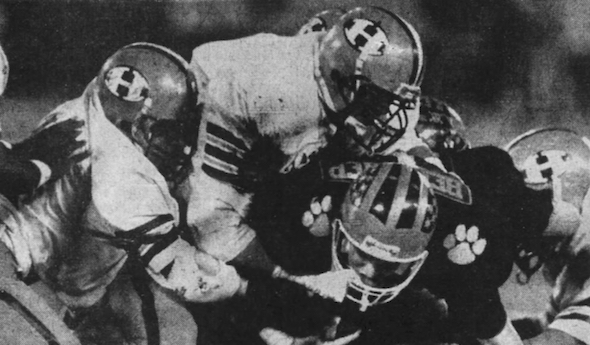
In Class B in 1989, Farmington Hills Harrison scored a 28-27 victory over DeWitt in what many still consider one of the greatest games of the MHSAA’s 45-year playoff history. The reigning Class B champion and top-ranked Hawks had their hands full. Tied 7-7 after one quarter, the Panthers grabbed a two-touchdown lead in the second quarter on 32-yard run by fullback John Tellford and a 35-yard pass play from Tellford to John Cowan. Harrison responded with a Matt Conley one-yard run to cut the margin to 21-14 at the half.
Hawks quarterback Mill Coleman knotted the score at 21-21 with a dazzling 16-yard run early in the fourth quarter, but DeWitt stormed back again driving 75 yards on 13 plays. The series was highlighted by tight end Dave Riker's 24-yard, one-handed catch to the Hawks’ 3-yard line. Two plays later, quarterback Chris Berkimer slipped over from the 1, and DeWitt again took the lead 27-21.
With 2:12 remaining and the ball at the Harrison 33, Coleman went to work. Three quick completions moved the ball to the DeWitt 16, and then Coleman let his legs do the rest. Following a Hawks timeout, Coleman dashed right for seven more yards to the Panthers’ 9. Facing a 2nd-and-3, Coleman dropped back to pass, escaped the rush at the DeWitt 17, then scampered up the middle and dove into the end zone for the tying points. Steve Hill added his fourth PAT of the game with 1:34 remaining for the final margin, then secured the victory with an interception on the next series.
Electrifying
Charles Rogers, perhaps the most electrifying high school receiver to ever touch the carpet at the Pontiac Silverdome, caught a single pass in the 1999 Division 2 title game, but he was the difference maker in Saginaw’s 14-7 win over Birmingham Brother Rice. The reception, defended by a single back, was a 60-yard touchdown reception from Brandon Cork on Saginaw’s first possession. Rogers broke a pair of tackles on the way to the end zone to open the scoring. The point-after attempt was blocked.
It was one of only six pass attempts by Saginaw on the day, and the only completion. But after that, as Mick McCabe of the Detroit Free Press wrote, “If Rogers would have gone up to the concourse for a hot dog, I’m sure a couple of Rice defensive backs would have been there to wipe the mustard off his chin.”
“He’s a big-time player, he should be in the NFL,” Rice coach Al Fracassa told McCabe. “He reminded me of Randy Moss. He’s always a threat just having him out there.”
A Saginaw fumble on the first play of the second half was recovered by Rice’s Tony Gioutsos at the Trojans’ 31. Eight plays later, Gioutsos scored from five yards out. Ross Ryan added the extra point for a 7-6 Rice lead.
Saginaw’s defense was aggressive, with constant pressure on Rice quarterback Mark Baker, sacking him twice while holding the Warriors to 78 yards rushing on 36 attempts.
Saginaw took advantage of the extra attention received by Rogers. Terry Jackson pounded out 106 yards on 18 carries, including 60 of Saginaw’s 84 yards on their game-winning drive in the fourth quarter. With Rogers drawing triple coverage, Jackson dashed opposite side for a 17-yard TD with 7:03 to play. Jackson also added the 2-point conversion for the game’s final margin.
A Wild Ride
Farmington Hills Harrison picked up its 10th state title with a 42-35 win over Grand Rapids Creston in a 1999 Division 3 championship game filled with wide-open play. Creston opened the title contest with a recovered onside kick and then drove 49 yards in five plays, ending with an Andrew Terry’s touchdown from a yard out. Harrison rebounded with a field goal, followed by a three-yard TD run by Kevin Woods off a pass interception for a 10-7 lead.
Creston responded with a four play, 79-yard touchdown drive that consumed a little over two minutes. Featuring a 41-yard pass play from QB Carlton Brewster to Lanard Latham near the end of the first quarter, the Polar Bears opened the second with a 25-yard run to the end zone by Terry. Odene Pringle’s extra point gave Creston a 14-10 lead.
Harrison then went 68 yards in six plays and under three minutes as Woods scored again from a yard out to regain the lead for his team 17-14.
The fireworks continued following another pass interception by the Hawks and another three-yard TD by Woods that upped the lead to 24-14. By halftime it was 27-21.
Harrison’s lead was short-lived as coach Charles “Sparky” McEwen’s Creston squad went 80 yards in 2:27 following the kickoff, capped by a Brewster to Latham 11-yard scoring strike. Pringle’s kick made it 28-27.
The Hawks responded on the next drive. It was 35-28 at the end for three quarters, then 42-28 when Woods scored again near the beginning of the fourth. In total, he would finish with 153 yards on 33 carries and four touchdowns, tying then-Final scoring marks for touchdowns and points.
Creston struck again with a 56-yard touchdown pass to Richard Gill from Brewster with 7:00 remaining to pull within a seven, 42-35. The Polar Bears regained the ball with 57 second remaining, but a final Hail Mary fell incomplete, ending one of the tournament’s most entertaining games.
Thriller
In 2007, the East Grand Rapids-Orchard Lake St. Mary’s championship battle was a 5 OT affair.
In 2009, it was again anybody’s guess who would emerge as the winner between the schools. The Pioneers entered undefeated, while Orchard Lake St. Mary’s carried four losses into the contest. They began the year with two defeats for the first time since 1991. The first was to this same East team, 21-7. Two others were to Division 1 Detroit Catholic Central, 27-0 and then 7-0.
The opening quarter of the Division 3 Final was scoreless. Orchard Lake opened the scoring early in the second. Quarterback Robert Bolden hit Gary Hunter for a 49-yard completion, and three plays later Bolden broke a pair of tackles to ramble across the goal line from 13 yards out. The Pioneers tied the game at 7-7 with 30 seconds remaining before the intermission, when 6-foot-7 Colin Voss caught a five-yard pass from Ryan Elble and snaked the last two yards into the end zone. St. Mary’s nearly answered in the time remaining as Hunter returned the kickoff 63 yards to the Pioneers’ 24. A false start penalty sent the ball back to the EGR 29, but then Bolden completed a pass to Allen Robinson for 28 yards to the Pioneers’ 1-yard line. Two rushing attempts by St. Mary’s were stopped at the goal line as time expired in the half, the last by Bolden that was ended by East’s Joshua Laarman.
Orchard Lake had opened a 21-17 lead with 9:12 remaining in the game following a three-yard TD by Cortez Riley and an extra point by Nathan Perry. With 4:01 left, that score still stood as the Pioneers took possession at their own 13 following an Eaglets punt. Kirk Spencer dashed for 38 yards to the Orchard Lake 49 on the first play. But with 2:49 remaining, East faced desperation at 4th-and-14. The ensuing pass, intended for Voss, slipped off his fingertips, but was caught by Spencer for a gain of 27 yards to the St. Mary’s 26. With 1:14 to play, Elble found Deon Jobe in the end zone from 15 yards out. Bobby Aardema’s kick gave East Grand Rapids a 24-21 lead.
“But it wasn’t quite over until we heard from Laarman and Spencer one more time,” wrote McCabe about play after the touchdown. “Bolden completed two passes to get to East’s 44 when he took off running. Earlier he scored on a breathtaking 83-yard keeper (giving St. Mary as 14-10 lead in the third quarter).
“The first thing Laarman thought of when he saw Bolden take off was: here we go again.”
Laarman caused a fumble on his attempted stop, and Spencer came up with the ball to seal victory. The win gave East Grand Rapids its fourth consecutive championship. East Grand Rapids would win five straight Division 3 titles between 2006 and 2010.
 Ron Pesch has taken an active role in researching the history of MHSAA events since 1985 and began writing for MHSAA Finals programs in 1986, adding additional features and "flashbacks" in 1992. He inherited the title of MHSAA historian from the late Dick Kishpaugh following the 1993-94 school year, and resides in Muskegon. Contact him at [email protected] with ideas for historical articles.
PHOTO: Farmington Hills Harrison scored late to edge DeWitt 28-27 in the 1989 Class B Final. (Photo courtesy of the Lansing State Journal.)