

Inside Selection Sunday: Mapnalysis 2012
October 24, 2012
By Geoff Kimmerly
Second Half editor
Between double checking data for more than a third of our 626 football teams, and creating 136 first-round games for our most popular tournament, the morning of MHSAA football "Selection Sunday" is both one of the most exciting and nerve-wracking of the school year.
So for those scratching their heads the last few days over how we picked the brackets this season, I offer one question and one warning:
How would you have done so differently?
And before you answer, remember that moving the position of one school affects at least seven more – if not all 32 in that division.
This was the second year I was involved in the football selection process, which while appearing simple on its face actually is layered with hours of discussions, calculations, checking and re-checking, and anything else we at the MHSAA can do to make sure we’ve created the best tournament possible.
Simply put, it’s more than just drawing circles and calling them good.
Below are a brief description of what we do, the history behind the process, and some challenges we face each time we draw these brackets – including some examples of our toughest this time around.
The process
Our past: The MHSAA playoff structure – with 256 teams in eight divisions, and six wins equaling an automatic berth – debuted in 1999. An 8-player tournament was added in 2011, resulting in nine champions total when November is done.
That’s a long way from our start. The first playoffs were conducted in 1975 with four champions. Four more football classes were added in 1990 for a total of eight champions each fall. Through 1998, only 128 teams made the postseason, based on their playoff point averages within regions (four for each class) that were drawn before the beginning of the season. The drawing of Districts and Regions after the end of the regular season did not begin until the most recent playoff expansion.
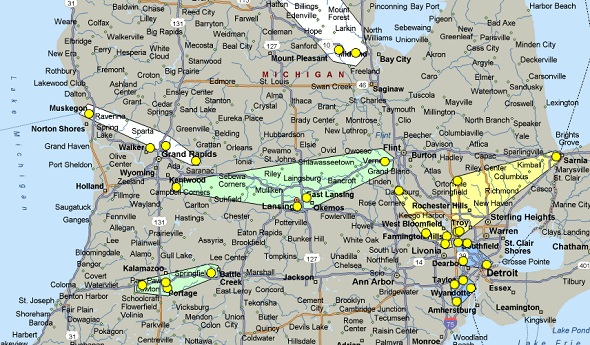
In early years of the current process (or until the middle of the last decade), lines were drawn by hand. Dots representing qualifying schools were pasted on maps, one map for each division, and those maps were then covered by plastic sheets. Districts and Regionals literally were drawn with dry-erase markers.
Our present: After a late Saturday night tracking scores, we file in as the sun rises Sunday morning for a final round of gathering results we may still need (which can include making a few early a.m. calls to athletic directors). Then comes re-checking and triple-checking of enrollments, co-ops, some records and more before the numbers are crunched and the field of 256 is set.
Those teams are then split into eight equal divisions based on enrollment, and their locations are marked on digital maps that are projected on wall-size screens and then discussed by nearly half of the MHSAA staff plus a representative from the Michigan High School Football Coaches Association. Only the locations themselves are marked (by yellow dots) – not records, playoff points averages or names of the schools or towns. In fact, mentions of those are strictly prohibited. Records and playoff points are not part of the criteria. Matchups, rivalries, previous playoff pairings, etc. also DO NOT come into play.
Geography rules: Drawing Districts and Regionals is all about location. Travel distance and ease DO come into play. Yes, ease is important. Schools near the same major highway might be further from each other in mileage than other options but have a better trip. A good example this year is in Division 6, which has seven teams in the U.P. and the northern Lower Peninsula. That meant Shelby needed to be included with those teams to make eight, and left Montague to a District that includes Hemlock – more than halfway across the Lower Peninsula. But at least, in this case, much of that trip will be on one roadway, M-46.
There is certainly conversation about every possible option. The staff splits into two groups, each handling four divisions (plus one of the groups handles 8-player too), and then the entire committee comes together to view all nine maps. There wasn’t one division where the group as a whole said, “That looks great, what’s next?”
Observations and answers
A different ballgame: I was asked whatever happened to Districts, meaning teams opening with opponents nearby. Remember that with eight divisions and 32 teams in each, the difference between maximum and minimum enrollments for each division is smaller than it used to be with just four classes, and the probability of finding two schools in the same division next door to each other is lower. This is especially true for our smaller schools, and those pairings are more spread out. Division 7 provides an excellent example. Opponents Dansville and Ottawa Lake Whiteford are 84 miles apart. But in another option considered, Dansville would’ve played Gobles – and those two are separated by 114 miles.
Points still matter: And that means strength of schedule is a big factor. After Districts are drawn, playoff point average determines the home team for those two games and Regionals as well. There are five Districts in which the team with the best or second-best record did not get home games because those teams’ playoff point averages ranked third among the four teams in those brackets. A number of other Districts have 8-1 teams playing at other 8-1 teams. It’s true: there are times a school can’t help the opponents it plays, because of league affiliation perhaps, and they have no control over how an opponent does the rest of the season. But a Class B team playing in a league with Class D schools can’t expect to compare averages well against teams in their division who face similarly-sized opponents during the regular season.
No boating: This didn’t come up last season, but did twice Sunday. We had to decide if it was a better trip for teams in the thumb to go around Saginaw Bay to play northern opponents, or instead send teams a little bit south of the thumb but with a straight shots north. As the bird flies, the thumb teams were closer in some cases. But I’ve never heard of a team hopping into a boat to get to a playoff game.
The fifth wheels: The toughest lines to draw are around areas with five schools in the same division. Remember, Districts come in fours, and one dot affects the rest. The Grand Rapids area gave us tough calls because of five teams in Divisions 2 and 4. The same was true in the southwest corner in Division 7 and the southeast corner in Division 6. No matter how we circled it, one of those teams got stuck with a longer trip. This time, that group included Caledonia, Grand Rapids South Christian, Blissfield and Gobles.
It’s easy to say certain areas of these maps should’ve been drawn differently. But again, keep in mind a statewide view.
Some of our pairings could create gigantic matchups earlier in the playoffs than those teams might like. But again, who is to decide which teams are the best and which matchups most “gigantic” before they prove it on the field? At least three teams touted during this fall as potentially the best in the state this season didn’t even win their conference titles.
And as I said in this analysis last year, determining the playoff schedule is just one step in many. Nine MHSAA champions must survive until the end, regardless of which opponents they face along the way.
Their journeys begin Friday.
1st & Goal: Finals in Review
January 28, 2021
By Geoff Kimmerly
Second Half editor
With absolute certainty, we can say this recently-concluded football season was like no other during the nearly 100-year history of the MHSAA.
But after just more than five months, and amid COVID-19, it was played to completion – with 8-Player Finals on Jan. 16 at Brighton’s Legacy Center and 11-Player Finals Jan. 22-23 at Ford Field in Detroit.
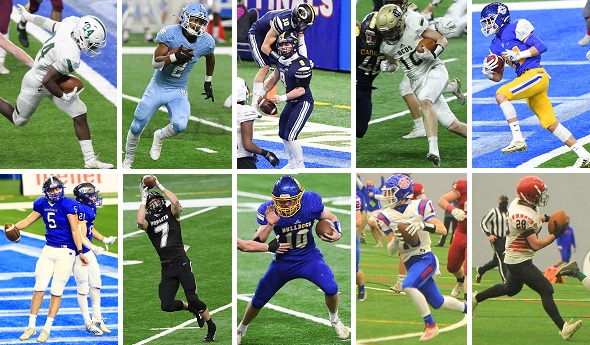
Second Half again covered all 10 championship games, with quick recaps and links (click on the game scores) to those stories below followed by notations of performances entered into the MHSAA Finals record book and a report on some of the biggest and best stories to emerge from the championship weekends. See also below highlights from State Champs Sports Network.
Finals in Review
11-Player Division 1: West Bloomfield 41, Davison 0
Led by Donovan Edwards’ 257 yards and three touchdowns rushing, West Bloomfield won its first Finals championship with a shutout of the 2019 champion Cardinals. Much more on Edwards below, but the Lakers’ effort on the other side of the ball can’t be overlooked – the shutout was the team’s sixth of the season.
11-Player Division 2: Muskegon Mona Shores 25, Warren De La Salle Collegiate 19
After winning its first championship in 2019, Mona Shores earned another in its encore led again by quarterback Brady Rose. Rose had started last season’s Final in place of an injured all-stater, but he was hardly unknown this time – and still ran for 154 yards and two touchdowns, including a 65-yard sprint during the fourth quarter that helped wrap things up for the Sailors.
11-Player Division 3: DeWitt 40, River Rouge 30
DeWitt finished off the longest football season in MHSAA history with its first championship, earning it against a River Rouge team looking to repeat after winning its first title in 2019. Quarterback play was on display in this finale as well, with DeWitt’s Tyler Holtz and Rouge’s Mareyohn Hrabowski putting up big numbers.
11-Player Division 4: Detroit Country Day 13, Cadillac 0
With youngest son Danny a major contributor, Country Day coach Dan MacLean led the Yellowjackets to their first Finals championship since 1999. Country Day kept first-time finalist Cadillac to just 166 total yards, and the shutout was the Yellowjackets’ third straight.
11-Player Division 5: Grand Rapids Catholic Central 48, Frankenmuth 21
The Cougars added their fourth championship in five seasons, this one their first in Division 5 after winning previously in Division 4. GRCC quarterback Joey Silveri accounted for six touchdowns in a Final for the second-straight season as his team built a big early lead against the first-time finalist Eagles.
 11-Player Division 6: Montague 40, Clinton 14
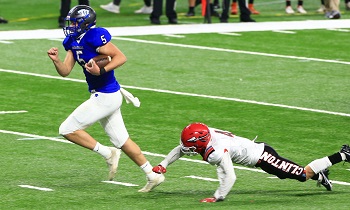
Strong quarterback play and a father-son connection both came into play in Division 6 as well as senior Drew Collins led dad Pat’s team to its first Finals championship since 2009. What Drew said after told the story of the entire season restart: “Everybody on this football team, coaches, players, trainers – everybody on this football team loves high school football. I love high school football. I love these coaches. I love my friends on the team. I love everybody on the team. I love the community. It’s bittersweet when you win a state championship when you’re a senior because it’s all over.”
11-Player Division 7: New Lothrop 42, Traverse City St. Francis 35
The Hornets’ Julius Garza put up one of the most impressive individual performances of the weekend, scoring three ways for a total of four touchdowns. New Lothrop got up early and then held off a St. Francis comeback to claim its second championship in three seasons.
11-Player Division 8: Centreville 22, Ubly 0
Centreville’s shutdown defense put together one more awe-inspiring performance to help the Bulldogs’ to their first championship. Centreville ran its state-best points-allowed-per-game average to 2.9 with its seventh shutout in 10 games played.
8-Player Division 1: Adrian Lenawee Christian 47, Suttons Bay 0
The Cougars put an exclamation point on a dominating first season of 8-player football with their first Finals championship in the sport, either format. Lenawee Christian not only performed well offensively but held Suttons Bay to 52 yards total. The Norsemen finished Division 1 runners-up for the second-straight season.
8-Player Division 2: Powers North Central 70, Portland St. Patrick 48
The Jets claimed their third championship in what was the highest-scoring 8-player championship game in the decade-long MHSAA Finals history of this format. More on that below, and also on North Central quarterback Luke Gorzinski and St. Patrick quarterback Connor Cross, who were among those to put up giant numbers. The Jets also feature a father/son combo, with Luke the son of head coach Leo Gorzinski.
Records Report
As one might imagine, the highest-scoring game in 8-Player Finals history was filled with record book accomplishments. North Central’s 70 points were the 8-Player Finals record for one team, and the combined 118 points were 19 more than the previous record set in Peck’s 67-32 win over Rapid River in 2013. The teams’ 933 combined total yards ranks third on that 8-Player Finals list, while North Central’s 22 first downs was tied for second and St. Patrick’s 21 first downs ranked fourth. Neither team punted, making for another first in 8-player championship games. The game was not only the highest-scoring 8-Player Final, but the third-highest scoring 8-player game in MHSAA history (including regular season), missing tying that record by only six points.
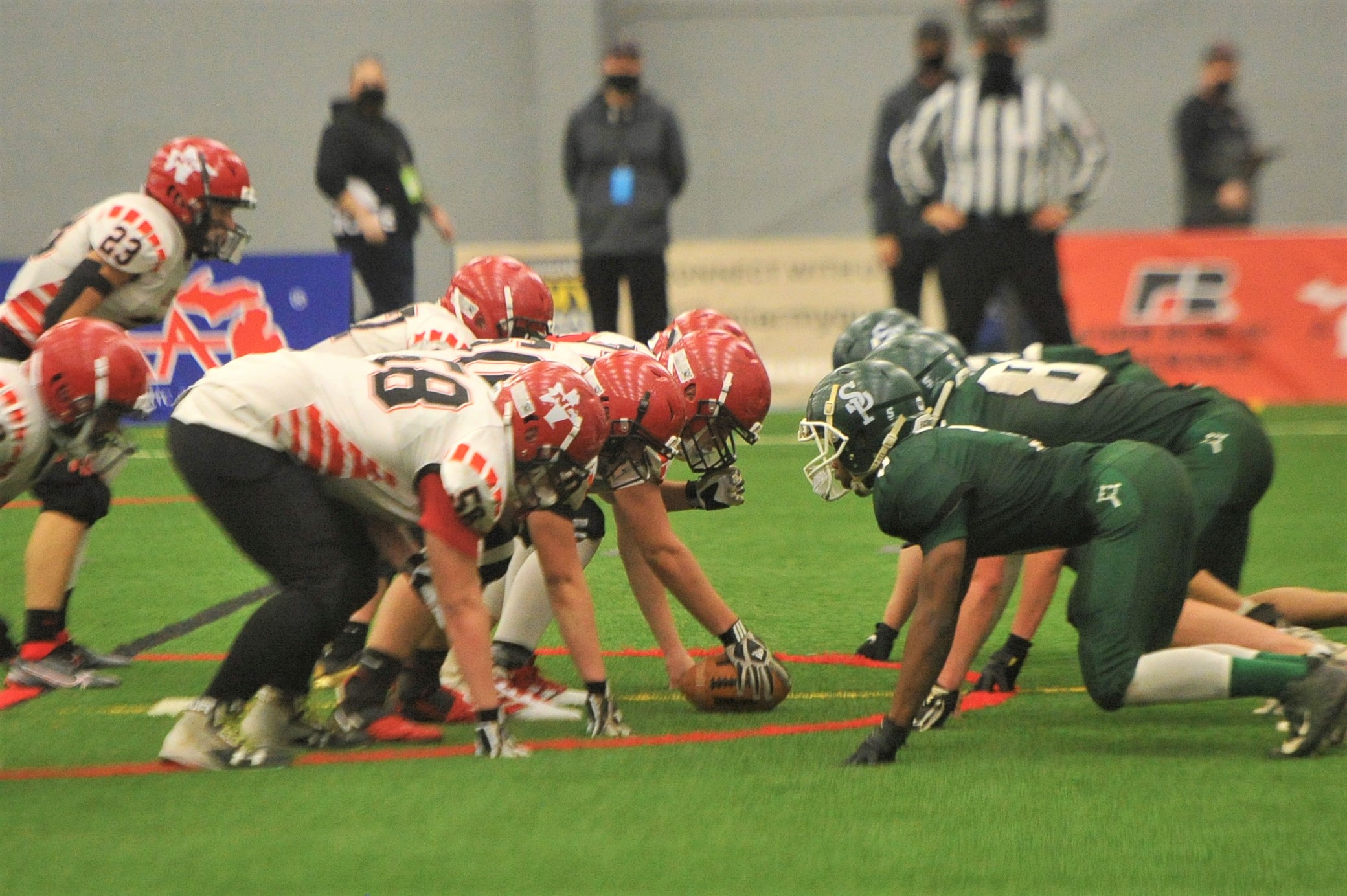 Also as noted above, all-state quarterback play was on display for both 8-player Division 2 finalists. North Central QB Luke Gorzinski totaled the second-most rushing yards, 299, in an 8-Player Final, and with 156 yards passing set the total offense record at 455. St. Patrick QB Connor Cross, with 397 total yards, is fourth on that list. Cross’s 374 passing yards were second-most in an 8-Player Final, as were his six passing touchdowns, and he earned the first listings with 25 completions and 38 pass attempts. Shamrocks receiver Shane Cook, meanwhile, set the record with 13 receptions for the second-most receiving yardage, 179. North Central as a team finished with the third-most rushing yards, 373 on 37 attempts, and third-most rushing touchdowns with six. St. Patrick as a team was second for team passing yards and touchdowns.
Gorzinski wasn’t the only offensive star for the Jets; teammate Wyatt Raab finished with the third-most points scored in an 8-Player Final, 32, on four touchdowns, three two-point conversions and a safety. Gorzinski did finish with the fourth-most points, 28, on four touchdowns and two two-point conversions. Both made the total touchdowns list with four apiece.
The 8-Player Division 1 Final made the record book as well, in two categories. Lenawee Christian as a team defense posted the lowest number of yards allowed, just 52. And Cougars quarterback Landon Gallant also made the total offense list with 326 yards – 59 rushing and 267 passing.
New Lothrop’s Julius Garza was among individual standouts from the 11-Player Finals, tying for fourth with 26 points scored – on four touchdowns and a two-point conversion – and also tying for fourth for touchdowns in a game, in Division 7.
West Bloomfield’s Jake Ward made all three kicking lists for 11-player, tying for third with two field goals in a game, ranking fourth for longest with a 45-yarder, and making the extra points list with five in the Division 1 Final. Grand Rapids Catholic Central’s Jack Barlow tied for fourth on that extra points list with six in the Division 5 game.
The Lakers’ Donovan Edwards was another of the stars of the weekend, with his 257 yards rushing ranking eighth all-time for an 11-Player Final – and while coming on just 14 attempts in Division 1.
Montague’s Drew Collins made the 11-player passing yards list with 244, coming on 15 completions in the Division 6 game. Three of those went for touchdowns to teammate Samuel Smith, who tied the record held by nine others for touchdown catches in an 11-Player Final.
DeWitt quarterback Tyler Holtz tied for fifth on the passing touchdowns list with four in Division 3. Opposing quarterback Mareyohn Hrabowski from River Rouge made the total yardage list with 321 – 94 rushing and 227 passing. New Lothrop’s Cam Orr also made the total yardage list with 344 – 122 rushing and 222 passing.
While quarterbacks starred in many cases, the run game was hardly left behind. In addition to Edwards’ performance for West Bloomfield, Clinton had the fifth-most rushing attempts in 11-player championship game history with 65, for 358 yards. Clinton also tied the record with just one pass attempt, with West Bloomfield tying for fifth on that list with two throws. Those two and Cadillac all tied the 11-Player Finals record by recording zero completions – they brought that all-time list to 21 teams that didn’t complete a pass in an 11-player title game.
Grand Rapids Catholic Central in Division 5 also became the 28th 11-player finalist to go an entire game without punting.
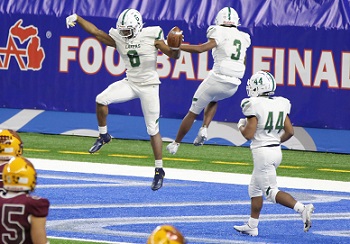 The Division 6 Clinton/Montague matchup also finished as one of the least-penalized in MHSAA 11-Player Finals history. The two teams combined for just 10 penalty yards, coming on one Clinton penalty. Montague was not penalized in the game.
Stories Behind the Scores
The Longest Season: Due to COVID-19, this season started on time, stopped, restarted, stopped again in mid-November, and restarted one more time with rapid testing the final week of December with playoffs ending over two weekends in mid-January. There are many reasons to want to forget the last year, and many much sadder circumstances. But the perseverance of all Fall athletes and families, coaches, administrators and support staff; along with the testing program provided by the Michigan Department of Health and Human Services, made for a memorable story that surely will be recalled for years to come.
First finishing 1st: West Bloomfield in 11-Player Division 1, DeWitt in Division 3 and Centreville in Division 8, and Adrian Lenawee Christian in 8-Player Division 1 all won their first MHSAA Finals in this sport. Cadillac in Division 4 and Frankenmuth in Division 5 made their first championship game appearances.
Edwards’ excellent ending: Edwards was slated to join University of Michigan’s football program as an early enrollee in January. But first, he wanted to finish his high school season, and career, with the Lakers. He led them to their first championship, with one of the top rushing performances in Finals history, and as arguably the biggest headliner from the weekend at Ford Field – likely gaining a few more fans along the way as well.
Many ways to win: As noted above, defense still works – four of 10 Finals were shutouts, and Centreville’s season-long performance was incredible. Also noted above, champions won both running and passing. But a final fun note on offense – seven of 10 champions this season scored 40 or more points in their championship games. That’s compared to two in 2019, five in 2018 and five in 2017.
(Click for more photos from Hockey Weekly Action Photos.)