

Inside Selection Sunday: Mapnalysis 2012
October 24, 2012
By Geoff Kimmerly
Second Half editor
Between double checking data for more than a third of our 626 football teams, and creating 136 first-round games for our most popular tournament, the morning of MHSAA football "Selection Sunday" is both one of the most exciting and nerve-wracking of the school year.
So for those scratching their heads the last few days over how we picked the brackets this season, I offer one question and one warning:
How would you have done so differently?
And before you answer, remember that moving the position of one school affects at least seven more – if not all 32 in that division.
This was the second year I was involved in the football selection process, which while appearing simple on its face actually is layered with hours of discussions, calculations, checking and re-checking, and anything else we at the MHSAA can do to make sure we’ve created the best tournament possible.
Simply put, it’s more than just drawing circles and calling them good.
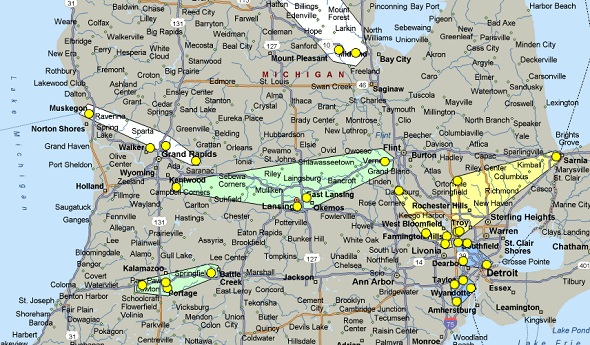
Below are a brief description of what we do, the history behind the process, and some challenges we face each time we draw these brackets – including some examples of our toughest this time around.
The process
Our past: The MHSAA playoff structure – with 256 teams in eight divisions, and six wins equaling an automatic berth – debuted in 1999. An 8-player tournament was added in 2011, resulting in nine champions total when November is done.
That’s a long way from our start. The first playoffs were conducted in 1975 with four champions. Four more football classes were added in 1990 for a total of eight champions each fall. Through 1998, only 128 teams made the postseason, based on their playoff point averages within regions (four for each class) that were drawn before the beginning of the season. The drawing of Districts and Regions after the end of the regular season did not begin until the most recent playoff expansion.
In early years of the current process (or until the middle of the last decade), lines were drawn by hand. Dots representing qualifying schools were pasted on maps, one map for each division, and those maps were then covered by plastic sheets. Districts and Regionals literally were drawn with dry-erase markers.
Our present: After a late Saturday night tracking scores, we file in as the sun rises Sunday morning for a final round of gathering results we may still need (which can include making a few early a.m. calls to athletic directors). Then comes re-checking and triple-checking of enrollments, co-ops, some records and more before the numbers are crunched and the field of 256 is set.
Those teams are then split into eight equal divisions based on enrollment, and their locations are marked on digital maps that are projected on wall-size screens and then discussed by nearly half of the MHSAA staff plus a representative from the Michigan High School Football Coaches Association. Only the locations themselves are marked (by yellow dots) – not records, playoff points averages or names of the schools or towns. In fact, mentions of those are strictly prohibited. Records and playoff points are not part of the criteria. Matchups, rivalries, previous playoff pairings, etc. also DO NOT come into play.
Geography rules: Drawing Districts and Regionals is all about location. Travel distance and ease DO come into play. Yes, ease is important. Schools near the same major highway might be further from each other in mileage than other options but have a better trip. A good example this year is in Division 6, which has seven teams in the U.P. and the northern Lower Peninsula. That meant Shelby needed to be included with those teams to make eight, and left Montague to a District that includes Hemlock – more than halfway across the Lower Peninsula. But at least, in this case, much of that trip will be on one roadway, M-46.
There is certainly conversation about every possible option. The staff splits into two groups, each handling four divisions (plus one of the groups handles 8-player too), and then the entire committee comes together to view all nine maps. There wasn’t one division where the group as a whole said, “That looks great, what’s next?”
Observations and answers
A different ballgame: I was asked whatever happened to Districts, meaning teams opening with opponents nearby. Remember that with eight divisions and 32 teams in each, the difference between maximum and minimum enrollments for each division is smaller than it used to be with just four classes, and the probability of finding two schools in the same division next door to each other is lower. This is especially true for our smaller schools, and those pairings are more spread out. Division 7 provides an excellent example. Opponents Dansville and Ottawa Lake Whiteford are 84 miles apart. But in another option considered, Dansville would’ve played Gobles – and those two are separated by 114 miles.
Points still matter: And that means strength of schedule is a big factor. After Districts are drawn, playoff point average determines the home team for those two games and Regionals as well. There are five Districts in which the team with the best or second-best record did not get home games because those teams’ playoff point averages ranked third among the four teams in those brackets. A number of other Districts have 8-1 teams playing at other 8-1 teams. It’s true: there are times a school can’t help the opponents it plays, because of league affiliation perhaps, and they have no control over how an opponent does the rest of the season. But a Class B team playing in a league with Class D schools can’t expect to compare averages well against teams in their division who face similarly-sized opponents during the regular season.
No boating: This didn’t come up last season, but did twice Sunday. We had to decide if it was a better trip for teams in the thumb to go around Saginaw Bay to play northern opponents, or instead send teams a little bit south of the thumb but with a straight shots north. As the bird flies, the thumb teams were closer in some cases. But I’ve never heard of a team hopping into a boat to get to a playoff game.
The fifth wheels: The toughest lines to draw are around areas with five schools in the same division. Remember, Districts come in fours, and one dot affects the rest. The Grand Rapids area gave us tough calls because of five teams in Divisions 2 and 4. The same was true in the southwest corner in Division 7 and the southeast corner in Division 6. No matter how we circled it, one of those teams got stuck with a longer trip. This time, that group included Caledonia, Grand Rapids South Christian, Blissfield and Gobles.
It’s easy to say certain areas of these maps should’ve been drawn differently. But again, keep in mind a statewide view.
Some of our pairings could create gigantic matchups earlier in the playoffs than those teams might like. But again, who is to decide which teams are the best and which matchups most “gigantic” before they prove it on the field? At least three teams touted during this fall as potentially the best in the state this season didn’t even win their conference titles.
And as I said in this analysis last year, determining the playoff schedule is just one step in many. Nine MHSAA champions must survive until the end, regardless of which opponents they face along the way.
Their journeys begin Friday.
Football Finals: Top 10 of first 15 Years
By
Ron Pesch
MHSAA historian
January 23, 2021
Not long ago, MLive published an article listing its "Top 30" Michigan high school football state finals performances over the last 30 years.
But what about those feats from the first 15 years (1975-1989)?
There were a total of 60 championships awarded in that first decade-and-a-half of play in Michigan, with title trophies awarded in only four classifications of 11-player football.
Since the beginning of the postseason, one can certainly argue the game of football has evolved from a run-dominated approach to a more wide-open style. While rushing marks from those first 15 years still dot the MHSAA championship record book, title game passing records overwhelmingly come from the later years of the playoffs.
Despite the changes made over time to the postseason, it’s interesting to note, the average margin of victory for 312 MHSAA football championship games has not really changed much. For the first 60 titles, the differential was 15.88 points. For the 252 played since 1989, it averages 16.12.
 What has changed is the average score. For the first 60, it was 25-9 (25.25 to 9.37). Since then, it has climbed to 30-14 (29.98 to 13.84). In other words, the offense for both the victor and the runner-up is more productive.
The defense has shut out its opponent on 42 occasions over the past 45 years. That happened on 16 occasions in those first 15 years, over 26 percent of the time. Over the last 30 years, that’s happened in just over 10 percent of MHSAA title games played since 1990.
Top performances aren't always found in a state record book. In a world that's constantly changing, the circumstances that form the setting mean everything.
Now about those 10 performances, shown chronologically by year.
1975 Class C
Mike Dellangelo, Ishpeming vs Hudson
Quarterback Mike Marana earned Detroit Free Press Class C all-state honors come December, but it was a 5-foot-6, 160-pound running back named Mike Dellangelo who stole the spotlight when Ishpeming stunned Hudson, 38-22, in the MHSAA title game in 1975 hosted at Central Michigan University. The postseason lasted only two weeks in that inaugural season of the playoffs, with only four teams qualifying in each of four classifications.
Dellangelo’s two touchdowns, a pair of two-point conversions and his 158 rushing yards on 21 carries may seem pedestrian to most when looking at playoff history today. But when studied against the accomplishment of Ishpeming’s opponent, Hudson, it magnifies the performance. The Tigers were, at the time, the most famous high school football team in America. Riding a 72-game win streak, recognized at the time as the longest ever in the nation, Hudson’s team’s achievements were featured in Sports Illustrated, before a Sunday broadcast of NFL games, and in countless newspapers and magazines from coast-to-coast.
“Few except the loyal fans from Ishpeming gave the Hematites a chance,” wrote Free Press sports writer, Hal Schram.
“A blocked punt by Bill Andriacchi early in the first period set up the game’s opening score,” stated the Green Bay Press-Gazette. ”Andriacchi broke through and blocked a punt by John Barnett on the 49-yard line, with the ball going out of bounds on the Hudson nine.”
Ishpeming coach Mike Mileski told Press-Gazette sports editor Len Wagner that the play turned the game over to the Hematites.
“We had three guys scout Hudson in their semi-final and one of the things we thought we could do was block their punts,” Mileski revealed. “We had four different rushes planned and we just called the right one in that case. It was our game after that.”
Dellangelo’s first TD, a 60-yard dash on a pitchout from Marana, in which he reversed his field and turned on the jets, was the day’s most explosive play. Followed by a two-point conversion by Marana, it gave the Hematites a stunning 24-8 first quarter lead. His second, a 10-yard scamper in the third quarter, upped the lead to 36-16.
Following the game, Hudson coach Tom Saylor called Dellangelo “the finest back I’ve seen this year. No one is quicker.”
That Saturday night, a welcoming party of 1,000 fans greeted the Hematites upon their arrival home to help celebrate their 38-22 triumph.
1975 Class D
Bill Santilli, Crystal Falls Forest Park & the Trojans defense vs. Flint Holy Rosary
Of course, the big story of the 1975 football playoffs was the end of Hudson’s national-record winning streak played out before a crowd of 7,000 at CMU. Yet, perhaps the most impressive performances on the day were provided by the Crystal Falls Forest Park squad, who completely stymied Flint Holy Rosary, 50-0, in the Class D Final, hosted at Western Michigan University, the other site used by the MHSAA to host that first year of championship games. The Finals would move indoors, away from the elements, to the recently-opened Pontiac Silverdome in 1976.
It would take until 1994 for a single championship team to equal the 50-point total put up by Forest Park that day, and until 2002 for a single team to exceed the point total. Bill Santilli “was double-teamed and even triple-teamed” for much of the day, but still managed to rack up 178 yards rushing and three touchdowns on 37 carries. The 5-foot-9 senior totaled 226 points on the season, (including 46 points in the team’s 67-0 thrashing of Posen in the Semifinals a week earlier) to set an MHSAA single-season record for points scored at the time. Quarterback Rich Mettlach totaled 148 yards passing, with 103 to Bryan LaChapelle out of the backfield.
The Forest Park defense limited Holy Rosary to an incredible -32 yards rushing, 78 passing and only four first downs in the contest.
“They told us the competition got tougher the farther south we got,” said winning coach Richard Mettlach. “We like it down here and may come back next year.”
The two teams squared off again each of the next two years to form one of the tournament’s first classic postseason rivalries. These were much better contests, with Crystal Falls again victorious,14-6, in 1976, and Rosary the winner, 21-20, in 1977.
1978 Class C
Kerry Smith, Grand Rapids Forest Hills Northern vs Bad Axe
Quick. Tell me who was the first to break the Pontiac Silverdome’s single-game rushing mark of 273 yards, set by O.J. Simpson on November 25, 1976? (No – it’s not Barry Sanders, who did run for more than 200 yards in a single game at the Silverdome on two occasions – the tops being 237 in 1994.)
The answer - Junior halfback Kerry Smith from Forest Hills Northern.
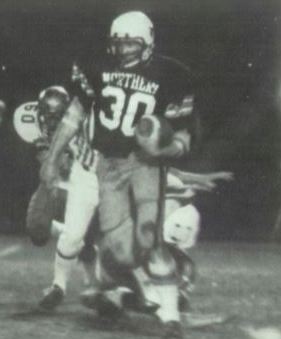 Running behind what was then considered a massive line (averaging 220 pounds), Smith rambled, seemingly at will, for 278 yards on 27 carries. The top mark would last for 13 seasons before being eclipsed by Farmington Hills Harrison’s Roy Granger.
Northern held a 12-0 halftime advantage, and an 18-0 third-quarter lead, before hanging on for an 18-16 win. Smith ran for 176 yards on 13 carries in the first half, and 252 on 20 totes through three quarters before a miscue and a 60-yard drive put the Hatchets into the game. But time was running out, and following a failed squib kick with 1:49 to go, Northern, handing the ball to Smith, ground out four more rushes to seal the victory.
An ideal fit under Bo Schembechler’s approach to football, Smith went on to a solid career at the University of Michigan.
1984 Class D
Jim Steinman, Gobles vs. Crystal Falls Forest Park
“Our scouting report indicated that we could pass on them,” said Gobles quarterback, Tony Koshar. Indeed, after grabbing a 6-0 lead on a 31-yard dash by Shawn Ampey on their opening drive of the game, Koshar connected with tight end Jim Steinman on a pass for the two-point conversion.
Following the exchange, Crystal Falls Forest Park responded with a long drive, but it stalled at the Gobles 9-yard line. Following a procedure penalty, Koshar spotted Steinman on the left sideline at the Tigers 40. The 6-2, 195-pound junior grabbed the pass, shook off a defender, then sprinted to the end-zone. The 96-yard TD reception stood as a championship record until 2008. Koshar connected with his big receiver for two more touchdown strikes of 17 and eight yards in the opening two quarters as Gobles opened up a 28-0 lead.
“We were sleeping in the first half,” said Forest Park coach Dick Mettlach, whose squad was making its sixth appearance in the Class D title game in 10 years.
The Trojans stormed back in the second half, closing the gap to 28-22, before Steinman ended the day with a championship-record field goal of 34 yards with 1:29 remaining to go up 31-22. (The mark would be topped a couple of hours later by Ann Arbor Pioneer’s Jeff Fisher, who booted a 42-yarder against Dearborn Fordson in the Class A title game). He finished the day with 23 points, also a new championship record. His point total mark would last until 1990.
(It’s also interesting to note that the 1983 season was the first in which the Silverdome installed high school goal posts for the four title games. Prior to that, the title games used pro posts, which measured 18 feet, 6 inches in width, versus the 23-feet, 4-inch posts used in high school.)
1987 Class A
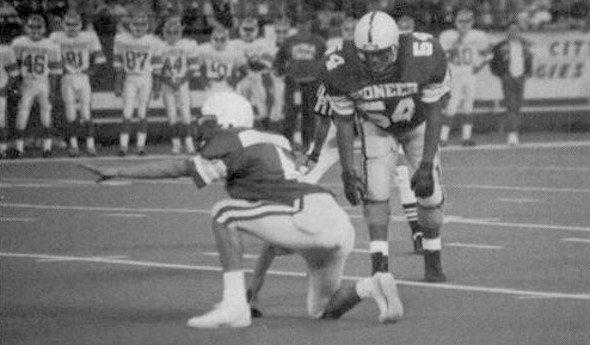
Chris Moore, Ann Arbor Pioneer vs Detroit Catholic Central
It doesn’t appear among final game record performances in today’s MHSAA record book, but it might arguably be called the most important field goal in championship game history. In all honesty, the boot held little meaning to those assembled in the press box until after the game was finished.
The 1987 Class A match-up between Detroit Catholic Central and Ann Arbor Pioneer was expected to feature two strong defenses. Ranked sixth in The Associated Press final press poll, the Shamrocks’ lone loss on the year had come against Pioneer, 7-2, in the third game of the season. Still, CC was favored by most after taking out Dearborn Fordson and Sterling Heights, ranked Nos. 1 and 2, respectively, in the final AP press poll, in their opening-round games of the postseason.
Pioneer, unranked with two losses, had barely slipped into the playoffs.
“In Pioneer’s last regular-season game against Ann Arbor Huron, (Chris) Moore lined up to kick a potential game-winning field goal but the kick was blocked,” noted Free Press sports writer Mick McCabe. The football was scooped up and returned 85 yards for a touchdown as time ran out, giving Huron a 27-21 win.
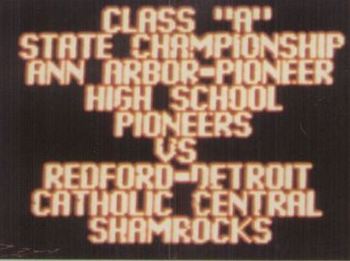
The football Final was a “day of redemption,” as Moore’s 35-yard kick, midway through the second quarter, broke a scoreless tie. In the end, it would be the only points scored in Pioneer’s 3-0 victory over Catholic Central. The point total still stands alone as the lowest number scored by two teams in the 45-year history of the postseason championship contests.
“I wanted Coach to call on me, but I didn’t know if he would,” said Moore after the game. “The snap was a little off but Sterling Olsen caught it and put it down. As soon as I kicked it, I felt good about it. It was on the left hash and I’m left footed, so I hooked it a little and it went right down the middle.”
“It might not have been the best-looking game,” stated Pioneer coach Chuck Lori, “but from this side of the press room it’s a beautiful win.”
1988 Class D
Brad Johnson, Schoolcraft vs. Frankfort
Over 30 years later, Brad Johnson’s record-setting 87-yard TD on a punt return still stands as an MHSAA title game record.
Johnson, Schoolcraft’s top rusher with more than 1,600 yards on the season, fielded the kick midway between the far right sideline and the hash mark, headed left, faked a reverse to teammate Todd Spears, then followed a wall of blockers down the left sideline to the end zone, giving the Eagles a 21-7 lead with a little over nine minutes remaining in the first half.
The return was his second touchdown of the game. Schoolcraft finished with a 42-7 victory over Frankfort.
1988 Class B
Brian Wauldron, Farmington Hills Harrison vs. St. Joseph
Farmington Hill Harrison’s junior quarterback Mill Coleman broke the state’s championship records for passing yards with 228 on 12 of 14 completions and with four passing touchdowns, but it was Brian Wauldron’s 177 yards and three TDs (on a mere five receptions), two interceptions and a fumble recovery that were truly mind-blowing at the end of the day.
St. Joseph took the game’s opening kickoff and moved from its 19 to Harrison’s 30 before Wauldron intercepted a fourth-down pass. On the next play, Coleman fired a perfect strike to Wauldron, who caught the ball in stride and streaked into the end zone. The play went for 71 yards.
The Bears responded with a long scoring strike of their own, cutting the lead to 7-6. Then 5-foot-9 Coleman connected again with Wauldron for a 72-yard TD. Their third touchdown, Waldron’s final catch of the day, came from 15 yards out in the third quarter.
The Hawks’ 44-9 win marked the first of back-to-back titles and came in the second of three straight visits to the Class B title game. Harrison had lost to Grand Rapids Catholic Central a year earlier, 19-7.
1989 Class A
Marcus Longmire, Muskegon vs. Detroit Martin Luther King
“Two years ago, Ann Arbor Pioneer won the Class A state championship by scoring three points,” wrote Mick McCabe in his pregame article on the Detroit Martin Luther King/Muskegon game, scheduled for Saturday. Playing in another Class A contest matching outstanding defenses, Detroit Martin Luther King was the first Detroit Public School League team to reach the Finals. Muskegon had made its first appearance in an MHSAA title game in 1986, defeating Sterling Heights Stevenson for the Class A crown.
The Son of Swami gave a vote of confidence to King and coach Jim Reynolds in his annual pregame picks, but noted that “SOS has a funny feeling that Muskegon might come into the Dome and leave with the state championship trophy.”
Muskegon held a 9-0 halftime lead and didn’t allow King a first down until midway through the second quarter, but it was an 89-yard playoff record kickoff return by Marcus Longmire to open the second half that stands out from the game in the minds of most.
Twelve seconds into the second half, Muskegon led 16-0. King responded almost instantaneously, with a Class A record-setting 76-yard TD pass from quarterback Zolton Hall to David Bowden. Then, with 3:36 left in the third quarter, Hall scored from three yards out to pull King within three, 16-13. Big-play defense ruled the scoreless fourth quarter, punctuated by strong secondary play by Longmire, and the Big Reds escaped with the trophy.
Longmire’s return has since been equaled or topped on 13 occasions, but lasted as the record until 1996 when Martez Johnson took one 95 yards to the house for Detroit St. Martin dePorres in the 1996 game against Iron Mountain.
1989 Class B
Mill Coleman, Farmington Hills Harrison vs. DeWitt
Mill Coleman’s performance in 1988, impressive as it was, is overshadowed in many minds by both Brian Wauldron’s game and what Coleman engineered a year later. The 1989 title game with DeWitt was a battle, in which the top-ranked and Class B reigning champion Hawks had their hands full.
Tied 7-7 after the first 12 minutes of play, DeWitt, ranked No. 8 in the final Associated Press poll, opened a two-touchdown lead in the second quarter on a 32-yard run by fullback John Telford and a 35-yard option pass from Telford to John Cowan. Harrison responded with a Matt Conley one-yard run to cut the margin to 21-14 with just over a minute left to play before the half.
After a scoreless third quarter, Coleman knotted the score at 21-21 with a dazzling 16-yard run early in the fourth quarter, but DeWitt stormed back again driving 75 yards on 13 plays. The series was highlighted by tight end Dave Riker's 24-yard, one-handed catch to the Hawks’ 3-yard line. Two plays later, quarterback Chris Berkimer slipped over the goal line from the 1. The extra point attempt was blocked but DeWitt again held the lead, 27-21.
With 2:12 remaining and the ball at the Harrison 33, Coleman went to work. Three rapid completions of 24, 12 and 15 yards gave the Hawks a first down at the DeWitt 16 with 1:50 left on the clock. Following a Hawks timeout, Coleman dashed right for seven more yards to the Panthers’ 9. On second down, he dropped back to pass, moved to his left at the DeWitt 17, then, feeling the pressure, darted up the middle, shaking off a tackle at the 15 and slipping past two defenders at the 10, a third at the 6 and a fourth at the 4 before diving into the end zone for the tying points. Steve Hill added his fourth PAT of the game with 1:34 remaining, giving Harrison only its second lead of the day, 28-27. Hill then sealed the victory with an interception on the next series.
Coleman finished with 297 yards of total offense (89 rushing and 208 passing). The mark stood until 2002, and has since been topped an amazing 29 times by 27 players.
(One might also point out that Coleman ended his prep career as the most prolific quarterback in state history, throwing for 7,464 yards and 77 touchdowns during his career. Today, both marks rank 10th overall.)
Still, when it comes to top individual performances in 45 years of MHSAA Final games, in my mind, no one has topped Coleman’s galvanizing performance on that championship weekend in November.
 Ron Pesch has taken an active role in researching the history of MHSAA events since 1985 and began writing for MHSAA Finals programs in 1986, adding additional features and "flashbacks" in 1992. He inherited the title of MHSAA historian from the late Dick Kishpaugh following the 1993-94 school year, and resides in Muskegon. Contact him at [email protected]:void(0);t with ideas for historical articles.
PHOTOS: (Top) Ann Arbor Pioneer’s Chris Moore lines up to kick what will be the winning field goal of the 1987 Class A Final. (Middle) Kerry Smith starred at Forest Hills Northern before going on to play at University of Michigan. (Below) The scoreboard announced the 1987 Class A championship game still remembered. (Photos gathered by Ron Pesch.)