

Inside Selection Sunday: Mapping the Football Playoffs
October 24, 2011
Sitting on the other side of this process for a number of years, I can admit to occasionally scratching my cynical head over some of the matchups that have come out of Selection Sunday.
How could teams so far from each other play in the same district? Why would two schools in the same town play in different regionals? Are they picking out of a hat at 1661 Ramblewood Drive?
Now, I have answers.
Sunday morning, we filed into headquarters for what might be the most important non-game day on the MHSAA calendar. “We” were made up of half of the MHSAA staff, plus a representative from the Michigan High School Football Coaches Association.
Here’s some of what I learned from being a part of the process:
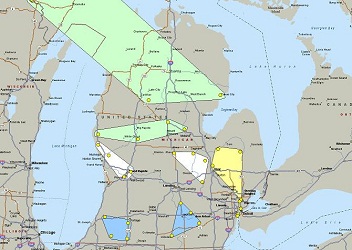
? First, a brief history lesson. In early years (or until the middle of the last decade), lines were drawn by hand. Dots representing qualifying schools were pasted on maps, one map for each division, and those maps were then covered by plastic sheets. Districts and regionals literally were drawn with dry-erase markers. No longer. Using a variety of spreadsheets and mapping software, we’ve gone digital. Staff is split into two teams, each considering four divisions (and the 8-player map) before we reconvene and look at all nine divisions together.
? We are presented digital maps of the state covered in dots. That’s about it. The rule of the day, simply, is “geography rules.” Which teams are represented by the dots is not considered, much less discussed, until lines are drawn. While considering my group’s first map, I began to bring up teams – and immediately was shot down (with good reason). Teams, matchups, rivalries, previous playoff pairings, etc. DO NOT come into play. We draw boxes in what we figure are the most logical ways of making districts and regions work.
? Travel distance and ease DO come into play. This especially is true when considering which districts will include teams from the Upper Peninsula. An example: Marquette is closer to the schools we placed in its district – Fenton, Bay City Western and Okemos – than some other options because those schools are closer to I-75. Schools further north on the map but farther from a main highway would’ve created longer trips.
? Sometimes, maps get ugly. And sometimes, it was a matter of choosing the least ugly situation. Of course, a D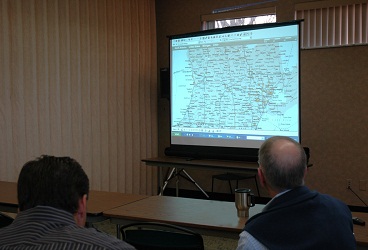 ivision 4 District of Lansing Sexton, Dearborn Heights Robichaud, Battle Creek Pennfield and Vicksburg isn’t ideal. But with no other Division 4 schools within 35 miles of Lansing, we were put in a tough spot. Add in that there were 13 teams in the Detroit area, leaving one as the odd team out of three districts based there. Something had to give, and drawing things up as we did caused the fewest messes.
? Considering how to set up the entire state is different than figuring out what teams make the most sense for just one school or area. And shifting just one dot on a map can change things for all 32.
? Back to “geography rules.” The Division 8 district including Saugatuck, Muskegon Catholic, Mendon and St. Joseph Lake Michigan Catholic might be the most competitive, on paper, in the state. Saugatuck is the reigning MHSAA runner-up in the division, and Muskegon Catholic and Mendon were ranked Nos. 1 and 2, respectively, in the most recent Association Press poll. Seeing that after we’d drawn the line caused a collective “ouch.” But again, the line was drawn based on dots on a map.
I thought back on some of the matchups I’d questioned in the past, and came back to what I’d ask people now: How would you do things differently?
I imagine there would be some creative answers, but I also would guess we considered those scenarios too.
And remember, determining the playoff schedule is just one step in many. Eight state champions must survive it, regardless of which opponents they face along the way.
Drive for Detroit: Week 1 in Review
September 3, 2013
By Geoff Kimmerly
Second Half editor
Let’s start our first weekly review of MHSAA football action with some of the results you won’t see among our list of most significant from opening weekend:
Kent City’s first opening night win over Ravenna in 15 tries and Beal City’s incredible 61-0 win over rival Mount Pleasant Sacred Heart. Kalamazoo Central’s 14-13 win over neighbor Loy Norrix and Kinde-North Huron’s 28-14 win over reigning MHSAA 8-player champion Deckerville.
All are big-time results, no doubt. But below I’ve tried to tell you about five more from each region of our state, organized by the winner in each game, that might have bigger impacts as we move immediately forward with most leagues schedules kicking off in three days.
West Michigan
Zeeland West 44, Detroit Country Day 28
Country Day came into this season with plenty of deserved hype returning most of its star power from last season’s run to the MHSAA Division 4 Final. But Zeeland West has plenty of championship experience too, and its tough running proved too much for the Yellowjackets. Click to read more from the Oakland Press.
Also noted:
East Grand Rapids 24, Grand Rapids Catholic Central 7 – The Pioneers began making up for last season’s first playoff miss since 2000 with a solid win over another perennial power.
Grand Rapids Christian 41, Grand Rapids South Christian 13 – New faces abound, but the reigning Division 3 champion won big over last season’s Division 4 title winner.
Muskegon Oakridge 31, Grand Rapids West Catholic 25 – The Eagles are soaring high to start this fall after finishing 2012 with a 13-6 District Final loss to West Catholic.
Rockford 23, Utica Eisenhower 6 – Given these teams’ histories, no one would be stunned if they met again in 13 weeks in the MHSAA Division 1 Final.
Greater Detroit
Oak Park 25, Orchard Lake St. Mary’s 20
Oak Park entered its opener with the opportunity to show last season’s historic run wasn’t over with 2012’s final horn. Four touchdowns during the second half against the reigning MHSAA Division 3 runner-up proved the Knights will be talked about plenty again in 2013. Read more in the Detroit Free Press.
Also noted:
Detroit Cass Tech 18, Southfield 14 – Two-time reigning Division 1 champion Cass Tech and quarterback Jayru Campbell edged an improved Bluejays team to start 1-0.
Clinton Township Chippewa Valley 27, Dearborn 20 (2 OT) – Chippewa Valley also beat Dearborn on opening night last season on the way to its first playoff berth in three seasons; this one could be prove just as important.
Rochester Adams 12, Clarkston 7 – Coming off its first playoff miss since 1996, Adams won for the first time in its last four tries against one of the biggest and best programs in the state.
Lake Orion 35, Oxford 30 – If this was an indication, these two should again be contenders in their respective divisions of the Oakland Activities Association. Lake Orion has held the Double "O" Pigskin Trophy three of four seasons since the series was restarted in 2010; the teams formerly played for the prize from 1962-83.
Southwest and Border
Battle Creek Harper Creek 27, Mattawan 7
Both of these teams should be contenders in their respective divisions of the Southwest Michigan Athletic Conference, and both will run their way to success again this fall. It will be interesting to see in eight weeks just how similar their paths finish after a game that would’ve been much closer if not for some untimely Mattawan turnovers. Click to read more from the Battle Creek Enquirer.
Also noted:
Battle Creek Central 15, Benton Harbor 0 – The Bearcats ended their 18-game winless streak with their first shutout since 2007.
Portage Central 55, Sturgis 0 – Sturgis has a Division 1 college prospect in quarterback Chance Stewart, which made this arguably the most impressive defensive performance statewide.
Watervliet 43, Gobles 14 – Simply put, this was a solid nonleague matchup between teams that each won eight games last season. Watervliet has the head start on repeating that feat.
Edwardsburg 34, Otsego 7 – Different teams, same story as above as both are playoff regulars that should again be in the mix by the end of the season.
Bay and Thumb
Saginaw Swan Valley 27, Saginaw Nouvel 20
Both might end this season at Ford Field after Swan Valley missed by one win a year ago and Nouvel missed by two after winning Division 7 in 2011. But as for the best in Saginaw, it looks like the Vikings at this point after running back Alex Grace ran for more than 200 yards in one of the state’s most intriguing openers. Click to read more from the Saginaw News.
Also noted:
New Lothrop 28, Traverse City St. Francis 7 – The Hornets traveled north for a tough opener and came back with plenty of momentum for the Genesee Area Conference Blue schedule.
Hemlock 19, Frankenmuth 12 – Hemlock, the 2012 Tri-Valley Conference Central champion, held on to beat the 2012 TVC East winner.
Montrose 38, Reese 8 – This looked to be a close game between 10-win teams from a year ago, but Montrose instead avenged last season’s 21-point loss to the Rockets in a bigger way.
Saginaw Arthur Hill 24, Goodrich 14 – Arthur Hill has struggled since it last playoff berth in 2008, but appears on the rebound with this reversal of a 41-6 loss to Goodrich in 2012.
Mid-Michigan
Ithaca 57, Williamston 13
This wasn’t really close, but was significant nonetheless. The win was Ithaca’s 43rd straight, tying the record for longest victory streak in MHSAA history in which all games were won during the playoff era. This week, the Yellowjackets face rival St. Charles with a chance to move up the list again. Click to read more from the Lansing State Journal.
Also noted:
Jackson Northwest 35, Hillsdale 20 – Only a record performance by Ithaca could trump what might be Northwest’s best football win since the mid-2000s. Hillsdale is coming off an 11-win season, and Northwest has won one game in each of the last three years.
Lansing Sexton 21, Chelsea 14 – Beating a team with 14 straight playoff berths will no doubt help the Big Reds return to the postseason after missing last season.
Pewamo-Westphalia 20, Lansing Catholic 7 – This reversed a 24-point loss to the Cougars last season as the Pirates began their quest for a third straight MHSAA Semifinals run.
Eaton Rapids 44, Leslie 0 – New Greyhounds coach Mike Smith, most known from his success at Holt, started his Eaton Rapids rebuilding effort with the team’s biggest win since 1996.
Upper Peninsula
Negaunee 36, Manistique 30
Negaunee had to be on its game for a tough Mid-Peninsula Conference opener against another playoff team from 2012. But the Miners held on through a late Manistique run and scored last to open league play and the season 1-0. Big plays were key, as Negaunee scored on an 80-yard kickoff return and 66-yard run. The Miners continued claim of the Oscar Wassberg Trophy, named for the former coach of both teams. Click to read more from the Marquette Mining Journal.
Also noted:
Cedarville 42, Posen 40 – The Trojans didn’t feel much of a challenge until Week 8 last season, but survived this one to kick off its 8-player season.
Ishpeming 36, Iron Mountain 0 – The reigning MHSAA Division 7 champion kept rolling with a win over another playoff team from last season.
Bessemer 28, Hancock 26 (OT) – The last three games between these two have been decided by a touchdown or less, but all in favor of the Bessemer-led co-op.
Marquette 31, Traverse City Central 23 – Marquette should get a solid boost at playoff selection time from this win as it goes for a fourth straight postseason berth.
Lower Up North
Reed City 39, Big Rapids 26
As stated earlier last week, this game eventually decided last season’s Central State Activities Association title in favor of Reed City. This was the fourth straight opening-night win for the Coyotes over rival Big Rapids. This game is played for the Pioneer Trophy. Click to read more from the Cadillac News.
Also noted:
Alpena 15, Escanaba 7 – Alpena has won only one game in each of the last two seasons and was outscored by Escanaba by a combined 72-0 over 2011 and 2012.
Hillman 55, Gaylord St. Mary 54 – These teams combined for only 41 points when they met to open 2012. This time, they qualified for the MHSAA record book.
Charlevoix 20, St. Ignace 0 – Coming off one win in 2012, and against a team that was 24-2 combined over the last two seasons, Charlevoix pulled off one of the biggest upsets statewide.
Maple City Glen Lake 27, Boyne City 13 – Glen Lake continued rolling off last season’s best finish in more than a decade by beating again the team it defeated to open the 2012 playoffs.
Trophy Games
Each week the MHSAA highlights trophy games played across the state. A few were mentioned above, with these the rest we knew about heading into the weekend.
- Bull Bowl – This is one of our newest trophies, established in 2011 for the opener between Fremont and Sparta. The Spartans gained a 2-1 advantage in the series last week. Final: Sparta 6, Fremont 0.
- Battle of 127 Trophy – Hudson and Addison have met for a number of years for this trophy sponsored by a local insurance company and local automotive group. Final: Hudson 46, Addison 0.
- Battle for The Paddle – Neighbors Sanford Meridian and Bullock Creek have met on opening night for the last dozen seasons. Bullock Creek owns a 7-5 advantage during that time. Final: Meridian 26, Bullock Creek 22.
- State Bank Traveling Trophy – Linden and Fenton have played for this prize dating to 1976, including on opening night the last two seasons. Final: Fenton 39, Linden 27.
- Little Brown Jug – Two games were played for these last week: Napoleon and Brooklyn Columbia Central continuing a series begun in 1967, and Manton and Mesick. Finals: Manton 29, Mesick 0; Columbia Central 26, Napoleon 18.
- Border Battle Cheese Trophy – Hurley (Wis.) made it eight straight opening-night wins over rival Ironwood. Final: Hurley 47, Ironwood 7.
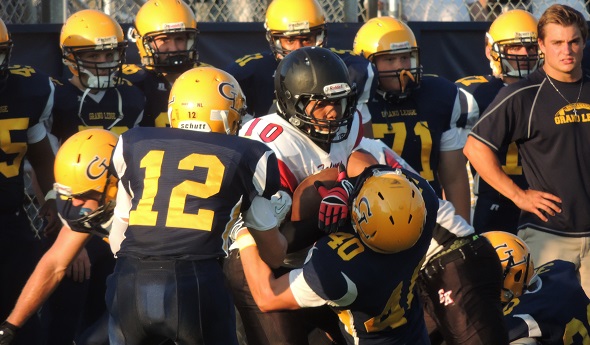
PHOTO: Grand Ledge made this stop, but fell a few short in a 16-14 opening-night loss at home against East Kentwood.