

Inside Selection Sunday: Mapping the Football Playoffs
October 24, 2011
Sitting on the other side of this process for a number of years, I can admit to occasionally scratching my cynical head over some of the matchups that have come out of Selection Sunday.
How could teams so far from each other play in the same district? Why would two schools in the same town play in different regionals? Are they picking out of a hat at 1661 Ramblewood Drive?
Now, I have answers.
Sunday morning, we filed into headquarters for what might be the most important non-game day on the MHSAA calendar. “We” were made up of half of the MHSAA staff, plus a representative from the Michigan High School Football Coaches Association.
Here’s some of what I learned from being a part of the process:
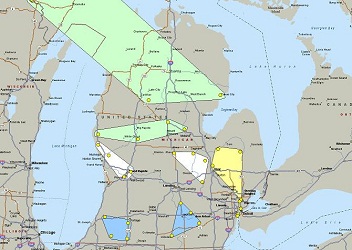
? First, a brief history lesson. In early years (or until the middle of the last decade), lines were drawn by hand. Dots representing qualifying schools were pasted on maps, one map for each division, and those maps were then covered by plastic sheets. Districts and regionals literally were drawn with dry-erase markers. No longer. Using a variety of spreadsheets and mapping software, we’ve gone digital. Staff is split into two teams, each considering four divisions (and the 8-player map) before we reconvene and look at all nine divisions together.
? We are presented digital maps of the state covered in dots. That’s about it. The rule of the day, simply, is “geography rules.” Which teams are represented by the dots is not considered, much less discussed, until lines are drawn. While considering my group’s first map, I began to bring up teams – and immediately was shot down (with good reason). Teams, matchups, rivalries, previous playoff pairings, etc. DO NOT come into play. We draw boxes in what we figure are the most logical ways of making districts and regions work.
? Travel distance and ease DO come into play. This especially is true when considering which districts will include teams from the Upper Peninsula. An example: Marquette is closer to the schools we placed in its district – Fenton, Bay City Western and Okemos – than some other options because those schools are closer to I-75. Schools further north on the map but farther from a main highway would’ve created longer trips.
? Sometimes, maps get ugly. And sometimes, it was a matter of choosing the least ugly situation. Of course, a D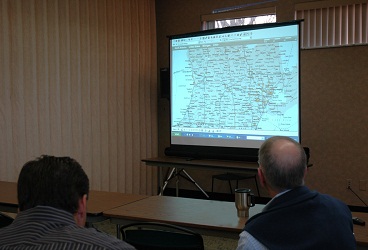 ivision 4 District of Lansing Sexton, Dearborn Heights Robichaud, Battle Creek Pennfield and Vicksburg isn’t ideal. But with no other Division 4 schools within 35 miles of Lansing, we were put in a tough spot. Add in that there were 13 teams in the Detroit area, leaving one as the odd team out of three districts based there. Something had to give, and drawing things up as we did caused the fewest messes.
? Considering how to set up the entire state is different than figuring out what teams make the most sense for just one school or area. And shifting just one dot on a map can change things for all 32.
? Back to “geography rules.” The Division 8 district including Saugatuck, Muskegon Catholic, Mendon and St. Joseph Lake Michigan Catholic might be the most competitive, on paper, in the state. Saugatuck is the reigning MHSAA runner-up in the division, and Muskegon Catholic and Mendon were ranked Nos. 1 and 2, respectively, in the most recent Association Press poll. Seeing that after we’d drawn the line caused a collective “ouch.” But again, the line was drawn based on dots on a map.
I thought back on some of the matchups I’d questioned in the past, and came back to what I’d ask people now: How would you do things differently?
I imagine there would be some creative answers, but I also would guess we considered those scenarios too.
And remember, determining the playoff schedule is just one step in many. Eight state champions must survive it, regardless of which opponents they face along the way.
Drive for Detroit: Week 9 in Review
October 28, 2019
By Geoff Kimmerly
Second Half editor
Just like that, nine weeks of Michigan high school football have come and gone this fall, and more than half the state’s 600+ teams are turning in their helmets and pads as we turn our attention toward the final 288 playing for MHSAA championships.
 But let’s not skip by Week 9 just yet. It definitely deserves a few more minutes of our time and attention.
The regular season made plenty of noise on its way out this weekend, with a few surprise conclusions to league title races and plenty of teams with plenty to celebrate. Some of those achievements were obvious, some not, and below we tried to cover many in both categories.
"Drive for Detroit" is sponsored by MI Student Aid.
Bay & Thumb
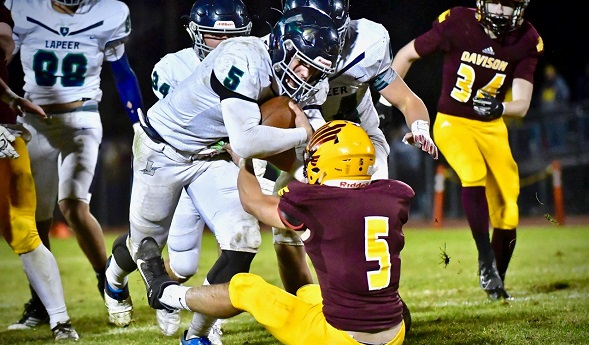
HEADLINER Lapeer 24, Davison 21 (2OT) For the second-straight year, the Saginaw Valley League Blue title came down to these two in a regular-season finale. And this one came down to a pair of field goal attempts in double overtime – Lapeer (8-1) made its kick and then blocked Davison’s to lock up the win and the repeat championship after also defeating the Cardinals (7-2) in the clincher a year ago. Click for more from the Flint Journal and see highlights below from State Champs Sports Network.
VIDEO: Check out the highlights of the Lapeer (@LapeerFootball) at Davison football game from tonight. @LapeerAthletics
Brought to you by @LTUAthletics, @MHSAA, @hungryhowies & @DACathlete pic.twitter.com/WzyOS5FZIi— STATE CHAMPS! (@statechampsnet) October 26, 2019
Watch list Midland Dow 42, Midland 7 The Chargers (6-3) started this season 2-3 and lost a Week 5 league game to Saginaw Heritage, which finished 4-5. But they battled all the way back and clinched a shared league title with the Chemics (8-1) by breaking a three-game losing streak against their rivals.
Remember this one Millington 41, Central Montcalm 18 The Cardinals (5-4) needed to close with a significant win to extend their playoff streak to 16 years, and they made it as an additional qualifier after defeating a league champion in Central Montcalm (7-2).
More shoutouts Harbor Beach 21, Elkton-Pigeon-Bay Port Laker 6 The Pirates (9-0) finished their third undefeated regular season this decade and first since 2014, with Laker (6-3) one of four opponents that also made the playoffs. Flint Hamady 56, Flint Southwestern 18 The Hawks (7-1) locked up the Genesee Area Conference title outright to go with their win in the old GAC Blue a year ago.
Greater Detroit
HEADLINER Orchard Lake St. Mary's 13, Detroit Catholic Central 0 The co-champions of the Detroit Catholic League Central met again two weeks after DCC’s 20-14 win sealed the shared title. The Eaglets (8-1) avenged as well as any team could hope, not only claiming the Prep Bowl Bishop championship but also keeping the Shamrocks (4-5) from advancing to the playoffs for the first time since 2014. Click for more from the Detroit News.
Watch list Belleville 41, Plymouth 14 The Tigers (9-0) capped a third-straight undefeated regular season with another Kensington Lakes Activities Association overall title, in this KLAA final handing Plymouth (8-1) its only loss.
Remember this one Detroit Martin Luther King 27, Detroit Denby 6 The Crusaders (7-2) have rebounded from losses to DCC and Muskegon to open this season to win a third straight league championship and this PSL 1/2 final. Denby also is 7-2, with its losses both to King.
More shoutouts Brownstown Woodhaven 49, Birmingham Groves 28 The Warriors (9-0) locked up their second perfect regular season over the last six with a season-high scoring output against Groves (7-2). West Bloomfield 16, Warren De La Salle Collegiate 8 The Lakers (8-1) brought their average points allowed down to 12 with a near-shutout of the two-time reigning Division 2 champion Pilots (5-4), whose last three defeats have been by a combined 12 points.
Mid-Michigan
HEADLINER New Lothrop 42, Frankenmuth 22 Three games this weekend matched undefeated teams, and reigning Division 7 champion New Lothrop (9-0) made a statement handing a loss to Division 5 Frankenmuth (8-1). The Hornets completed their eighth unbeaten regular season over the last 10 years, locking it up by scoring more than double the number of points the Eagles allowed in any other game going back to Week 2 of 2018. Click for more from the Saginaw News and see highlights below from WJRT.
New Lothrop stings Frankenmuth with its first loss of the year in battle of state powers@NLAPS @FMuthAthletics @adm168 @CoachGalvas @JacobGr58140536 https://t.co/p4exVlIWcu
— ABC12WJRT (@ABC12WJRT) October 26, 2019
Watch list Pewamo-Westphalia 41, Williamston 0 Last year the Pirates got past the Hornets by a point in Week 9 on the way to the Division 7 Regional Finals. This time, P-W (9-0) earned its sixth shutout of the season, impressive even more considering the Hornets (5-4) are headed back to the Division 4 playoffs.
Remember this one Mason 48, Eaton Rapids 6 The Bulldogs, 5-4 last season and 2-7 in 2017, finished their first 9-0 regular season – an accomplishment made more impressive considering Mason had finished with one regular-season loss nine times over the last 35 years.
More shoutouts Holt 42, Grand Ledge 37 The Rams (7-2) held on against the rival Comets (2-7) to clinch a share of the Capital Area Activities Conference Blue title (with East Lansing and DeWitt) and guarantee their winningest season since 2010. St. Johns 21, Alpena 20 (OT) The Redwings (6-3) went to overtime to guarantee a playoff berth in coach Andy Schmitt’s first season and in the process ended any hopes for Alpena (4-5), which was hoping to make the playoffs for the first time since 2004.
Northern Lower Peninsula
HEADLINER Traverse City Central 41, Cadillac 13 The Trojans (8-1) finished an outright championship run through the Big North Conference with their fifth straight win over Cadillac. Central hasn’t lost since Week 1 against DeWitt, which also went on to share a league title this fall. There’s a consolation, however, for the Vikings (5-4) – they’re back in the playoffs for the first time since 2016 and after going a combined 3-15 over the last two seasons. Click for more from the Traverse City Record-Eagle.
Watch list Ogemaw Heights 30, Houghton Lake 18 The Falcons improved to 7-2, their best and also first winning record since 2013, and this win over Houghton Lake (6-3) arguably was the best of the run so far. The Falcons’ losses were to two other playoff teams, Kingsley and Sault Ste. Marie.
Remember this one Lake City 14, Sanford Meridian 10 Lake City’s streak of two straight undefeated regular seasons ended opening night. But the Trojans won four straight to get back to the playoffs for the third-straight year, with this win over Meridian (6-3) arguably their best this fall.
More shoutouts Johannesburg-Lewiston 47, Indian River Inland Lakes 0 The Cardinals finished the regular season 9-0 for the first time since 1998 and finished an outright championship run through the Northern Michigan Football League Legacy division. Kingsley 44, Boyne City 16 The Stags (9-0) had a similar story in the NMFL Legends, with this win completing a run to an outright title and their first perfect regular season since 2005.
Southeast & Border
HEADLINER Reading 51, Addison 6 The reigning Division 8 champion Rangers appear to be in postseason form after winning this crossover of winners from the Big 8 and Cascades conferences. Reading was the Big 8’s best for the third straight season and hasn’t scored fewer than 44 points in a game since being shut out opening night by still-undefeated Division 7 contender Pewamo-Westphalia. Cascades champion Addison (7-2) could see Reading again in the Regional Final. Click for more from the Hillsdale Daily News.
Watch list Saline 45, Grand Blanc 27 The Hornets are headed into arguably the toughest District in the state, regardless of division, but not without some momentum. Saline (8-1) is unbeaten since falling opening night to reigning Division 1 champion Clinton Township Chippewa Valley. Grand Blanc (5-4) scored the second-most points the Hornets have given up this fall, but Saline reached 400 points for the season – 40 more over nine games than the Hornets scored over 13 last season when they made the Semifinals.
Remember this one Whitmore Lake 41, Livonia Clarenceville 6 The Trojans’ first season in the Michigan Independent Athletic Conference now includes the outright league title, a first playoff berth since 2013 and at 7-2 its most wins since 2008. Clarenceville did miss the playoffs, but at 5-4 posted its first winning season since 2013.
More shoutouts Concord 51, Hanover-Horton 49 The Yellow Jackets (5-4) pushed back into the playoffs for the first time since 2016 with their first winning record since that year, while also dashing the hopes for Hanover-Horton (4-5) as it sought its first playoff berth since 2014. Grass Lake 26, Jonesville 24 The Cascades took this matchup of runners-up as Grass Lake (8-1) received one of its toughest challenges from the Comets (6-3), who have a winning record and made the playoffs both for the first time since 2013.
Southwest Corridor
HEADLINER Edwardsburg 44, Paw Paw 14 This decade now has included eight league championships for the Eddies, who locked up another in the Wolverine Conference as well as their fourth perfect regular season over the last five years. This matchup was for the outright title as Paw Paw (8-1) also hadn’t lost heading into the weekend. But Edwardsburg put up nearly half of the 92 points the Redskins have given up all season.
VIDEO: Check out the highlights of the Edwardsburg (@EddiesAthletics) at Paw Paw football game from last night. @jhutt5 reporting
Brought to you by @LTUAthletics, @MHSAA, @hungryhowies & @DACathlete pic.twitter.com/EcjBi0UucN— STATE CHAMPS! (@statechampsnet) October 26, 2019
Watch list Portage Northern 49, St. Joseph 26 The co-leaders of the Southwestern Michigan Athletic Conference West also played for that outright championship, with Portage Northern (8-1) claiming it after sharing the title with Portage Central a year ago. St. Joseph (6-3) will try to bounce back from three straight losses as it heads into the playoffs for the fifth straight season.
Remember this one Kalamazoo United 35, Schoolcraft 27 Perhaps this shouldn’t be considered a stunner – the Titans won the Southwestern Athletic Conference Valley a year ago. But United (5-4) also bounced back from an 0-3 start and a loss in Week 8 to Constantine to deliver Schoolcraft (8-1) its only defeat – and turn the league title into a three-team share between the Titans, Eagles and Falcons.
More shoutouts Mattawan 32, Stevensville Lakeshore 6 The Wildcats (5-4) won four straight to get back to the playoffs for the third-straight year, and in the process ended Lakeshore’s bid to make the playoffs for the 22nd straight season by sending the Lancers to 4-5. Niles Brandywine 52, Buchanan 38 The Bobcats are 9-0 for the first time since 1995 after putting up 50 points for the fifth time this season to increase their scoring average to 50.3 points per game.
Upper Peninsula
HEADLINER Marquette 31, Kingsford 7 The Redmen (5-4) did it all in their regular-season finale, clinching the Great Northern Conference title outright while locking up their first winning regular-season record and playoff berth both since 2014. In the process they ended the postseason hopes for Kingsford, which at 4-5 fell a win shy of consideration for the second straight year. Click for more from the Marquette Mining Journal.
Watch list Menominee 48, Hopkins 38 The Maroons may have had a chance to get back to the playoffs at 5-4, but guaranteed a spot finishing 6-3 with this win over the Vikings (8-1), winners of the Ottawa-Kent Conference Silver this fall.
Remember this one Ishpeming Westwood 42, Negaunee 14 The Patriots (7-2) have beaten Negaunee in three straight, but the Miners (6-3) can earn a rematch as they line up on opposite sides of the same Division 6 District.
More shoutouts Ishpeming 54, Bark River-Harris 8 The Hematites (7-2) finished a perfect run through the Western Peninsula Athletic Conference Iron – and will see Bark River-Harris (5-4) again this week in a Division 8 opener. Iron Mountain 42, Gogebic 14 The Mountaineers (9-0) claimed the outright West PAC Copper title and finished the regular season unbeaten for the first time since 2011.
West Michigan
HEADLINER Rockford 17, East Kentwood 7 The last two weeks in the O-K Red have been unpredictable to say the least. Week 8 saw Grandville down Rockford 30-3 to move into a first-place tie with a game to play for both. Rockford (8-1) took care of its end of winning the league title with this victory over East Kentwood. And the Rams finished the weekend outright champs after Caledonia upset the Bulldogs 56-35. Rockford’s win avenged a loss last season to the Falcons – and the Rams can double up as they face East Kentwood (5-4) again in a Division 1 opener this week. See below for highlights from FOX 17.
Rockford wins the OK Red outright with win over East Kentwood and Grandville's loss to Caledonia. https://t.co/L0KyoREBr4
— FOX 17 Blitz (@FOX17Blitz) October 26, 2019
Watch list Hudsonville Unity Christian 55, Zeeland East 28 The Crusaders (6-3) needed a victory to guarantee returning to the playoffs after winning Division 5 a year ago – and they got it by avenging last season’s defeat to Zeeland East (5-4), one of two teams to beat Unity during the 2018 title run.
Remember this one Grand Haven 37, Grand Rapids Union 6 The Buccaneers (5-4) finished the regular season with a winning record and earned a playoff spot both for the first time since 2011 after closing with four straight victories.
More shoutouts Muskegon Oakridge 25, Traverse City St. Francis 20 The Eagles (9-0) finished their first perfect regular season since 2012 with a final defensive stand against another annual power in St. Francis (6-3). Montague 18, Portland 14 Downing last season’s Division 5 runner-up Portland (7-2) was a huge way to ride into the playoffs for Montague, which was runner-up in Division 6 last year.
8-Player
HEADLINER Gaylord St. Mary 53, Brethren 14 Prospects turned dim when St. Mary had to forfeit four wins three weeks ago. But the Snowbirds (4-5) did everything possible to get into the playoffs, with this victory over Brethen (5-4) joining a Week 8 win over Mio that helped them accumulate enough points to earn a spot in the Division 1 bracket. Click for more from the Gaylord Herald Times.
Watch list Martin 26, Climax-Scotts 24 The Clippers (9-0) just continue to impress, this weekend getting past Climax-Scotts (7-2) to lock up their first perfect regular season since 1987, in this their first season of 8-player football.
Remember this one Sutton Bay 27, Mesick 18 The Norsemen (9-0) closed the regular season winning this matchup of league champions over Mesick (7-2), which still finished with its best regular-season record since 1995.
More shoutouts Engadine 54, Cedarville 20 The Eagles (8-1) ran their winning streak over Cedarville (5-4) to five; Engadine’s only regular-season losses the last two seasons have come to Pickford, this week’s playoff opponent. Deckerville 48, Peck 0 The Eagles (9-0) finished their second straight North Central Thumb League Blue outright title and third perfect regular season this decade with their sixth-straight win over Peck (5-4).
Second Half’s weekly “Drive for Detroit” previews are powered by MI Student Aid, a part of the Office of Postsecondary Financial Planning located within the Michigan Department of Treasury. MI Student Aid encourages students to pursue postsecondary education by providing access to student financial resources and information. MI Student Aid administers the state’s 529 college savings programs (MET/MESP), as well as scholarship and grant programs that help make college Accessible, Affordable and Attainable for you. Connect with MI Student Aid at www.michigan.gov/mistudentaid and find more information on Facebook and Twitter @mistudentaid.
PHOTO: Lapeer rumbled to a 24-21 double overtime win over Davison in Week 9 to lock up the Saginaw Valley League Blue championship. (Photo by Terry Lyons.)