

Inside Selection Sunday: Mapping the Playoffs
December 13, 2011
Sitting on the other side of this process for a number of years, I can admit to occasionally scratching my cynical head over some of the matchups that have come out of Selection Sunday.
How could teams so far from each other play in the same district? Why would two schools in the same town play in different regionals? Are they picking out of a hat at 1661 Ramblewood Drive?
Now, I have answers.
Sunday morning, we filed into headquarters for what might be the most important non-game day on the MHSAA calendar. “We” were made up of half of the MHSAA staff, plus a representative from the Michigan High School Football Coaches Association.
Here’s some of what I learned from being a part of the process:
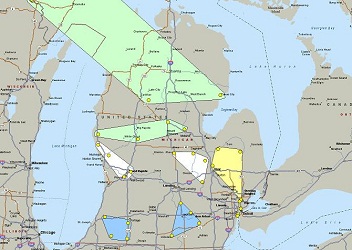
? First, a brief history lesson. In early years (or until the middle of the last decade), lines were drawn by hand. Dots representing qualifying schools were pasted on maps, one map for each division, and those maps were then covered by plastic sheets. Districts and regionals literally were drawn with dry-erase markers. No longer. Using a variety of spreadsheets and mapping software, we’ve gone digital. Staff is split into two teams, each considering four divisions (and the 8-player map) before we reconvene and look at all nine divisions together.
? We are presented digital maps of the state covered in dots. That’s about it. The rule of the day, simply, is “geography rules.” Which teams are represented by the dots is not considered, much less discussed, until lines are drawn. While considering my group’s first map, I began to bring up teams – and immediately was shot down (with good reason). Teams, matchups, rivalries, previous playoff pairings, etc. DO NOT come into play. We draw boxes in what we figure are the most logical ways of making districts and regions work.
? Travel distance and ease DO come into play. This especially is true when considering which districts will include teams from the Upper Peninsula. An example: Marquette is closer to the schools we placed in its district – Fenton, Bay City Western and Okemos – than some other options because those schools are closer to I-75. Schools further north on the map but farther from a main highway would’ve created longer trips.
? Sometimes, maps get ugly. And sometimes, it was a matter of choosing the least ugly situation. Of course, a D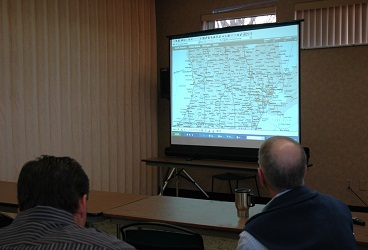 ivision 4 District of Lansing Sexton, Dearborn Heights Robichaud, Battle Creek Pennfield and Vicksburg isn’t ideal. But with no other Division 4 schools within 35 miles of Lansing, we were put in a tough spot. Add in that there were 13 teams in the Detroit area, leaving one as the odd team out of three districts based there. Something had to give, and drawing things up as we did caused the fewest messes.
? Considering how to set up the entire state is different than figuring out what teams make the most sense for just one school or area. And shifting just one dot on a map can change things for all 32.
? Back to “geography rules.” The Division 8 district including Saugatuck, Muskegon Catholic, Mendon and St. Joseph Lake Michigan Catholic might be the most competitive, on paper, in the state. Saugatuck is the reigning MHSAA runner-up in the division, and Muskegon Catholic and Mendon were ranked Nos. 1 and 2, respectively, in the most recent Association Press poll. Seeing that after we’d drawn the line caused a collective “ouch.” But again, the line was drawn based on dots on a map.
I thought back on some of the matchups I’d questioned in the past, and came back to what I’d ask people now: How would you do things differently?
I imagine there would be some creative answers, but I also would guess we considered those scenarios too.
And remember, determining the playoff schedule is just one step in many. Eight state champions must survive it, regardless of which opponents they face along the way.
Adrian Football's 'Storyteller' Koehn Begins 52nd Season on Radio Waves
By
Doug Donnelly
Special for MHSAA.com
September 3, 2025
John Koehn used to collect Sports Illustrated covers – with good reason.
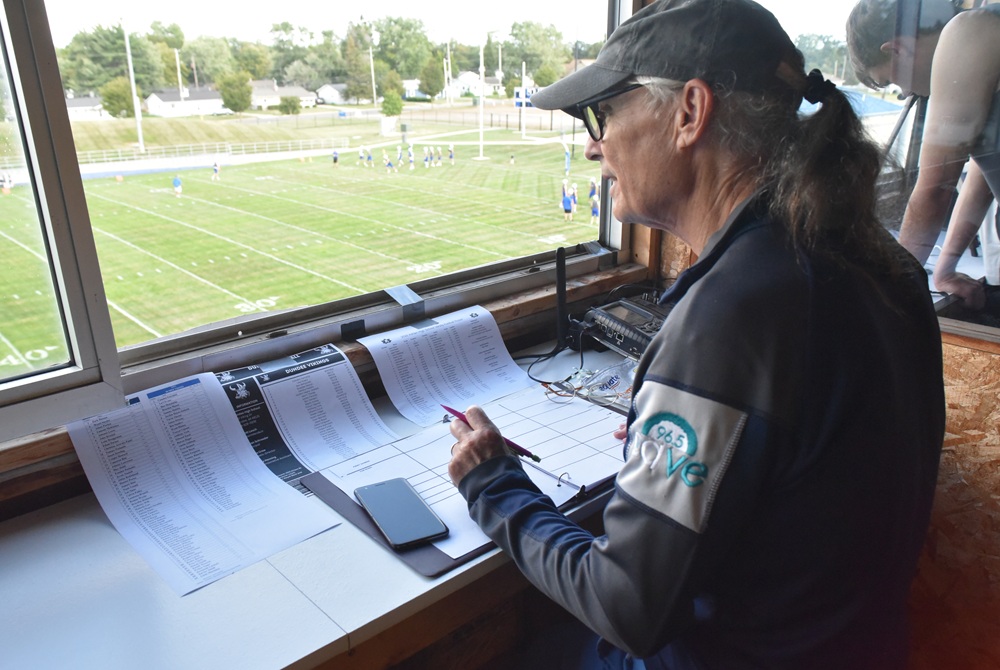
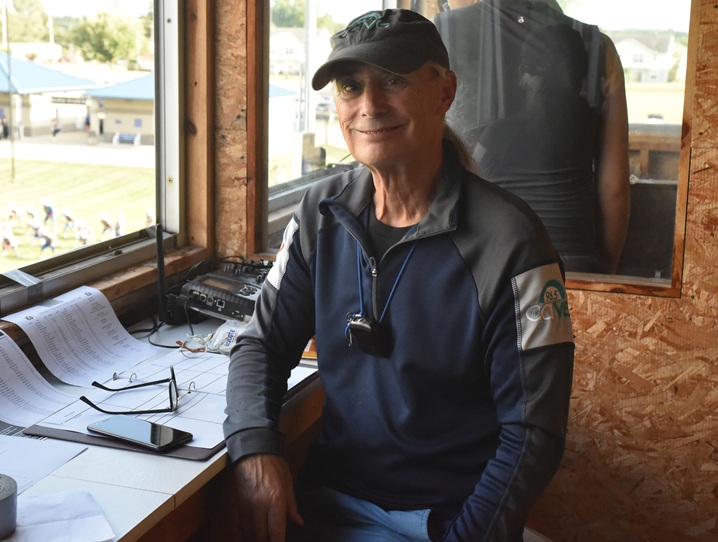
 Koehn, 74, has been a sports broadcaster at WLEN, a 3,000-watt station at 103.9 on the FM dial in Lenawee County for more than 50 years. If you are at a football or basketball game where Koehn is broadcasting, chances are you will see a “WLEN” banner hanging nearby.
That banner has been in some unique settings.
“We used to collect Sports Illustrated covers because every once in a while, someone would take a photo and I’d be in the background with the WLEN banner doing the game,” Koehn said. “Over the years we had six or seven Sports Illustrated covers that popped up like that. We went all over back then.”
Koehn broadcast University of Michigan football and basketball games for two decades for WLEN, bringing the action home to listeners in Lenawee County long before the days of streaming services or Internet radio. He did live play-by-play at The Spectrum in Philadelphia when Michigan battled Indiana University in the NCAA men’s basketball championship game in 1976.
“That’s always been my favorite Michigan team ever,” Koehn said.
His favorite thing to broadcast – and the one that has stuck the longest – is Adrian High School football. Koehn did his first Maples football game in 1974 and has done almost every Adrian game since, live on the air. Last week he kicked off his 52nd year doing Maples football when Adrian defeated Dundee 21-0 at Maple Stadium.
“I’ve only missed a handful of games,” he said. “I had a wedding once, and I think another time or two I was sick. I thought I was going to do this maybe three or four years. Here I am. On and on it went.”
Joel Przygodski is the Adrian head football coach. Before that he was an assistant for several seasons and got to know Koehn. Now, they do a weekly pregame coaches show together.
“John has been an important part of the Adrian football community,” Przygodski said. “Friends and families of the program have had the pleasure of hearing his voice call our games for a long time. I enjoy our weekly conversations during the season, and we always seem to talk about players and teams from the past.”
Koehn’s voice is familiar to sports fans in Adrian and Lenawee County. In addition to broadcasting Maples football, he also does at least one county high school basketball game a week and still broadcasts live a handful of baseball and softball games every spring.
“Spring sports are tougher,” he said. “Games get canceled, and it becomes difficult to make them up. The weather outside is unpredictable.”
Koehn grew up in Adrian and played football for the Maples in 1967 and 1968. His father, also John Koehn, held various jobs in the county, including teaching a class at Adrian College.
“He was working on his MBA and teaching at Adrian College,” Koehn said. “For his senior business thesis class, he assigned his students a semester project to research the feasibility of starting an FM radio station in Adrian. He gave them all good grades and used the information to start the station.”
His father was granted the license for 103.9 FM in 1965.
“I was in high school, but I was here when it all started,” Koehn said. “I was pushing a broom and that kind of stuff.”
Adrian had an AM radio station at the time, but the FM station was new.
“The first few years we just gave away FM radios and FM car converters so that people could get the signal,” Koehn said.
One of the first things his father did was form a small network of five stations to broadcast University of Michigan football and basketball games.
 “When we started, Michigan allowed any station to broadcast as long as they paid the fees,” Koehn said. “There were at least seven stations. Our station started doing Michigan in 1965 when they went on the air. They were able to do that until the mid-1980s before they went to (WJR) network.”
Koehn, who graduated from Notre Dame, never intended to get into broadcasting. He was at an Adrian basketball game when it happened.
“My first game was a basketball game,” he said. “I just went to help out. I was there, doing stats, and the second half started and the general manager who was doing the game said, ‘Here,’ and handed me the microphone. I got handed a soapbox.”
His dad also launched an FM station in Monroe, 98.3, and gave famed WJR host Paul W. Smith his first radio job.
“My dad knew all about big radio,” Koehn said. “He always said the only way we are going to survive is to make it local, local, local.”
For Adrian, University of Michigan football and basketball was local. He put a lot of miles on his car.
“Back in the day, Michigan basketball played games on Thursdays and Saturdays,” he said. “I remember one weekend, on a Thursday morning, I drove to Madison, Wisconsin, to do a Michigan basketball game. I drove home after the game, got home probably 6 a.m., got some sleep, did a high school game Friday night, and Saturday afternoon I went up to Ann Arbor to do Michigan-Indiana and did a high school game Saturday night. I didn’t have much in the way of pipes by then.”
He also was part of the MHSAA broadcasting network for years.
“I was probably doing 80 basketball games a season back then and driving everywhere,” he said.
During his broadcasts, Koehn keeps his own running stats and often refers back to them throughout his coverage. At halftime, he gives halftime stats, such as leading rushers in football, and tracks things like penalties and first downs.
Koehn said he is an Adrian fan for every game – except when the Maples are playing another local team.
“I’m a fan,” he said. “The only time I’m not is when Adrian is playing another county school. You have to be nonpartisan with that.”
The radio stations have remained in the family. WLEN and 96.5 The Cave, an all-sports format station in Adrian, are owned by his late father’s trust. The other two stations in Adrian, 95.3 FM and WABJ – an AM radio station that was around when WLEN was created – are owned by John’s sister Julie. All four stations are housed in one building in downtown Adrian.
Koehn, who is married, has two children, three grandchildren and three great-grandchildren. His bucket list is to broadcast a hockey game.
While he waits to do that, Koehn remains hooked on broadcasting Adrian football.
“You get to be a little crazy,” he said. “You get into doing the games. We are telling stories and creating memories for people. I’ve had people come up to me and say, ‘Oh, I remember that one game. I was listening. That was one heck of a game.’ It’s all linked to some other memory outside of the football game. Basically, I’m a storyteller – a partisan storyteller.”
 Doug Donnelly has served as a news and sports reporter at the Adrian Daily Telegram and the Monroe News for 30 years, including 10 years as city editor in Monroe. He's written a book on high school basketball in Monroe County and compiles record books for various schools in southeast Michigan. He is now publisher and editor of The Blissfield Advance, a weekly newspaper. E-mail him at [email protected] with story ideas for Jackson, Washtenaw, Hillsdale, Lenawee and Monroe counties.
PHOTOS John Koehn begins his 52nd season as the voice of Adrian High School football, broadcasting last week from Maple Stadium. (Photos by Deloris Clark-Cheaney.)