

Ishpeming 'Makes Way' to MHSAA Title
November 24, 2012
By Geoff Kimmerly
Second Half editor
DETROIT – When Ishpeming coach Jeff Olson watched film this week of Saturday opponent Detroit Loyola, he saw a team that continuously “demoralized” its opponents.
By midway through the second quarter of the MHSAA Division 7 Final, his players understood what he meant.
Senior Brad Wootke, easily the Hematites’ biggest player, joked after about getting knocked around by the multiple more sizable Bulldogs across the line. Junior quarterback Alex Briones rolled his eyes into his head describing a blast he withstood.
But it would’ve taken more than that to knock Ishpeming off its path to an MHSAA football title. As Olson also explained, “They guys made their own way, and they made it all year.”
The Hematites doled out plenty of physicality and turned away a few late rushes to hang on to a 20-14 Division 7 championship win at Ford Field.
“First of all, we’re a hard-nosed football team. We don’t take anyone prisoners. We’re going to fight all we can,” Briones said. “They’re big, but we just didn’t let them dominate us.”
The championship was Ishpeming’s first since 1979, and came two seasons after the team fell 28-26 to Hudson in a 2010 Final. The Hematites finished this fall 13-1.
Loyola, 13-0 entering the day, was playing in its first MHSAA championship game and could be back again soon – the Bulldogs had only five seniors this fall.
But Loyola also was ranked No. 1 heading into these playoffs, featured the second-leading scorer in MHSAA single-season history in senior running back Keymonn’e Gabriel, and had eight players – to Ishepming’s one – weighing in between 250 and 290 pounds.
The No. 4-ranked Hematites were underdogs. And they knew it. But they obviously didn't believe it.
“Our coach he said it best before the game when we were at our school. He said the game’s going to be won or lost on the first smack, the first hit,” Gabriel said. “I guess we were just on the receiving end. We didn't come out strong like we were supposed to, and we just came up a little bit short.”
Although Loyola led at halftime, that advantage was slim – only 8-6. The Bulldogs had outgained the Hematites, but only 153-80. Seven minutes into the second half, Ishpeming appeared to change the tide with senior Eric Kostreva’s second touchdown run. But Loyola turned it back when Gabriel scored on a 20-yard run on the final play of the third quarter to make the score 14-12.
In the end, it would come down to a few close plays, all coming on fourth down. Ishpeming made good on both of its fourth-down attempts. Loyola was successful on four of five – but that one miss might have eventually been the decider.
Loyola faced fourth-and-seven with 7:47 to play and trailing 20-14, when Gabriel ran on a punt fake for 38 yards to Ishpeming’s 17-yard line. But four plays later, on fourth-and-one, Gabriel was hung up for no gain by the waiting Briones, who had senior R.J. Poirier right behind providing support.
Then it was Ishpeming’s turn to convert instead. Its first fourth-down make set up a third-quarter touchdown. That wasn't the case this time. But making good on a fourth-and-one try from its own 18 – after twice trying to draw Loyola off-side and calling two timeouts – allowed the Hematites to drain two more minutes off the clock before junior Tyler Windahl’s 44-yard punt pinned the Bulldogs on their 28 with 1:14 to play.
Loyola made one more first down, but ended the game on its 41-yard line.
 “I’m surprised I didn't want to go for it right off the bat. When we called timeout, I said we’re going to punt it, and I think half of you guys (his players) said, ‘Nope, we’re going for it,’” Olson said. “And when I thought about it, we always go for it on fourth and one. But if somebody offers me fourth and three inches for a state championship, I’m going for it.
“We weren't going to punt it away and hope it happened. We wanted to make it happen.”
Gabriel finished with 21 carries for 129 yards and a touchdown rushing, and also caught four passes for 52 yards and a score. That gave him 326 points this season – second-most in MHSAA history, and final unofficial rushing numbers of 145 carries, 2,516 yards and 36 scores. The yards rank 20th in MHSAA history for one season, and the rushing touchdowns are 11th.
He did so running in part behind junior tackles Malik McDowell (6-foot-7, 290 pounds) and Kajohn Armstrong (6-5, 275), and Loyola certainly felt the impact Saturday when Armstrong had to leave the game early with an injury.
“Our seniors are the reason we’re here; they were our leaders although there were only five of them. But now it’s time for the other group to step up,” Loyola coach John Callahan said. “We had a lot of sophomores playing, a lot of freshman playing. I’m pretty sure I know what we did and what we didn't do, and we've got all offseason to work on and correct, and next season, to start over again.”
Kostreva ran 20 times for 182 yards and all three Ishpeming touchdowns, and also had 16 tackles. He’s one of 12 seniors who helped guide the program through a tough start to the fall after Olson’s son, Daniel, was found after committing suicide in July.
Jeff Olson said after this game wasn't about him, but Briones was quick to point out that the players certainly wanted to win in part for their coach and the memory of their former teammate.
“I didn't know how this year would go. But I know once I got on the football field, it was a relief for me,” Olson said. “It was where I really felt comfortable. It’s because of these guys right here. They made it comfortable for me.”
Click for full statistics and to watch a replay of the game. See below for the full press conference.
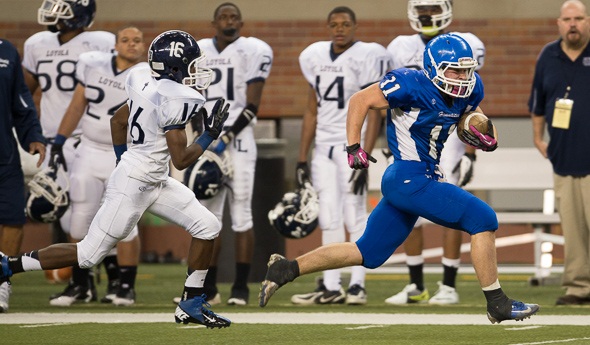
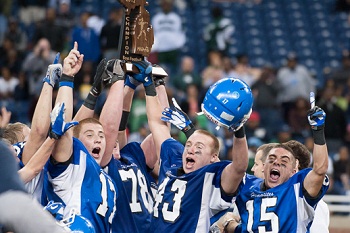
PHOTOS: (Top) Ishpeming running back Eric Kostreva (11) races down the sideline as Detroit Loyola's Anthony Frierson gives chase Saturday. (Middle) The Hematites celebrate their first MHSAA championship since 1979. (Click for more from Terry McNamara Photography.)

Best Practices
April 10, 2012
For decades, football has had the greatest participation among high school sports. In recent years it’s become the greatest spectator sport as well. Today, MHSAA Football Playoff revenue exceeds that of Boys and Girls Basketball Tournaments combined. And if I ever want to generate comments to a blog, all I have to do is mention football.
I can write either the most inspired or inane words about most topics, and not generate a comment. But mention “football,” and opinions come fast and usually furious.
So it was with my eyes wide open that I challenged some “sacred cows” in my posting of March 20, questioned some of the standard operating procedures of high school football practice, and predicted that we will soon be making some changes in the sport I played through four years of college and coached in high school and to which I owe more of my character development than any other sport. I knew some readers would call me out of date and out of touch, knowing nothing of my past or my passion.
I knew some readers would challenge any comparison made with college and professional players, asserting that older players need fewer practices with less contact because they already have the skills and techniques of blocking and tackling. However, they miss the fact that it is the younger and still growing body that needs more care and caution, not less. Less hitting, not more. More heat and humidity acclimatization, not less.
I knew some readers would complain about diminishing time to develop young players, overlooking the proliferation of camps, clinics, combines, 7-on-7 leagues and the like which have improved skills and conditioning for many athletes prior to the official start of practice. If that were not true or if we would dial down the out-of-season demands, then I might not join the amassing advocates for reduced in-season practice demands. But sadly, it is true; coaches already have these kids year-round.
On the same day that I posted predictions of changes for football practice policies in Michigan, including more days before pads and fewer days with double sessions, the Georgia High School Association adopted policies that did just that, requiring five days of practice before the first with full pads and prohibiting two-a-day practices on consecutive days.
Such changes reflect the growing body of evidence regarding “best practices” for high school football, including the recommendations of the American Academy of Pediatrics, the Centers for Disease Control and Prevention, and the National Federation of State High School Associations. This train has left the station; and Michigan should be an early stop, an early adopter of practice policies modifications. We put our players, coaches and selves in peril if we ignore the evidence.
I’m embarrassed to say that for too long I avoided this topic because I knew it would bring ridicule. Then recently, a young but experienced head football coach told me that these are the kinds of changes that football needs. Needs to keep the game attractive to kids; and needs to keep the game safe for kids.