

Ithaca Finds a Hero in Hessbrook
November 23, 2012
By Geoff Kimmerly
Second Half editor
DETROIT – Logan Hessbrook started at quarterback for Ithaca’s junior varsity last season as a sophomore, and probably would start for a few hundred teams that don't have the luxury of all-state quarterbacks every season.
But neither takes away from the fact that he’d taken only one or two reps at the position during the last four weeks of practice. With junior superstar Travis Smith behind center, there really wasn't a need.
So when Smith was injured on his team's second play of Friday’s MHSAA Division 6 Final at Ford Field, his coach and top receiver were quick to offer encouragement.
“I said, ‘Listen bud. Travis isn't coming back,’” Ithaca coach (and Logan’s uncle) Terry Hessbrook said. “’We’re going to live and die with you. Just play the way you’re capable of playing.’”
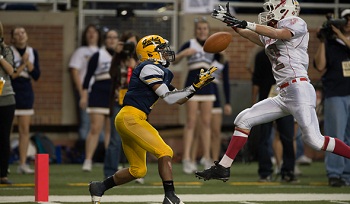
Senior Markes Gadlen – a three-year starting receiver and the third-string quarterback – also took Logan aside. “I can’t see over the line,” Gadlen told him, “so I was just letting him know he’s all we've got.”
And Hessbrook was more than enough.
Ithaca won its third straight MHSAA title – with a third quarterback leading the way – by downing Constantine 37-27. It was the second straight season the teams met in the championship game.
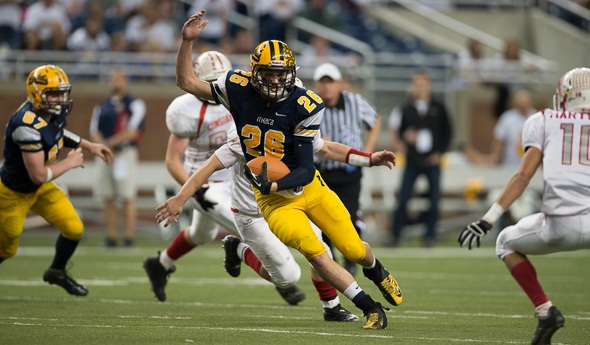
And Hessbrook was the most unlikely of heroes. Sure, he’s a starting defensive back. But in his number 26 jersey, he couldn't have looked more out of place running the offense – until he led it to four straight scores to break the game open midway through the fourth quarter.
“I was obviously nervous at the beginning, but I settled in as the game went on, and my teammates kept picking me up,” Hessbrook said. “They were saying you’re all right, we can help you, we can pick you up. The linemen did a great job blocking, the receivers did a good job blocking on the edge, and they ran good routes. We just did what we could do.”
The win also gave Ithaca its third straight 14-0 season. That streak of 42 straight victories is fourth in MHSAA history and two from tying for second. It’s also second and one win shy of the longest streak among those that took place entirely within the playoff era that began in 1975.
The Yellowjackets have beaten opponents by an average of 37 points over those games. And this season, they scored their most points (675, good for third-most in MHSAA history) and gave up their fewest (110) of the streak. But this game had all the signs of a streak buster.
“This might be the toughest game we've ever been a part of,” Terry Hessbrook said. “We haven’t faced a lot of adversity during this run. And a lot of our games have been over in the second or the third quarter. For these players to continue to fight the way they (were), I can’t put it into words and I can’t express how proud I am of the way they just kept fighting.”
Smith was hurt on a four-yard run on his team’s second play from scrimmage. But after that and despite his sizable absence, this rematch began playing out a lot like the teams' matchup in 2011.
Like last season, Ithaca and Constantine went into halftime tied – this time 20-20. And like last season, Ben Mallo and the Falcons’ run game was doing just about everything they wanted.
That’s hardly rare – the team ran for 6,407 yards on the season. And in this game, Constantine ran for 287 yards during the first half, and Mallo had 147. But after the Yellowjackets reviewed their assignments during halftime, the Falcons added only 130 more yards over the final two quarters.
 And Logan Hessbrook looked like yet another star Ithaca quarterback. After completing just 2 of 5 passes this season heading into the game, he hit 7 of 13 for 104 yards and two touchdowns. He ran for 113 yards and two more scores.
“ We've struggled all year stopping people defensively. So when we game-planned to stop Ithaca, it wasn't to stop Travis Smith, so to speak,” Constantine coach Shawn Griffith said. “They did step up, I think, and show the ability to run a little bit better than we thought they were capable of doing when we came into the game. And they still hit the big pass when they needed to. You don’t win 42 straight football games because of one good football player. You've got to have a stable of them, and he’s got quite a few.”
While Ithaca’s second-half possessions amounted to 17 points, Constantine’s turned into seven – and included a turnover on downs, a lost fumble and a punt that was blocked by senior Tyler Gibson and eventually led to a field goal.
Constantine did end up with 504 total yards. Mallo ran for 207 and a touchdown – and had 12 tackles at linebacker – and sophomore Justin Hull added 102 yards and a score on the ground. Senior Tommy Reed, who didn't get to play quarterback in last season’s Final because of an injury, ran for a score and had 10 tackles at safety.
The Falcons finished 11-3 and made their run after finishing third in the Kalamazoo Valley Association.
“We were all seniors, and we all wanted to get back. We didn't want football to end, because for most of us this is our last chance,” Reed said. “Once the playoffs came, we finally started playing as a team. Our defense picked up and our offense continued to roll.
“To get back here, we had a couple turnovers that went our way, and we were able to convert on every turnover. This game was the opposite. We had a couple of turnovers and we couldn't convert, and the one we turned over to them they ended up converting. That’s what hurt us.”
Senior Jared Evers ran for one score and caught a pass for another for Ithaca. Senior Josh Capen had a team-high 10 tackles.
Click for full statistics and to watch a replay of the game. See below for the full press conference.
PHOTOS: (Top) Ithaca quarterback Logan Hessbrook (26) eludes Constantine defenders during one of his runs Friday. (Middle) Ithaca receiver Markes Gadlen hauls in a touchdown pass midway through the second quarter. (Click for more from Terry McNamara Photography.)
Thank Roosevelt for Football Weekends
December 20, 2013
By Rob Kaminski
MHSAA benchmarks editor
The next time you find yourself immersed in a tense crosstown football rivalry on a Friday night followed by a Saturday pilgrimage to the nearest college campus and a Sunday afternoon with a remote and your favorite snacks and beverages, take a moment to consider what the weekend would be like if it weren’t for Teddy Roosevelt.
The man who became our 26th President shortly after the turn of the 20th Century following the assassination of William McKinley in 1901 was a football fan like you. Maybe more so.
Today’s game of football has reached a critical crossroads. Player size and speed have increased across the board. Savage use of equipment as weapons rather than protective gear has been glorified on television networks and social media. Leaders of the game at all levels have recognized the need for change, employing new rules and widespread educational efforts to aid in preserving the sport.
History, as they say, is repeating itself.
In an ironic twist, it was Roosevelt who saved the then-brutally violent game of football from itself more than 100 years ago. Yes, the same “Rough and Ready Teddy” who led the charge up San Juan Hill during the Spanish-American War and often sparred in the boxing ring while in office from 1901-09 opined that football was becoming so gruesome that he delivered an ultimatum: clean up the game or it would be outlawed.
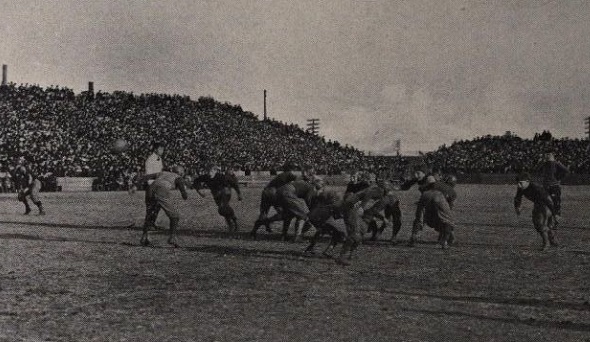
The Chicago Tribune reported that in 1904 alone, there were 18 football deaths and 159 serious injuries, mostly among prep school players. Football deaths suffered by younger players were reported on a nearly weekly basis, as outraged citizens called on colleges and high schools to banish football outright.
In stepped Roosevelt, who called head coaches and representatives from Harvard, Yale and Princeton – college powers at the time – to the White House in 1905 urging them to eliminate excessive violence and set an example of fair play for the rest of the country. When the casualties actually rose by one during the ensuing season, Roosevelt reacted with greater resolve and convened leading football authorities for the purpose of authoring drastic rules changes. What emerged was an intercollegiate conference which was the predecessor of the NCAA.
Among the most effective changes for the 1906 season were the legalization of the forward pass, the elimination of mass formations, and the creation of a neutral zone. Football fatalities fell to 11 in each of the next two seasons, and severe injuries fell drastically.
Thanks to the introduction of protective equipment and ever-evolving rules changes, football during the 100-plus years to follow has become an exponentially safer game. Yet, the game’s leaders always will need to adjust and react to scrutiny that comes with the territory.
So, as the game once again undergoes rules modifications in the name of safety, give a tip of the cap to President Roosevelt while you enjoy college bowl season and the NFL playoffs and begin to think ahead to the first high school practice of 2014.