

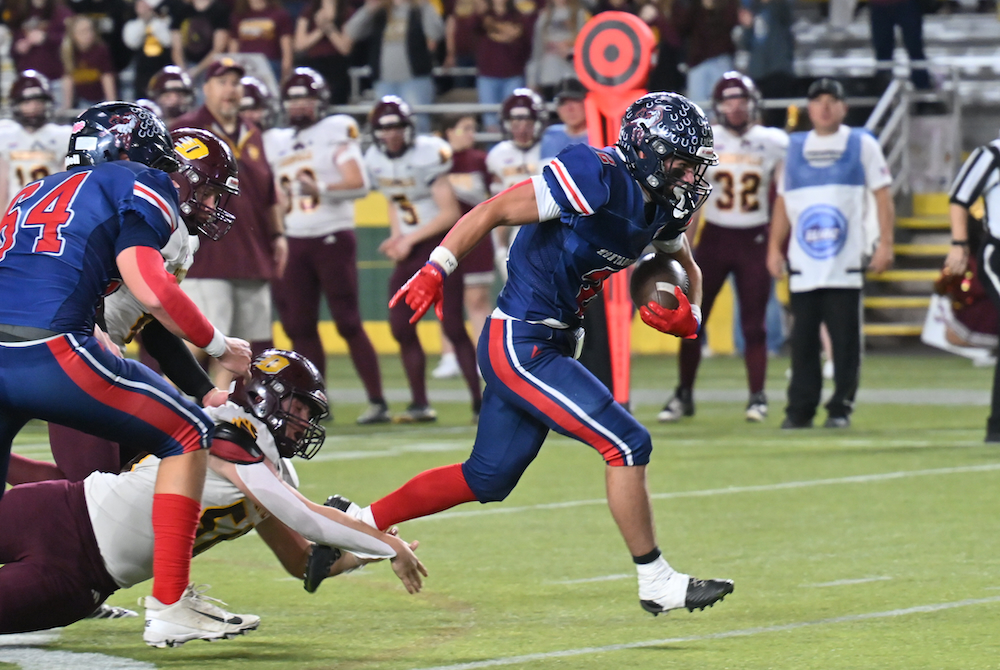
Jensen Helps Make Prediction Come True with Record-Setting Performance
By
Jason Juno
Special for MHSAA.com
November 21, 2026
MARQUETTE — When Blanchard Montabella running back Austin Jensen was in eighth grade, he predicted the Mustangs would win a state championship.
His coach, Tim Webb, was skeptical because there was no reason to believe that would happen. The Mustangs weren’t winning many games at the time, the playoffs weren’t even realistic, and Jensen didn’t have a championship group to emulate.
“I’m like, ‘I don’t think you even know how this works. There’s some really, really good teams, and we haven’t proven anything,’” Webb said.
“But, yeah, he was right.”
The 5-foot-9, 165-pound senior sure was a big part of making it happen.
Jensen set 8-Player Finals records with 371 rushing yards and seven touchdowns as Montabella dominated Deckerville for a 56-0 Division 1 title-clinching victory Saturday. The championship was the school's first on the football field.
The Mustangs made it back to the Superior Dome after falling in the title game last year. They did the 6:30 a.m. workouts all winter and they showed up all summer, hoping to not only make it back here but leave with a win instead of a loss.
“We sat in this room last year, and not a great feeling,” Webb said. “We had a lot of guys coming back, and they just made a commitment that they wanted to be different this time. And they did it, man. Hardest working group of kids I’ve ever seen, most dedicated, most selfless, smartest, most mature, you name it, man, tough, talented. It’s a special group and just really, really proud to be associated with them as their coach.”
The result of all that work was domination all season. Only two of their wins were by fewer than 20 points, and they scored at least 50 points 11 times. They relied on their running game, and they piled up 5,400 rushing yards coming into this title game.
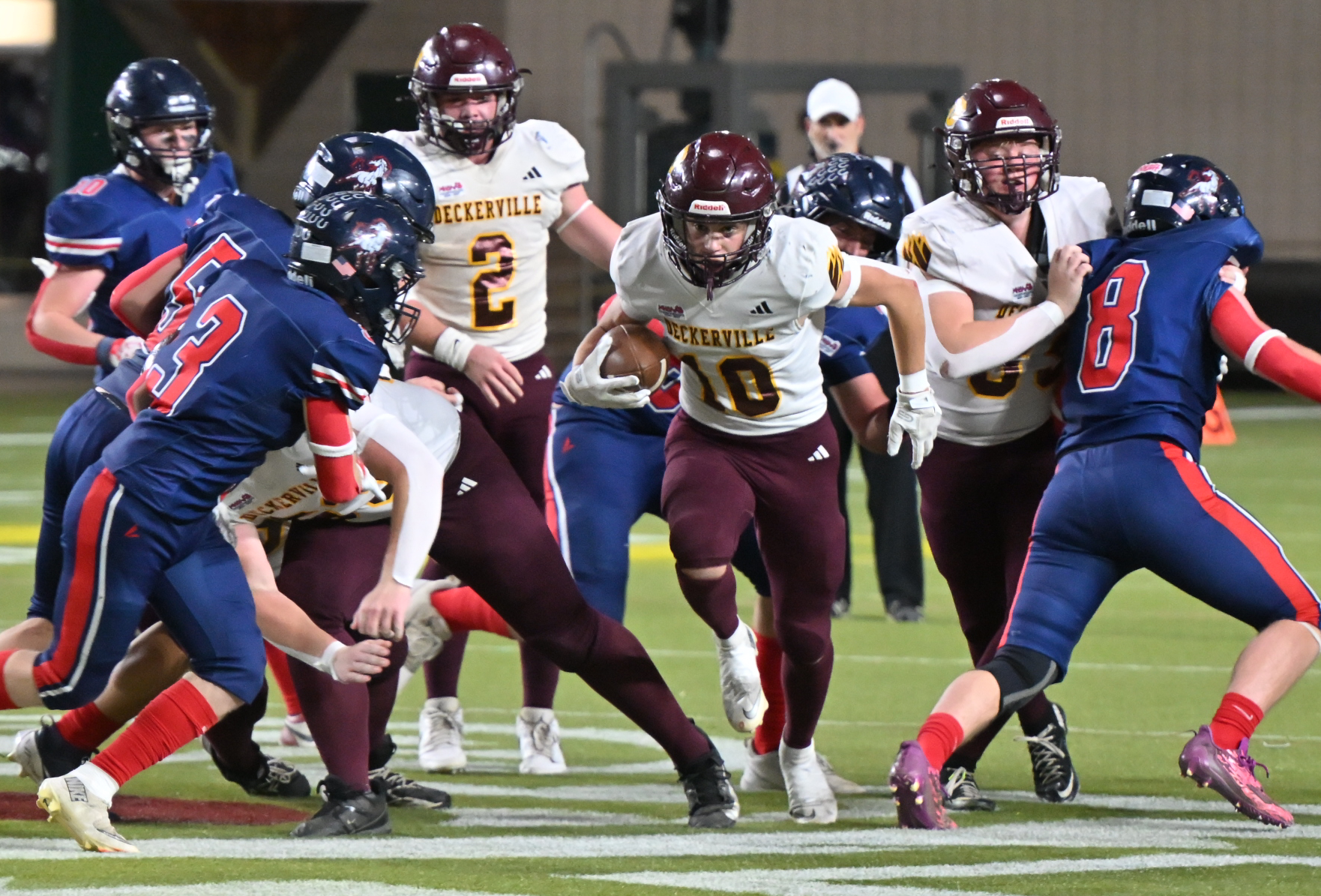
And by halftime Saturday, Montabella had a 35-0 lead. Their run game couldn’t be stopped, and their defense was just as effective.
It all started fast for the Mustangs (11-1).
Jensen ran 42 yards for a touchdown on the second play of the game. Ethan Greene recovered a fumble on Deckerville’s first possession, and Montabella took five plays to score this time as Jensen ran 30 yards for the score and a 13-0 Montabella lead.
Deckerville seemed poised to make it a one-score game on the ensuing possession. The Eagles got into the red zone on a nice run, but a holding call pushed them back to the 29. They only picked up two yards from there, and Greene intercepted a pass on 4th-and-11.
That meant Montabella started at its own 2, not that it bothered the Mustangs any.
On 2nd-and-8 from their own 43, Deckerville had Jensen wrapped up at its 45, but he kept fighting and he broke loose for a 57-yard touchdown.
Deckerville neared the red zone again, but the drive stalled out. Jensen scored on the second play of the next drive. He went right, cut back to the middle, made a defender fall and went 67 yards in all for the touchdown. Montabella led 29-0.
Deckerville came up short on a couple of drives that could have kept the game close, but instead it became a runaway.
“Nobody’s been able to keep up with them all year. They’re just so explosive offensively," Deckerville coach Bill Brown said.
Montabella added one more score before the half when quarterback Gabe Kauffman hit Noah Carlson for a deep pass of 46 yards.
That was the only touchdown Jensen didn’t score. He added three more in the second half, including the longest at 71 yards on his record-setting day.
“It’s a team record, it’s not just my record,” Jensen said.
He had missed a couple of games with a bum ankle, and that’s something they monitored all year. His season numbers could have been even better, but none of that really mattered Saturday.
“I know what kind of competitor he is, and in a game like this, he’s gonna show that he’s the best, he is not gonna get tackled, that’s what kind of drive he has inside of him,” Webb said. “That’s what champions do, man, they rise to the occasion and I knew he would do that.”
Kauffman said Jensen’s numbers were surreal, but he still wasn’t surprised, reiterating Webb’s thoughts. “He’s the best player in 8-man ever, I’m confident in saying that,” Kauffman declared.
Brown marveled at Jensen’s speed.
“His lateral movement’s great, too,” he said. “He gets a little space, he’s gone. He’s done that all year. His lateral movement is exceptional as a running back. And they fed him; who wouldn’t? I mean, he’s really good. He’s got a lot of good players in front on the line, too.”
Before learning the kind of numbers Jensen put up, Webb talked about Montabella as a true team that didn’t worry about individual stats. The Mustangs came in with two 1,000-yard backs (including Josh Arganbright as well) and a quarterback who was capable of big things, but deferred to their effective running style.
“Their one rule was just to win, and we did,” Webb said.
Deckerville was seeking its second championship in three years. The Eagles had to settle for their third runner-up trophy and an 11-2 season.
They battled through three season-ending injuries that hurt their depth, size and athleticism, with quarterback Cooper Brown also battling an injury all year. They still got to the state title game.
“That trophy’s just got silver on it instead of the gold,” said Brown, who finished his 34th year coaching. “It’s a trophy, it validates what we’re doing here. … It shows a lot about what’s going on here in Deckerville, the character of these kids. They worked their tails off all this year.
“We’re here, we gave it our best shot. They’re a good football team.”
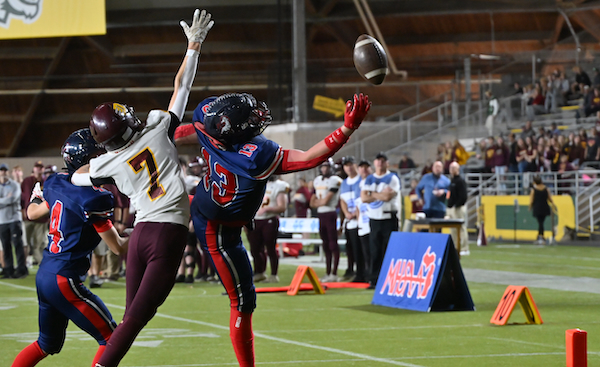
PHOTOS (Top) Montabella’s Austin Jensen (2) pulls away for a first-half touchdown run Saturday at the Superior Dome. (Middle) Deckerville’s Ashton Wedge (10) breaks through an opening. (Below) The Mustangs’ Mason Bogart (13) and Eagles’ Ashton Peruski (7) try to pull in a pass in the end zone. (Photos by Cara Kamps – Click for more.)
Detroit's Goodfellows Game Pioneered Playing for Good Cause
By
Ron Pesch
MHSAA historian
August 31, 2021
Among the many benefits that come from a football game is the ability to use the gathering for the greater good.
Football games for charity are still played. In Michigan, Lowell High School is well known for its annual Pink Arrow game, created in 2008 to raise money and awareness for all types of cancer. Since that time, numerous schools across the state have done the same, bringing consciousness and much needed financial support to a variety of charities.
Beginning near the end of the 1930s, Detroit’s “Goodfellow Game” set the standard for such contests while becoming a classic of the Detroit sports landscape for 30 years.
The cast of characters fortunate enough to feel a connection to the game — students, coaches, and spectators — is impressive. But, with the final game played in 1967, and the passage of time, those with ties to the game are slowly disappearing.
The season-ending battle was built around a simple concept and became a huge fundraiser for the city’s “Goodfellow” organization, or Old Newsboys as they are often identified. Today, the group is perhaps best known for the yearly tradition of volunteers, stationed on city streets and street corners, selling special edition newspapers near the holiday. The Detroit edition of the organization was founded in 1914, and it still works to make sure no child is forgotten at Christmas.
Football and the Goodfellows
The connection between Detroit’s Goodfellows and football harkens back to at least Nov. 18, 1934, when, according to the book, “The Story of the Goodfellows,” written by Ernest P. Lajoie and published in 1938, “the Detroit Lions, a professional football team, staged a benefit game for the Old Newsboys” with the St. Louis Gunners.
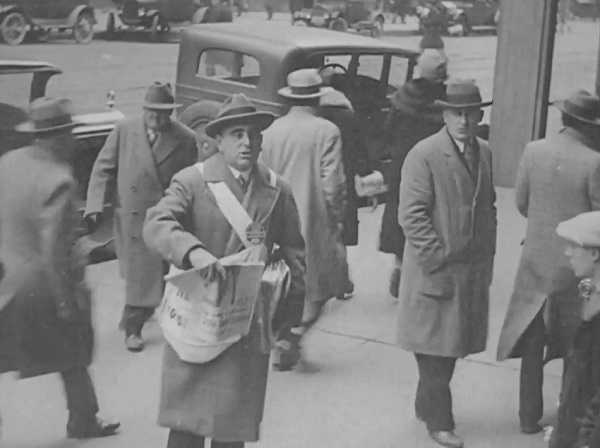 George Albert Richards, radio station owner and the football club’s president, gave the charity the receipts from the game, played before 13,000 at University of Detroit stadium, then tacked on a personal check for an additional $1,000, “as a manifestation of his keen interest in the work of the Old Newsboys.”
The Kelly Bowl, played in Chicago and designed to raise money for charity, triggered the idea of mixing the fundraising efforts of the Goodfellow group with high school football. That game, first played in 1934 as well, “pitted the champion of Chicago’s public schools against that of the area’s Catholic League.” According to the Chicago Tribune, this “post-Thanksgiving match between private and public school squads was the only football game that really mattered at the end of the season.” Initially administered under the guidance of Mayor Edward J. Kelly, it was renamed the Prep Bowl during the 1940s.
An estimated crowd of 75,000 packed Soldier Field in 1936, and Detroit attempted to replicate the idea in 1937. Built around the concepts of “bragging rights” and civic pride, the contest would pit the champions of the Detroit Metropolitan League (later known as the City League and/or Public School League) and the Detroit Parochial League (or Catholic League). The winners, of course, could then legitimately call themselves Champions of Detroit.
A committee of the Old Newsboys, headed by Lajoie and two other past presidents of the group, pitched the idea to the officials of both high school leagues. The committee had hoped to arrange a contest between Detroit Catholic Central and Hamtramck high schools, “the only unbeaten or untied elevens in the metropolitan district.” According to the Detroit Free Press, it was estimated that with “favorable weather conditions, more than 15,000 would turn out for the contest.” However, the attempt failed when the committee was unable to get the idea past “Metropolitan League officials because of an iron-clad rule prohibiting post-season contests.”
The potential for good was far too great to drop the idea, so Detroit’s Goodfellow’s organization was back with its pitch in 1938. The Chicago game, according to reports, drew an unimaginable 120,000 football enthusiasts to the 1937 showdown, and this single game generated over $100,000 for the Windy City’s Christmas Fund, designed to help the needy. The colorful press clippings and imagery describing the contest and pageantry from the Chicago media must certainly have been impressive ammunition when arguing the case for trying to duplicate the concept.
In July 1938, Lajoie, representing the group, met with Frank Cody, superintendent of public schools; Rev. Father Carroll F. Deady, superintendent of schools in the Detroit archdiocese; and various other conferees, and he managed to successfully bring the parties together in agreement.
Detroit’s Goodfellow Game
The contest would be “staged on the plan adopted in Chicago for the annual classic in Soldier Field” and feature the champions from the two leagues. Thanks to the generosity of Detroit Tigers owner Walter Briggs, the match-up was scheduled for play at Briggs Stadium, home to both the Major League Baseball Tigers and the National Football League Lions.
“Our aim is to make the meeting an annual one, on the same basis as the Chicago game,” said Lajoie. “(T)he title game is certain to become a sporting fixture in Detroit and one of the classics of the year.”
Scheduling conflicts within the two leagues in that first year meant the contest would have to be played after the normal end of the prep season. Because the Michigan High School Athletic Association regulation barred teams engaging in a game after Thanksgiving Day, special permission was needed to play. A waiver was granted, and on Saturday, Nov. 26, an announced crowd of 30,000—the most ever to watch a prep game in Michigan—gathered at Briggs Stadium for the showdown between heavily favored Hamtramck and Detroit Catholic Central. Special jerseys were ordered to add vivacity to the event.
The Cosmos “will wear blue sweaters with gold numerals, instead of (their normal) maroon with white numbers and (Catholic) Central players will sport gold jerseys with blue letters instead of blue with white,” noted the Detroit Times.
Both teams were again undefeated, with Catholic Central carrying a 25-game win streak into the game, while Hamtramck “a 3-1 favorite before the opening kickoff” carried an 18-game win streak into the contest. Players and fans were greeted by “falling snow and penetrating cold,” but the action on the field quickly cast the weather conditions aside.
The 19-13 victory by Detroit Catholic was, according to John Sabo of the Free Press, “the most spectacular and certainly the most interesting high school football game in Detroit history.
“Outplayed from the start from scrimmage, Catholic Central turned two intercepted passes and an end sweep into three long touchdown gallops which left the powerful Hamtramck team stunned almost before the game was underway.”
“All of Catholic Central’s scoring came in the first half,” noted Bob Murphy of the Times. “John McHale, Catholic Central’s center, supplied the first touchdown on a 52-yard gallop with an intercepted pass early in the game.”
The Cosmos blocked the extra point attempt then responded with their own 54-yard touchdown drive. With a successful point-after attempt, Hamtramck held a 7-6 lead.
Hamtramck had driven to the Shamrocks’ 11-yard line in the second quarter, before the game’s second pass attempt was snatched by 142-pound Rudy DeFrank, the “smallest back in the game,” who “streaked 97 yards down the sidelines to score.”
“The piece-de-resistance,” said Murphy, “was supplied by the swivel-hipped Tony Groth who cut through the heart of Hamtramck’s famed defense for 85 yards and a touchdown.” The score came in the last two minutes of the first half. The Shamrocks “only made one first down in the first half when it was running up its 19 points,” added the Free Press. With the win, Detroit Catholic made a claim to the state’s mythical state championship.
This inaugural battle for city bragging rights netted $22,000 for the Yuletide fund. The span between 1938 and 1967 was filled with thrillers (and a few blowouts) as the annual game generated “some $1.4 million (well in excess of $11 million in 2021 dollars) for the needy at Christmas time” during its run. The chase for the chance to play before a super-sized audience includes a roster of some of the greatest coaches and athletes in metro Detroit athletic prep history.
Goodfellows Game Grows
The 1939 interleague rivalry game, initially planned for Thanksgiving Day, was also a challenge to schedule and was one of two games in the series that were ultimately played in December. The newspapers in the days leading up to the contest between University of Detroit High and Detroit Catholic Central were filled with side stories, helping to build the pomp and circumstance that surrounded the affair. Tickets for the game were available for purchase at local bank branches, pharmacies, and retailers in a variety of locations, including establishments in Motor City architectural gems like the Penobscot Building and the General Motors Building (today known as Cadillac Place).
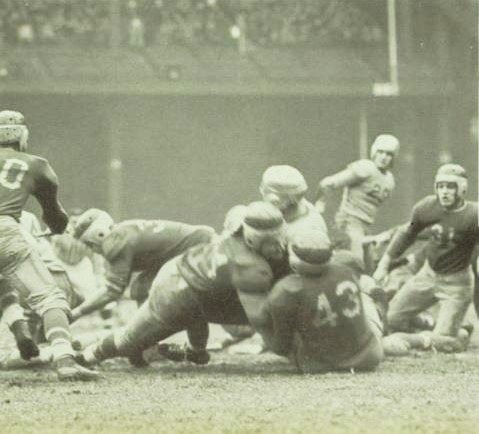 Biographies on the head coaches appeared in print. Hamtramck’s 114-piece band took on the halftime duties for U of D High, as the school did not have a marching band. Both U of D and DCC were all-boys schools. While Catholic Central High for Girls, a separate institution, aligned and cheered for the Shamrocks, there was no such association for U of D. According to the Times, female students from Detroit Cooley chose to adopt the team and cheer it on.
The University of Detroit High Cubs scored a 20-0 win over Detroit Catholic before 23,120 spectators. The victory ended the Shamrocks’ 34-game win streak that dated back to 1934.
Installation of a new drainage system at Briggs had prompted the need for a different location for the 1940 game. Detroit Cooley and Detroit St. Theresa finished in a 6-6 deadlock before a crowd of 14,861, in one of three Goodfellow games that was played at University of Detroit stadium, located at McNichols and Livernois at the northeast corner of the college campus. It marked the first of three ties contained within the results of the 30 contests.
Detroit’s Lions first played on Thanksgiving Day in 1934. However, with the NFL decision to avoid Thanksgiving Day contests between 1939 and 1944 due to World War II, and the MHSAA’s requirement that the football season end no later than that holiday, Goodfellow organizers took advantage of the opportunity. The 1941 game was moved back to Briggs with a scheduled 11 a.m. kickoff. The early start was selected so as to not interfere with traditional celebration dinners. Fire stations were added to the list of locations where tickets could be purchased.
The move was a roaring success, as a new record crowd of 30,714 fans showed up for a repeat of the 1940 match-up. The rematch was tight for the first half, with Cooley grabbing a 14-6 lead over St. Theresa at the break before the Cardinals blew it open, winning 47-6.
“The seven-touchdown parade that Cooley staged could not be considered an upset, and the score and the game’s statistics give a fairly accurate comparison of these two teams, both the tops in their own class, but definitely not in the same class,” said Marshall Dann in the Free Press.
Detroit Catholic Central won back-to-back titles in 1942 and 1943. The ’42 contest, the second, and last, played on Thanksgiving, was a 46-0 mismatch with Hamtramck. The ’43 game, moved back to U of D Stadium due to a pre-scheduled reconditioning at Briggs Stadium, was an 8-0 surprise victory upset over Cooley. Two long spiraling kicks by DCC’s Ed Burgess pinned Cooley deep inside its 10-yard line, leading to Shamrock scores. In comparison to previous years, the reduced crowd of 17,500 spectators was a disappointment.
In the week prior to the game, LaJoie had noted that tickets sales were moving slowly. Underscoring this area of concern was the fact that the Kelly Bowl game in Chicago, played on the same day, attracted 80,000 fans. Detroit News sports editor H.G. Salsinger expressed his opinion that proper promotion of the game by organizers in Detroit was at fault. Other sportswriters concurred.
“What is needed, noted the Free Press, is a group of workers of the type of the New Orleans Sugar Bowl Committee, who will devote time and energy to putting across not only the sale of tickets but the staging of the game as a civic proposition.”
Locally, citizens responded, and for the 1944 match-up, refocused efforts were made to ensure success of the game’s amazing ability to raise significant funds earmarked for the greater good. The Detroit Police Department took over the sale of tickets, improving distribution. Tickets could still be purchased at various locations throughout the city, but now, under the direction of Senior Inspector Samuel J. Throop, they could also be bought directly from any police officer.
The game that fall was moved back to Briggs and dedicated to the memories of four former Goodfellow Game stars, each who had given their lives while serving in World War II. In a battle of previously unbeaten squads, a 13-yard field goal in the last 18 seconds of play by Jerry Wood gave Detroit Mackenzie High a nail-biting 3-0 victory over Holy Redeemer before a throng of 30,054 onlookers.
“Although beaten, Redeemer staged one of the most courageous battles ever witnessed in Briggs Stadium. Four times the Lions halted the Stag’s offensives inside their 15-yard line,” noted the Free Press. It was Wood’s first field goal attempt on the season, although his accuracy on extra points earlier in the year had ensured two other Mackenzie wins.
The public schools won three in a row between 1946 and 1948, including two consecutive by Detroit Denby. A record crowd of 39,004 was on hand for the 1948 game at Briggs, the first played at night on a Friday, when Denby trounced St. Mary’s of Redford, 28-0.
U of D fumbles set up an upset 19-13 victory by East Side underdog St. Anthony in 1949 before 34,038.
Power Begins to Swing
During the 10-game span of the ’50s, the right to brag was equally divided.
In 1950, Detroit Redford squeezed out a 7-6 public school win over little Detroit St. Gregory. The single point win would stand as the thinnest margin of victory in the three-decade run of games.
 “I’m sure that at the end most of the fans wished there was no such thing as the extra point in football,” wrote Murphy, now sports editor of the Times. “St. Gregory deserved a tie.”
A few days later, a true list of Detroit sports legends attended the annual football bust designed to honor members of both teams.
“The Big Guys paid the Little Guys a visit Tuesday night,” said Hal Schram of the Free Press. “Never before in the 13-year history of the event have so many guest stars attended. “Doak Walker, Leon Hart, Thurman McGraw, Jack Adams, Red Kelly, Gordie Howe, Ted Lindsay, Ted Gray, Harry Heilmann and Bo McMillin all took a bow while several offered brief congratulations.”
Van Patrick, sports director for radio station WJR and play-by-play man for the Tigers and Lions, served as toastmaster.
The St. Mary’s Rustics of Redford, coached by Al Chesney, won consecutive games in ’51 and ’52, then the public schools won three straight between 1953 and 1955.
“The slashing runs of halfback Fred Julian, Pershing High’s finest back since the days of Harry Szulborski (Purdue), enabled the Doughboys to claim their second City football championship in three years,” Schram told his readers in 1955. “Julian scored one touchdown — a brilliant 57-yard spring — and set up the other as Pershing conquered St. Mary of Redford, 13-7 before 29,830 fans in Briggs Stadium Friday night.”
(Julian would later play at the University of Michigan, then for a year in the American Football League for the New York Titans. As head football coach at Grand Rapids West Catholic for 16 years, he guided his team to the MHSAA Class B runner-up finish in 1979.)
Closer Look
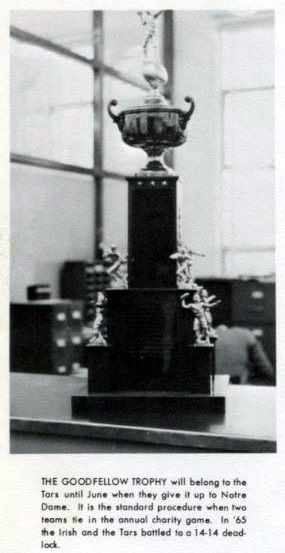
Further examination shows that between 1946 and 1955, the City League won seven of 10 games. But as the parochial schools began to draw in more students from across the metro area, fortunes started to shift. The arrival of the 1956 season saw Detroit DeLaSalle down Denby, 26-20. The next 12 years illustrated the growing strength of the Detroit Catholic League in metro Detroit as parochial squads won eight of those showdowns, against three for the city league teams. One game, the 1965 match between Harper Woods Notre Dame and Denby, ended in a 14-14 deadlock.
Coach Dan Boisture of St. Mary of Redford and his younger brother, Tom, coach at little Grosse Pointe St. Ambrose, showcased their coaching chops in the Catholic League and before huge audiences in the Goodfellows Game. (Dan would later assist head coach Duffy Daugherty at Michigan State, then guide Eastern Michigan University’s gridiron squad for seven seasons. Tom would coach at Holy Cross before moving on to the NFL, first as a scout for the New England Patriots, then as director of player personnel for the New York Giants.)
Dan guided St. Mary of Redford to four of five Goodfellow Games, between 1954 and 1958, defeating Southeastern in 1957. Tom led St. Ambrose to, arguably, the greatest upset in the series in 1959, when his team took down top-ranked Cooley behind the running of Joe D’Angelo.
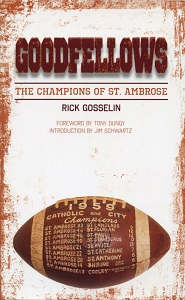
Tied 7-7 with less than 90 seconds remaining, the 5-foot-6, 150-pound “streak of lightening” took a fourth down handoff and “ducked into a “cluster of humanity,” wrote Rick Gosselin in his 2009 book, Goodfellows: The Champions of St. Ambrose.
 Seemingly stopped at the line of scrimmage by three Cooley linemen — or was it four — D’Angelo kept his feet moving and “squirted loose.” In the play of the game, his 22-yard run gave the Cavaliers a stunning 13-7 lead.
“Cooley would get the ball back with 1:20 remaining,” Gosselin continued. “But like St. Ambrose, the Cardinals were built to win games by running the football, not throwing it. … The biggest upset in Goodfellow history was sealed.”
(D’Angelo would later coach teams at St. Ambrose and Erie Mason, win two MHSAA football titles at Detroit Country Day, then finished his career at Birmingham Hills Cranbrook Kingswood. He retired with 239 victories.)
Gosselin, who graduated from St. Ambrose and Michigan State University and has covered the NFL for 49 years for some of the nation’s largest media outlets, recaps the story of the school without a home field succinctly in Chapter 1 of his publication:
“Over a nine-year period from 1959 through 1967, the Cavaliers would post a 64-8-3 record, winning six conference titles, five Catholic League titles with a perfect 5-0 record in Goodfellow Games, and four state championships. Little St Ambrose would enjoy four 9-0 seasons during that stretch with two other seasons ending with a single loss.”
The 1960 battle at Briggs, a 21-18 come-from-behind victory by Denby over Catholic Central, featured an all-time Goodfellow attendance record of 39,196.
St. Ambrose won consecutive titles in 1961 and 1962 with a pair of shutout victories. Tom Boisture’s ’61 team downed Pershing, 20-0. Boisture’s replacement as coach for the 1962 season was George Perles, who had played in the 1951 game for Detroit Western and would later guide Michigan State’s football squad. Perles guided the team to triumph, 19-0 over Cooley. Each game hosted at the ballpark located at Michigan and Trumbull — by then named Tiger Stadium — drew over 37,000. The 1962 game marked the sixth in a row in which attendance exceeded 30,000.
TV & Tragedy
In 1963, a pair of teams with 6-1 records squared off in the Soup Bowl — the nickname for the Catholic League championship game — for their first-ever chance to play in the Goodfellow Game. Harper Woods Notre Dame and Royal Oak Shrine battled for 48 minutes to a scoreless tie before 17,500 fans at U of D. To determine a winner, league rules awarded the game to the team with the greatest yardage gained. Over the game’s final minute and 26 seconds, Notre Dame had picked up 21 yards during the final series of downs and finished with 163 yards to Shrine’s 159. Hence the Irish scored a “four-yard victory” over the Knights.
One week later, Denby dumped Cooley, the No. 1-ranked team in the state according to the Free Press, 26-13, in the 1963 public school championship game played before another crowd of 17,500 at U of D to earn its third trip to the Goodfellow Game in eight years.
 This time, plans were made for a television broadcast of the City Championship game. Game chairman I.A. Capizzi said he didn’t know what effect televising the game might have on gross receipts, but he thought the experiment made sense. WWJ-Channel 4 in Detroit was cancelling the airing of the Bob Hope show and planned to air a 30-minute pregame show, which would “carry the (Goodfellow’s) message of charity work to thousands of viewers.” The hope was that loss in attendance at the gate would be minimal, and that the group might see an increase in revenue during the annual Goodfellow newspaper sales on the streets of Detroit.
The transmission would certainly bring the organization’s message before a new audience. Unfortunately, the impact of the test would not be known. Events of the day meant the broadcast would be cancelled.
 At 1:30 p.m. Michigan time on November 22 — the scheduled day of the 26th Goodfellow Game — President John F. Kennedy was killed while riding in a motorcade in Dallas. Goodfellow officials, faced with an immediate decision, considered rescheduling, but the contest went on as planned, “in spite of the national tragedy.”
“The purpose of the game is to provide help for needy children,” Capizzi told the media. “(C)anceling it would have deprived thousands of these children of a visit from Santa. We believe President Kennedy would have concurred in the decision since he held so much love for humanity, especially little children.”
“Both schools also decided it would be unfair to ticket holders to cancel on such notice,” added the Free Press.
To no surprise, attendance suffered with a crowd of 23,500 reported.
Denby won the game, 7-0, beneath a cloud of sorrow as a light rain fell. The win was the Tars’ ninth on the year and 36th in the previous 37 games. With the victory and a No. 1 ranking by the Free Press, they staked a claim on the state’s Class A mythical title.
Attendance Sinks
Fundraising took another hit in 1964. The game, played on a sloppy, slippery Tiger Stadium field, was scheduled for a Thursday night — a school night — as the National Football League restricted use of the field based on the days before a Lions game. Adding to the challenges, a newspaper strike affected publicity for the game. And, this time, the game was televised.
“Only 15,104 fans braved the winter’s first measurable snow (a blizzard) to see St. Ambrose beat Southeastern, 20-0, the smallest crowd ever, the worst weather ever,” reported the Free Press. “(Cavalier Coach) Perles had a nine-inch television monitor at the sidelines. ‘All I could see was snow — on the set and on the field,’ Perles laughed.”
“Television gave us a half hour (before the broadcast) to tell the history of the Goodfellows and their work at Christmas,” noted the group. This time, there was no need for crunching numbers. There was little question that the airing of the game hurt attendance.
Reported gross income of $63,000 from the contest was off significantly from the past averages of $75,000-$80,000. St. Ambrose’s fourth appearance in six years, combined with its fourth victory over City League competition, prompted conversation about adding suburban schools into the mix when determining teams that would meet the parochial champion.
“Extensive grade school, even freshman and reserve programs, give the Catholic League a decided superiority the City League can’t match,” said Dr. Robert Luby, Health and Physical Education Supervisor of the Detroit Public Schools to the Free Press, discussing possible solutions to sagging interest in the game. “(M)aybe it would help to allow suburban schools to take part in the championship."
 The crowd was back up above 25,000 for the 1965 game, a 14-14 stalemate between Denby and Harper Woods Notre Dame played on a Friday night. Officials looked at playing the 1966 game on a Saturday night at Tiger Stadium, however NFL requirements related to prepping the stadium before a Detroit Lions game again created challenges. When combined with the fact that the Detroit Board of Education had banned night football because of rowdyism and disturbances, the contest was moved back to the University of Detroit and scheduled with a 10:30 a.m. kickoff Saturday, Nov. 19. The early start was designed to avoid competition with the Michigan State-Notre Dame game scheduled for 1:30 p.m.
“There would be little sense … to try to compete,” said a spokesman. “(Otherwise) we would probably wind up with 20 people.”
As it turned out, only 12,337 fans showed up — less than half the crowd size from the year previous — to watch St. Ambrose win its fifth city championship, 33-19 over Denby. With the triumph, the series was now evenly split, with 13 wins for each league against three tie ballgames.
Reduced costs meant the charity still netted around $45,000, but it was a fraction of past years.
Goodfellow Game’s Clock Hits 0:00
“With Michigan, Michigan State, the Lions, the Red Wings and the Pistons playing away this weekend,” stated the Free Press, “the Denby-Divine Child struggle in the (30th) annual Goodfellow game at Tiger Stadium rates as the top local attraction."
“The game lived up to advance predictions of a knockout,” wrote another newspaper.
Tied 7-7 at the half, a costly fumble gave Dearborn Divine Child a 14-7 upset of Denby. Ed Puishes, the Falcons’ all-state back, scored Divine Child’s first touchdown and would go on to play at the University of Texas at El Paso. Divine Child’s Gary Danielson, a future NFL quarterback, scored the game’s last TD on an eight-yard rollout midway through the third quarter.
Despite the return to the large facility, and a strong matchup, only 15,186 made the trip to Detroit’s Corktown neighborhood. In August 1968, officials announced the end of the annual contest. Sagging interest and attendance figures were mentioned at the forefront, but Free Press coverage also stated that athletic directors from both leagues had “long urged that the game be dropped since it impressed a harsh handicap in scheduling for the entire season.”
Difficulty controlling crowds in recent years was also cited as a concern.
Occasionally, conversations surface about resurrecting the game, but times have changed. With the consolidations and closings of schools within both the Catholic parishes and the Detroit Public School system, the establishment of the MHSAA football postseason, and the influences of Michigan’s school of choice program, it would be nearly impossible to recreate.
Still, the impact of the game on the lives of those who participated in the game, as well as the lives of those who saw Christmas boosted by the work of the Goodfellows, should always be remembered.
The MHSAA is always on the lookout for memorabilia from Michigan’s school sports past. Please contact historian Ron Pesch at the email address below if you have photos, programs, trophies or similar items you’d like to share or donate.
 Ron Pesch has taken an active role in researching the history of MHSAA events since 1985 and began writing for MHSAA Finals programs in 1986, adding additional features and "flashbacks" in 1992. He inherited the title of MHSAA historian from the late Dick Kishpaugh following the 1993-94 school year, and resides in Muskegon. Contact him at [email protected] with ideas for historical articles.
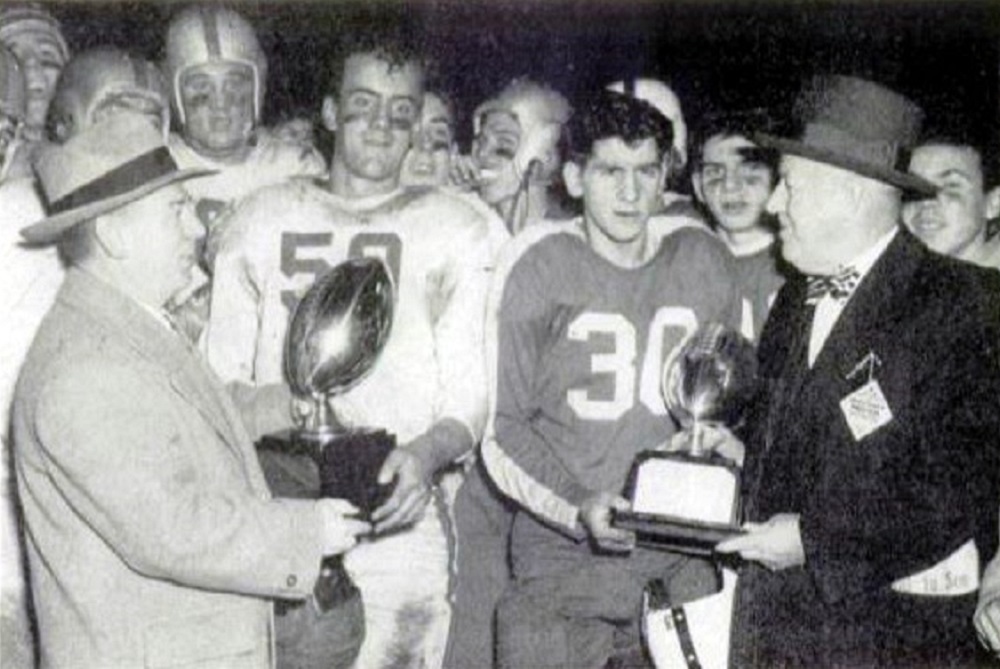
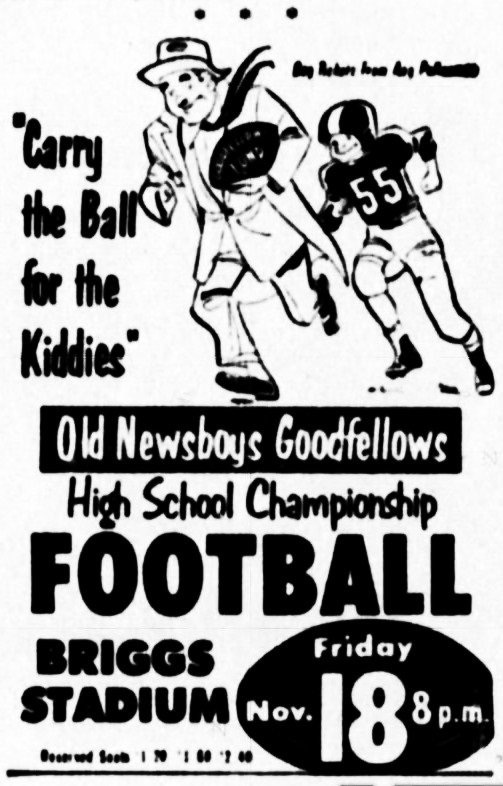
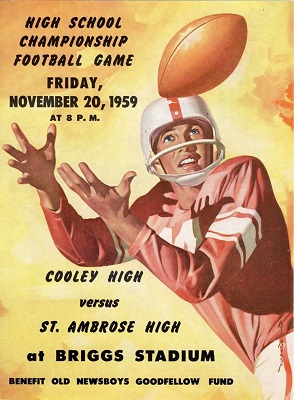
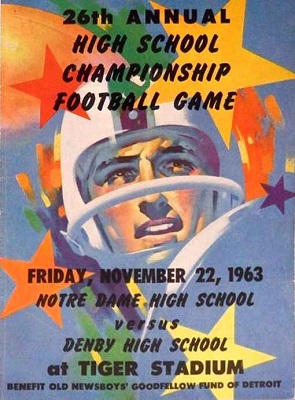
PHOTOS: (Top) Members of the Detroit Redford and St. Gregory teams receive their trophies after Redford’s 1950 Goodfellows Game win. (2) The Old Newsboys’ Ernest P. Lajoie sells newspapers on the streets of Detroit. (3) University of Detroit High plays to a 20-0 win over Detroit Catholic Central in 1939. (4) The Detroit Tribune advertises the 1955 Goodfellows game. (5) The 1956 trophy was set to split the year between schools after Denby and Notre Dame tied. (6) The 1959 and 1963 programs reflect the name change at the Goodfellow Games’ home field, Briggs Stadium-turned-Tiger Stadium. (7) Nationally-acclaimed journalist Rick Gosselin tells the Goodfellows story of his alma mater. (Photos gathered by Ron Pesch with courtesy to the Detroit Tribune and local yearbooks.)