

Jesuit's Nelson Thrives in Many Roles
By
Tom Markowski
Special for Second Half
August 31, 2016
DETROIT – Scott Nelson and his football coaches at U-D Jesuit are doing their best to deter specialization.
 Nelson, a senior defensive back/receiver, was the sixth man on the U-D team that won the school’s first basketball MHSAA title, in Class A, this past spring. He started in the outfield on the school’s varsity baseball team as a sophomore – although he chose not to play baseball this past season so as to concentrate on football and basketball.
“When I grew up I just played sports,” Nelson said. “I stopped playing hockey to play football.
“I love competing. I love playing sports.”
U-D is an all-male private school located on the city’s northwest side. The academic curriculum is demanding, and most students who attend the Jesuit school choose to go there for that reason without the thought of participating in athletics. Some programs have thrived; the school's basketball, soccer and bowling teams have won MHSAA championships over the last 15 years, while the baseball, tennis and lacrosse teams have finished Finals runners-up.
It’s different for coach Oscar Olejniczak’s football program. Participation is a must for football coaches. They need players, and lots of them, to conduct practices properly. U-D has not been able to field a junior varsity team the past two seasons. Olejniczak has 44 on varsity, which is a workable number, but it is paramount that the good athletes in the school participate in more than one sport to help fill out the rosters.
“I encourage every one of our players to play two sports,” Olejniczak said. “If they play three sports, no problem, but academics is so tough here that two is all most can handle.
“When you play two sports … it helps them 100 percent. Each sport uses different muscles. It helps with hand-eye coordination.
“It’s a big mistake when you play one sport. People get into their ear. I’m sorry to say sometimes it comes from the coaches.”
 It’s likely Nelson could have played any one of the three sports in college. In the end he chose football for the simple fact that he likes it more than the others. Nevertheless, he fully intends on playing basketball this winter. And why not? He’ll have a chance to start on a team that’ll once again be one of the state’s best.
“I’m biased,” Nelson said. “Multiple sports give you different skills. Basketball gives me that. You have to be in great shape to play basketball. On the basketball court, I’m not the best player. That helped me mentally. Playing with Cassius (Winston, now at Michigan State), people aren’t concentrating on you. That’s fine. Let me do my role. And that’s what I’ll do, and I’ll do my best. In football it’s different. I am an important part. With my coaches, they know I shouldn’t have a bad game. I put pressure on myself. I know I can make the big plays.”
Defensive coordinator George Harris knew that before Nelson did. Nelson played on the freshmen team before he was moved up to the varsity in time for the 2013 Division 2 playoffs. Not only did he dress, but Nelson was shocked to learn he would start that first playoff game against Warren Woods Tower.
“A senior was late for team prayer service,” Harris said. “We have rules here, and we suspended him for the first quarter. So I asked (Nelson) if he knew the coverages and everything. His eyes got real big.
“His football I.Q. was high for a young kid. He wasn’t afraid of the moment. That year we had a (preseason) 7-on-7 scrimmage and he had six interceptions in one game. I said, oh my goodness. He has a lot more confidence now. He’s more physical. That comes from just growing into his body. I can pull things out of his brain, and we can now talk the same language.”
The skills the other sports taught him undoubtedly made Nelson a better football player. At 6-foot-2 and 185 pounds, he’ll likely play safety in college. Northwestern is the lone school that’s recruiting him to play receiver. The other schools that have offered him a scholarship want him to play defense. Nelson has narrowed his choices down to five: Northwestern, Iowa, Michigan State, Penn State and Wisconsin.
Nelson is coming off of what was a breakthrough season. He accounted for 21 touchdowns, which came passing (2), rushing (13), receiving (4) and on kick returns (2).
This season he was not expected to play quarterback, but he was pressed into service, due to injury, in the opener at Detroit Mumford. The Cubs led 2-0 late in the first half and prevailed, 23-14.
As far as his college future, Nelson is uncertain whether he’ll make his decision during the season or after.
There’s no hurry. The Cubs, which made the playoffs last fall losing to eventual Division 2 champion Detroit Martin Luther King 35-24 in a Pre-District, are optimistic that they’ll make a return trip.
 Tom Markowski is a columnist and directs website coverage for the State Champs! Sports Network. He previously covered primarily high school sports for the The Detroit News from 1984-2014, focusing on the Detroit area and contributing to statewide coverage of football and basketball. Contact him at [email protected] with story ideas for Oakland, Macomb and Wayne counties.
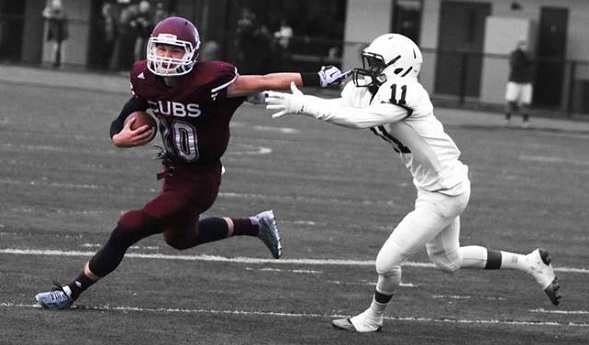
PHOTO: Scott Nelson (10) eludes a pursuing defender. (Photo courtesy of U-D Jesuit/Brent Wilkerson.)
Many-Sport Standout Gash Closing High School Career with Repeat Title Pursuit
By
Keith Dunlap
Special for MHSAA.com
September 3, 2026
Gideon Gash said this fall is marking the end of an era for him athletically.
 Throughout his life, it didn’t seem to matter what the sport was, because Gash was playing it.
Whether it was soccer, basketball, lacrosse, football, or track & field, Gash sampled them all, and it didn’t stop when his high school career began.
Last year as a junior at Detroit Catholic Central, Gash continued to play several sports after being named all-state for football in the fall.
During the winter, he played on Catholic Central’s basketball team. In the spring, he decided to go out for track and thrived, finishing second in the 100-meter dash and winning the long jump at the Catholic High School League meet, and then taking third in the long jump at the Lower Peninsula Division 1 Finals.
Following that championship meet, Gash returned to the lacrosse team and suited up for the Shamrocks during the final week of the season, which culminated in a DCC Division 1 title. Gash had played lacrosse the previous spring as a sophomore, but decided to focus more on track as a junior.
“I worked out different muscles and different skills and just having that versatility helped me a lot throughout life,” Gash said. “Being able to do different things and learn faster and having to keep up with everyone in terms of basketball, lacrosse, in terms of just raw skills. That helped me a lot in terms of just being able to add to my bag and be the best I can.”
But now, Gash said his multi-sport playing days are all but over.
One of the premier college football recruits in the nation, the 6-foot-4, 210-pound Gash has committed to play at Texas Tech for now, although he recently said his recruitment is “not closed down,” according to an article on Rivals.com.
 Regardless of where he ends up, Gash said he plans on enrolling early and starting college in January, adding he made sure to accumulate enough class credits to be able to do so.
That means it’s football from here on out, and odds are he’s going to have a monster senior year for reigning Division 1 champion Catholic Central.
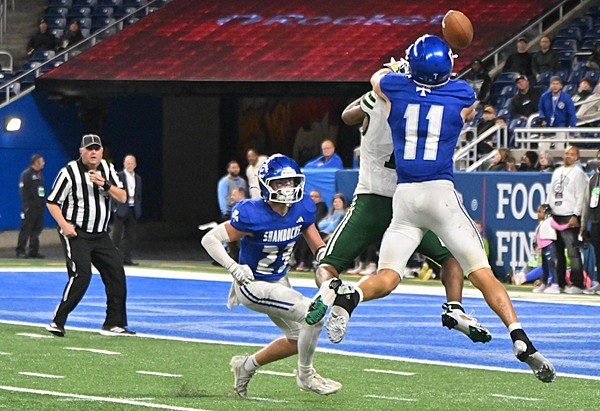
Last year, Gash was all-state in Division 1-2 as a lockdown defensive back, collecting 74 tackles and nine pass breakups. He also was a big-play threat as a wideout, catching three long touchdown passes for Catholic Central in a championship game win over Detroit Cass Tech at Ford Field.
There are times this season where Gash may never leave the field, given he will see lots of time as a dangerous punt returner. In a season-opening win over Clinton Township Chippewa Valley, Gash returned a punt 48 yards for a touchdown.
Playing so many sports throughout his life has shaped him into an all-around force on the football field and helped turn him into a dominating physical specimen.
Gash gained 10 pounds of muscle since last fall and going into his senior year is more chiseled and faster than he has ever been.
“He just loves competing,” Catholic Central football head coach Justin Cessante said. “When we compete and he works the way he does when nobody is watching, and he’s got his agility, his strength and his size, he’s a 10 times better player and athlete than he was last year. I think that attributes to doing all those different things.”
This is the first year Gash is not playing alongside his older brother, Samson, the 2025 Finals champion in the 100-meter dash and all-state wide receiver last fall who is a freshman at Michigan State.
Gideon Gash will certainly be counted on for veteran leadership since Catholic Central entered this season with only two returning starters, although there are several talented underclassmen already with Division I college scholarship offers who are expected to soon make names for themselves on the high school level.
While the next wave of great players is already coming for Catholic Central, it certainly will be hard to replace Gash and how he was able to excel at more than just football.
“I’m going to miss it,” Gash said. “I’ve been playing three sports my whole life, so I’m going to miss it a lot.”
 Keith Dunlap has served in Detroit-area sports media for more than two decades, including as a sportswriter at the Oakland Press from 2001-16 primarily covering high school sports but also college and professional teams. His bylines also have appeared in USA Today, the Washington Post, the Detroit Free Press, the Houston Chronicle and the Boston Globe. He served as the administrator for the Oakland Activities Association’s website from 2017-2020. Contact him at [email protected] with story ideas for Oakland, Macomb and Wayne counties.
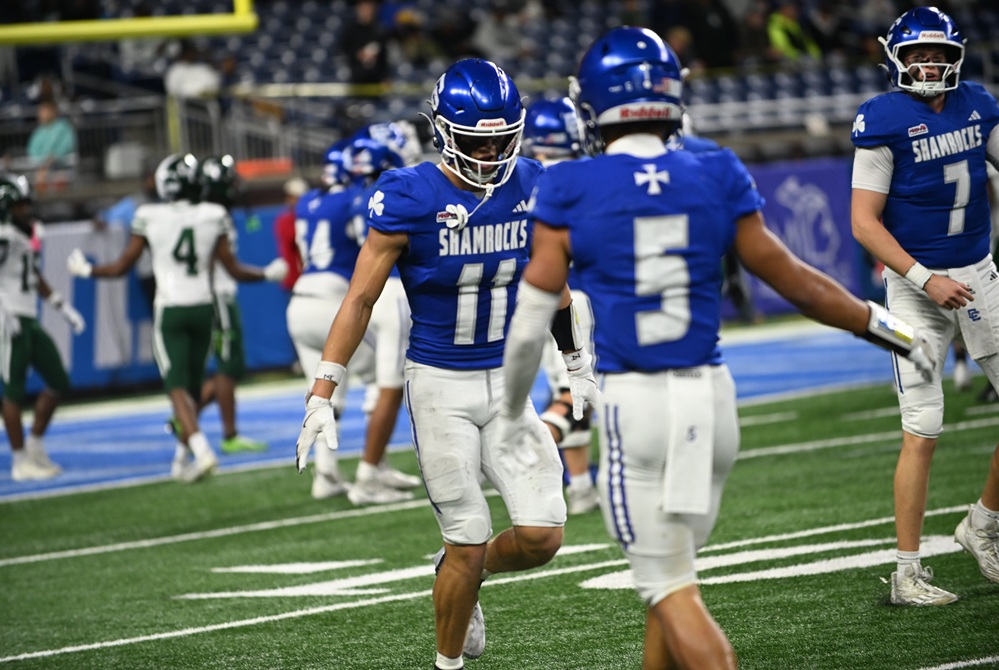
PHOTOS (Top) Detroit Catholic Central’s Gideon Gash (11) is congratulated by brother Samson Gash after scoring during last season’s Division 1 Final. (Middle) Gash breaks up a pass during the win over Detroit Cass Tech.