


Jones' Motto Inspires 'Get To' Foundation's Work to Provide Opportunities
By
Tom Kendra
Special for MHSAA.com
October 4, 2023
Ben Jones always had the same, simple message, even if it was 100 degrees and sunny or 35 degrees and raining sideways, and whether he was playing for a powerhouse like Muskegon Catholic Central or coaching a program trying to establish itself at Bloomfield Hills Cranbrook Kingswood.
 “We get to play football today,” Jones would say, as many of those around him were complaining and grumbling.
It was never “have to” for Jones, but always “get to.”
Jones, who was about to start his second year as head coach at Cranbrook, had his life tragically cut short by a drunk driver who crashed into his vehicle as he was traveling home from work in Detroit on Aug. 19, 2020. He was just 30 years old.
While Jones is gone, leaving a hole as large and painful as the 6-foot-2, 260-pound frame he carried as a tight end in his senior year at Hillsdale College, that “Get To” mentality is alive and well, and thriving and growing – thanks in large part to the efforts of his football teammates from Muskegon Catholic and later at Hillsdale.
The Get To Foundation, a 501(c)3 non-profit organization, was formed in Jones’ honor and has grown exponentially in less than three years, providing grants to sports organizations and scholarships to student-athletes.
“There is a core group of about 10 of them that have worked on (the foundation), and it’s been amazing,” said Theresa Jones, Ben’s mother, who with her husband Bruce has worked with the foundation. “It started small, and then it caught fire.”
The president of the foundation is Tim Hornak, Jones’ best friend and teammate in the trenches at both Muskegon Catholic and Hillsdale. Hornak returned to deliver a pre-game speech before the Crusaders’ home game on Sept. 15 against Kalamazoo United, where he talked about the man who is the inspiration behind the rapidly-growing Get To movement.
“You don’t have to, you get to – that simple difference can change your lives,” said Hornak, who teamed with Jones when both were seniors to help the Crusaders to a 14-0 record and the Division 8 championship in 2008. “You get to play football tonight and continue the tradition that started here in the 1950s.
“You get a chance to line up and play a great game with your best friends.”
Inspired by Hornak’s words and Jones’ legacy, the Crusaders downed Kalamazoo United 27-7 that night, the team’s second-straight win after an 0-2 start, which put them back in the Division 8 playoff picture.
 A tailgate party was held before the game as a fundraiser for the Get To Foundation, and it happened to coincide with the 15th anniversary of the Crusaders’ 2008 championship team – arguably one of the best teams in the school’s storied history. MCC has won 12 state championships, trailing only Farmington Hills Harrison in state playoff history.
The phrase “get to,” according to Hornak, goes back to the whiteboard in the MCC locker room his sophomore year and perfectly captures Jones’ approach to life and to football, whether his team was unbeaten like at MCC or struggling like the Chargers did just after he and Hornak graduated.
Jones, who wore No. 62 at MCC, was a two-way starting lineman who also played on the Crusaders’ 2006 championship team as a sophomore. His best friends on the team were the Hornak twins, Tim and Jon, whose father Mike was an assistant coach.
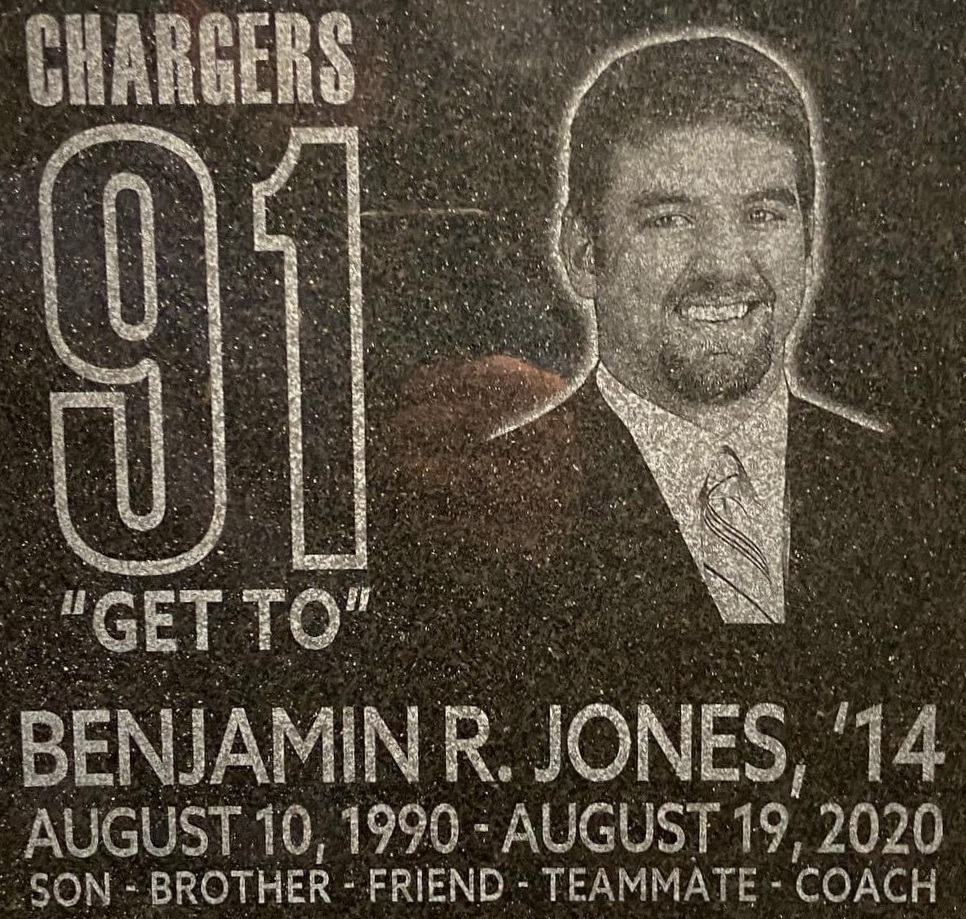
After his funeral service on Aug. 24, 2020, Jones’ hearse made a stop at MCC’s Kehren Stadium on the way to the cemetery, taking a lap on the track around Mike Holmes Field.
He went on to play on three teams which won or shared Great Lakes Interscholastic Athletic Conference titles at Hillsdale, where he wore No. 91 and played tight end and H-back.
“He had an inner self-confidence that you could tell right away when talking to him,” said Hillsdale coach Keith Otterbein. “He was very positive. He encouraged his teammates.”
Jones graduated from Hillsdale in 2013 with a degree in financial management and a minor in mathematics, moved to Royal Oak and took a job as a portfolio manager and financial planner at Schwartz & Co. Investment Advisors.
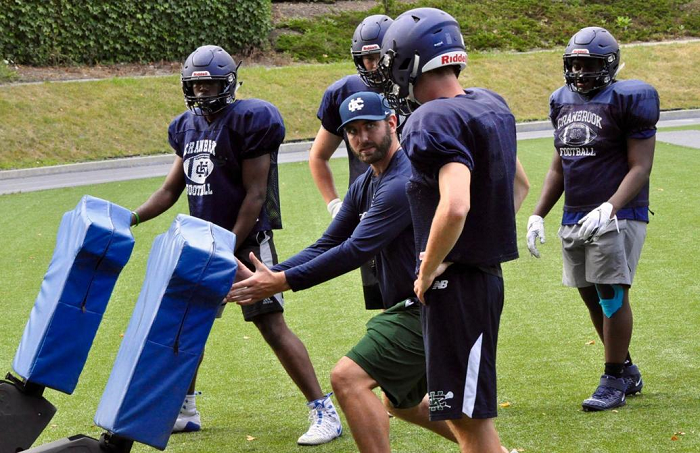
In his free time, he worked as an assistant varsity football coach at Cranbrook from 2015 to 2018, before being elevated to head coach in 2019 at the age of 28.
One of his first actions as head coach was getting Cranbrook football T-shirts printed with the message “Get To” on the back. Jones guided the Cranes to a 6-4 record and a Division 4 playoff berth in what would prove to be his only season as head coach.
 He died nine days before Cranbrook’s scheduled season opener in 2020, which ended up being delayed six weeks due to the COVID-19 pandemic.
In the immediate aftermath of Jones’ shocking death, the Hornak brothers and other former teammates vowed to do something to honor Ben and to help out his family. Out of that mission, the Get To Foundation was born.
Get To has awarded scholarships for the past three years. In 2023 alone, the foundation awarded $16,000 in scholarships to 22 student-athletes from around the state.
In addition, Get To has awarded $55,000 in grants to 17 organizations – including $3,000 to the Eaton Rapids High School football program for new shoulder pads and helmets and $2,500 to the Detroit Tigers Foundation’s Gloves for Kids program.
The next event on the foundation’s busy calendar is a speech by best-selling motivational author Jon Gordon at Lawrence Tech University on Oct. 17.
The foundation’s board has trademarked the phrase “Get To” and hopes to continue to grow the organization’s size and scope – in a way mirroring how big and impactful Ben’s life could have been if it wasn’t cut short.
For more information or to make a donation, go to the organization’s website at www.gettofoundation.org.
The relentless efforts of Ben’s ex-teammates to keep his memory alive means the world to his parents, as well as his two younger siblings – Alissa, a standout swimmer at Hillsdale who is now the school’s assistant women’s swimming coach; and Nate, who also played football for the Chargers and is now a foreign currency trader for Barclay’s, based in New York City.
Theresa Jones said coming together with all of Ben’s closest friends for Get To Foundation events has been a continuous blessing for the family.
“Every time we have an event for the foundation, it’s all of Ben’s friends and family members dressed up and having a good time,” his mother said. “It always feels like Ben’s wedding reception that he never got to have.”
 Tom Kendra worked 23 years at The Muskegon Chronicle, including five as assistant sports editor and the final six as sports editor through 2011. E-mail him at [email protected] with story ideas for Muskegon, Oceana, Mason, Lake, Oceola, Mecosta and Newaygo counties.
PHOTOS (Top) Ben Jones is shown before the 2008 Division 8 championship game at Ford Field during his senior year at Muskegon Catholic Central. The Crusaders defeated Crystal Falls Forest Park, 40-0. (Middle) Jones works with his linemen during his first year as head coach at Bloomfield Hills Cranbrook Kingswood in 2019. (Below) A plaque honoring Jones has been placed in the tunnel leading from the home locker room to the football field at Hillsdale College. (Top photo by Tim Reilly. Additional photos courtesy of the Get To Foundation.)
MHSAA Vault: Shooks a Legend as Freshman Coach
By
Geoff Kimmerly
MHSAA.com senior editor
September 4, 2026
The following originally appeared in the Lansing State Journal on Oct. 28, 2004, and was reprinted by the MHSAA that winter.
Wayne Shooks retired from coaching entirely in 2008 and died Tuesday at the age of 84.
Wayne Shooks tried the varsity football thing once. Some time during the late 1980s, longtime DeWitt coach Gail Thornton asked Shooks to be his offensive coordinator.
“I didn't sleep a night. My wife, after three weeks, said, ‘You're going back to freshmen,’” Shooks remembered.
And those three weeks were in the month of June.
But Shooks' wife must have been on to something. Because few, if any, freshman football coaches have accomplished what Shooks finished with one last win last fall.
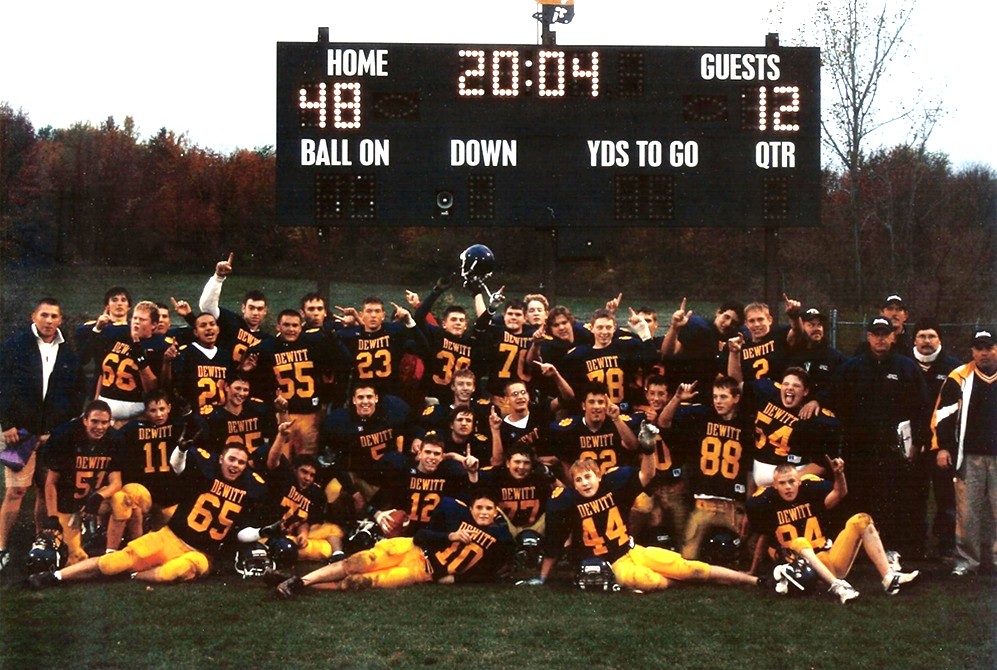
He ended his 16th and final season as freshman coach with a 135-2-1 record.
Amazing.
“You can't lose a game for him, or you'll feel bad,” DeWitt senior Mat Brynick recalled from his days as a freshman. “Coach never says it, but it's what everyone expects.
“He taught us how to win.”
 Guys like Shooks, 62, usually go unappreciated.
They get the kids fresh to high school, fresh to high school sports, and still learning things like not spiking the ball after a touchdown.
But few freshman football coaches are as legendary as Shooks is in DeWitt. They are so unappreciated that it's impossible to find out if anyone has accomplished what he's done.
Shook is not big on numbers. Never has been during his 41 years teaching in the district, or more than 20 coaching everything from football to basketball to wrestling to tennis. Oh, and track since 1980.
He also coached 8th-grade football for a few years, junior varsity for one season and was a varsity assistant. But he'll be remembered for what he did with the freshmen.
The losses came in 1993 to Mason during a terrible wind storm, and in 2002 to Greenville. That same year, the Panthers tied Haslett, meaning it was the only year during his tenure that DeWitt wasn't sure if it finished first in its league, since league titles aren't handed out at the freshmen level.
“The kids felt bad. They did their best,” Shooks remembered.
But the losses, however few, were more of a relief for Shooks than a letdown.
Don't take that to mean Shooks doesn't like to win.
Sure, he embraced the role of teacher as much as any freshman coach. But as DeWitt varsity coach Rob Zimmerman said, “If he was a 5th-grade coach, he'd be the most competitive 5th-grade coach you've ever seen.”
“I never pointed (our record) out, it was not our goal,” Shooks said. “Our goal was to win the next week. Although the kids knew it. They just assumed we were going to go 9-0, I guess.”
Guess so.
Shooks had more easily-attainable goals:
- Have fun
- Learn fundamentals
- Emphasize the logical stuff, like the importance of bringing equipment to school every day
“He does a really good job teaching expectations about being young men and being great students,” Zimmerman said. “It's gigantic.”
And it kept kids coming back to junior varsity and varsity. You could hear the fun coming out in Brynick's voice.
He was remembering his freshman football experience, remembering his time with perhaps Michigan's most successful coach at that level.
“I remember a few games, we'd find one play that works, and we ran it to death, pounding it and pounding it,” Brynick recalled. “He loves running the same play over and over. If you can do that, march 80 yards down the field, you're doing something right. No one could stop us.”
That was not all Brynick remembered, or didn't.
Shooks almost never yelled. If he did, it meant a kid messed something up over and over and over again.
He has a doctorate in zoology. Education is obviously a big deal. He loves to win, but he loves to teach. And he's hesitant to go looking for any attention for what he's done.
All made him a perfect freshmen football coach.
“Sometimes I don't think people understand about coaches. You think college level, they are coaches first, that's their job, but not at the high school level,” Shooks said.
“It's not what I've done, it's what they've done. I've always believed the focus should be on the kids. My job is a teacher. I coach because I love to coach.”
PHOTO DeWitt freshman coach Wayne Shooks, fourth from right, stands for a photo with this final football team in 2004. (Photos courtesy of the DeWitt football program.)