

Kalamazoo Rivals 'United' for Football
By
Pam Shebest
Special for MHSAA.com
August 24, 2015
KALAMAZOO — With a big grin, Isaac DeVries said he was relieved a year ago when he heard his Kalamazoo Christian football team was uniting with Hackett Catholic Prep for the next two seasons.
“My first thought was ‘I don’t have to play special teams’,” the K-Christian senior said, laughing. “There’s more people to play. Getting breaks every once in a while is always good.”
 K-Christian junior Alex Visser echoed DeVries sentiments.
“(Two years ago) we only had 13 players on the team, and that was tough,” DeVries said. “We had to play both ways the entire game. The idea of having more players on our team sounded real nice.
“It was different at first because you didn’t really know the (Hackett) kids, but once we got into the season, it was good.”
One year later, the feeling among the players is more than relief.
Despite graduating 22 players and returning only six letterwinners from 2014, the Hackett/Christian co-operative program – which goes by Kalamazoo United – has 22 players on the varsity and 26 on the junior varsity.
It’s coming off a 6-4 finish and appearance in the Division 4 playoffs. Prior to last season, K-Christian last made the playoffs in 2011, while Hackett last qualified in 2006.
The team’s helmets are black with a “U” on the sides – one half of the U green for Hackett, the other purple for Kalamazoo Christian. Instead of choosing Fighting Irish or Comets – the mascots for those schools – the team is called the Titans and made up nearly evenly of athletes from both.
“The best thing is we’re all friends,” Hackett sophomore Keaton Ashby said. “As a team, we’re brothers. This is a family.
“Personally, I love how we all treat each other. We’re not Hackett and Christian; we’re Kalamazoo United.”
Low numbers at both schools led to the football merger, Hackett athletic director Mike Garvey said.
“(K-Christian AD Jerry Weesies) and I were concerned with the health and safety of the kids with so few numbers,” he said. “It’s hard to maintain a football program if you can’t provide a junior varsity program.”
 Weesies said 8-player football was discussed and discarded.
While talking about combining the two rivals into one team, much of the concern came from parents.
“We initially knew we were going to get push back,” Weesies said. “We knew from both sides there would be some faith-based religious push backs. Also push back from the rivalry. We anticipated it. It was there initially and died quickly.
“What changed the course so quickly, once we started moving forward in spite of some of the push back, was the kids got along so well and so quickly started doing summer activities together that some of the parents said, ’Oh, look at my son. He’s happy. These are just kids.’”
As the victories started coming, that brotherhood strengthened.
None of last year’s players had previously experienced the playoffs. United lost to Eaton Rapids 36-0 in the first round, but that’s only made the players hungrier for success.
“It was great, sitting there at the (MHSAA playoff pairings show) watch party, watching to see who we were going to play,” Hackett senior Jacob Buchman said. “It was one of the best feelings in the world.”
While the players are brothers in football, that doesn’t diminish the rivalry in other sports.
DeVries, who also plays basketball, said it just makes their hoops rivalry more intense.
“Everyone wants to win that one, just to get bragging rights during football season,” he said. “It’s always fun playing Hackett in basketball and (to) see all the guys you know cheering against you.”
Three of the football team’s six returnees are team captains.
Patrick Koning was chosen by the coaches.
 “He is a leader both in the weight room and in conditioning,” first-year head coach Jesse Brown said. “He’s a charismatic leader.”
The other two were chosen by team vote.
Buchman, a unanimous choice, “is the hardest worker and put in the most work over the summer,” Brown said. “He’s always uplifting, and people listen when he speaks.”
The third captain is Jordan Corstange, who “leads by his performance,” Brown said. “He’s very important with what he does on the field.”
The fourth will be chosen weekly by the coaches based on his performance.
“It could be a different guy every week or it could be the same one for a couple of weeks,” Brown said.
Ashby will lead the team at quarterback.
“He has a big frame and a strong arm,” Brown said. “He’s a very intelligent player, and that made the coaches’ decision unanimous.”
This year’s United team not only has a new coach but also a new affiliation: the Southwestern Athletic Conference. When the Kalamazoo Valley Association disbanded this spring after more than 65 years, United became part of the 20-team SAC and opens the season by hosting Decatur on Thursday.
The team will play in the SAC Division 1 with Coloma, Fennville, Watervliet and former KVA partners Constantine and Delton Kellogg
“The (SAC) merger has changed some things for us,” Brown said. “It’s schools that are comparable to the size of Christian and Hackett. The KVA became unbalanced with the size of schools.
”As the enrollment in Hackett and Christian was going down, others were going up. It’s hard to take a team with 17 to 25 kids going against one with 60.”
Koning said there will be adjustments to playing in a new conference.
“The difference is that with the KVA, it’s been there for a long time, as long as I can remember,” he said. “You knew what was going on with each team.
“Some teams would run the same formation every year. This year, we don’t know much about each team, so it’s just going to be adapting to each team we play.”
While the players might not be familiar with the SAC, Brown and three of his assistants played in the conference. Brown graduated from Martin High School, David Arrasmith and Rob Hardy from Gobles and Vinny Church from Bloomingdale.
“Some of our (13) coaches don’t know which school these (United) kids are from, and that’s a really neat thing,” Brown said. “You just can’t tell. They’re all stand-up young men.”
Summer conditioning and workouts take place at K-Christian, but the team’s home field is Soisson-Rapacz-Clason Field, which was shared by both Hackett and K-Christian football teams in the past.
A few players dropped out of the program when the teams merged.
“I play for the love of the sport,” Koning said. “Some people who didn’t love it left. We just love the sport. It doesn’t matter who you play with or how you get to play, you just play.
“I learned how easy it is to have chemistry with new people. The chemistry with both schools coming together. We really meshed, and this year was easier than last year because we already knew each other.”
“The team’s goal last season was to be successful,” Visser added. “There were a lot of people doubting the whole United thing. We wanted to just go out there and win some games and be successful.”
But this season, expectations are higher: “We want to make the playoffs again,” Visser said.
Ashby said he hopes the co-op team continues past this season.
“I think this is the greatest thing that Hackett and Christian has ever done,” he said. “We put ourselves out there every single day. Honestly, we are improving even more. This is a great opportunity to keep going with another contract.”
 Pam Shebest served as a sportswriter at the Kalamazoo Gazette from 1985-2009 after 11 years part-time with the Gazette while teaching French and English at White Pigeon High School. She continues to freelance for MLive.com covering mainly Kalamazoo Wings hockey and can be reached at [email protected] with story ideas for Calhoun, Kalamazoo and Van Buren counties.
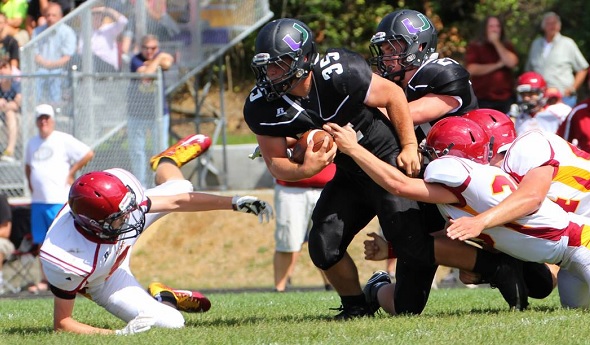
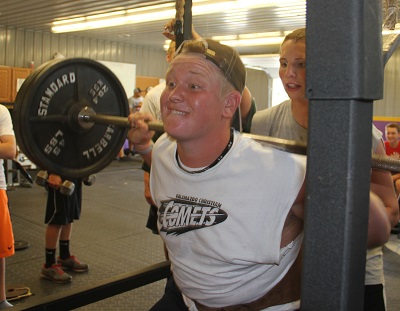
PHOTOS: (Top) Kalamazoo United running back Jacob Buchman breaks through tacklers during a game last season. (Middle) Patrick Koning, a captain this fall, works out while spotted by teammate Isaac DeVries. (Below) Coach Jesse Brown is in his first season leading the program. (Top photo by Dan Cooke; others by Pam Shebest.)
Drive for Detroit: Week 8 Preview
October 13, 2016
By Geoff Kimmerly
Second Half editor
The MHSAA football playoff picture should become much clearer by the time the cooled-off dirt and grass settle at the end of this weekend.
 So far, 115 teams have earned automatic berths for the 256-team 11-player postseason field. A total of 91 teams can earn automatic berths this weekend, although, in at least a few cases, hopefuls will face off.
We look at some of those matchups and many more below in the Week 8 edition of Drive for Detroit, powered by MI Student Aid. Remember to follow the MHSAA Score Center for up-to-date scores, standings and playoff point rankings as results come in. All games below are Friday unless noted.
Bay & Thumb
Richmond (6-1) at Algonac (7-0)
The only loss between these two this season was by Richmond on opening night to Marysville, which can win the Macomb Area Conference Gold title outright tonight. And the only regular-season loss Algonac suffered during its miraculous turnaround last fall from 1-8 in 2014 to 10-2 was 15-14 to Richmond in the final game of the Blue Water Area Conference schedule. That defeat created a shared title between the two; the winner of this rematch will take the BWAC championship outright.
Others that caught my eye: Ubly (7-0) at Harbor Beach (4-3), Midland (4-3) at Lapeer (5-2), Flint Carman-Ainsworth (5-2) at Midland Dow (7-0), Pinconning (5-2) at Saginaw Michigan Lutheran Seminary (5-2).
Greater Detroit
Warren Mott (6-1) at Utica Eisenhower (7-0)
Mott’s unexpected 31-8 loss to Romeo last week took a bit of wind out of this anticipated matchup – but it could return if Mott does win to force a shared Macomb Area Conference Red championship with Eisenhower and possibly Romeo as well. Mott has lost all five meetings with Eisenhower over the last six seasons, but knows winning well with six straight playoff berths. The Eagles, meanwhile, clinched their 17th playoff berth over the last 18 seasons with their best start since 2004 – and haven’t allowed more than 14 points in a game despite playing in one of the most respected leagues in the state.
Others that caught my eye: Berkley (5-2) at Bloomfield Hills (7-0), Dearborn (6-1) at Dearborn Fordson (7-0), Clarkston (5-2) at Lake Orion (5-2), Harper Woods Chandler Park (5-2) at Warren Michigan Collegiate (6-1).
Mid-Michigan
Brighton (6-1) at Howell (5-2)
This rivalry game between old Kensington Valley Conference neighbors hasn’t carried much in league title significance during their near-decade in the Kensington Lakes Activities Association West – but tonight’s game can either cement an outright championship for Brighton or give Howell a share. The Highlanders own a 5-3 advantage in those KLAA West meetings and also beat Brighton in a 2010 rematch in the playoffs, but the Bulldogs have navigated the league a little more carefully this fall with a four-point win over Pinckney (which beat Howell) and a one-pointer over Grand Blanc.
Others that caught my eye: Wyoming Kelloggsville (6-1) at Belding (5-2), Menominee (7-0) at DeWitt (6-1), Grand Ledge (6-1) at East Lansing (5-2), Pewamo-Westphalia (7-0) at Fowler (5-2).
Northern Lower Peninsula
Frankfort (7-0) at Charlevoix (6-1)
Frankfort has two league games remaining but can clinch a share of the Northern Michigan Football Conference Leaders championship with a win tonight. Charlevoix and Maple City Glen Lake both have a loss in the league, so the Rayders could really shake things up. Their only loss this season was to Glen Lake, by 42, in Week 5; Frankfort beat Glen Lake by five a week later. Charlevoix and Frankfort both were undefeated in the league when they played each other last year, and the Panthers won 20-0 to claim the title outright.
Others that caught my eye: Cadillac (5-2) at Manistee (4-3), Johannesburg-Lewiston (3-4) at East Jordan (4-3), Hillman (4-3) at Whittemore-Prescott (4-3), Kalkaska (6-1) at Traverse City St. Francis (7-0) on Saturday.
Southeast & Border
Ottawa Lake Whiteford (7-0) at Sand Creek (7-0)
Six of eight teams in the Tri-County Conference are at least 4-3 and can still clinch automatic playoff berths, but the title race has finally been whittled down to Whiteford and Sand Creek. Whiteford has had its share of success over the years and this season qualified for the playoffs for the fifth straight, but has never gone undefeated in the league dating back to its first year, 1975. Sand Creek had a perfect TCC run in 2011 but then won a combined eight games over the next four seasons – a total they can equal just this season with another win tonight.
Others that caught my eye: Hillsdale (4-3) at Ida (6-1), Battle Creek Pennfield (4-3) at Jackson Lumen Christi (5-2), Adrian Madison (4-3) at Petersburg-Summerfield (4-3), Dundee (3-4) at Brooklyn Columbia Central (5-2).
Southwest Corridor
Three Rivers (6-1) at Edwardsburg (7-0)
It seems like the Eddies have had only one or two games of consequence during a four-year undefeated run in the Wolverine Conference, but this will be one of those games. This meeting could look a lot more like Edwardsburg’s 42-40 win in 2014 than its 65-21 defeat of Three Rivers a year ago. The Eddies can clinch a share of the league title with a 27th straight conference win. But a Three Rivers victory could create a three-team tie for first (along with Vicksburg) with a week to play. The Wildcats’ lone loss was the Plainwell on opening night.
Others that caught my eye: Marshall (4-3) at Battle Creek Harper Creek (6-1), Berrien Springs (4-2) at Buchanan (4-2), Kalamazoo Central (4-3) at Portage Central (6-1), Springport (6-1) at Quincy (5-2).
Upper Peninsula
Felch North Dickinson (5-2) at Lake Linden-Hubbell (7-0), Saturday
North Dickinson is reportedly taking its long history of success to 8-player next season, and there would be little better way to finish in 11 than by knocking newcomer Lake Linden-Hubbell off its roost atop the Mid-Eastern Conference. The Lakes are working toward a second straight perfect regular season and haven’t allowed an opponent closer than 14 points since opening night. But the Nordics, on the verge of securing their first winning season and playoff berth in three years, could move into first place in the league with a victory and set up an opportunity to share the title for the first time since winning five straight from 2009-13.
Others that caught my eye: Norway (6-1) at Gwinn (5-2), Hancock (4-3) at Iron River West Iron County (4-3), St. Ignace (6-1) at Ishpeming (3-3), Gladstone (3-4) at Kingford (5-2)
West Michigan
Grand Rapids West Catholic (6-1) at Grand Rapids Catholic Central (7-0)
This rivalry will play out for the first time since 2009 because these teams are now together in the Ottawa-Kent Conference Blue – and tied for first with two league games to play. The winner claims a share of the league title, which would be a repeat performance for both – West Catholic won the last two Blue titles, and GRCC came over after winning the O-K Green last fall. The Falcons have given up a total of 14 points over four league games, but haven’t yet faced third-place Allendale, which put 20 on a GRCC defense that otherwise hasn’t given up more than 15 in a game.
Others that caught my eye: Rockford (5-2) at East Kentwood (4-3), Hudsonville Unity Christian (6-1) at Hamilton (5-2), Muskegon Mona Shores (4-3) at Muskegon (6-1), Byron Center (6-1) at Zeeland East (6-1).
8-Player
Fife Lake Forest Area (6-1) at Wyoming Tri-unity Christian (7-0)
The inaugural Midwest Central 8-Player Conference championship comes down to this game as both teams are undefeated in league play heading into the finale. Tri-unity has been stellar giving up only 36 points in winning more games this fall than the last four seasons combined. Fife Lake Forest Area has a similar story with six wins for the first time since 2008. The Warriors made the move to 8-player this fall after winning 11 games total over the last five seasons.
Others that caught my eye: Morrice (4-3) at Webberville (5-2), Pickford (6-1) at Cedarville (6-1).
Second Half’s weekly “Drive for Detroit” previews are powered by MI Student Aid, a part of the Student Financial Services Bureau located within the Michigan Department of Treasury. MI Student Aid encourages students to pursue postsecondary education by providing access to student financial resources and information, including various student financial assistance programs to help make college more affordable for Michigan students. MI Student Aid administers the state’s 529 savings programs (MET/MESP) and eight additional aid programs within its Student Scholarships and Grants division. Click for more information and connect with MI Student Aid on Facebook and Twitter @mistudentaid.
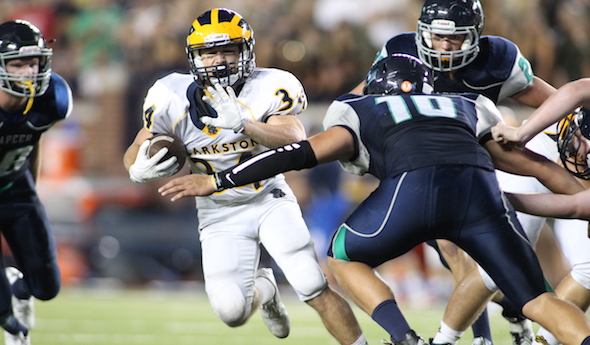
PHOTOS: A Clarkston ball carrier prepares to collide with a Lapeer defender during their Week 1 game this season at the University of Michigan. (Click to see more from HighSchoolSportsScene.com.)