

Kalamazoo Rivals 'United' for Football
By
Pam Shebest
Special for MHSAA.com
August 24, 2015
KALAMAZOO — With a big grin, Isaac DeVries said he was relieved a year ago when he heard his Kalamazoo Christian football team was uniting with Hackett Catholic Prep for the next two seasons.
“My first thought was ‘I don’t have to play special teams’,” the K-Christian senior said, laughing. “There’s more people to play. Getting breaks every once in a while is always good.”
 K-Christian junior Alex Visser echoed DeVries sentiments.
“(Two years ago) we only had 13 players on the team, and that was tough,” DeVries said. “We had to play both ways the entire game. The idea of having more players on our team sounded real nice.
“It was different at first because you didn’t really know the (Hackett) kids, but once we got into the season, it was good.”
One year later, the feeling among the players is more than relief.
Despite graduating 22 players and returning only six letterwinners from 2014, the Hackett/Christian co-operative program – which goes by Kalamazoo United – has 22 players on the varsity and 26 on the junior varsity.
It’s coming off a 6-4 finish and appearance in the Division 4 playoffs. Prior to last season, K-Christian last made the playoffs in 2011, while Hackett last qualified in 2006.
The team’s helmets are black with a “U” on the sides – one half of the U green for Hackett, the other purple for Kalamazoo Christian. Instead of choosing Fighting Irish or Comets – the mascots for those schools – the team is called the Titans and made up nearly evenly of athletes from both.
“The best thing is we’re all friends,” Hackett sophomore Keaton Ashby said. “As a team, we’re brothers. This is a family.
“Personally, I love how we all treat each other. We’re not Hackett and Christian; we’re Kalamazoo United.”
Low numbers at both schools led to the football merger, Hackett athletic director Mike Garvey said.
“(K-Christian AD Jerry Weesies) and I were concerned with the health and safety of the kids with so few numbers,” he said. “It’s hard to maintain a football program if you can’t provide a junior varsity program.”
 Weesies said 8-player football was discussed and discarded.
While talking about combining the two rivals into one team, much of the concern came from parents.
“We initially knew we were going to get push back,” Weesies said. “We knew from both sides there would be some faith-based religious push backs. Also push back from the rivalry. We anticipated it. It was there initially and died quickly.
“What changed the course so quickly, once we started moving forward in spite of some of the push back, was the kids got along so well and so quickly started doing summer activities together that some of the parents said, ’Oh, look at my son. He’s happy. These are just kids.’”
As the victories started coming, that brotherhood strengthened.
None of last year’s players had previously experienced the playoffs. United lost to Eaton Rapids 36-0 in the first round, but that’s only made the players hungrier for success.
“It was great, sitting there at the (MHSAA playoff pairings show) watch party, watching to see who we were going to play,” Hackett senior Jacob Buchman said. “It was one of the best feelings in the world.”
While the players are brothers in football, that doesn’t diminish the rivalry in other sports.
DeVries, who also plays basketball, said it just makes their hoops rivalry more intense.
“Everyone wants to win that one, just to get bragging rights during football season,” he said. “It’s always fun playing Hackett in basketball and (to) see all the guys you know cheering against you.”
Three of the football team’s six returnees are team captains.
Patrick Koning was chosen by the coaches.
 “He is a leader both in the weight room and in conditioning,” first-year head coach Jesse Brown said. “He’s a charismatic leader.”
The other two were chosen by team vote.
Buchman, a unanimous choice, “is the hardest worker and put in the most work over the summer,” Brown said. “He’s always uplifting, and people listen when he speaks.”
The third captain is Jordan Corstange, who “leads by his performance,” Brown said. “He’s very important with what he does on the field.”
The fourth will be chosen weekly by the coaches based on his performance.
“It could be a different guy every week or it could be the same one for a couple of weeks,” Brown said.
Ashby will lead the team at quarterback.
“He has a big frame and a strong arm,” Brown said. “He’s a very intelligent player, and that made the coaches’ decision unanimous.”
This year’s United team not only has a new coach but also a new affiliation: the Southwestern Athletic Conference. When the Kalamazoo Valley Association disbanded this spring after more than 65 years, United became part of the 20-team SAC and opens the season by hosting Decatur on Thursday.
The team will play in the SAC Division 1 with Coloma, Fennville, Watervliet and former KVA partners Constantine and Delton Kellogg
“The (SAC) merger has changed some things for us,” Brown said. “It’s schools that are comparable to the size of Christian and Hackett. The KVA became unbalanced with the size of schools.
”As the enrollment in Hackett and Christian was going down, others were going up. It’s hard to take a team with 17 to 25 kids going against one with 60.”
Koning said there will be adjustments to playing in a new conference.
“The difference is that with the KVA, it’s been there for a long time, as long as I can remember,” he said. “You knew what was going on with each team.
“Some teams would run the same formation every year. This year, we don’t know much about each team, so it’s just going to be adapting to each team we play.”
While the players might not be familiar with the SAC, Brown and three of his assistants played in the conference. Brown graduated from Martin High School, David Arrasmith and Rob Hardy from Gobles and Vinny Church from Bloomingdale.
“Some of our (13) coaches don’t know which school these (United) kids are from, and that’s a really neat thing,” Brown said. “You just can’t tell. They’re all stand-up young men.”
Summer conditioning and workouts take place at K-Christian, but the team’s home field is Soisson-Rapacz-Clason Field, which was shared by both Hackett and K-Christian football teams in the past.
A few players dropped out of the program when the teams merged.
“I play for the love of the sport,” Koning said. “Some people who didn’t love it left. We just love the sport. It doesn’t matter who you play with or how you get to play, you just play.
“I learned how easy it is to have chemistry with new people. The chemistry with both schools coming together. We really meshed, and this year was easier than last year because we already knew each other.”
“The team’s goal last season was to be successful,” Visser added. “There were a lot of people doubting the whole United thing. We wanted to just go out there and win some games and be successful.”
But this season, expectations are higher: “We want to make the playoffs again,” Visser said.
Ashby said he hopes the co-op team continues past this season.
“I think this is the greatest thing that Hackett and Christian has ever done,” he said. “We put ourselves out there every single day. Honestly, we are improving even more. This is a great opportunity to keep going with another contract.”
 Pam Shebest served as a sportswriter at the Kalamazoo Gazette from 1985-2009 after 11 years part-time with the Gazette while teaching French and English at White Pigeon High School. She continues to freelance for MLive.com covering mainly Kalamazoo Wings hockey and can be reached at [email protected] with story ideas for Calhoun, Kalamazoo and Van Buren counties.
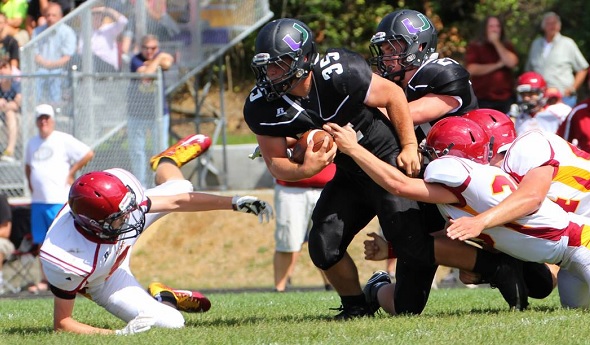
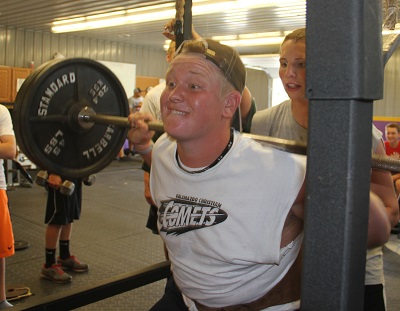
PHOTOS: (Top) Kalamazoo United running back Jacob Buchman breaks through tacklers during a game last season. (Middle) Patrick Koning, a captain this fall, works out while spotted by teammate Isaac DeVries. (Below) Coach Jesse Brown is in his first season leading the program. (Top photo by Dan Cooke; others by Pam Shebest.)
A Game for Every Fan: Playoffs Week 3
November 12, 2015
By Geoff Kimmerly
Second Half editor
Through the rain, and fog, and in some places up north a few flakes of snow, we see the MHSAA Football Finals finally approaching – even if predicting which teams will be playing is still no easy task.
Plenty of opponents facing off this weekend have seen each other at this late date before. For a handful of others, this has been a wild first-time ride.
Here’s a look at what might be the most intriguing of this weekend’s 11-player Regional Finals, plus a longer glance at both 8-player Semifinals. All games are tonight unless noted.
Division 1
Detroit Cass Tech (9-2) at Macomb Dakota (9-2)
It’s hard to believe Macomb Dakota hasn’t played in an MHSAA championship game since 2007, but the 2010 and previously-undefeated 2013 teams both saw their seasons end in Regional Finals against Cass Tech. The Technicians, led by standout quarterback Rodney Hall, have lost only to Detroit Martin Luther King this season, twice. They are playing to make a third straight Semifinal – and get a shot at getting back to the championship game for the first time since 2012.
Other Regional Finals: Rockford (8-3) at Grand Ledge (11-0), Detroit Catholic Central (9-2) at Romeo (10-1), Canton (9-2) at Saline (10-0).
Division 2
Muskegon (9-2) at Lowell (10-1)
Muskegon’s path has been such that every week’s game has been one of the state’s most anticipated. After eliminating previously undefeated Traverse City Central and Muskegon Mona Shores in the District, the Big Reds must hit the road again to take on a Lowell team that is only two three-point losses from perfection. Not that this is an unfamiliar position for either program – although they didn’t meet last year, Lowell and Muskegon ran across each other in the playoffs six straight seasons from 2008-13.
Other Regional Finals: Midland Dow (10-1) at Walled Lake Western (11-0), Livonia Franklin (8-3) at Berkley (9-2), Detroit East English (9-2) at Detroit Martin Luther King (11-0), Saturday.
Division 3
Coldwater (11-0) at St. Joseph (10-1)
This trip into uncharted waters keeps getting longer for the Cardinals, who won their first playoff game ever two weeks ago. Although this level of the tournament is new, St. Joseph isn’t a completely unfamiliar opponent – the Bears beat Coldwater on opening night 2013. St. Joseph has downed league champions three of its last four games and is seeking its first Regional title since 2007.
Other Regional Finals: Chelsea (10-1) at Allen Park (10-1), East Grand Rapids (8-3) at Mount Pleasant (9-2), Saturday; St. Johns (8-3) at Orchard Lake St. Mary’s (9-1), Saturday.
Division 4
Flint Powers Catholic (9-2) at Richmond (10-1)
The first game between these schools features two programs looking to get over the Regional hump. Powers has fallen in two Regional Finals in three seasons since winning Division 5 in 2011. Richmond lost in the Regional Final last year after falling in District Finals both of the two seasons prior; the Blue Devils are trying to make their first Semifinal since 2003. After winning its playoff games by a combined eight points, Richmond will have to contend with a Chargers defense that hasn’t given up a point in these playoffs and has six shutouts total in 11 games.
Other Regional Finals: Remus Chippewa Hills (9-2) at Ada Forest Hills Eastern (10-1), Hudsonville Unity Christian (8-3) at Zeeland West (11-0), Milan (9-2) at Detroit Country Day (10-1), Saturday.
Division 5
Grand Rapids West Catholic (9-2) at Menominee (11-0), Saturday
This has become an annual game at some stage of the playoffs. Saturday will mark the sixth straight postseason meeting between these two, including Semifinals last season, 2010 and 2012 and the 2013 Division 5 Final. The Maroons usually can take advantage of opponents not familiar with their single-wing offense, but West Catholic should be plenty familiar; what Menominee can boast this time is its most impressive defense since the back-to-back undefeated seasons of 2006 and 2007.
Other Regional Finals: Lansing Catholic (10-1) at Freeland (11-0), Buchanan (11-0) at Ida (11-0), Algonac (10-1) at River Rouge (10-1).
Division 6
Boyne City (10-1) at Traverse City St. Francis (11-0)
The first battle between these rivals this season wasn’t much of one by the end, with St. from running back Malik Smith, and fumbled three times – which makes it feel like this rematch will be much closer if the Ramblers keep mistakes to a minimum. It’s fair to say St. Francis creates its own opportunities, though; the Gladiators have five shutouts in 11 games.
Other Regional Finals: Laingsburg (8-3) at Ithaca (11-0), Jackson Lumen Christi (8-3) at Clinton (11-0), Constantine (7-4) at Grand Rapids NorthPointe Christian (11-0), Saturday.
Division 7
Sandusky (11-0) at New Lothrop (11-0)
Sandusky is stacking accomplishments like no football team at the school before. The Redskins have more than nine wins for the first time and won a District title for the first time, and now will take on the powerhouse Hornets for the first time. Few teams in Michigan have put together a run over the last six seasons like New Lothrop, which is 65-5 during that span. But the Hornets have been stopped short of the MHSAA championship game all of those seasons, and surely would like a first Finals appearance since 2006 to add to its recent local dominance.
Other Regional Finals: Cassopolis (9-2) at Pewamo-Westphalia (11-0), Dansville (10-1) at Detroit Loyola (9-2), McBain (8-3) at Ishpeming (10-0).
Division 8
Crystal Falls Forest Park (7-3) at St. Ignace (10-1)
In pursuit of its third Regional title in five seasons – and really, in pursuit of its first MHSAA Final appearance since 1985 – St. Ignace has shown well against the toughest competition of its season. Three of the last four games, all four against playoff teams, have been decided by eight points or fewer, and the Saints came back from a second trip to rival Johannesburg-Lewiston last week with a second win over the Cardinals. Forest Park has no losses left to avenge after winning rematches the last two weeks against the two in-state teams it fell to during the regular season. But the Trojans did fall to St. Ignace in their last meeting, a 2011 Regional Final.
Other Regional Finals: Ottawa Lake Whiteford (9-2) at Climax-Scotts (11-0), Saturday; Muskegon Catholic Central (8-2) at Frankfort (9-2), Saturday; Saginaw Michigan Lutheran Seminary (10-1) at Waterford Our Lady (11-0), Saturday.
8-Player
Cedarville (9-2) at Powers North Central (11-0)
North Central is led by a talented quarterback making the entire state take notice – junior Jason Whitens is up to 41 touchdown passes without an interception to go with his 10 scores on the ground, and junior running back Bobby Kleiman has run for 17 touchdowns and caught 14 of Whitens’ scoring tosses. But Cedarville doesn’t give up too many scores. The Trojans handed Owendale-Gagetown and Posen their only losses of the season the last two weeks, giving up only 48 points total over those two games – a respectable total in the wide-open 8-player format.
Deckerville (10-1) vs. Battle Creek St. Philip (11-0), Saturday at Battle Creek Central
St. Philip got past rival Lawrence one final time last week, but the path to Legacy Field remains blocked by another past champion. Deckerville avenged its lone loss of the season by doubling up Morrice last week and has run over opponents for nearly 3,400 yards, with senior Jared Philpot and juniors Austin Fritch and Brandon Pattullo combining for 2,300 yards and 37 touchdowns on the ground. The Eagles have thrown only 48 times, but St. Philip is much more balanced. The Tigers have nearly the same rushing and passing yardage totals this season – within 77 yards – with senior Brendan Gausselin throwing 35 touchdown passes and senior Brayden Darr running for 23 scores and catching 14 touchdown passes.
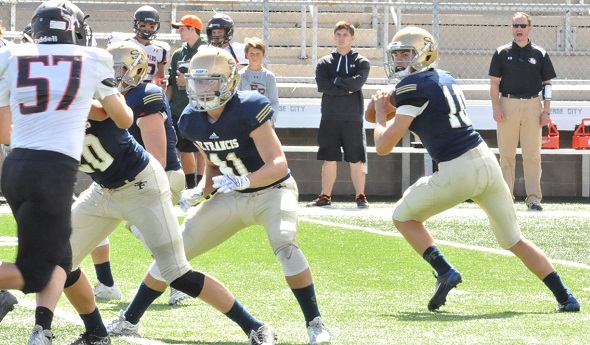
PHOTO: Traverse City St. Francis, here against Elk Rapids, is 11-0 for the first time since its undefeated season of 2009. (Photo courtesy of St. Francis athletic department.)