

King Avenges Early Defeat to Reign Again
November 24, 2018
By Tom Kendra
Special for Second Half
DETROIT – Rematches are rare in high school football, especially for teams located on opposite sides of the state.
But Detroit Martin Luther King on Saturday got the chance to avenge a Week 2 loss at Muskegon, and star senior quarterback Dequan Finn and his talented supporting cast made the most of it.
Finn, a 6-foot-1,190-pound senior who has committed to sign with Central Michigan University, threw four touchdown passes and ran for another as the Crusaders’ offensive versatility was the difference in a 41-25 victory over previously unbeaten Muskegon in the Division 3 Final at Ford Field.
“So many great King teams have lost to Muskegon, and it felt great to be the first to beat them,” said Tyrone Spencer, who has two MHSAA titles and a Semifinal appearance in his three years as King’s head coach. “They are a great program with a rich tradition, and it feels good to beat them for a state championship.”
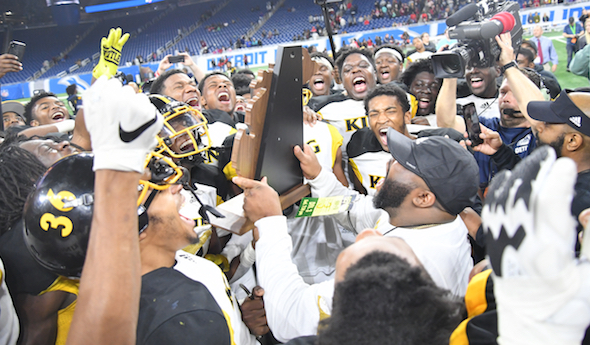
King (12-2) won its third Finals championship in four years, after claiming back-to-back Division 2 crowns in 2015 and 2016. The Crusaders have won four titles overall, with their first also in Division 2 in 2007.
Muskegon (13-1) was shooting for its seventh MHSAA title, but instead finished runner-up for the fifth time, and saw its state-best 27-game winning streak snapped.
The final championship game of the weekend was a matchup between arguably the two best quarterbacks in the state – and neither disappointed.
Muskegon junior Cameron Martinez (5-11, 190) was once again the workhorse for the Big Reds, carrying 37 times for 211 yards and two touchdowns. He completed only 1-of-4 passes, but that completion was good for a 13-yard touchdown to senior Ali’vonta Wallace.
Finn, meanwhile, was deadly with his arm and feet.
Finn completed 9-of-13 passes for 173 yards and the four scores, as his offensive line gave him plenty of time to pick apart the Muskegon secondary. He was also King’s second-leading rusher with 11 carries for 73 yards and another touchdown.
“I’m just happy with the whole team, the effort that we gave,” said Finn. “It’s a surreal moment right now. I’m lost for words.”
The quarterback matchup went back-and-forth for three quarters, and when Martinez plunged in from two yards out late in the third quarter to draw his team within 21-17, it appeared the stage was set for a fantastic finish.
Instead, King’s myriad offensive weapons overwhelmed Muskegon over the final 12 minutes.
Three players scored in the fourth quarter as the Crusaders pulled away – senior receiver Ahmad Gardner on a 22-yard pass from Finn, junior running back Peny Boone on a 52-yard run and senior receiver Darrell Wyatt on a three-yard pass from Finn that was nearly intercepted in the end zone.
“There were a lot of plays that could have been big for us, but there were dropped passes and a missed interception,” said Martinez, who finished his junior year with a school-record 2,527 rushing yards. “In a game like this, you can’t afford to make mistakes.”
Muskegon, which was playing in an MHSAA Finals game for the sixth time in seven years, got off to a great start.
The Big Reds forced a punt on King’s first possession, and despite taking over at their own 3-yard line, marched 97 yards in 13 plays behind their dominating offensive line. Martinez sprinted in from 10 yards out for a 7-0 lead.
 Making openings for Martinez were four seniors up front – tackles Anthony Bradford (6-5, 360) and Evan Towers (6-4, 285) and guards Marquis Cooper (6-1, 330) and Da’Quarious Johnson (6-0, 260) – along with junior center DeAndre Mills-Ellis (6-0, 290).
King countered with the passing of Finn, who connected with senior wideout Dominick Polidore-Hannah on a pair of first-half touchdown passes covering 42 and 22 yards as the Crusaders took a 14-10 halftime lead.
The third quarter was even as Finn and Martinez each had scoring runs, but King’s athleticism prevailed over Muskegon’s size and strength during the final quarter.
“We won 27 games in a row, and you have no idea how remarkable that is,” Muskegon ninth-year head coach Shane Fairfield told his huddled team on the Ford Field turf afterwards. “It hurts and it should hurt, but we haven’t felt this in a while.”
Boone made Muskegon pay for spreading out to cover the pass, hammering his way for 111 yards on 14 carries. Gardner and Polidore-Hannah each caught three passes. Leading King defensively was junior free safety Joe Frazier with 11 tackles, sophomore safety Jaylen Reed and senior safety Ray Williams with 10 tackles apiece and senior linebacker Rich Miller with nine stops.
The victory was sweet revenge for the Crusaders and especially Finn. In the Week 2 meeting, he mishandled a snap with 35 seconds remaining. Muskegon’s Billie Roberts recovered the fumble, and the Big Reds held on for a 24-21 win at Hackley Stadium in Muskegon. They went on to be ranked No. 1 in Division 3 the entire regular season and heading into the playoffs
“Our kids didn’t have any quit in them,” Spencer said. “I told them to give more effort, and that’s what they did. We got some breaks tonight, but (Muskegon) had some breaks when we went to their place and played. It’s a part of the game, and I’ll take it all day. Our guys never quit, and I’m proud of them.”
Senior Demario Robinson was the second-leading rusher for the Big Reds with 47 yards on six carries, while senior Carlos Hernandez booted a 37-yard field goal on the final play of the first half. Wallace led the defense with seven tackles, junior linebacker Tarran Walker had six and senior defensive back Isaiah Moore made five stops.
Muskegon, the winningest team in state history with 844 victories over 124 years of football (dating back to 1895), beat Farmington Hills Harrison last year for the Division 3 title. The Big Reds also have lost twice to Birmingham Brother Rice (2012 and 2013), twice to Orchard Lake St. Mary’s (2014 and 2016) and now King in championship games.
Fairfield scheduled the regular-season game against King to help prepare his team for the type of athletes it might see at Ford Field. He did not expect to see King again, as the Crusaders have traditionally slotted into the Division 2 bracket. But a drop in enrollment put both teams in the same division – and on a collision course.
Both had to survive Pre-District playoff scares, as Muskegon edged East Grand Rapids by one score (42-35), while King beat River Rouge by just one point (7-6).
After that, both teams rolled over their next three opponents en route to Ford Field.
Saturday’s matchup was the second time the two schools have met in an MHSAA Finals game, with the first meeting in the Class A Final in 1989 at the Pontiac Silverdome. Muskegon, which is now 5-1 all-time against King, prevailed in that title game 16-13.
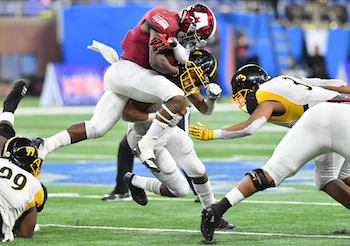
PHOTOS: (Top) Detroit Martin Luther King raises the Division 3 championship trophy Saturday night at Ford Field. (Middle) Crusaders defenders work to bring down a Muskegon ball carrier.
A Game for Every Fan: Week 4
September 20, 2013
By Geoff Kimmerly
Second Half editor
Welcome to fall, Michigan. Be sure to bring a coat and umbrella when you venture out to watch your favorite football team this weekend.
And what better way to spend a fall evening than watching one of the many 3-0 vs. 3-0 matchups dotting our state as we head into the meat of many league schedules.
See below for what should be some of the best games this weekend, and be sure to monitor all the scores at the MHSAA Score Center.
West Michigan
Muskegon (3-0) at Lowell (3-0)
For the second straight week, Muskegon finds itself in the most anticipated game statewide. Seven days ago the Big Reds responded with a 45-0 victory over Rockford. Tonight they’ll try to make it three straight against Lowell after beating the Red Arrows by 15 during the regular season and then 15-13 in a District Final in 2012. Lowell has been similarly dominant this fall, but Muskegon surely will be its toughest test so far.
Others that caught my eye: Comstock Park (3-0) at Allendale (3-0), Caledonia (2-1) at Grandville (2-1), Hartford (3-0) at Saugatuck (2-1), Shelby (3-0) at Montague (2-1).
Southwest and Border
Portage Northern (3-0) at St. Joseph (3-0)
St. Joseph had similar aspirations a year ago after a 3-0 start – then fell 7-0 to Portage Northern in Week 4 and missed the playoffs with a final 5-4 record. This season’s run has included more impressive victories over Battle Creek Harper Creek and Stevensville Lakeshore, and vengeance no doubt is on the Bears’ minds.
Others that caught my eye: Decatur (3-0) at Gobles (1-2), Stevensville Lakeshore (2-1) at Portage Central (3-0), Quincy (2-1) at Jonesville (3-0), Otsego (2-1) at Plainwell (3-0).
Bay and Thumb
Saginaw Arthur Hill (3-0) at Midland (3-0)
The most impressive part of Arthur Hill’s start is that it includes wins over 2012 playoff teams Goodrich and Bay City Western – on top of the fact the Lumberjacks went 0-9, 3-6, 1-8 and 1-8, respectively, since their last playoff appearance in 2008. This game will be the true measuring stick as Midland has been the class of the Saginaw Valley Association with 15 straight league wins and the North division championship last season.
Others that caught my eye: Pontiac Notre Dame Prep (3-0) at Flint Powers Catholic (2-1), Lawrence (2-0) at Peck (3-0), Elkton-Pigeon-Bay Port (3-0) at Unionville-Sebewaing (3-0), Almont (3-0) at Richmond (2-1).
Greater Detroit and Southeast
Southfield (2-1) at Oak Park (3-0)
Little has slowed Oak Park over the last two seasons, and wins already this fall over Orchard Lake St. Mary’s and Rochester Adams are proof the Knights will be back in the mix in the Oakland Activities Association White. Southfield should be too – and would love to get a strong start to a string that follows with Farmington Hills Harrison, Oxford and Adams.
Others that caught my eye: Saline (3-0) at Ann Arbor Pioneer (2-1), Orchard Lake St. Mary's (2-1) at Detroit U-D Jesuit (3-0), Grosse Ile (3-0) at Monroe St. Mary Catholic Central (3-0), Warren DeLaSalle (2-1) at Birmingham Brother Rice (3-0).
Mid-Michigan
DeWitt (3-0) at Ionia (3-0)
This might not seem like much of a game considering the teams’ recent histories – but don’t expect the Panthers to overlook the rejuvenated Bulldogs, who have equaled their most wins in a season since 2006, the last they qualified for the playoffs. Ionia already has scored 125 points after totaling just 200 a year ago, and the defense has been pretty solid as well.
Others that caught my eye: Fowler (2-1) at Bath (2-1), Grand Blanc (2-1) at Brighton (2-1), Holt (1-2) at Lansing Everett (3-0), Carson City-Crystal (3-0) at Vestaburg (3-0).
Lower Up North
Grayling (3-0) at Traverse City St. Francis (2-1)
This arguably (but with little argument) was the best rivalry in the Lake Michigan Conference – although Grayling’s first win in their 10 games against each other didn’t come until last season after the Gladiators had left the conference for football. St. Francis can break the Vikings’ 12-game regular-season winning streak, dating to the Gladiators’ 20-19 win over Grayling in Week 9 of 2011.
Others that caught my eye: Elk Rapids (2-1) at Charlevoix (1-2), Whittemore-Prescott (3-0) at Standish-Sterling (3-0), Petoskey (2-1) at Traverse City West (2-1), Rogers City (2-1) at Hillman (2-1).
Upper Peninsula
Marquette (3-0) at Escanaba (0-3)
Escanaba obviously is off to a rough start, and Marquette has opened with three wins over 2012 playoff teams. But an intriguing side note to this game, in addition to being a Great Northern Conference opener, is one of the coaches on the Marquette sideline – Dan Flynn, formerly Escanaba’s coach from 1985-2011, is in his first season as an assistant with the Redmen. They’re looking to beat the Eskymos for the first time since 2010.
Others that caught my eye: Ishpeming Westwood (0-3) at Ishpeming (3-0), Iron Mountain (1-2) at Negaunee (3-0), Bessemer (3-0) at Lake Linden Hubbell (1-2), Stephenson (2-1) at Felch North Dickinson (3-0).
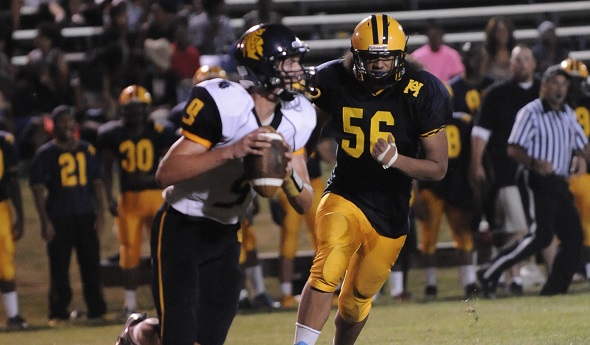
PHOTO: Saginaw Arthur Hill (in blue) defeated Goodrich on opening night and is in pursuit of its first 4-0 start since 2008. (Click to see more from High School Sports Scene.)