

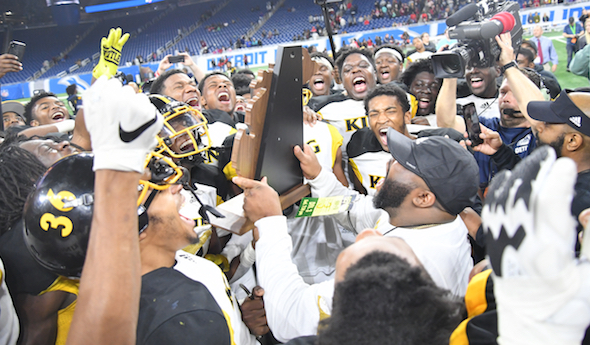
King Avenges Early Defeat to Reign Again
November 24, 2018
By Tom Kendra
Special for Second Half
DETROIT – Rematches are rare in high school football, especially for teams located on opposite sides of the state.
But Detroit Martin Luther King on Saturday got the chance to avenge a Week 2 loss at Muskegon, and star senior quarterback Dequan Finn and his talented supporting cast made the most of it.
Finn, a 6-foot-1,190-pound senior who has committed to sign with Central Michigan University, threw four touchdown passes and ran for another as the Crusaders’ offensive versatility was the difference in a 41-25 victory over previously unbeaten Muskegon in the Division 3 Final at Ford Field.
“So many great King teams have lost to Muskegon, and it felt great to be the first to beat them,” said Tyrone Spencer, who has two MHSAA titles and a Semifinal appearance in his three years as King’s head coach. “They are a great program with a rich tradition, and it feels good to beat them for a state championship.”
King (12-2) won its third Finals championship in four years, after claiming back-to-back Division 2 crowns in 2015 and 2016. The Crusaders have won four titles overall, with their first also in Division 2 in 2007.
Muskegon (13-1) was shooting for its seventh MHSAA title, but instead finished runner-up for the fifth time, and saw its state-best 27-game winning streak snapped.
The final championship game of the weekend was a matchup between arguably the two best quarterbacks in the state – and neither disappointed.
Muskegon junior Cameron Martinez (5-11, 190) was once again the workhorse for the Big Reds, carrying 37 times for 211 yards and two touchdowns. He completed only 1-of-4 passes, but that completion was good for a 13-yard touchdown to senior Ali’vonta Wallace.
Finn, meanwhile, was deadly with his arm and feet.
Finn completed 9-of-13 passes for 173 yards and the four scores, as his offensive line gave him plenty of time to pick apart the Muskegon secondary. He was also King’s second-leading rusher with 11 carries for 73 yards and another touchdown.
“I’m just happy with the whole team, the effort that we gave,” said Finn. “It’s a surreal moment right now. I’m lost for words.”
The quarterback matchup went back-and-forth for three quarters, and when Martinez plunged in from two yards out late in the third quarter to draw his team within 21-17, it appeared the stage was set for a fantastic finish.
Instead, King’s myriad offensive weapons overwhelmed Muskegon over the final 12 minutes.
Three players scored in the fourth quarter as the Crusaders pulled away – senior receiver Ahmad Gardner on a 22-yard pass from Finn, junior running back Peny Boone on a 52-yard run and senior receiver Darrell Wyatt on a three-yard pass from Finn that was nearly intercepted in the end zone.
“There were a lot of plays that could have been big for us, but there were dropped passes and a missed interception,” said Martinez, who finished his junior year with a school-record 2,527 rushing yards. “In a game like this, you can’t afford to make mistakes.”
Muskegon, which was playing in an MHSAA Finals game for the sixth time in seven years, got off to a great start.
The Big Reds forced a punt on King’s first possession, and despite taking over at their own 3-yard line, marched 97 yards in 13 plays behind their dominating offensive line. Martinez sprinted in from 10 yards out for a 7-0 lead.
 Making openings for Martinez were four seniors up front – tackles Anthony Bradford (6-5, 360) and Evan Towers (6-4, 285) and guards Marquis Cooper (6-1, 330) and Da’Quarious Johnson (6-0, 260) – along with junior center DeAndre Mills-Ellis (6-0, 290).
King countered with the passing of Finn, who connected with senior wideout Dominick Polidore-Hannah on a pair of first-half touchdown passes covering 42 and 22 yards as the Crusaders took a 14-10 halftime lead.
The third quarter was even as Finn and Martinez each had scoring runs, but King’s athleticism prevailed over Muskegon’s size and strength during the final quarter.
“We won 27 games in a row, and you have no idea how remarkable that is,” Muskegon ninth-year head coach Shane Fairfield told his huddled team on the Ford Field turf afterwards. “It hurts and it should hurt, but we haven’t felt this in a while.”
Boone made Muskegon pay for spreading out to cover the pass, hammering his way for 111 yards on 14 carries. Gardner and Polidore-Hannah each caught three passes. Leading King defensively was junior free safety Joe Frazier with 11 tackles, sophomore safety Jaylen Reed and senior safety Ray Williams with 10 tackles apiece and senior linebacker Rich Miller with nine stops.
The victory was sweet revenge for the Crusaders and especially Finn. In the Week 2 meeting, he mishandled a snap with 35 seconds remaining. Muskegon’s Billie Roberts recovered the fumble, and the Big Reds held on for a 24-21 win at Hackley Stadium in Muskegon. They went on to be ranked No. 1 in Division 3 the entire regular season and heading into the playoffs
“Our kids didn’t have any quit in them,” Spencer said. “I told them to give more effort, and that’s what they did. We got some breaks tonight, but (Muskegon) had some breaks when we went to their place and played. It’s a part of the game, and I’ll take it all day. Our guys never quit, and I’m proud of them.”
Senior Demario Robinson was the second-leading rusher for the Big Reds with 47 yards on six carries, while senior Carlos Hernandez booted a 37-yard field goal on the final play of the first half. Wallace led the defense with seven tackles, junior linebacker Tarran Walker had six and senior defensive back Isaiah Moore made five stops.
Muskegon, the winningest team in state history with 844 victories over 124 years of football (dating back to 1895), beat Farmington Hills Harrison last year for the Division 3 title. The Big Reds also have lost twice to Birmingham Brother Rice (2012 and 2013), twice to Orchard Lake St. Mary’s (2014 and 2016) and now King in championship games.
Fairfield scheduled the regular-season game against King to help prepare his team for the type of athletes it might see at Ford Field. He did not expect to see King again, as the Crusaders have traditionally slotted into the Division 2 bracket. But a drop in enrollment put both teams in the same division – and on a collision course.
Both had to survive Pre-District playoff scares, as Muskegon edged East Grand Rapids by one score (42-35), while King beat River Rouge by just one point (7-6).
After that, both teams rolled over their next three opponents en route to Ford Field.
Saturday’s matchup was the second time the two schools have met in an MHSAA Finals game, with the first meeting in the Class A Final in 1989 at the Pontiac Silverdome. Muskegon, which is now 5-1 all-time against King, prevailed in that title game 16-13.
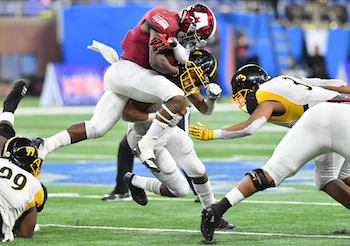
PHOTOS: (Top) Detroit Martin Luther King raises the Division 3 championship trophy Saturday night at Ford Field. (Middle) Crusaders defenders work to bring down a Muskegon ball carrier.
Ida Builds Greatest Season 'Brick by Brick'
By
Chip Mundy
Special for Second Half
November 5, 2015
By Chip Mundy
Special for Second Half
IDA – As the greatest football season in Ida High School history rolls into the second week of the MHSAA playoffs, it could be said that winning isn’t even the best thing the Bluestreaks have done this year.
 Winning certainly hasn’t been the most important thing they did this season.
With the community strongly backing the program throughout its undefeated season to date, which continues tonight in a Division 5 District Final at home against Dearborn Heights Robichaud, the team has given back – while building a collection of memories they will cherish no matter how long this history-making trip rolls on.
From hosting a fundraiser that hit much closer to home than they anticipated, to welcoming back a beloved member of the program after a health scare – and all while putting together the most successful run in school history – Ida has had a season to remember, even as it works to add more moments before the run is done.
Supporting a new teammate
The regular-season finale was designated as a fundraiser for childhood cancer awareness, and the game against rival Erie-Mason raised more than $4,000 for the St. Baldrick's Foundation, a private institution in California that gives grants to children who are battling cancer.
“I had seen something on Facebook and looked into it and decided that we needed to do something other than just get ready for football games,” Ida coach Tom Walentowski said. “We scheduled our Game 9 as a gold-out game with one of our rivals, Erie-Mason, and we raised money for childhood cancer awareness. The kids got big into that.”
Unknown at the time of the decision to raise funds for childhood cancer awareness, Chloe Arnold, a 5-year-old resident of the Ida community, was battling leukemia.
The close-knit Bluestreaks had room in their hearts to join another team. They joined Team Chloe. And in the regular-season finale, Team Chloe also was able to raise money through sales of merchandise.
One unique item was a helmet that had an Ida decal on one side and an Erie-Mason decal on the other. Players from both teams signed the helmets, which then were donated to Team Chloe for a silent auction that raised $665. A total of $2,315.42 was raised that night for Team Chloe.
“Gold is the color for cancer childhood awareness, and gold is in our school colors and it’s also in Erie-Mason’s school colors, so that’s why we decided that would be the game to do the gold-out,” Walentowski said. “We sold over 500 T-shirts. The kids were really into it.”
The greatest season
Entering the 2011 season, Ida had made the playoffs just three times and finished a regular season undefeated just once – in 1971. The Bluestreaks suddenly have made making the postseason a habit, going 6-3 before losing in the first round in 2011, just missing the postseason at 5-4 in 2012 and then returning to the playoffs each of the past three seasons. Last year, the team finished 8-3, tying the program record for victories with its most since 1991.
That is quite a turnaround for a program that had just three winning seasons from 1999-2010. The reversal of fortunes has been impressive. Prior to 2013, Ida had never scored more than 259 points in a season. The Bluestreaks scored 346 in 2013 and 349 in 2014, and they already have scored 428 this year.
This isn’t just an offensive juggernaut, either. Ida has allowed only 87 points through 10 games.
When asked what has made the difference, Walentowski opened the door to the weight room, where the players were busy doing their lifting on a Monday afternoon, and simply said, “These guys.”
Ida steamrolled its first seven opponents by a combined score of 310-40. Then, in the eighth week, Ida was tested. The Bluestreaks trailed Hillsdale 7-0 at halftime and pulled out a 20-17 victory in double overtime.
 “I think when you come out at halftime and you’re down 7-0 and you win the game, obviously that helps your confidence,” Walentowski said. “They never got rattled, they just went about their game.
“When you do that, it just reaffirms to them that you just keep playing your game and things will be fine.”
Ida completed the perfect regular season with a 63-7 victory over Erie-Mason and then won its first playoff game 35-23 over Ann Arbor Father Gabriel Richard. It was just the second home playoff game in school history, and tonight’s game will be the third.
“I love hearing all of our fans roar when we get a first down or a touchdown,” senior quarterback David Kolakowski said.
Needless to say, the Ida community has gotten behind the winning football team in a big way.
“We hear from a lot of coaches from other teams that they have never known a football team that had such a good community like we do,” senior guard/linebacker Mike Zlonkovicz said. “We drove into town on playoff day, and there was the score from every game on the light posts.
“It was really touching to see that. We’re not only representing the entire school but the entire town.”
The Bluestreaks run an odd-front defense and an offense that so heavily relies on the running game that Walentowski said the old saying of “three yards and a cloud of dust” offense applies to this team in phrase only.
“We don’t like three yards, though,” he said. “We prefer to average eight or nine.”
Ida boasts a pair of 1,000-yard running backs in Eric Bugg and Nick Levicki. Bugg broke the single-season rushing record and also has scored the most touchdowns in school history. Levicki is second on the all-time touchdown list.
“Eric is, I guess for lack of a better term, he’s the poster boy of this team,” Walentowski said. “He is really a good young man. He’s a 3.5 student, he’s solid in the classroom, he’s a great citizen, he’s humble, he just works hard. He doesn’t particularly care for all the fanfare.”
Bugg said the pressure from last season’s success weighed on his mind this season.
“I didn’t know how to live up to it since we did so well last year,” he said. “We’re just trying to beat how we progressed last year, and so far we have.
“We have to get past districts and keep doing what we’re doing.”
Brick by brick
Defensive line coach Gary Deland delivers a motivating speech prior to every game. His topic this week was “brick by brick.” The players listen to him, and that message had extra importance because Deland is experiencing it in his personal life.
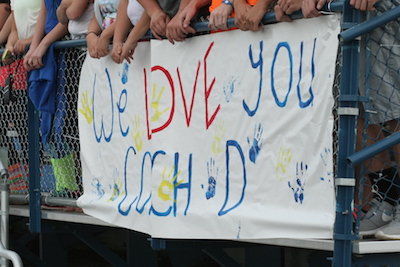
Midway through the season, Deland had to undergo emergency triple-bypass heart surgery, but he is back on the sidelines coaching the team and progressively getting better from week to week. In his words, he is improving brick by brick.
“He didn’t know it at the time, but in the first half of our first game against Jefferson, he was having a heart attack,” Walentowski said of Deland. “He got through the game and said his chest was bothering him, but he thought it was indigestion.
“A couple of weeks later it was still kind of bothering him on and off, and he said he should get it checked. We were getting ready to play Blissfield, which was Game 4, and he went to the hospital on Wednesday morning, and they said you’re not leaving, you are having open-heart surgery Thursday morning.”
 A week after triple-bypass heart surgery, Deland was back, giving a motivational speech to the players.
“It was a great talk,” Walentowski said. “He has quite a personality, and the kids love him. For us, it was like we hadn’t better screw anything up before Coach D gets back here. I think we all had that attitude.
“The following week, he was back on the sidelines.”
It seemed like nothing was going to keep Deland from returning to his boys.
“It was a blur,” Deland said. “I was less than a few weeks out of surgery, and I was back on the sidelines. My doctor did not approve, but he knew I was going to be on the sidelines and he wasn’t going to be able to stop me.
“I was there; I was with my team. These are a great group of kids. They work hard, and they deserve everything the coaching staff can give them, and that’s why I wanted to be there for them. They have been there for this school and this community all year long.”
Although Deland said he blocks out thinking about his health on the sidelines, the players remain very aware of it.
“The kids have gone out of their way to protect me on the sidelines,” he said. “When a play is coming out of bounds, I have to get out of the way. I cannot get run over. So they do protect me on the sidelines so I don’t get run over by any play out of bounds.
“The doctor doesn’t want me to get too excited, and I try not to. Each week I can feel the momentum of my strength coming back, and I get a little more vocal and a little more animated on the sidelines.
“I have a passion for football, and the kids know it. They know I can blow up at any time, or I can be the grandfather for them.”
And, every week, he is the motivator with his speeches.
“From that very first practice in the summer to the last game as a senior, everything is built brick by brick,” Deland said. “I can draw a correlation between that and my recovery, what I’ve gone through. It’s the same thing. It’s brick by brick.
“You might take two steps forward, and you think you’re getting on to where you want to be as a team, and I might be getting on to how I want to feel, and the next thing you take that giant step backwards. You don’t feel so great, or all of a sudden you were praised by the coach the day before and now you’re screwing up every which way.
“But you’re still going forward, and that is how I paint my recovery, brick by brick, the same as this team. They will progress in the season and the playoffs brick by brick.”
Nobody knows how the season will end, but it already is the greatest football season in school history. The Bluestreaks are giving back to the community with their work for childhood cancer awareness, and they are banding together to win football games.
It is the time of their young lives.
“Being a quarterback was not always my intention,” Kolakowski said. “I was a wide receiver, but in my JV season I had to play quarterback. Then, in the playoff game, I was like, ‘It would be so sweet to be able to run this offense,’ and now I’m getting to live out my dream, which is awesome.”
It is a season that has been building, excuse the expression, brick by brick.
“I think these guys have had a lot of goals,” Walentowski said. “Six of the seniors were with us as sophomores, and there were two freshmen who were with us back then, so those eight kids, they’re still here, and they’ve been building every year.
“They expected to work hard and do well, and that’s what they’re doing. They don’t just like to play football, they like to play football together. There’s a big difference.”
 Chip Mundy served as sports editor at the Brooklyn Exponent and Albion Recorder from 1980-86, and then as a reporter and later copy editor at the Jackson Citizen-Patriot from 1986-2011. He also co-authored Michigan Sports Trivia. E-mail him at [email protected] with story ideas for Jackson, Washtenaw, Hillsdale, Lenawee and Monroe counties.
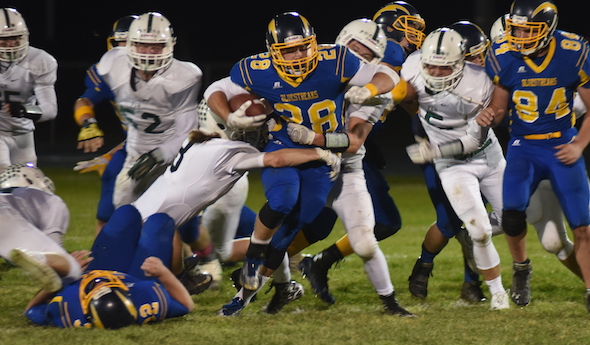
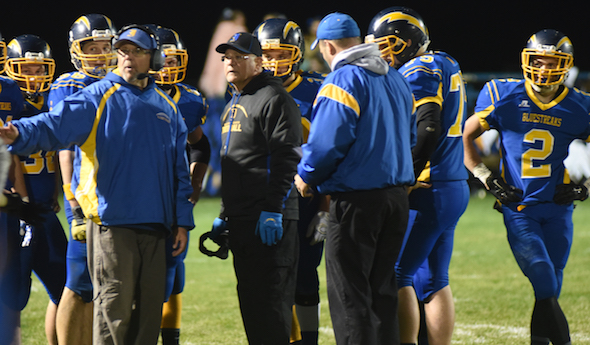
PHOTOS: (Top) Ida running back Nick Levicki attempts to run through tacklers during his team's win over Ann Arbor Gabriel Richard last week. (Middle) Head coach Tom Walentowski, far left, and assistant Gary Deland talk things over with the team looking on. (Below) Fans hung a sign supporting Deland upon his return. (Top and middle photos by Ray Leighton. Bottom photo by Kim Farver.)