

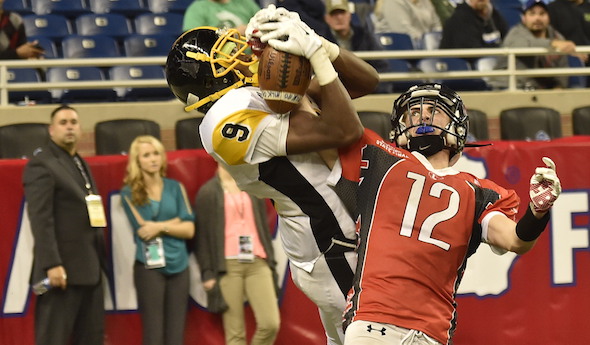
King Completes Perfect Run on Final Play
November 27, 2015
By Bill Khan
Special for Second Half
DETROIT — Armani Posey was supposed to be a two-week stopgap at quarterback for Detroit Martin Luther King.
 Two weeks turned into 11 weeks, building toward a championship finish for the ages.
In a moment that was “The Catch” and “The Drive” all rolled into one, Posey heaved a 40-yard touchdown pass to senior receiver Donnie Corley on the final play of the game to give King a 40-38 victory over Lowell in the Division 2 title game Friday at Ford Field.
Lowell led 31-13 in the third quarter before Posey responded by throwing four of his record-tying five touchdown passes in the final 15:41 of the game. The final drive began with 37 seconds remaining at King's 3-yard line after a punt out of bounds and a penalty.
It was a scenario tailor-made for John Elway — or Armani Posey.
"What happened today is a memory forever," Posey said. "I dreamed about that and went out there and did it today. I couldn't imagine that type of performance, but we got the job done. Shout-out to the O-line."
When the starter was suspended for two weeks, King coach Dale Harvel was in search of a quarterback for the Week 4 game against Detroit Denby and the week 5 game against eventual Division 1 finalist Detroit Cass Tech. Harvel wanted a mature senior to, at the very least, manage an offense that is loaded with Division I college prospects. Posey turned into much more than a game manager.
"What we found out was he settled down everybody in the offense, because the first week we struggled a little bit against (Warren) DeLaSalle and struggled against East (English) Village," Harvel said. "We were able to win because we were playing good defense. He's been a settling effect on our offense and we couldn't go away from him, because we were in a rhythm with our offense. So, we stuck with him all year."
Posey's first position was quarterback, but that was way back in his elementary school days playing in the Detroit Police Athletic League for the East Side Tigers. One of his teammates back in the day happened to be the young man with whom his legacy will forever be linked.
"He played quarterback when I played for the Tigers," Corley said. "He's always been a good quarterback. I didn't know he was going to play this well. He had five touchdowns for 300 yards today? That's amazing."
After starting the game with three three-and-outs and his team falling behind 17-0, Posey finished 19 for 27 for 383 yards, five touchdowns and no interceptions. He broke the MHSAA Finals record of 335 yards set by Olivet's Jay Cousineau in the 2010 Division 5 Final. He matched the record of five touchdown passes shared by Macomb Dakota's Mitch Lovett (2007, Division 1) and Cass Tech's Jayru Campbell (2011, Division 1). Posey also ran seven times for 20 yards and a touchdown.
It took a rare defensive stop by King to put Posey and Corley in a position to produce a moment that will be talked about for decades.
Lowell drove from its own 35 to King's 39 before its only negative play of the game, a 2-yard loss on a run by quarterback Ryan Stevens, forced only the second punt of the game for the Red Arrows. Stevens nailed the punt out of bounds at the 5 with 37 seconds left. An illegal procedure penalty on King before the first snap moved it back inside the 3.
"They battled, right down to where we punted the ball down to the 5 with (37) seconds on the clock," Lowell coach Noel Dean said. "I thought that would be a pretty good spot to be in. Credit them — they made the plays at the end."
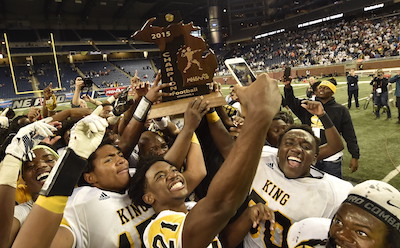 King made several plays on its way to the end zone.
A 22-yard pass to Lavert Hill, a 10-yard pass to Corley and a 25-yard pass to Dontre Boyd got the ball to the Lowell 40 with 10 seconds left. Boyd had to watch the final play from the sidelines, having injured his shoulder after his catch on a tackle by Alex Anschutz. Boyd had 126 yards on five catches.
"He could've easily dropped the football," Harvel said. "He focused on that football and knew he was going to get hit — a good legal hit. He caught the football and made the play for a first down for us and made the opportunity to throw that pass to Donnie. All of his teammates understand what he sacrificed for his football team out there today."
"To me, that was the biggest play of the game," said Corley, who was about to make the most memorable play of the 2015 season.
King had two shots at the end zone in the final 10 seconds. On the first play, Posey overthrew Ambry Thomas down the left side. Two seconds remained on the clock for a play that would make one team's dreams come true and crush another's.
As King lined up for the final play, Corley was in single coverage on the left side. This was an inviting prospect for the Crusaders, considering Corley is being recruited by Michigan, Michigan State, Notre Dame and Ohio State.
Corley said the Lowell cornerback called for safety help over the top, but that the safety didn't hear in the instructions.
"When we didn't see the safety move over, I was repeating, 'Throw it to Donnie, throw it to Donnie,'" Harvel said. "Nobody could hear me, but it was comforting to me to say that, even though nobody could hear me."
As Corley ran toward the left side of the end zone, Posey had time to heave the ball to his star receiver. Corley, who has a 37-inch vertical leap, won a jump ball against the corner who appeared to get a hand on the ball, then fell to the ground safely inbounds.
"It was a beautiful ball," said Corley, who caught six passes for 108 yards and two touchdowns. "It couldn't have been any better. He threw it just inbounds and in the back of the end zone. I knew where I was on the field. I couldn't believe it — I'm not gonna lie. We fought back from 17-0 and we won."
It's only the second time that the winning score in an MHSAA championship game took place on the final play. Steve Mann caught a 17-yard touchdown pass from Charlie Johnson to give Detroit Country Day an 18-14 victory over Muskegon Catholic Central in the 1986 Class C title game.
For most of the afternoon, this wasn't a championship game that appeared to be destined for a dramatic finish.
Max Dean's third touchdown run of the game, a 4-yarder with 8:24 left in the third quarter, gave Lowell a 31-13 lead. The Red Arrows had leads of 17-0 and 24-7 in the first half.
A 25-yard touchdown pass from Posey to Corley with 3:41 left in the third quarter and a 41-yard pass from Posey to Thomas got King back in the game, down only 31-26 with 11:44 remaining.
Lowell responded with a 10-play, 73-yard drive that culminated with a 2-yard touchdown run by Stevens with 7:10 remaining.
Aided by a personal foul for facemasking, King crept to within 38-34 on a 2-yard pass from Posey to Hill and a 2-point pass from Posey to Martell Pettaway with 4:42 to go.
Lowell got two first downs on its next possession, forcing the Crusaders to use their remaining timeouts. They were able to manage the clock well on the final drive, particularly when Hill gave up the opportunity for a few more yards to get out of bounds with 28 seconds left on the first play. The clock stopped temporarily when Corley's 10-yard catch got a first down. Boyd was on the field for a couple of minutes after being injured making his 25-yard catch, allowing King to discuss its options and be ready at the line when the clock started running as play resumed.
Corley's catch gave King its second MHSAA championship, matching the achievement of the 2007 team. It was King's fourth victory of three points or fewer in a 14-0 season.
Lowell scored on its first four possessions before taking a knee to end the first half during its fifth, leading 17-0 before King even registered a first down.
After getting first-and-goal at the King 5, Lowell settled for a 21-yard field goal by George Gonzales to open the scoring with 4:52 left in the first quarter.
A 36-yard pass to senior Gabe Steed was the key play on a 10-play, 70-yard scoring drive that ended with a 1-yard run by Dean with 11:03 left in the second quarter.
A 62-yard pass to a wide-open David Kruse on Lowell's third drive set up a 4-yard touchdown run by Stevens with 7:02 left in the first half. At this point, Lowell had a 173-9 advantage in total offense and a 17-0 lead.
It appeared King would suffer its fourth straight three-and-out to start the game when an intentional grounding penalty left the Crusaders facing third-and-20 from their own 25. That's when King's explosive offense finally showed life, as Boyd had a 73-yard catch and run down to the Lowell 2. Two plays later, Posey scored on a 3-yard bootleg to the right, cutting Lowell's lead to 17-7 with 4:21 left in the first half.
Lowell responded immediately, using a 66-yard pass to Sawyer Olesko to set up a 3-yard touchdown run by Dean with 1:53 to go in the first half, making it a 24-7 game.
King tightened the margin before the break, as Hill made an acrobatic 41-yard catch at the Lowell 12, then grabbed a 12-yard touchdown pass from Posey on the next play to cut Lowell's lead to 24-13 with 25 seconds left in the half. The extra point attempt failed.
Lowell (12-2) used some trickery to build its lead to 31-13, with Nathan Stephens taking a short direct snap on a fourth-and-one punt and running 38 yards to the King 5. Two plays later, Dean scored his third touchdown from four yards out with 8:24 left in the third quarter.
Dean finished with 99 yards rushing and three touchdowns on 22 carries. Stevens was 6 for 9 for 186 yards, running 22 times for 66 yards and two touchdowns.
The MHSAA Football Finals are sponsored by the Michigan National Guard.
PHOTOS: (Top) Detroit Martin Luther King’s Donnie Corley pulls down a touchdown pass on the final play of the game to give the Crusaders the lead and win. (Middle) King players celebrate their second MHSAA championship.
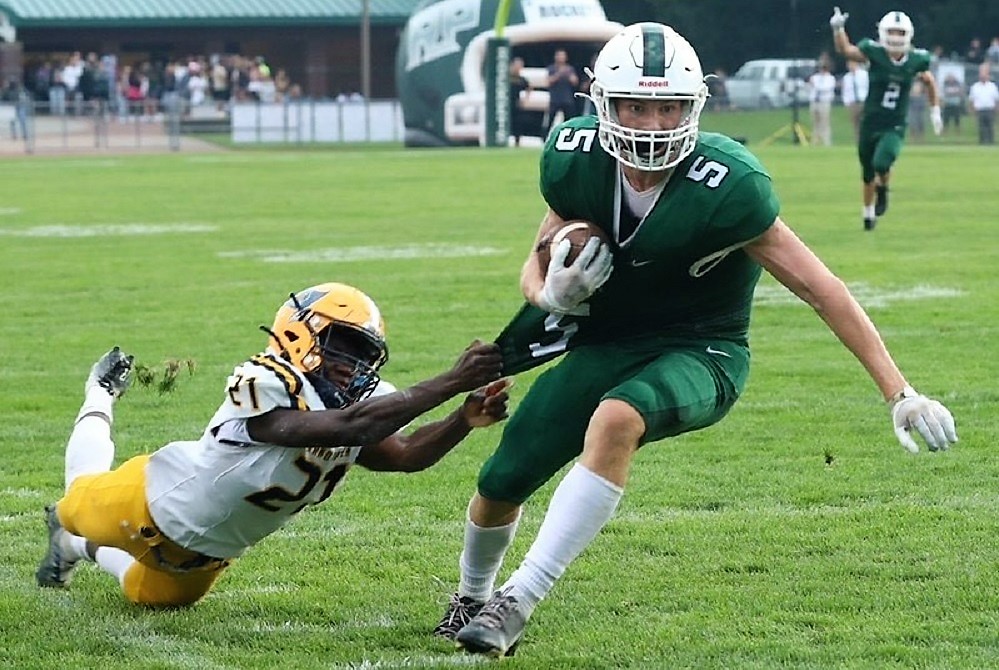
VanderLeest Working to Help Reeths-Puffer Make Most of Opportunities Ahead
By
Tom Kendra
Special for MHSAA.com
September 7, 2022
Tayte VanderLeest is a prototypical receiver and safety, with great size (6-foot-4, 200 pounds) and speed (4.5 seconds in the 40-yard dash).
 Muskegon Reeths-Puffer first-year coach Cody Kater also gushes about the senior’s work ethic and attitude, and concludes by saying, “He’s the kind of kid you want to date your daughter.”
Weaknesses?
“I would say he’s too nice,” said Kater, a two-time all-stater at Montague who went on to play quarterback at Grand Rapids Community College and Central Michigan. “We’d like to see him a little grittier, but he’s a gamer and I have seen him flip that switch. I expect him to do that this Friday night.”
Reeths-Puffer (2-0) plays one of its biggest football games in years Friday, when it travels across town to face Muskegon (1-1) in the Ottawa-Kent Conference Green opener for both teams.
Historically, it hasn’t been much of a game, with Muskegon holding a lopsided 22-1-1 edge in the all-time series, and with most of those games in the blowout category. Muskegon has won the past nine games by an average of 44 points.
That puts the Rockets into a somewhat ideal position – no pressure, but with the opportunity to make a huge statement.
“It’s very exciting,” said VanderLeest, a returning all-conference receiver who has received interest from several Mid-American Conference schools including Central Michigan, Eastern Michigan and Miami (Ohio). “We are 2-0, which is great, but this is the kind of game where we can really prove ourselves. We want to show that we belong in big games like this.”
Puffer opened the season with a convincing 32-20 win over visiting Grand Haven, then hit the road last Thursday for a 38-14 win over St. Johns.
Muskegon, meanwhile, has not looked like its normal dominating self thus far (although playing a pair of strong opponents certainly has been a contributing factor). The Big Reds rallied from an eight-point, fourth-quarter deficit for a 20-14 win over visiting East Kentwood in the opener, then lost 49-16 on Friday to reigning Division 2 champion Warren De La Salle Collegiate. East Kentwood bounced back last week to defeat Bloomfield Hills Brother Rice, and De La Salle hasn’t lost since the 2020 Division 2 championship game.
Some of the issues for Muskegon are injuries and youth, with 13th-year head coach Shane Fairfield looking for more seniors to step up in leadership roles.
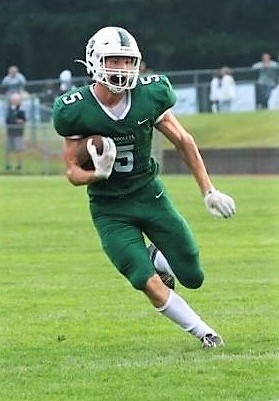 VanderLeest and other strong senior leaders like quarterback Brady Ross and center/defensive tackle Hunter Allison have sparked the Rockets’ quick start. The soft-spoken VanderLeest is more of a leader-by-example, although Kater said he has noticed him becoming more vocal with the younger receivers and defensive backs.
VanderLeest is one of those players who has football in his blood, literally, as his father Rob VanderLeest was an all-state lineman at Muskegon Catholic Central and went on to play four years at Michigan under Gary Moeller and Lloyd Carr.
“Football is in my DNA,” explained Tayte VanderLeest. “It’s been part of my life as long as I can remember. Now I’m a senior, and I feel the pressure on me to live up to the standards that my dad set.”
He will play a key role defensively from his strong safety spot, where one of his main duties will be trying to tackle Muskegon’s dynamic junior duo of running back Jakob Price and slotback Destin Piggee, preventing long TD runs and forcing the Big Reds to march the ball down the field.
VanderLeest had five tackles and an interception last week at St. Johns, in a game that was tied at halftime before Puffer pulled away with a 24-0 scoring edge in the second half.
“He has a knack defensively for knowing where he needs to be and always ending up around the ball,” explained Kater, who also was the offensive coordinator at Montague during the 2020 season, helping the Wildcats to an undefeated record and the Division 6 championship. “A lot of that stuff you can’t really teach. Because of that, we’re letting him roam around a little bit back there.”
On offense, VanderLeest and fellow senior wideout Clyde Bartee are the Rockets’ home run threats. Kater also lauded the stalk blocking of that duo during the first two games, allowing Ross and junior running back Brody Johnson to find running room downfield.
VanderLeest, who had five touchdown receptions last year en route to first-team all-OK Green honors, had a big game offensively in the opener against Grand Haven, making six catches for 106 yards – highlighted by a 47-yard touchdown reception.
Another storyline going into Friday’s game involves Kater, who played for former Muskegon coach Tony Annese at GRCC and was hired last spring as Muskegon’s offensive coordinator. However, Kater departed shortly thereafter to join former Lowell coach Noel Dean’s staff in Tipton, Ga. Kater then returned to West Michigan on Dec. 31, when he was named Puffer’s new coach.
Kater, 30, is calling the offensive plays for R-P, while his former CMU teammate Alex Smith – who most recently served as head coach at Holton – is the defensive coordinator.
The bigger goal for the Rockets, beyond this week’s showdown at historic Hackley Stadium, is to get into the playoffs and then win a playoff game – something they have not done in 30 years since their memorable, undefeated 1992 season, which ended with a Class A title.
Puffer has qualified for the playoffs five times since that championship season, but each of those postseason appearances were “one and done.”
Kater is encouraged that R-P has enough high school football players to field freshman, junior varsity and varsity teams – something that less than half of the teams in the O-K Green can claim. He also notes that the Rockets have good athletes and numbers in their middle school and youth programs.
He believes this year’s senior leaders like VanderLeest, who hung in there through a 3-6 junior season and a coaching change, will be remembered as the ones who turned the tide.
“I don’t think you’ve seen the best of Tayte yet,” said Kater, the sixth head coach for the Rockets since Hall of Famer Pete Kutches led them to that 1992 title. “We are coaching him extremely hard, and he is getting better. He is a pillar of our team.”
 Tom Kendra worked 23 years at The Muskegon Chronicle, including five as assistant sports editor and the final six as sports editor through 2011. E-mail him at [email protected] with story ideas for Muskegon, Oceana, Mason, Lake, Oceola, Mecosta and Newaygo counties.
PHOTOS (Top) Muskegon Reeths-Puffer’s Tayte VanderLeest (5) works to break away from a Grand Haven defender during an opening-night win. (Middle) VanderLeest cuts upfield during the 32-20 victory. (Photos by Joe Lane.)