

Kzoo Rivals Unite to 'Crush Cancer'
September 14, 2016
By Geoff Kimmerly
Second Half editor
Kalamazoo football players clad in pink and teal took to Loy Norrix’s football field Friday for one of southwest Michigan’s most anticipated annual rivalry games – but also, with the help of some notable alumni, to continue to spread the word about cancer awareness.
Kalamazoo Central downed Loy Norrix 41-13 in the Cross-town Crush Cancer game, Central wearing pink jerseys symbolic of breast cancer awareness and Loy Norrix in teal signifying ovarian cancer awareness.
The jerseys were provided in large part by a donation by former Loy Norrix stars Tico and Todd “T.J.” Duckett, who served as "ambassadors" for the evening along with another past Loy Norrix star, Little John Flowers, past Kalamazoo Central football standout Duane Young and past Central baseball standout Kevan Hess. Both Duckett brothers, Flowers and Young starred at Michigan State before spending time in the NFL, Young and T.J. Duckett playing professionally for six seasons each. Hess was drafted by the Tigers out of Western Michigan University in 2009 and played three seasons in Detroit’s minor league system.
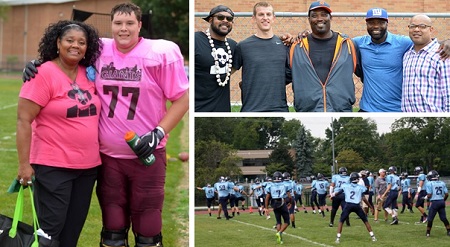 The teal jerseys had particular meaning for Tico and T.J. Duckett, as their mother Jackie Barham died after a fight with ovarian cancer.
“We chose a time such as this because of the anticipated large attendance and the potential for the greatest impact amongst our alma mater’s community members,” said the Duckett brothers in a statement leading up to the game. “Our own mother, Jackie Barham, would have celebrated more birthdays, if there was a cure for cancer. This is just one way that we can honor her memory.”
The jerseys featured the teams’ mascot names and also the Kalamazoo cityscape. Junior varsity players from both schools wore T-shirts with their dates of graduation and the cityscape as well as organizers set a theme of the entire community standing together for a common fight against cancer. The event was organized by a Kalamazoo Central parent committee headed by Terri Benton-Ollie together with administrators and other supporters representing both school communities.
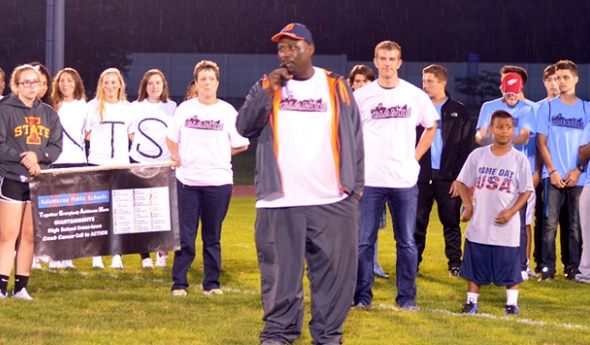
Students from both schools were joined on the field at halftime by 50 cancer survivors from the community, and funds raised will be donated to the West Michigan Cancer Center.
“We know that we must ‘tackle’ so many of our societal ills,” Benton-Ollie said. “Tragedy can be a disastrous one-moment incident or a phenomenon that must be reversed or a disease that lurks amongst us. Let’s create a ripple effect of continuous gestures and action that work in favor of the greater good and crush cancer.”
Click for more from Kalamazoo Public Schools.
PHOTOS: (Top) Former NFL player Duane Young speaks to the crowd during halftime of the "Crush Cancer" game. (Middle) Supporters and teams wore pink and blue signifying, respectively, breast and ovarian cancer awareness; the game's ambassadors were (from left) T.J. Duckett, Kevan Hess, Duane Young, Little John Flowers and Tico Duckett. (Photos by Walter Hall.)

Football Scheduling
December 23, 2014
The major complaint about the MHSAA Football Playoffs is not that too few teams qualify or too many, or that a five-week playoff is too long or should become six weeks, or that some worthy teams miss out while some less worthy teams get in. No; most people find a five-week, 11-player tournament after a nine-game regular season is the best that our late start to fall classes and our early start to winter weather will allow us in Michigan.
Many people appreciate being able to complete our 14-week season in the warmth of Ford Field on the Friday and Saturday of Thanksgiving weekend. Most people think that nearly 45 percent of 11-player schools is a sufficient tournament field. Many people like the excitement that the six-win threshold creates for teams that had been eliminated earlier from league championships.
The most serious and legitimate complaint about the season-ending playoffs is the stress it has placed on conferences and the struggles many schools have in building nine-game regular-season schedules. Some critics want to mess with the Football Playoffs because of the mess they believe it makes for regular-season schedulers.
Having the MHSAA provide every school a nine-game regular season schedule of the most nearby teams of the most nearly equal enrollments would shift scheduling headaches from the local level to the MHSAA.
I’m not suggesting that this solution to local problems doesn’t create new, large headaches for the MHSAA. But in fact, that is the tradition of school sports: when an issue is large enough in scope and common enough among member schools, the state high school association is asked to be the problem-solver. That’s how we got transfer rules, defined sports seasons and competitive cheer tournaments, for example. Just about every policy and procedure and program of the MHSAA arises from a common local problem looking for a statewide solution.
The 2014 Update Meeting Opinion Poll indicates that 70 percent of responding administrators do not favor the solution of the MHSAA making all schools’ regular-season varsity football schedules. Maybe the question should be narrowed to having the MHSAA complete member schools’ non-conference scheduling.
Meanwhile, we will keep watching as high school associations in other states move to statewide scheduling. For if scheduling is the problem, then scheduling itself needs to be the focus of the solution.