

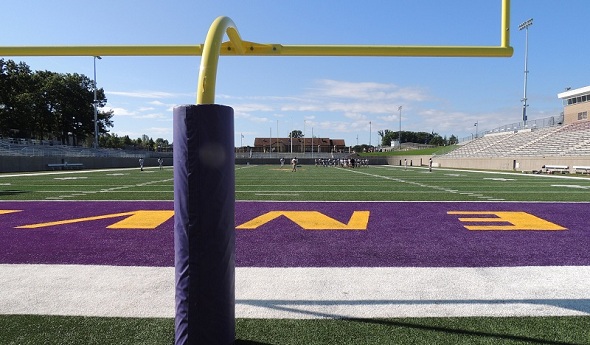
A Legacy Begins in Greenville
By
Geoff Kimmerly
MHSAA.com senior editor
August 24, 2012
GREENVILLE – Curtis Heppe has no idea what to expect, but a few guesses and a dream or two of how it will feel tonight to lead his teammates into Greenville's Legacy Field for the first time.
“It’s going to be electric, for sure. It’s a new vibe. It’s high-tech there,” the Yellow Jackets quarterback said Thursday after his team’s final preseason practice.
Those expectations are shared by a community that will be cheering on the local team in a new home after nearly a century at the legendary Black Field.
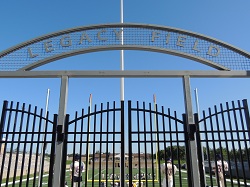 Workers put the finishing touches on the near-$7 million facility this week in advance of the season's first varsity game, tonight against rival Belding. Legacy Field officially opened for Wednesday’s freshman game, and Heppe said that even for that lower-level appetizer, the stadium began to come alive.
“We’ve just wanted Friday night to come. To get in and see how intense, how nice this place is,” he said. “Coming out of that tunnel, seeing our fans, it’s going to be the best feeling.”
Tonight’s grand opening will be the culmination of efforts from not just administrators, but students and community members as well – down to the name of the stadium itself.
“Legacy Field” was selected by Greenville’s school board. But it came as a suggestion from the school’s student council, which took submissions from classmates and then with faculty and administrators whittled the list to three favorites – Stinger Stadium and Community Field were next on their list.
But that’s just one way Legacy Field is a blend of old and new and ideas from all over town.
“In development, (it’s been) probably 10 years. We’ve been talking about it ever since I’ve been here, that one day we’d be able to do this,” said Greenville athletic director Brian Zdanowski, who is entering his 15th school year at that post. “It came through strategic planning. It came through community input. And then ultimately, our board bought in that there was enough interest in the community.”
Deeply rooted
A walk through Legacy Field is a history lesson. But first, an explanation of the Yellow Jackets’ past.
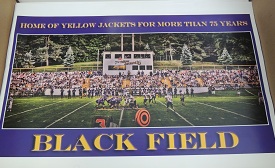
Black Field had served as the team’s home since 1916. It is nestled downtown next to Greenville’s former high school, which is now a library.
 The current high school, about 1.5 miles northwest, was built in 1963. Football teams continued to make the short trip for home games.
Black Field has its charms. With no track surrounding the field like at many multi-purpose stadiums, fans are only a few yards from the sideline. And all of that history added to the mystique for the latest players to wear the uniform.
The field also has had peculiarities. Zdanowski said at one point, the end zones were elevated in the corners. And the field wasn’t always square – a 10-yard penalty might measure 11 on one side of the field but only nine yards on the other.
But after just about every home game, students met for a bonfire on the grounds, an extension of the celebration by neighborhoods that surround Black Field and embraced the team for decades.
“It was the typical focal point of the community,” Zdanowski said.
Some things old, many new
Playing on Black Field was special, Heppe added. But he's equally if not more excited to be part of this new legacy. And architects made sure to bring that community feel to the new home this fall.
Destruction and construction began May 2, the day after last season’s final girls tennis match. The courts formerly sat in what is near the south end zone, and were moved closer to the track and soccer facility.
Amenities at the Yellow Jackets’ new football home are comparable to a college stadium’s, starting at the north side of the field.
 Players will enterthrough a tunnel that pours into the field like that of a miniature Spartan Stadium. Surrounding the tunnel are expansive locker rooms both for the home team and visitors, a similarly expansive training room and officials area and plenty of storage that will allow Greenville’s entire football program to be housed under that one roof. Unlike Black Field, tucked neatly among its neighbors, Legacy Field has plenty of parking and lighting, and builders were able to make that possible while also keeping intact a group of large oak trees near the south gate.
The turf is synthetic, like that played on by all but one member of the Yellow Jacket’s O-K Bronze conference. The difference from many is that the field has been dug out from the surrounding property, making it even more a focal point for those who will occupy the roughly 4,000 seats in the surrounding cement bowl. (The removed dirt was used to build two Little League fields on another part of the property.)
The sound system is of course state-of-the-art, and the press box, concessions area and restrooms also are equally expansive. But what locals should notice most are the throwbacks to the past that dot every corner of their new home.
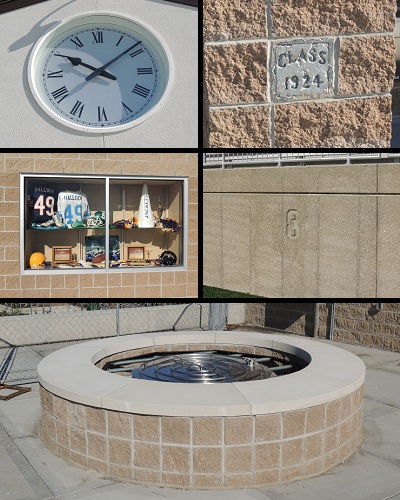
Cut into the brick work near the concession counter is a block from Black Field that had been dedicated by the school’s class of 1924. Atop the building is the Centennial Clock, 100 years old this year, which formerly hung at the entrance the old school and was donated by the class of 1912. It has been housed by Greenville’s museum until being re-donated to the school district to become part of the stadium.
Molded into the cement walls on the west and south sides of the field are the numbers formerly worn by players Henry Loding and Greg Blumberg. Both died from football-related injuries; Loding in 1906 and Blumberg in 1977. Two trophy cases are cut into the stone on the facing of the press box, including one featuring mementos celebrating alum and former Detroit Lions tight end Ty Hallock.
Another addition of historical significance will come later. The school’s first Hall of Fame class will be inducted before the Sept. 7 game, and that display will be housed near the south ticket area so residents and fans can check it out without having the enter the stadium itself.
And one last thing was added to keep with tradition. To the west of the concession area, but within the stadium fence, sits a large gas fire pit for those postgame gatherings – plus a sound system where students can plug in their mp3 players.
“We said we’re not forgetting our past, but we’re embracing our future,” Zdanowski said. “I’m sure a lot of people have said that before. So we really wanted to make sure we got community input on it and do as much as we could to replicate Black Field. … And I think we won some people over. We really wanted to do what we said (we’d do).”
PHOTOS: (Top) Greenville's junior varsity ran through drills during a morning session at Legacy Stadium, which opened this week. (Top middle) The ticket area and gate for fans sit on the south side of the field. (Middle) A poster given out last season celebrated the final to be played at Black Field. (Bottom middle) A number of pieces of Black Field's past and Greenville tradition were brought over to or included in Legacy Field, including Centennial Clock, which formerly was part of the old school.
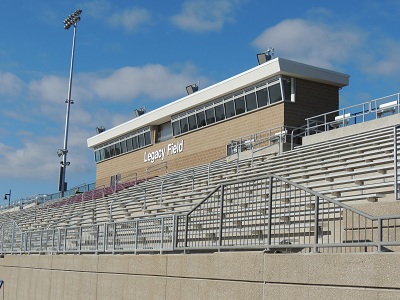 Legacy Field's press box is split into areas for game workers, coaches and media with a roll-up door for film crews.
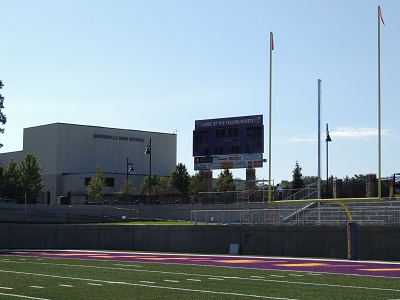
Legacy Field sits between Greenville's high school and middle school and adjacent to its soccer and track facilities.
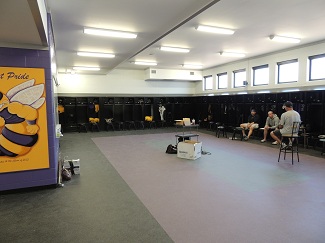 Coaches met in the spacious varsity locker room Monday morning. Junior varsity and freshman locker rooms are connected by a hallway with access to storage areas and the coaches' office.
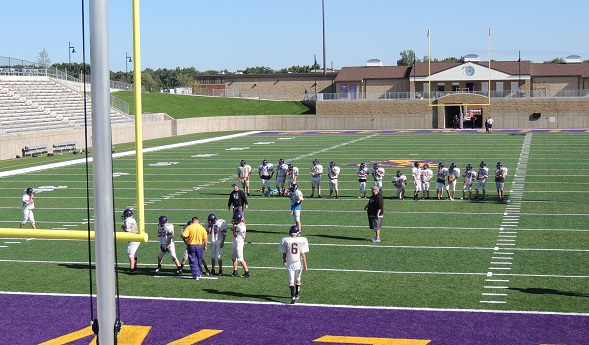 Players will enter Legacy Field through a tunnel at its north end. Above sits the concession area and restrooms, and the Centennial Clock that once ticked in the old Greenville school.
Drive for Detroit: Week 5 in Review
September 24, 2012
By Geoff Kimmerly
Second Half editor
Fall officially is upon us. And so is the home stretch of another MHSAA football regular season.
Four weeks remain before the playoffs begin, and that allows us to crunch some numbers all 596 11-player teams surely are following with interest.
So far, one team has qualified for the postseason. Another 73 can do so with a victory this week.
And that's only part of the excitement, as many still have chances at league championships hanging in the balance.
Many are mentioned below in this week's Drive for Detroit report.
Greater Detroit
Livonia Churchill 43, Canton 40
Churchill took a major stride toward its first league title since 1979. Although the teams combined for nearly 1,000 yards in total offense, the Chargers made a last stand to improve to 5-0 and 3-0 in the Kensington Lakes Activities Association South. For Canton, it’s been some tough luck – its two losses are by a combined four points. Click to read more from Mlive Detroit.
Also noted:
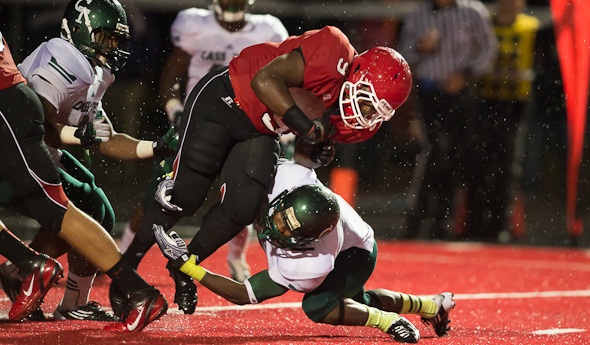
Orchard Lake St. Mary 13, Detroit Cass Tech 6 – Cass Tech has appeared invincible, but this victory by the reigning MHSAA Division 3 champion over the reigning champ in Division 1 re-opens the debate over the best in Michigan overall this fall.
Detroit University Prep 28, Warren Michigan Collegiate 26 – After winning one game in the Charter School Conference in 2011, University Prep is one win from clinching at least a share of the title and also equaling its most ever.
Oak Park 20, Farmington 15 – At 5-0, Oak Park has won its most games since 2007 and is off to its best start since 1998.
Milan 35, Monroe St. Mary Catholic 20 – The Big Reds are in the midst of one of the biggest turnarounds in the state this fall, now 5-0 after going 1-8 in 2011 and losing their last four to Monroe St. Mary.
West Michigan
Grand Rapids Forest Hills Central 43, East Grand Rapids 17
This was played in a baseball stadium, Fifth Third Ballpark, but hardly looked like a baseball game on the scoreboard. Forest Hills Central scored all 43 points in the first half and continued on what is shaping up as a special season despite the competition in the ultra strong O-K White. The Rangers improved to 4-1 and had lost seven straight to the Pioneers dating back to 2001. Click to read more from the Grand Rapids Press.
Also noted:
Grand Rapids Christian 38, Caledonia 21 – This is another one that dictates some order in the O-K White, with both of these teams still 4-1 despite the Eagles’ one-game league advantage.
Comstock Park 38, Belding 31 – The Panthers outlasted the Redskins to remain one of only two 2-0 teams atop the O-K Blue.
Montague 9, Whitehall 3 – Make that six straight wins for Montague in the battle for the “Bell” that has raged more than a century.
Muskegon Mona Shores 41, Grand Rapids Union 6 – Every week seems to bring another accomplishment for the Sailors, who are 4-1 for the first time since 1989.
Upper Peninsula
Kingsford 14, Menominee 13
Overlooked accidentally in Friday’s pregame report, this ended up as the best this weekend in the entire peninsula. Both entered 4-0 after the first week of Great Northern Upper Peninsula Conference play and with little to spare. The league again looks like a gauntlet after three of five teams made the playoffs in 2011 and a fourth finished 5-4. Click to read more from the Iron Mountain Daily News.
Also noted:
Marquette 35, Gladstone 14 – Also in the GNUPC, this keeps Marquette just a game back of the co-leaders and two from making the playoffs.
Rapid River 60, Engadine 40 – Rapid River was one of three undefeated teams atop the Bridge 8-Man Football Alliance heading into the week; now there are two.
Cedarville 42, Eben Junction Superior Central 12 – These were the other two B8FA teams that came in 4-0; Cedarville continues to look like possibly the best team in all of 8-player this fall.
Iron Mountain North Dickinson 40, Bark River-Harris 0 – The Nordics became the first team to earn an MHSAA playoff berth; they are 5-0 playing only eight regular-season games this fall.
Southwest and Border
Edwardsburg 49, Three Rivers 41
These Wolverine B Conference South foes seem to be tailor-made for the rain that fell all over the Lower Peninsula on Friday. On a night of offensive firepower, Edwardsburg supplied a little bit more by running for 485 yards and seven touchdowns. The win sets up the Eddies as Dowagiac’s biggest competition for the league title. Click to read more from the Kalamazoo Gazette.
Also noted:
Watervliet 41, Hartford 29 – The separation has begun in the Southwestern Athletic Conference South, and Watervliet moved to 5-0 overall.
Paw Paw 24, Vicksburg 13 – The Redskins also moved to 5-0 overall and are tied with Plainwell now atop the Wolverine B Conference North.
Portage Central 33, St. Joseph 23 – The best of the strong Southwestern Michigan Athletic Conference West keep beating up on each other, with the Mustangs now just a game behind the leaders.
Stevensville Lakeshore 37, Niles 21 – Similar story from this SMAC West game, but Lakeshore is sharing first place with Mattawan, a win ahead of Central and Portage Northern.
Lower Up North
Traverse City Central 49, West Branch Ogemaw Heights 21
There’s plenty to tout with the surging Trojans. They’re 4-1, tying last season’s win total. They’re tied with crosstown rival Traverse City West atop the Big North Conference. They’re off to their best start since 1991, when the schools were still combined. And they’ve got the Titans next in arguably the biggest game of this rivalry since they split in 1997. Click to read more from the Traverse City Record Eagle.
Also noted:
Traverse City West 40, Cadillac 11 – The Titans couldn’t afford a trip-up heading into this week’s game with Central that could eventually be the decider in the Big North Conference.
Traverse City Christian 60, Big Rapids Crossroads 48 – These teams have only one win combined between them, but Christian set a school record for points and Crossroads scored its third-most ever.
Kingsley 12, Frankfort 6 – After a four-point loss to Frankfort in 2011, the Stags turned the tables to keep atop the Northwest Conference.
Boyne City 29, Traverse City St. Francis 13 – The Ramblers had lost 10 straight to St. Francis, including 28-0 in 2011.
Thumb and Bay
Lapeer West 13, Linden 10
A 23-yard field goal with five seconds to play earned Lapeer West coach Mike Smith his 100th win and handed Linden its first loss of the season. Both Flint Metro League teams have a loss and are chasing first-place Swartz Creek. Click to read more from the Flint Journal.
Also noted:
Freeland 16, Saginaw Swan Valley 14 – Another week, another Tri-Valley Conference Central re-mix at the top; now it’s Hemlock in first with these two tied for second.
Midland 41, Mount Pleasant 34 – The Chemics keep churning through close ones; they improved to 5-0 with their third win of seven or fewer points this fall.
Reese 23, Vassar 0 – This wasn’t as close as billed, perhaps, but Reese now is the sure frontrunner (again) in the Greater Thumb Conference West.
Richmond 35, Armada 33 – While Croswell-Lexington has a firm hold on first in the Blue Water Area Conference, five more teams (these two included) are either 3-2 or 2-3 overall and working toward that magic number of six wins.
Mid-Michigan
Charlotte 35, Mason 3
On one hand, it was a little early to put so much pressure on a young Mason team that indeed started 4-0, but against opponents that have combined for only two wins so far. On the other hand, few in mid-Michigan gave Charlotte much of a chance in this one – and the Orioles no doubt took that to heart. Charlotte is 3-2 and looks good to win at least three more and earn its first playoff berth since 2008. Click to read more from the Lansing State Journal.
Also noted:
Holt 21, East Lansing 14 – Despite a couple of tough losses to elite teams, Holt isn’t going away; the Rams are 3-2 and look good to double that win total after handing the Trojans their first loss this fall.
Springport 26, Union City 25 – Three losses by a combined 21 points led to a tough start this fall for the Spartans, but this helps after they lost to Union City 47-8 in 2011.
DeWitt 34, St. Johns 20 – The Panthers look like they’ve found another quarterback in Jacob Heath, and need just one more win in the Capital Area Activities Conference Red for a share of the title.
Portland 40, Williamston 7 – This sets up the CAAC White as a two-team race between the Raiders and Lansing Catholic.
Trophy Games
Each week, the MHSAA highlights trophy games around the state. Here's another to go with the Montague/Whitehall battle for "The Bell" mentioned above.
- Iosco County News-Herald and Oscoda Press (News-Press) Trophy: Oscoda hosted Tawas in this 58th meeting dating back to 1954, and won its seventh straight of the series. Final: Oscoda 22, Tawas 18.
PHOTO: Orchard Lake St. Mary junior fullback Jeff Robinson rumbles through the Detroit Cass Tech defensive during Friday's win by the Eaglets. (Click to see more at Terry McNamara Photography.)