

Lelito's Work Helps St Clair Athletes Play
By
Paul Costanzo
Special for MHSAA.com
May 31, 2017
If not for sports, Tim Lelito isn’t sure he would have finished high school.
 Now that he’s entering his fifth season in the National Football League, Lelito is doing what he can to make sure kids in St. Clair County don’t have to worry about that.
The Lelito Legacy Foundation has teamed with the Community Foundation of St. Clair County to grant $9,000 for county schools to cover athletic participation fees for students in need.
“I used sports as a vehicle for where I am now – to get to college and get through high school,” the 2007 St. Clair High School graduate said. “If I didn’t have sports, I don’t think I would have graduated high school at all. School wasn’t a priority; the horses that my grandparents raised were the priority, because that was our livelihood.
“Making it to college and being the first one in my family to graduate with a degree, sports was that vehicle for me to get that degree, and that really hit home with me.”
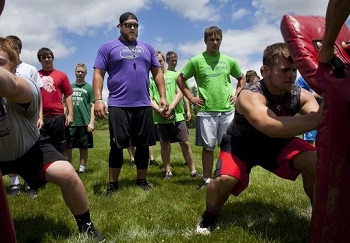
Five St. Clair County community partners were able to raise $4,500, and Lelito’s foundation matched. The funds will be able to cover participation fees for 116 students at St. Clair County high schools and middle schools during the 2017-18 school year.
 The Port Huron Schools Endowment Fund, East China School District Athletic Boosters and PTOs, the Community Foundation of St. Clair County’s Youth Advisory Council and its Marysville Community Fund, and the Capac Adolescents Preventing Abuse and Crime (CAPAC) Fund were the five partners.
“It’s exciting to see someone who is not only successful and has come back to help his hometown, but he’s so humble about it,” Community Foundation Vice President Jackie Hanton said. “When we were in our meetings, it’s not about Tim. It’s that he has this vision to help kids who are like him.”
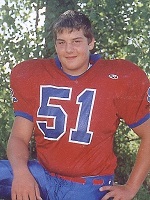
Lelito was a mauling all-state offensive lineman at St. Clair, paving the way for the team’s option attack. He was also an all-state thrower on the Saints’ track & field team.
Playing sports required a participation fee, something Lelito’s grandparents handled, even if they struggled to do so.
“When I was younger, my grandparents raised racehorses, and money was tight for a while,” Lelito said. “My grandparents put my brother and I in sports, and we always played sports. I didn’t realize how bad it was until I was older. They were pinching pennies together and taking care of us before taking care of their needs.”
Lelito earned a scholarship to Grand Valley State University, where – after redshirting as a freshman and being forced to take a medical redshirt his second year – he started 45 straight games and was named Offensive Lineman of the Year by the Great Lakes Intercollegiate Athletic Conference in 2012.
He was signed by the New Orleans Saints as an undrafted free agent in 2013, and worked his way into the rotation almost immediately, seeing action in 63 games during his four years in New Orleans and starting 24 games, including 13 in 2015.
This past offseason, Lelito signed a free-agent deal with the Tennessee Titans.
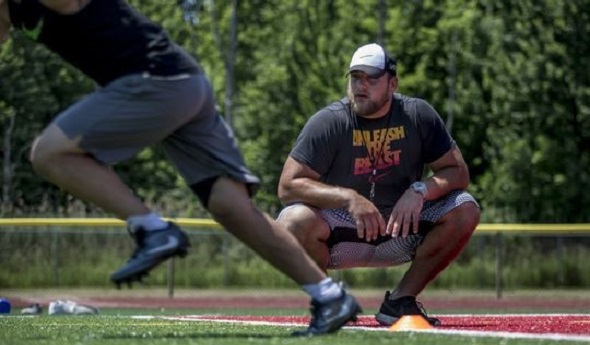
Throughout his NFL career, Lelito has given back, both to his hometown and his professional town. He has conducted free football camps for St. Clair County kids for the past few years.
 “He’s just a young man that I’ve continued to be impressed with how grounded he’s remained,” Bill Nesbitt, Lelito’s football coach at St. Clair, said. “He understands the big picture. His success is not just in playing at that level, but in helping others. That’s his great success.”
Funds for the participation fees will be given to the school districts in St. Clair County, and the schools will be tasked with selecting students most in need. In future years, Lelito hopes to help schools purchase equipment for kids in need, and eventually he wants his foundation to reach more than just athletes.
“My foundation isn’t just for kids in sports, it’s for underprivileged youth,” Lelito said. “I think moving forward, in the next five years, I want to be able to take care of a lot of kids in a very broad spectrum – in sports and arts and other extracurricular activities.”
That will take funding, but Lelito said he has found generous donors in St. Clair County.
“That’s why I bought a house here,” he said. “I love it here. I love the people; they’ll give you the shirt off their back. That’s why I wanted to put roots down here.”
With his efforts, Lelito is doing all he can to make it an even better place to call home. Nesbitt believes the funds could be the difference in playing sports as opposed to sitting out for some students, which he hopes will have a lasting effect.
“I think it definitely can have a positive impact that way,” Nesbitt said. “Hopefully, in a larger, greater, grander sense, these kids who are participants could one day give back themselves. If they are able to go on and have some success, maybe they could remember that somebody had helped them out and do the same.”
 Paul Costanzo served as a sportswriter at The Port Huron Times Herald from 2006-15, including three years as lead sportswriter, and prior to that as sports editor at the Hillsdale Daily News from 2005-06. He can be reached at [email protected] with story ideas for Genesee, Lapeer, St. Clair, Sanilac, Huron, Tuscola, Saginaw, Bay, Arenac, Midland and Gladwin counties.
PHOTOS: (Top) Tennessee Titans offensive lineman Tim Lelito watches an athlete work out during a camp he conducts in the St. Clair area. (Middle) Lelito during his high school career at St. Clair. (Below) Lelito, middle, has worked this offseason to help pay participation fees for athletes in need of financial assistance. (Top and below photos courtesy of the Port Huron Times Herald.)
Cass Tech, Campbell's Glories Grow
November 24, 2012
By Bill Khan
Special to Second Half
DETROIT — Thomas Wilcher is a former Detroit Public School League football star who has become one of the most successful coaches in the state.
Perhaps such a future awaits the city’s brightest current star, Detroit Cass Tech quarterback Jayru Campbell.
Wilcher raved about his sophomore signal caller’s mental grasp of the game after the Technicians became the first PSL team to win back-to-back MHSAA football championships with a 36-21 victory over Detroit Catholic Central on Saturday at Ford Field.
Campbell has orchestrated the offense during both championship runs, each of which ended with a dominant performance against perennial power Catholic Central. Cass Tech routed the Shamrocks 49-13 in last year’s title game, as Campbell threw for five touchdowns.
Campbell’s stats weren't as gaudy this time around (4 for 12, 154 yards, one touchdown), but it’s not his physical gifts that drew high praise from Wilcher after the game.
“I told him on the telephone one night, ‘I don’t care about your arm right now. I just love the way you think on the football field,’” Wilcher said. “That’s what makes him so important to me right now. We’re teaching.”
As a freshman, Campbell was given limited ability to change plays at the line of scrimmage. As a 10th-grader who has already started 28 varsity games, he has earned more trust from his coaching staff than many seniors.
“They gave me more of a green light this year,” Campbell said. “Last year, they pretty much told me I could change the play from left to right; that was the most green light I had. This year, I’m changing passes to runs, runs to passes. It’s not getting difficult, but it’s more responsibility on me. I’m up for the challenge.”
Campbell altered the original call on two of Cass Tech’s biggest offensive plays.
On the Technicians’ first play from scrimmage, he audibled senior receiver Jourdan Lewis from a stop route to a go route. Lewis made a leaping catch between two defenders along the left sideline and took off for an 89-yard touchdown to open the scoring with 9:31 left in the first quarter.
“It was supposed to be a stop,” Campbell said. “The corner was playing so far up, I knew Jourdan Lewis was going to get around him. I just told him to go ahead and do what you do.”
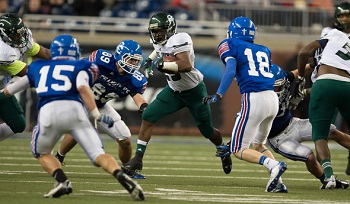 In the fourth quarter, with Cass Tech trying to put the game away, Campbell changed a pass to a draw play to running back Mike Weber on fourth-and-10 from Catholic Central’s 30-yard line. Weber exploded 26 yards to the 4-yard line, setting up a 3-yard touchdown run by Campbell that expanded the lead to 29-7 with 7:59 remaining.
“I saw they had only one linebacker in the back,” Campbell said. “Coach Wilcher really believes in me. He knows I will get the job done. He really trusts me.”
Catholic Central came in looking to avenge last year’s 36-point loss in the Final, but the Shamrocks fell behind 12-0 in the first five minutes on the 89-yard catch by Lewis and a 58-yard fumble return by 260-pound defensive tackle Kenton Gibbs.
The Shamrocks (9-5) slowed the momentum and got back in the game at 12-7 on an 18-yard pass from Garrett Moores to Zach Bock with 2:02 left in the first half. The Technicians (12-2) tacked on a 31-yard field goal by Ken Snapp to take a 15-7 lead into halftime.
A 57-yard run by Weber on third-and-17 set up a 30-yard touchdown run by Deon Drake Jr. on the following play, giving Cass Tech a 22-7 lead on the first series of the third quarter.
“We knew going in from last year’s experience that we can’t make mistakes, because they capitalize well on mistakes, but we did,” Catholic Central coach Tom Mach said. “They made a great throw and catch on the first touchdown. Then we made a couple of mistakes that they capitalized on. We found ourselves in a hole and had to try to get out of that hole. We were doing a good job of that, I thought. Then they exerted themselves and put another touchdown in.”
It became a 29-7 game when Cass Tech went 79 yards in 16 plays, taking 7:14 off the clock before Campbell scored on his 3-yard run with 7:59 left in the fourth quarter.
Catholic Central twice made it a two-possession game in the final 5:57 on touchdown passes by Moores, but the Technicians had an 84-yard interception return for a touchdown by Delano Hill in between them.
“It was no different than last year,” Catholic Central senior running back Anthony Darkangelo said. “We knew last year they were a fast team and we had to keep contain on the edges outside. They executed their game plan and we didn't execute the plan we had for the game.”
Click for full statistics and to watch a replay of the game. See below for the full press conference.
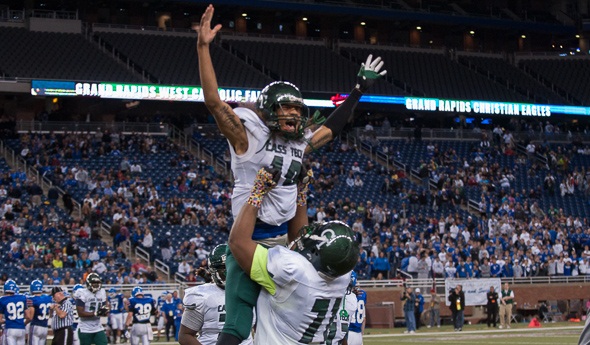
PHOTOS: (Top) Detroit Cass Tech David Dawson hoists quarterback Jayru Campbell (10) during Saturday's Division 1 Final. (Middle) Cass Tech running back Mike Weber runs into a crowd of Detroit Catholic Central defenders including Sean Birney (18) and Dylan Roney (89). (Click for more from Terry McNamara Photography.)